Agile Marketing Examples for SaaS Teams
Real SaaS sprint cases show why delegated authority matters.
Agile sprint-based methods fit SaaS marketing because subscriptions demand continuous iteration across onboarding, retention, and lifecycle messaging. As user behavior and products change, the assumptions behind a campaign can become out of date. Sprints give teams recurring opportunities to adjust, but only when they have authority to act on the evidence. That combination of delegated authority, shared objectives, and feedback loops also provides an organizational foundation for effective AI integration.
Why SaaS Marketing Fits Agile Iteration
SaaS companies operate in a continuous loop of observing user behavior, updating their offerings, and releasing changes. Marketing works within that same loop because its messages must reflect both the product and how customers use it. Churn makes the consequences more than a campaign concern. When messaging falls out of step with users, the mismatch can become a retention problem rather than simply a missed opportunity to attract attention. With the subscription model, marketing decisions therefore affect the customer relationship over time.
A conventional 12-month marketing strategy becomes too inflexible when its underlying premises cannot change at the pace that relationship demands. An inability to revise priorities when customer evidence challenges the plan makes the strategy inflexible. Fortnightly sprint reviews provide a regular mechanism for making those revisions, allowing findings from current work to shape the next set of priorities. This makes agile a structural fit for SaaS marketing rather than merely a way to organize campaign production into shorter periods.
Turning Agile Frameworks Into Marketing Sprints
Scrum uses fixed-length sprints with planning and review, while flow-based frameworks organize work on a continuous board. A continuous board suits always-on channels such as content and paid media, where work can come in outside campaign cycles. Hybrids combine the two approaches. The approaches differ in how teams organize the movement of work, while all require clear priorities and recurring feedback. Each approach depends on an operating model that allows the team to respond to what it learns.
A SaaS marketing sprint begins with analysis of a recent campaign and an update to the backlog. The team then plans work by priority, checks progress at the midpoint, and uses a closing review to guide the next cycle. Jira, Asana, or Trello can support the workflow, and product groups often already use them in daily routines. But software cannot decide which priorities come first or give teams the authority to act, so teams need more than a familiar tool to make sprints work.
How Sprints Change Campaign Testing
With SEMrush’s flat hierarchy, leaders set goals while teams decide how to reach them. That division removes the approval bottleneck between identifying a test and running it. Sprints then give experiments a regular place in the workflow so they can run without waiting for a later campaign review. A/B testing results can feed directly into the backlog.
Santander Bank also used sprints to run quick experiments, showing that the mechanism applies beyond software companies. Its relevance to SaaS rests on the opportunity to test and revise. More tests, however, do not automatically mean better tests. SEMrush’s steady revenue gains support the value of autonomy and regular testing, but they do not prove that agile marketing alone accounts for how the business performed.
Content Workflows at Northern Arizona and Deakin
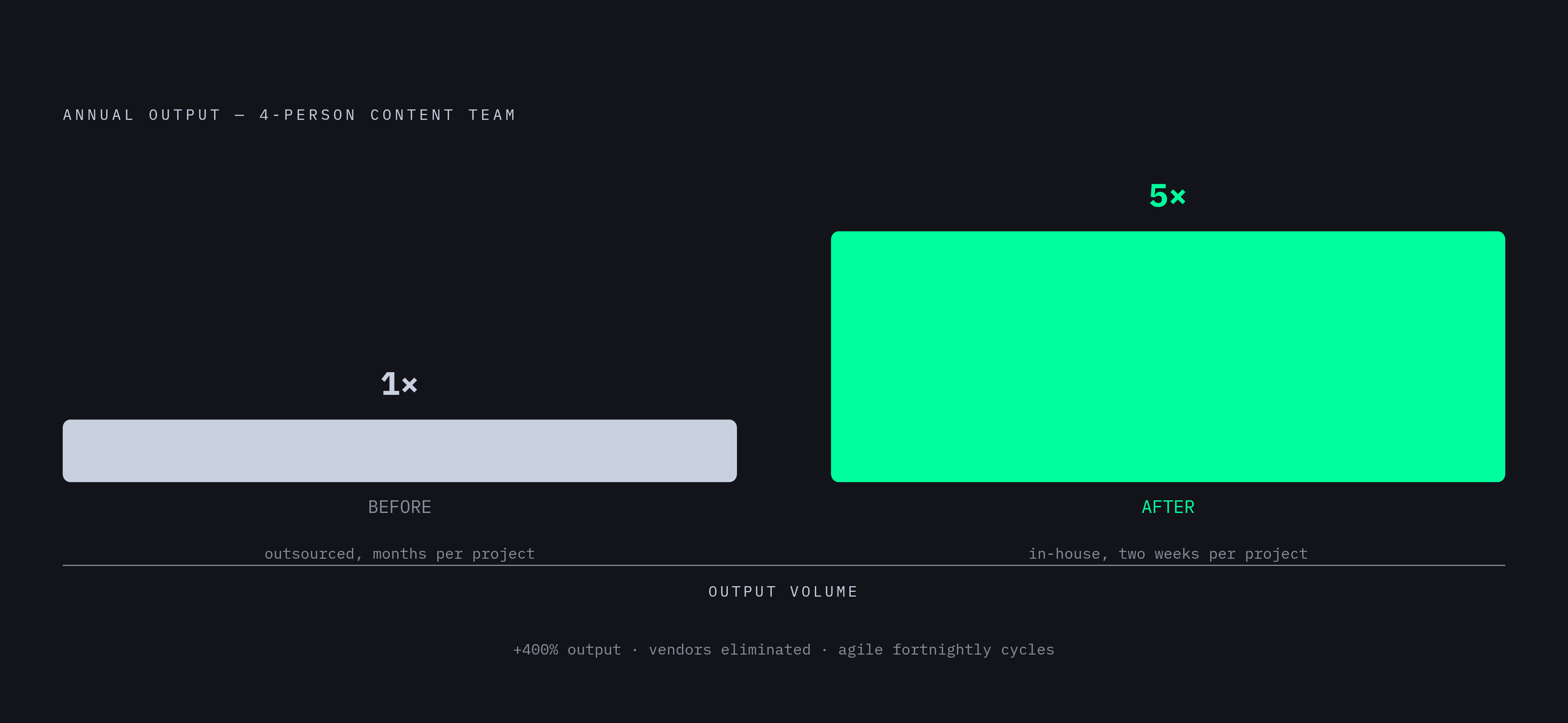
Northern Arizona University changed both the timing and the organization of its content work. Its four-person team had previously produced a small amount of marketing collateral each year with help from contractors and agencies. The university adopted fortnightly cycles, collaborated with IT to build an internal creative unit, and eliminated outside vendors. Output reportedly jumped 400%. Projects that had required months of outsourced revisions finished in two weeks, reflecting a broader operational change than a shorter review schedule.
The assignment model changed as well as the timetable. Work was divided into smaller pieces and routed across available teammates with the required expertise. That division enabled parallel contribution and provides the substantive connection to SaaS content creation. Deakin University does not support an equivalent performance claim because documented methods and outcomes are absent from the supplied case, leaving Northern Arizona as the substantive institutional example.
Cross-Functional Sprints Coordinate Product Launches
HubSpot synchronized product, go-to-market, and revenue messaging for its free CRM rollout through parallel sprints with shared targets. Coordination was built into the operating rhythm rather than left to sequential handoffs between departments. For SaaS, the product and the messages used to bring it to market need to remain aligned as work proceeds. Shared targets let departments work toward the same goals at the same time while each does its own tasks.
Adobe’s shift to subscriptions required a unified strategy across product, sales, and marketing so that messaging kept pace with changes in both the product and the buying model. UruIT approached cross-functional work by adopting agile in marketing after seeing it succeed in engineering. It used sprint cycles, daily check-ins, story cards, and backlog refinement to give marketing, product management, design, development, and data analysis a common operating rhythm. Those practices broke down departmental silos by organizing work across functions rather than treating marketing as a separate downstream activity.
Team Structure That Supports Agile Work
A small cross-functional pod assigned to one go-to-market segment, offering, or territory keeps sprint planning and backlog grooming close to the people doing the work. Its composition should reflect customer-lifecycle responsibilities, including onboarding, retention, and upsell. Those responsibilities require marketing, product management, design, development, and data analysis expertise working together. The group needs the expertise and authority to carry out its assigned work.
A pod without that authority can run every sprint ceremony and still be stuck waiting for sign-off. Delegation therefore changes both what the team can accomplish within a cycle and how independently it operates. Autonomy still requires shared conventions across the organization. Customer-lifecycle results provide a common basis for SaaS marketing because they connect local decisions to onboarding, retention, and expansion work. With that basis, pods can choose how to do the work while answering to shared goals that keep them from going in unrelated directions.
Where Agile Adoption Breaks Down
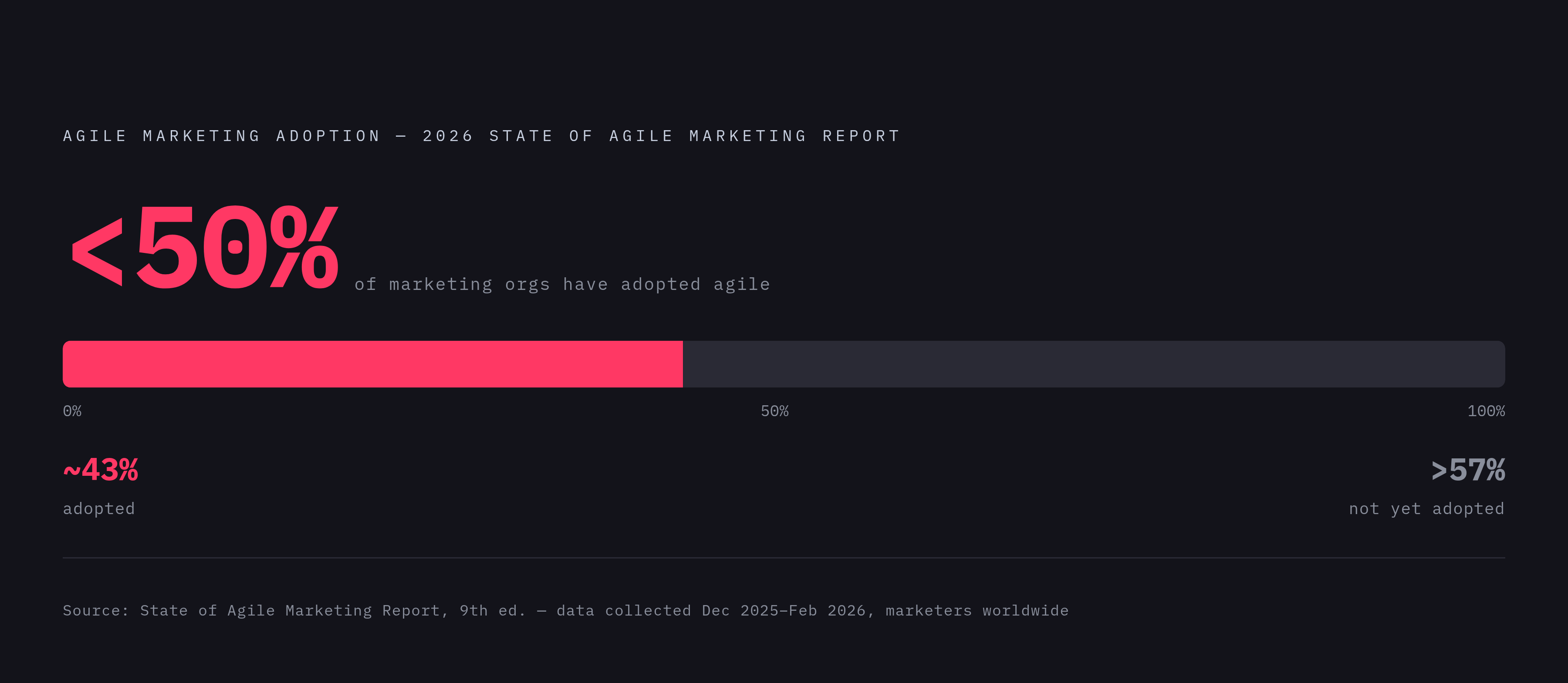
The 2026 State of Agile Marketing Report found that fewer than half of marketing organizations had moved to agile. Its ninth edition polled marketers worldwide between December 2025 and February 2026. Culture and structure pose a greater obstacle than framework choice because teams can master ceremonies without changing approval processes or dismantling departmental silos. In that setting, sprint reviews may identify a need for change while leaving the team unable to act on it.
Northern Arizona’s output gains illustrate why organizational changes cannot be separated from the reported result. Its move to fortnightly cycles coincided with changes in assignment practices, in-house design capacity, and reliance on external contractors. Sprint length alone cannot explain the improvement. Likewise, a team still lacks parts of the setup it needs if it cannot reassign tasks after a review, share people’s expertise across the work, or choose how to do it. Those limits keep teams from acting on feedback, even when planning meetings and reviews happen on schedule. The barrier is therefore not simply incomplete familiarity with agile terminology or routines.
Agile Infrastructure Prepares SaaS Teams for AI
AI integration requires many of the same organizational habits as agile marketing, including fast testing, ongoing input, willingness to revise, and openness to shifting results. Without those practices, teams risk limiting AI to a one-time fix and failing to develop it as an ongoing capability. Sprint cycles provide a set time to review AI-driven results and adjust the work. The operational fit is the stronger argument. Evidence links agile maturity with AI implementation, but it does not establish which way the influence runs, so the association cannot show that adopting agile causes effective AI integration.
For SaaS marketing, repeated evaluation connects AI work to the customer signals that already inform onboarding, retention, and expansion. Those signals can also inform AI-driven personalization and lifecycle marketing. The organizational requirement is continued attention to results. A team needs room to revise its approach rather than treating an initial implementation decision as the end of the work. Shared goals guide what the team looks for in that review, while delegated authority lets it act on what it learns.
To build that setting, SaaS marketing leaders should review tasks in sprint cycles and assign them based on who has the skills and time to do them. They should also set shared launch goals across departments and give pods the authority to choose how to do the work. These decisions address the structural barriers that ceremonies leave intact. They connect the authority to act with the responsibility to evaluate outcomes, making iteration part of the operating model rather than an occasional response to disappointing results. That is the organizational preparation needed to develop AI as an ongoing marketing capability supported by changes to the workflow.
Sources
- (PDF) A Review of Agile Marketing in Cross-Functional Teams: Driving Product Growth through Collaboration
Supplied the cross-functional examples, including HubSpot's parallel sprints with shared targets, Adobe's subscription shift and UruIT's sprint practices.
- Agile Approach to SaaS Marketing - Kanban Zone Blog
Supported the argument that SaaS marketing fits agile iteration and the contrast between Scrum sprints and flow-based boards.
- The New Marketing Team Structure in 2026: SaaS Org Charts
Informed the section on small cross-functional pods organized around customer-lifecycle responsibilities.
- What is marketing agility? A 2026 guide for enterprise teams
Contributed the point that culture and structure, not framework choice, are the main obstacles to agile adoption, and the link between agile maturity and AI.
- Agile Marketing: Sprints & Backlogs Explained
Informed the description of a marketing sprint's flow: backlog updates, planning, midpoint check and closing review.
- Agile Marketing — the Complete Guide
Provided background on Scrum, Kanban and hybrid frameworks and on tools like Jira, Asana and Trello.
- Agile For Marketing Case Studies - Concepts and Beyond
Supplied the case examples of SEMrush's flat hierarchy and Santander's quick experiments.
- NAU Digital Marketing Partnership
Documented Northern Arizona University's in-house creative unit, fortnightly cycles and output gains.