Content Gap Analysis for Established Blogs
Five distinct gap types demand different fixes—misdiagnosing them wastes months of work.

A content gap is the distance between what your visitors are trying to find and what your site actually delivers. That definition is broader than most teams assume. It spans missing topics, yes, but also outdated coverage, wrong formats, insufficient depth, and the growing question of whether you appear when users ask AI tools instead of search engines.
Established blogs typically carry all five gap types simultaneously, and each requires a different fix. Conflating them is where most audits go wrong.
Keyword gaps are the most tool-visible: a competitor ranks for a specific query and you don't. This is what most people mean when they say "content gap." It is also the smallest part of the problem.
Topic gaps are broader. Entire themes relevant to your audience that your site never addresses. These matter structurally because closing them builds topical authority, which improves how the whole cluster performs, not just one page.
Intent and format gaps are subtler and frequently overlooked. You've covered the topic, but the format doesn't match what users expect. A narrative post where they want a comparison table. A 3,000-word guide where they want a quick checklist. The content exists; it just doesn't serve.
Quality and depth gaps are where most mature blogs actually bleed. Content exists but is thin, dated, or derivative. The originality problem lives here too: a post that recaps what every competitor already says, without a distinct angle or first-hand knowledge, is a quality gap even if it's long and well-formatted. You know these posts when you read them — they answer the question and somehow say nothing. Like a fortune cookie that tells you to eat more fortune cookies.
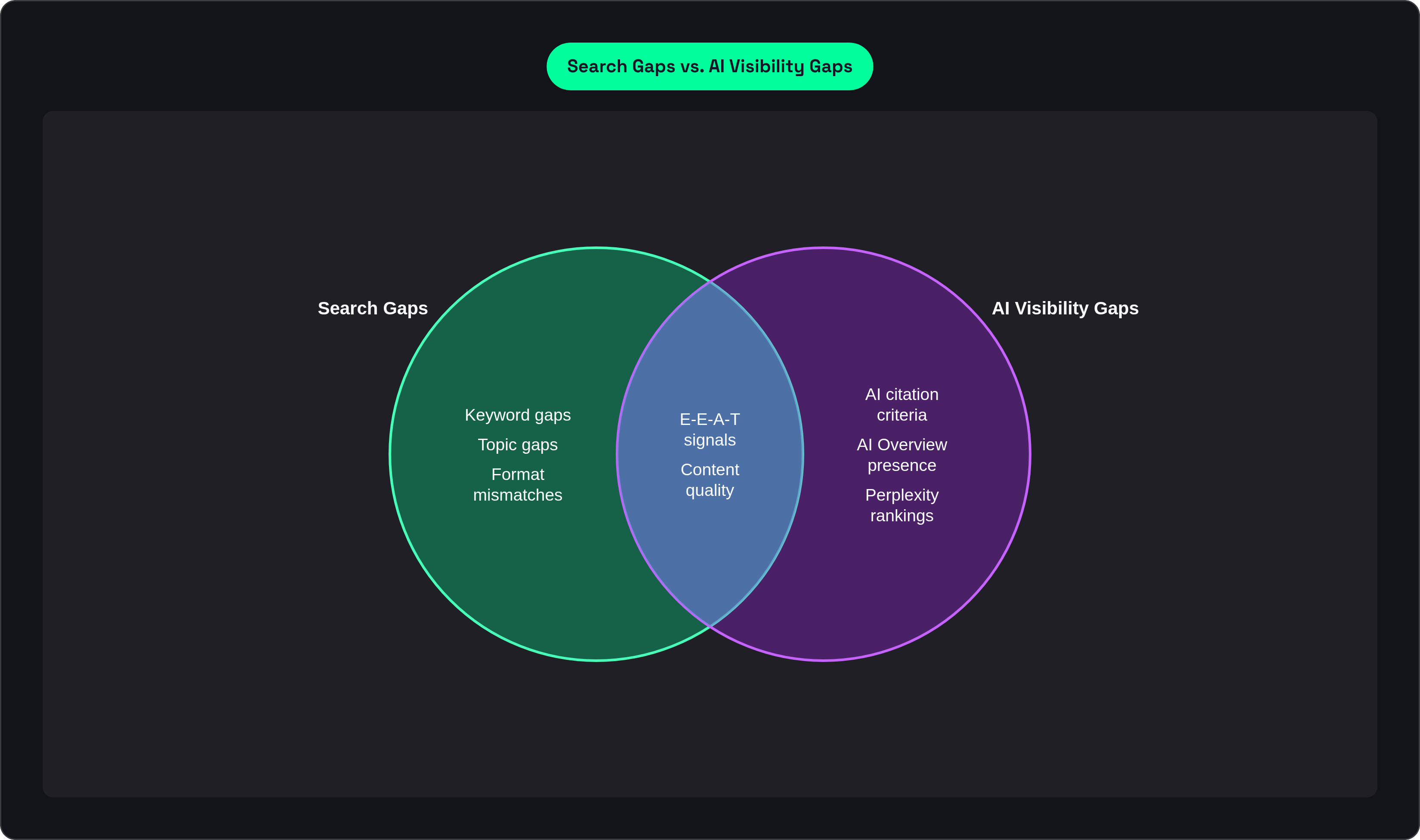
AI visibility gaps are the newest category and increasingly consequential. A page performs in organic search but never surfaces when users ask related questions in ChatGPT, Perplexity, or Google's AI Overviews. Semrush found that nearly 90% of pages ChatGPT cited fell outside Google's top 20 organic results, which means search rank and AI citation operate on entirely separate criteria. A page can rank well and be invisible to AI systems, or vice versa. These are now two distinct surfaces to audit, and treating them as the same thing will produce a gap list with real holes in it.
The reason to identify gap type upfront is practical. Applying a creation fix to a quality problem wastes time and splits authority. Applying a format fix when the topic is genuinely absent doesn't help either. Get the diagnosis right before you touch anything.
How the search landscape in 2025–2026 made gap analysis more urgent
Several overlapping shifts converged in 2024 and 2025 that made surface-level content far more costly to produce and far less rewarding to publish. Understanding them isn't academic; they directly determine which gaps matter most.
Google's March 2024 Core Update folded "Helpful Content" into core ranking signals and explicitly penalized consensus content: posts that summarize the top ten results without adding anything new. Around the same time, a Google patent describing an "information gain" principle entered wide discussion. The implication is structural. Content that repeats what competitors say carries a diminishing ranking signal. Originality is now a ranking factor, not a differentiator.
The E-E-A-T experience dimension followed directly. Content demonstrating first-hand experience saw meaningful visibility gains during late 2025 volatility, per Yotpo's analysis, with a reported 38% lift. Correlation, not causation, fine. But the directional finding aligned with what practitioners observed across multiple verticals: generic overviews lost ground, and posts grounded in direct experience gained it. That pattern is consistent enough to act on.
The AI Overview situation deserves its own accounting. As of March 2026, AI Overviews appear on 48% of all Google search queries, up from 34.5% in December 2025, according to Advanced Web Ranking and Digital Applied data. They are no longer an edge case. Semrush's 2025 research found that 57% of long-tail queries trigger AI Overviews, which is precisely the content type established blogs produce most.
The CTR data from Seer Interactive's longitudinal study makes the stakes concrete. Across 2.43 billion impressions, 5.47 million queries, 53 brands, and 14 months of observation, organic CTR on AI Overview queries dropped from 1.76% to 0.61% between June 2024 and September 2025 (a 65% collapse) before rebounding to 2.4% by February 2026. A separate behavioral study from Pew Research Center, conducted in July 2025 across 900 US adults and nearly 69,000 real searches, found that users clicked a traditional result only 8% of the time when an AI Overview was present, versus 15% without one.
The implication for gap analysis is direct. Brands cited inside AI Overviews receive 35% more organic clicks and 91% more paid clicks than non-cited brands on the same SERP, per Seer. Being cited in AI systems is now a distinct output of the audit process. That changes what "closing a gap" means.
The funnel-stage audit that reveals where established blogs lose readers they've already won
Before running any tool, do this manually. Map every indexed URL against four buyer journey stages: Awareness, Consideration, Decision, and Retention.
The pattern that surfaces on almost every mature blog is the same. Heavy Awareness inventory: introductory posts, definitions, trend roundups. Thin Consideration coverage: comparisons, structured guides, how-to-choose frameworks. Sparse Decision content: use-case walkthroughs, ROI cases, migration guides. Retention content is often nearly absent: advanced how-tos, troubleshooting, upgrade paths.
What happens in practice is that readers arrive through search, learn the basics from your Awareness content, and then leave to find decision-stage content somewhere else. You acquired them; a competitor converted them. That is the actual problem most established blogs are living with, and more Awareness content doesn't fix it. Think of it like a restaurant that perfects its appetizer menu and then wonders why no one stays for dinner.
The strategic error that pure keyword-volume optimization perpetuates is worth naming explicitly. High search volume concentrates at the top of the funnel. Tools surface mostly Awareness-stage opportunities because those queries have the highest counts. Mid- and lower-funnel gaps carry lower volume but significantly higher conversion value. If you optimize for volume alone, you build more of what you already have too much of. The audit exists partly to prevent that.
Tag each URL by funnel stage. That tag becomes critical input at the prioritization stage. The output of this step is a distribution map: where your content investment is concentrated, and where it's absent. That structural picture is something keyword tools alone cannot produce.
How to expand the competitive set before running any gap tool
Most teams define their competitive set as their business rivals. For gap analysis in 2025, that framing is too narrow and will produce a distorted gap list.
The real competitive set is whoever occupies the search results for your target queries, regardless of industry overlap. Three categories of SERP competitors regularly displace established blogs on their own priority terms.
Aggregators and directories dominate high-intent queries. G2, Capterra, and "Best of" list sites rank consistently on comparative searches. Their presence in the SERP is a signal: this is a content format your blog likely doesn't produce, and the gap isn't just a keyword gap. It's a format gap.
Forum content, specifically Reddit, has become a persistent ranking presence. Reddit's traffic from Google grew 39% year-over-year per Business Insider's 2024 reporting. Reddit threads now rank for queries where a well-structured, authoritative blog post should win. That's actually good news. A current, clearly structured piece from a credible domain can displace a forum thread, particularly as that thread ages and the information in it stops being accurate.
Adjacent-niche publishers round out the set. These are sites that don't compete for your customers but do compete for your rankings on shared informational topics.
The practical step before opening any tool: run searches for five to ten priority queries and manually record positions one through five. Categorize each result type. This tells you what content format is actually winning on those SERPs, not just which domains are. If your competitive set going into a gap tool consists only of business rivals, the output will miss the actual SERP winners, and the gap list will be wrong.
Running the audit: the four-source method for finding gaps tools miss
Scope the audit first. Decide whether it covers the full domain, a topic cluster, or a single funnel stage. Scoping prevents the paralysis of a 3,000-item gap list with no clear starting point. A cluster-level scope is often the right starting unit for a first audit.
Source 1: Tool-based keyword gap analysis
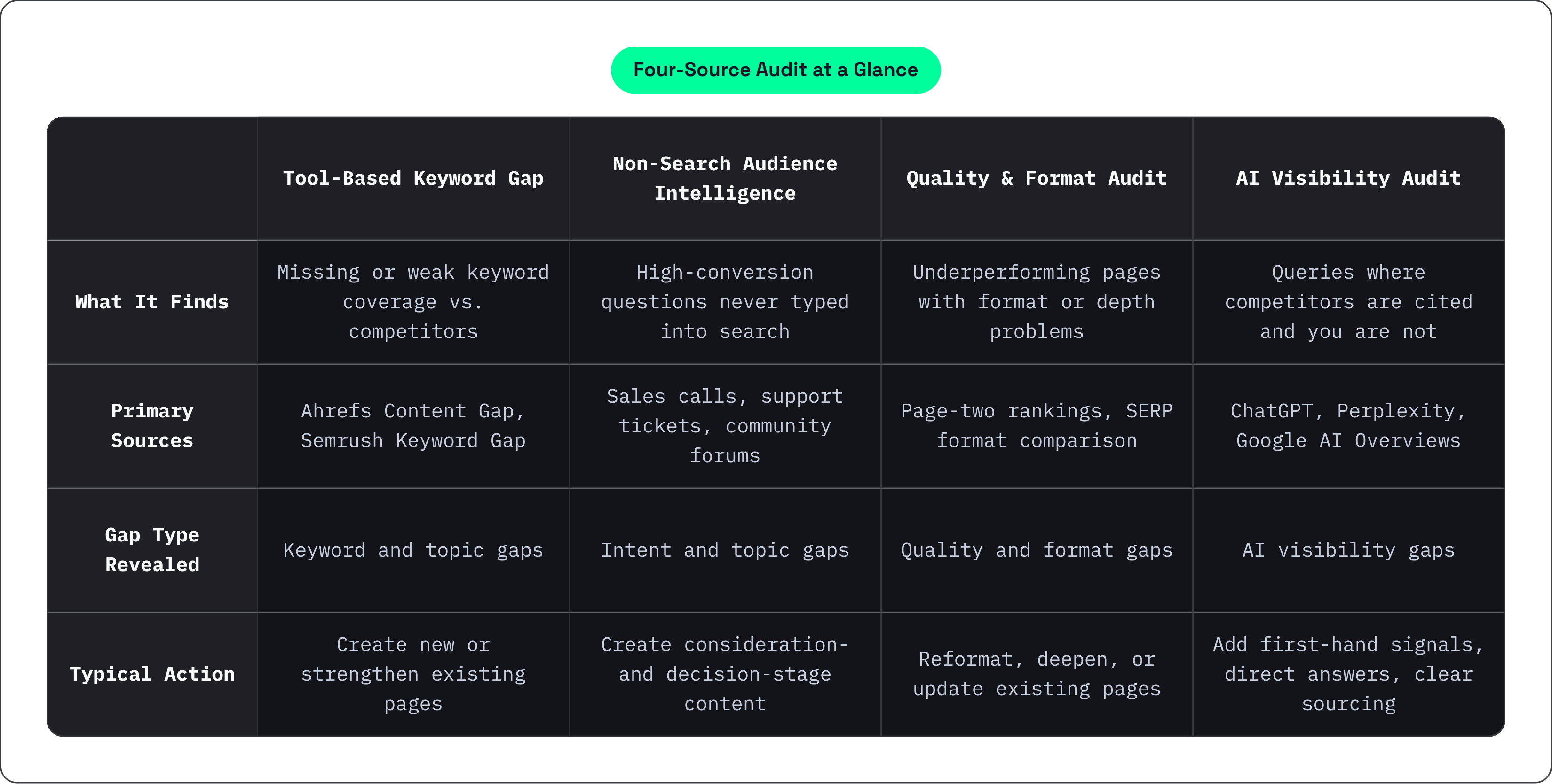
Export all indexed URLs and tag each by topic cluster, target keyword, and funnel stage. Screaming Frog or Ahrefs Site Audit handles this at scale. Then run Ahrefs Content Gap or Semrush Keyword Gap against three to four true SERP competitors identified in the prior step, not just business rivals.
Semrush's taxonomy of "Missing," "Weak," and "Untapped" maps directly onto keyword gaps, quality gaps, and topic gaps respectively. Use that categorization to sort output rather than treating all results as equivalent. A "Weak" result is an update candidate; a "Missing" result warrants new creation. They require different responses and shouldn't share a queue.
Source 2: Non-search audience intelligence
Sales call recordings, support tickets, product reviews, and community discussions surface questions that audiences actually have but never type into a search bar. These represent real content gaps (often high-conversion topics) that keyword tools structurally cannot find.
Tag these by funnel stage. They frequently land in Consideration and Decision, which fills the structural deficit the funnel audit identified. In my experience, this source alone often produces the highest-priority gaps on the final list. The questions your sales team fields every week are a direct signal of what your content is failing to answer.
Source 3: Quality and format audit of existing content
Identify posts ranking on page two or three for their target query. These are not missing-topic gaps; they are quality, depth, or format gaps. The authority signal is already present. The content is underperforming, not absent.
Check whether format matches SERP intent. If the top three results are comparison tables and you have a narrative post, the gap is format, not coverage depth. Adding more text to a post that needs structural reform doesn't close that gap; it just makes the post longer and still wrong.
Flag posts with statistics older than 18 months. Date decay is a quality gap that signals low E-E-A-T to both Google and AI citation systems, regardless of how well the surrounding prose reads.
Source 4: AI visibility audit
Run your top 20 priority queries through ChatGPT, Perplexity, and Google AI Overviews. Record which domains get cited. Any query where a competitor is cited and you are not is a distinct AI visibility gap, separate from your keyword gap list.
Ahrefs' analysis of 730,000 AI responses found only 13.7% overlap between AI Mode and AI Overview citations. Audit both surfaces separately; they do not substitute for each other. Analysis of 15,847 AI Mode results found that 96% of AI Overview citations come from sources with strong E-E-A-T signals. The lack of first-hand experience markers is frequently the specific cause of AI citation gaps, not keyword presence or domain authority alone. That distinction matters when you're deciding what to fix.
Prioritizing the gap list: which gaps are worth closing first
A long gap list is not a to-do list. Working through it by search volume is the default mistake, and it reproduces the same funnel imbalance the audit just revealed.
Score each gap against these variables.
Business relevance comes first. Does ranking for this topic move a reader toward becoming a customer, or deepen an existing relationship? A high-volume gap with low business relevance ranks below a lower-volume gap with a direct conversion path. Volume is a tiebreaker, not a primary signal.
Funnel stage balance adjusts for structural deficits. Gaps in underrepresented stages (Consideration and Decision in particular) earn priority over additional Awareness content regardless of search volume. You are correcting an imbalance, not maximizing impressions.
Cluster leverage separates isolated wins from compounding investments. A topic gap that anchors a new content cluster produces returns across multiple future pages. An isolated keyword gap produces a single traffic increment. When resources are finite, cluster anchors take priority.
Competitive displacement opportunity factors in win probability. Gaps currently held by outdated competitor articles or aging Reddit threads are higher-probability wins than gaps held by freshly updated domain authorities. The effort-to-outcome ratio is materially better on the former.
Make the create-versus-update decision at prioritization, not at the writing stage. If an existing page partially covers the intent but ranks weakly, updating is the faster path and avoids splitting authority across two pages. If the gap represents a distinct search intent with no close existing match, create new.
Backlinko's data puts the urgency of page-two rankings in useful relief: the top three results receive 54.4% of all clicks, while only 0.63% of users click any page-two result. Gaps where you're already on page two are higher priority than gaps where you're entirely absent. The authority signal already exists. An update moves the needle faster than a new page competing from zero.
The output of prioritization is a ranked gap list with gap type, recommended action (create, update, reformat, or prune), funnel stage, and cluster assignment. That artifact is what the team actually works from.
Closing gaps: how update decisions differ from creation decisions in practice
Updating existing content
Preserve the URL and all internal links. Changing a URL resets authority signals accumulated over months or years, and there is rarely a reason compelling enough to justify that cost.
Add missing subtopics, not just words. Length without new information does not close an originality gap and does not satisfy the information gain signal. More of the same at greater volume is padding. Readers can tell. So can Google.
Refresh all statistics to 2025 or 2026 sources. A post citing 2022 data signals low E-E-A-T to both readers and AI citation systems, regardless of how well the surrounding prose reads.
Mark the post "Updated [Month, Year]" and submit the URL for recrawling in Google Search Console immediately after publishing.
For format gaps specifically: restructure around the dominant SERP format rather than rewriting from scratch. If the top results use comparison tables, add the table. If they use structured step-by-step guides, reorganize accordingly. Rewriting a post that needs restructuring wastes the work the existing page has already done.
Creating new content for genuine gaps
New content earns creation when the gap represents a distinct intent, a new funnel stage, or a cluster anchor. Not when an existing post could cover it with additional depth.
For AI visibility gaps specifically, structure content to be citable. Direct answers to specific questions. Clear, attributable claims. Demonstrable first-hand expertise. AI citation criteria reward precision and sourcing, not length or comprehensive coverage. A concise, well-sourced answer to a specific question is more citable than a thorough general overview. This is counterintuitive for writers trained on the "be comprehensive" doctrine, but the behavior of these systems rewards it.
Internal linking at publish is not optional. New pages that don't slot into an existing cluster take longer to earn authority and don't contribute to topical depth signals. Before publishing, identify which existing pages link to this new one and which new one links out to cluster neighbors. Do that work before the URL goes live.
Content pruning as a gap-closing action
Thin, duplicative, or off-topic posts dilute topical authority and can drag down domain-level quality signals. Pruning (whether that means consolidating near-duplicate posts or removing content with no traffic and no strategic value) is a legitimate gap-closing move.
Pruning is not failure. A tighter, more coherent content footprint performs better than a sprawling one with redundancies everywhere and gaps in the places that actually matter. Some of the most effective audits I've seen produced a shorter site, not a longer one.
Making gap analysis a repeatable process rather than a one-time project
A single gap audit is a point-in-time snapshot. The search landscape shifts, competitors publish, AI systems update their citation patterns, and your own content ages. An audit conducted once and then shelved becomes outdated before the last gap on the list gets closed.
The process becomes repeatable by building the infrastructure during the first audit, not after. Maintain the tagged URL inventory. Keep the funnel-stage map current. Add new queries to the AI visibility audit as your priority topic set evolves. Document the competitive set definition, the four-source methodology, and the prioritization criteria as a standing process, not a one-time project deliverable.
Set a cadence that reflects the pace of change in your space. A quarterly cluster-level review is a reasonable default for most established blogs. A full-domain audit annually. After major Google updates, run a targeted quality audit on any cluster that shows traffic movement in either direction. A drop signals a gap; a gain sometimes reveals a format or intent you can replicate elsewhere.
The editorial calendar should be downstream of the gap list, not parallel to it. If the gap list doesn't inform what gets assigned, the calendar fills with what's easy to write, which is typically more Awareness content, which is typically what the site already has too much of.
An established blog's real advantage is the authority it has already accumulated. The gap process is the mechanism for directing that authority where it actually converts. Done once, it's a useful exercise. Done consistently, it becomes a system that compounds.
Sources
- https://www.semrush.com/blog/content-gap-analysis/
Provided the statistic that nearly 90% of pages cited by ChatGPT fall outside Google's top 20 organic results.
- https://pressfrolic.com/seo/content-gap-analysis/
Corroborated the statistic about ChatGPT citations falling outside Google's top 20 organic results.