Bottom of Funnel Content Types That Drive Conversions
Comparison pages and case studies drive conversions by addressing buyer doubts before deals stall.

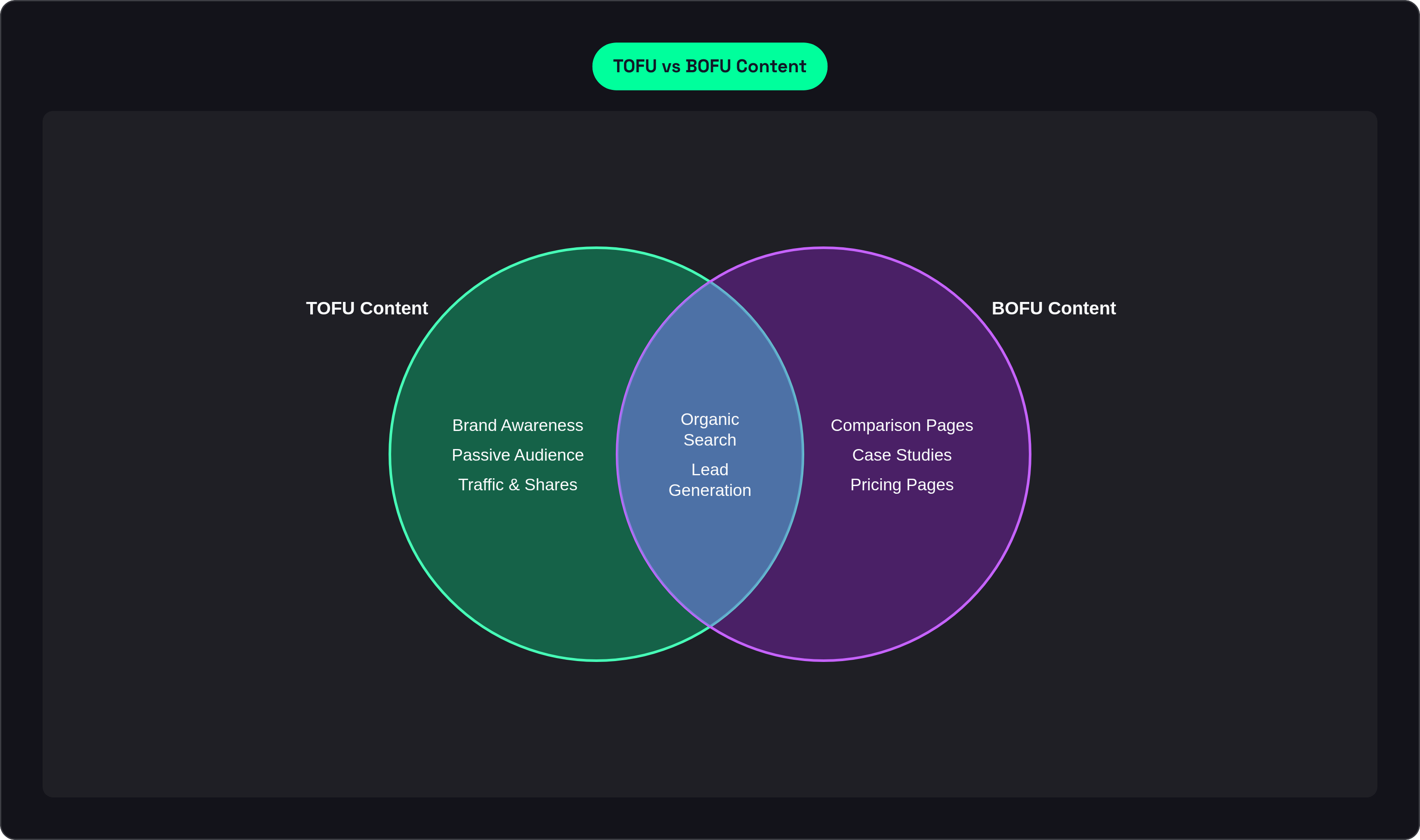
The gap between top-of-funnel and bottom-of-funnel conversion rates is not marginal. In the same client environments, BOFU content routinely outperforms TOFU by an order of magnitude. Most content programs are built to ignore this fact — like a fisherman who spends all day casting a wide net in shallow water and wonders why his boat stays empty.
At any given moment, only a small slice of B2B buyers are actively in-market. TOFU content broadcasts to the much larger passive majority, most of whom are not going to buy anything this quarter. BOFU content is built for the buyers who are. You would think this calculus would be obvious to anyone running a content program, and yet the editorial calendar stays weighted toward awareness almost everywhere I have seen it.
Part of that is habit. Awareness content feels productive because it generates traffic and shares and visibility. BOFU content is quieter, harder to attribute in a last-touch reporting world, and it does not win awards. Comparison pages and pricing content are unglamorous. But they close deals, and awareness content largely does not.
Full-funnel strategies consistently outperform single-stage approaches. That holds across industries and company sizes. The practical failure mode is not that marketers ignore BOFU entirely; it is that they under-resource it. You can fill the top of the funnel with genuinely qualified buyers and lose them at the bottom because there is nothing there to catch them.
How to think about BOFU content as a set of distinct persuasion jobs
The bottom of the funnel is not a smaller version of the top. Buyers arriving here have already done substantial independent research, narrowed a shortlist, and are weighing specific options against one another. The central question has shifted from "what solves my problem?" to "why this vendor, not the others?" That is a different psychological situation entirely, and it demands different content.
B2B buyers complete the majority of their purchase journey before ever contacting a vendor. By the time they land on BOFU content, many already have a candidate in mind. Most winning vendors are on the shortlist from day one. Which means BOFU content is less about initiating consideration and more about confirming an existing preference or displacing a competitor who got there first. That is a more precise, higher-stakes job than building brand awareness, and it requires precision the way awareness content does not.
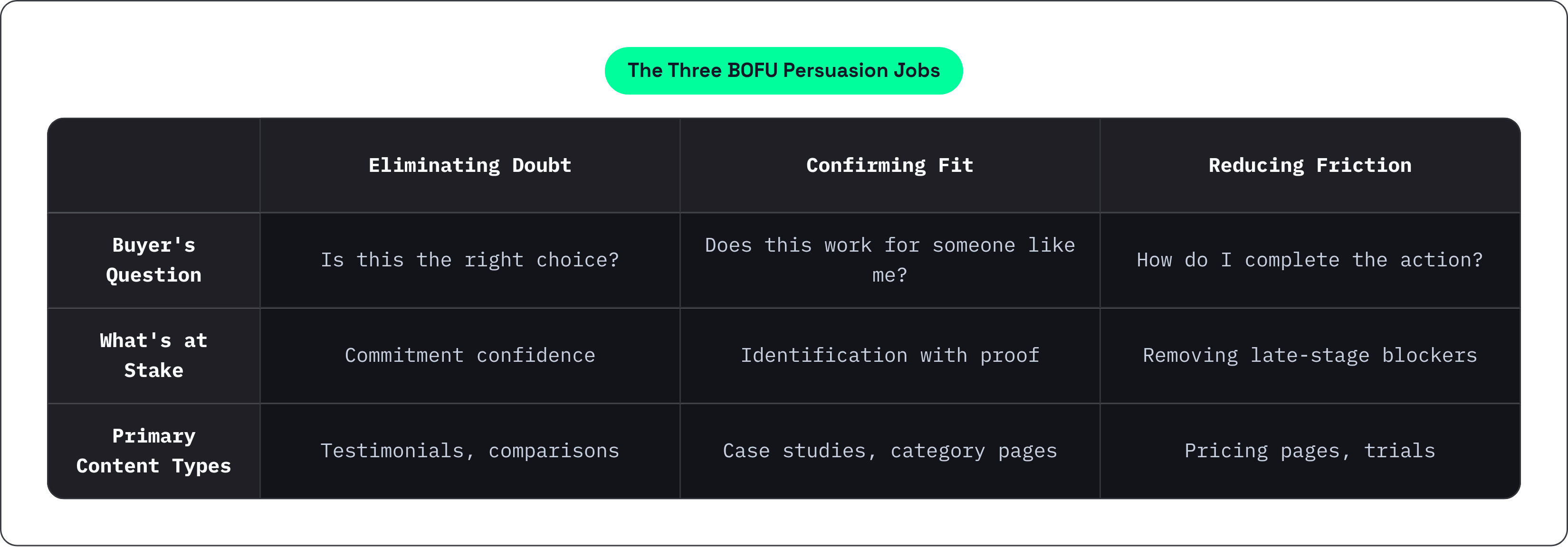
Three distinct persuasion jobs cover most of the territory.
The first is eliminating doubt, which answers the objection: "What if this is the wrong choice?" The buyer is not unconvinced of the category; they are uncertain whether the evidence tips the scales clearly enough to commit.
The second is confirming fit, which answers: "Does this actually work for someone like me?" This is about identification. The buyer needs to see their industry, their company size, their specific problem reflected in the proof you are offering.
The third is reducing friction, which removes the barriers that prevent a buyer who has already decided from completing the action. Pricing ambiguity, unclear onboarding expectations, and opaque procurement requirements stall deals that were effectively already closed.
A well-designed BOFU content mix addresses all three. Leave one unaddressed and you leave a gap, and gaps stall deals that should have been yours.
Comparison and alternative pages — the highest-intent format in the BOFU toolkit
A buyer searching "[Competitor] alternatives" is not browsing. They are dissatisfied, price-blocked, or actively evaluating a switch. They will buy something in the near term; the only open question is what. That intent profile makes comparison and alternatives pages among the highest-converting content types across the entire funnel, often outperforming even branded category terms.
Honesty is the strategy here, not a brand value to perform. Decision-stage buyers verify claims in real time. A stale or one-sided comparison destroys page credibility faster than any objection the page was designed to address, and when a buyer catches an inaccuracy, they do not just distrust that page; they distrust the vendor. Credibility built through candid acknowledgment of tradeoffs, including your own, transfers directly to purchase confidence in a way that promotional copy never does.
These pages are also perishable. Competitor pricing changes, feature updates, and positioning shifts all require prompt revision. Quarterly review is a floor; major competitive events trigger immediate updates. This is not a format you build once and forget.
There is a secondary job these pages do that often goes unacknowledged. They intercept buyers who found a competitor first and redirect their consideration. That is a form of acquisition that pure awareness content simply cannot replicate.
Case studies — confirming fit for buyers who need proof from someone like them
The buyer's underlying question is specific: "Did it work for someone in my situation?" Industry, company size, problem type, and measurable outcome all contribute to the sense of identification that makes a case study actually land. A case study about a midsize logistics company does limited work for a buyer at a consumer software startup, even when the results are genuinely impressive. Specificity of match outweighs impressiveness of outcome, almost every time.
Case studies consistently rank among the most influential content types for final purchase decisions in B2B, a position they have held across multiple years of content marketing research. CMI's 2025 B2B findings put customer stories and case studies in the top two most effective formats, with only video edging them out. That durability reflects something real: they provide structured evidence that satisfies the skepticism of informed, comparative buyers in a way that product pages do not.
They also function as asynchronous selling tools inside the buying committee, which is where deals actually live or die. A champion can forward a case study to a skeptical finance director or a risk-averse CTO without needing to be in the room to make the argument. The document makes the case independently. In B2B environments where buying committees of six to ten stakeholders are the norm and the champion rarely controls every conversation, that independence is worth a great deal.
The difference between a case study that works and one that does not usually comes down to specificity. "They transformed our workflow" reads as marketing copy. "We reduced onboarding time from three weeks to four days" reads as evidence. That gap in persuasive force is not subtle.
Testimonials and social proof — the trust signals that keep doubt from returning at the last moment
There is a specific psychological moment that testimonials address, and it is distinct from what case studies do. A buyer who has largely decided often experiences a final surge of uncertainty just before committing — not unlike a diver standing at the edge of the board, certain they want to jump, scanning the water one last time for reasons not to. They are not seriously reconsidering the vendor; they are looking for a signal that it is safe to proceed. Testimonials provide that signal continuously, through ambient placement throughout a page or flow, rather than through structured argument.
Placement drives outcome more than most teams realize. Testimonials near call-to-action elements and demo request forms outperform those buried below the fold, because the anxiety being addressed is immediate. A testimonial the buyer has to scroll to find does not intercept the doubt it was meant to resolve. Position it where the hesitation actually occurs.
Specificity matters as much as placement. A named individual describing a specific problem solved and a measurable result achieved is persuasive. A company logo accompanied by "great product, highly recommend" is essentially inert. The same budget spent acquiring fewer, better, more specific testimonials consistently outperforms a larger volume of generic praise.
Logo walls, security badges, and third-party certifications do their own version of this work, particularly for buyers concerned about vendor credibility or data security. These are not decorative elements. They are doing active persuasion work for a specific type of residual doubt that testimonials alone do not fully address.
Pricing pages — the content that filters serious buyers and removes a major friction point
A large majority of B2B buyers expect clear, detailed pricing upfront. Withholding it is not a sales tactic; it is a reason to look elsewhere. C-suite buyers, per G2 research, are particularly sensitive to gating. A significant share say they are less likely to purchase from vendors who require contact information before showing pricing. The signal a gated pricing page sends is not "our product is premium." It is "we do not trust you with this information," and sophisticated buyers read it exactly that way.
Transparent pricing pages do double qualification work. They filter poor-fit prospects before they consume sales capacity, and they signal confidence in the product's value to buyers who are genuinely ready. A vendor willing to show pricing is implicitly saying: the number is defensible, and we believe the value is clear enough to survive contact with it.
A BOFU-optimized pricing page covers considerably more than the number itself. Implementation expectations, support tiers, risk reversal signals such as trial periods and cancellation terms, social proof placed near the call to action where commitment anxiety peaks. The pricing page is often the last page a buyer visits before converting or leaving. Given that, the typical level of investment in its content is disproportionately low.
Free trials and freemium — the format where product experience does the persuasion
No claim a vendor can make about their product is as credible as the buyer's own experience of using it. Trials work by making value real rather than asserted, shifting the buyer's internal question from "will this work for me?" to "I have seen it work; do I want to stop?" That reframe is powerful, and it is unique to this format.
Trial structure has a large effect on conversion. Opt-out trials, where a credit card is required upfront, convert to paid at roughly three times the rate of opt-in trials, per research from both First Page Sage and ChartMogul. The mechanism is selection: the upfront commitment filters for serious buyers. Opt-in trials reach a wider pool but require substantially stronger activation content to compensate for the lower initial seriousness of the cohort.
Human touchpoints inside the trial window consistently lift conversion. Even a single onboarding call or product walkthrough moves the number. Buyers who feel supported during a trial are more likely to reach the moment where the product's value becomes undeniable.
Timing matters acutely. Most B2B trial conversions cluster near the trial expiration, and activity drops steeply after the first two weeks. That makes early activation, in-app prompts, onboarding email sequences, and guided setup flows the highest-leverage content investments in the trial environment. The content job here extends well beyond the trial itself; it encompasses everything that guides the buyer to the moment where stopping feels like the worse option.
Interactive demos and ROI calculators — giving buyers the tools to convince themselves and their committees
In buying committees where six to ten stakeholders are involved, per Gartner's 2024 research, the champion carries an internal selling burden that most content completely ignores. They need to make the case to colleagues who never interacted with the vendor's sales team, never read the comparison pages, and may be encountering the product for the first time in a budget approval meeting. Interactive demos and ROI calculators give that champion shareable, credible artifacts designed to survive internal circulation without a sales rep present to contextualize them.
Interactive product tours on pricing pages replace gated demo request forms with immediate experience. The friction of waiting for a scheduled call disappears. Buyers who engage with a self-serve tour arrive at a subsequent live demo with specific questions rather than general curiosity, which improves lead quality substantially. When one B2B SaaS company replaced its gated form with an ungated embedded product tour, conversion on that page rose meaningfully, per Walnut Platform data from 2025.
ROI calculators address the objection that surfaces most reliably at final approval stages: "What is the business case?" A large majority of B2B buyers identify price and ROI as top factors in the final decision. A calculator that models the timeline to positive ROI reduces perceived risk in a way that a written claim about ROI simply cannot, because the buyer has produced the number themselves. That matters. Personalization multiplies the effect further; demos built for a CFO and demos built for a VP of Engineering are telling different stories about the same product, and both stories are more persuasive than one generic version attempting to serve both audiences simultaneously.
Forrester's 2024 State of Demand and ABM report found that organizations embedding interactive product experiences into their content saw meaningful improvements in pipeline conversion rates compared to those relying on static materials.
Category and "best of" pages — capturing buyers who have decided to buy but not yet decided on a vendor
Queries like "best accounting software" or "top project management platforms" represent a buyer who has already moved past problem definition. They are not asking whether they need the category; they have decided they do. They are selecting. That intent profile is distinct from an informational search, and the content that serves it needs to reflect that distinction rather than defaulting to educational framing.
Category pages consistently deliver strong conversion rates across large samples of organic traffic, per Grow and Convert's analysis. That reflects the purchase readiness of the audience arriving on these pages, not anything magical about the format itself.
High-converting category pages are written for someone making a decision. They surface differentiators, specifically use-case fit, integrations, pricing tiers, and support structures, that matter to a buyer comparing finalists. And they do what effective comparison pages do: they name where the product is not the best fit, which builds credibility that generic promotional copy cannot.
There is also a defensive function here that is easy to underestimate. If your product does not appear on third-party "best of" lists or rank for its own category terms, a competitor's page becomes the last content the buyer reads before deciding. You are absent from that moment by default, and in a BOFU context, absence is not neutral. It is a loss.
How AI search is shifting BOFU content's role and its attribution
Informational and educational content, the TOFU majority, is losing organic clicks to AI Overviews and generative search interfaces, which answer general queries without requiring the user to visit a source. A buyer asking "what is a CRM?" may never reach a website at all. The top of the funnel is becoming increasingly AI-mediated, and that compression is structural, not a temporary algorithmic fluctuation.
BOFU content is less vulnerable to this shift, and in some respects benefits from it. Queries that carry high commercial intent, comparison searches, pricing searches, alternatives searches, category-level vendor evaluations, still resolve in clicks because the buyer needs specificity that an AI summary cannot provide. They need to see the actual comparison table, the actual pricing structure, the actual case study from a company like theirs. A generated summary cannot substitute for that level of concrete detail.
The attribution consequence is real. As TOFU content produces fewer directly attributable sessions, BOFU content's contribution becomes proportionally larger in the metrics that track revenue-relevant activity. This is partly a measurement shift, but it is also a genuine concentration of purchase-proximate behavior in BOFU formats.
There is a parallel shift in how AI search surfaces vendor recommendations. Generative interfaces increasingly recommend specific products in response to "best of" and comparison queries, drawing from the same content ecosystem that has historically fed these searches. BOFU content, comparison pages, case studies, and category pages, is the raw material those systems cite. A well-built BOFU content library does not just convert buyers who visit directly; it shapes how AI-mediated search describes you to buyers you never see in your analytics.
BOFU content was already the most underleveraged part of most content programs, and some platforms are built to automate the full production cycle so teams can close that gap without adding headcount. The shift in how search works is making that underinvestment more expensive by the quarter.
Sources
- https://realize.com/marketing-hub/bottom-of-the-funnel/
Supported the point about only a small slice of B2B buyers being actively in-market at any given time.
- https://mintposition.co/blog/bottom-of-funnel-content/
Cited as a reference for comparison pages and pricing content as unglamorous but deal-closing BOFU formats.
- https://firstpagesage.com/seo-blog/sales-funnel-conversion-rate-benchmarks-2025-report/
Provided research on opt-out versus opt-in trial conversion rates, cited alongside ChartMogul.
- https://searchengineland.com/bottom-of-funnel-content-ai-search-474654
Informed the section on how AI search is shifting BOFU content's role, particularly that high-commercial-intent queries still resolve in clicks.
- https://seoprofy.com/blog/b2b-marketing-statistics/
Supported the claim that only a small slice of B2B buyers are actively in-market at any given time.
- https://www.averi.ai/guides/content-marketing-roi-benchmarks-b2b-saas
Supported the claim that full-funnel strategies consistently outperform single-stage content approaches.