How to Run a Quarterly Content Planning Cycle That Sticks

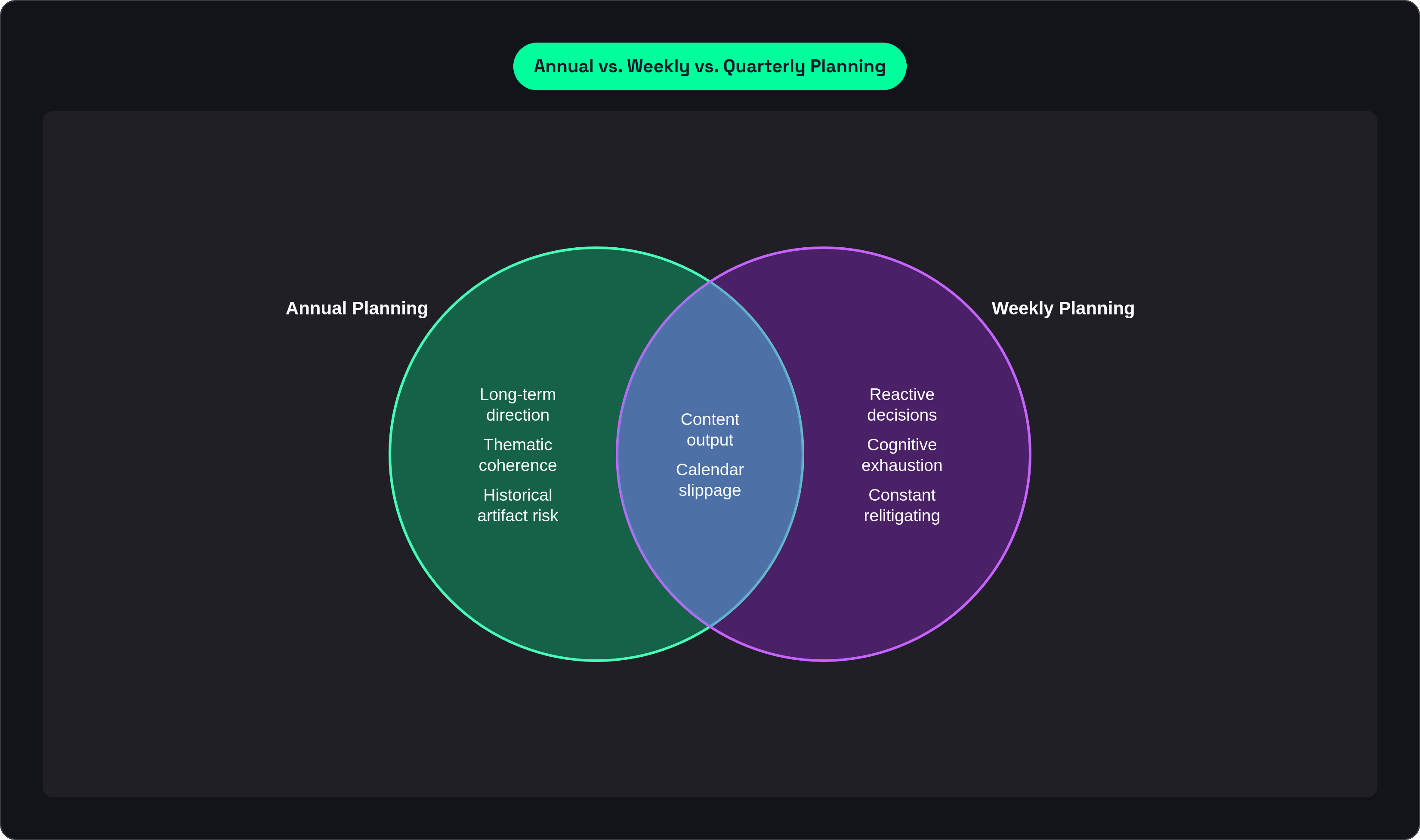
Annual planning tells you where you're going. It doesn't tell you how to get there when the terrain shifts, and it always shifts. By Q3, most annual content plans are effectively historical documents, artifacts of assumptions nobody has formally retired. You're executing against a market that moved on six months ago.
Weekly planning breaks the other way. Deciding what to create fifty-two times a year doesn't produce better content; it produces exhaustion. Every cycle spent relitigating "what should we post this week?" is cognitive bandwidth that could have gone into making the actual work better. That cost is invisible until the calendar starts slipping and nobody can explain why.
Ninety days is long enough to build thematic coherence, content that reads as intentional rather than opportunistic, content that's clearly building toward something. Audiences feel that coherence even when they can't articulate it. And ninety days is short enough that your strategic assumptions stay honest. Search behavior, product positioning, the questions your audience is actively asking: these shift meaningfully on roughly that interval. A quarterly cycle forces re-examination at exactly the right cadence, frequently enough to stay calibrated, infrequently enough that you're not constantly relitigating decisions you already made.
One clarification worth making explicit: an editorial calendar is not a schedule. A schedule is a spreadsheet. An editorial calendar is the implementation plan for a documented strategy. One requires knowing what you're trying to accomplish. A quarterly cycle forces you to revisit that underlying strategy every ninety days. For teams that already run annual audits, the quarterly cycle layers on top, functioning as an early warning system rather than a replacement.
The Retrospective: What to Measure Before Planning Anything New
The mistake I see constantly is teams starting quarterly planning with a blank calendar and filling it with energy. The slightly less common version is copying last quarter's calendar forward with minor edits. Both approaches share the same flaw: they reproduce prior choices without asking whether those choices worked.
Before any planning happens, audit across three dimensions. Visibility: how often did your content surface, and when it did, did it earn the click? Engagement: when people landed, did they stay, respond, share, save? Business impact: did any of it move the conversions, pipeline, or audience behaviors the organization actually cares about? Not impressions. The things that matter.
Within those dimensions, a few specific questions generate the most actionable inputs. Which topics drove genuine engagement, not surface metrics, but comments, saves, direct messages, the kind of response that signals real resonance? Which platforms produced actual traffic or conversions rather than just activity? And the question most teams skip entirely: what was planned last quarter but never published? That unpublished list is signal. It tells you something real about volume assumptions, process integrity, or topic viability, and all of it should inform what you commit to next quarter.
One finding worth taking seriously: practitioners who regularly refresh high-performing existing content consistently outperform those who only produce net-new pieces. That should prompt a standing question in every retrospective. What do we already have that's worth updating rather than replacing?
Scope doesn't need to be exhaustive. Focus on your highest-traffic content and your most recent ninety days of output. One to two days of work, not a multi-week project. The retrospective's output is deliberately narrow: a short list of what to stop, what to do more of, and what to fix. Not a performance report. Just the inputs the planning session needs to make better decisions than last time.
Setting the Quarter's Single Objective and the Key Results That Confirm It
Once you know what worked and what didn't, you can set direction. The OKR framework, adapted for content, is the right tool here. Not because it's fashionable, but because it enforces a discipline most content teams quietly avoid: separating the objective from the tactics used to pursue it.
One qualitative objective. Two or three key results specific enough that, at quarter's end, there's no ambiguity about whether you hit them.
The failure mode is treating tactics as objectives. "Publish twenty articles this quarter" is not an objective. Publishing is a tactic. The objective is what those twenty articles accomplish: awareness in a segment you don't currently reach, inbound pipeline from a specific buyer persona, recognized authority in a topic where you're currently invisible. The moment you conflate tactic with objective, you lose the ability to make good in-quarter decisions, because you can no longer evaluate whether a given choice actually advances the goal.
The quarterly theme is the practical expression of that objective across the calendar. If the objective is user acquisition, the theme orients every content brief toward the problems that drive potential customers to seek solutions. The theme is not a hashtag. It's the connective tissue that makes the quarter's work read as a coherent body rather than a collection of loosely related pieces.
Teams that consistently perform well share two characteristics: they align content goals to organizational objectives, and they actually measure and demonstrate performance against those goals. The objective-setting step is where that alignment either gets built in from the start or gets skipped entirely. There's no recovering it later.
The practical risk with OKRs is that teams set them and never look at them again. The fix is simple: make the objective present in planning sessions, in content briefs, in channel reviews. Ask explicitly, with each decision, how does this choice advance the objective? That question, asked consistently, is what turns a documented strategy into an operational one. Everything else in the quarter is accountable to the answer.
Building the Calendar: Mix, Formats, and Channels Before Individual Topics
The planning session has a sequence, and the sequence matters. Most teams skip directly to topic selection because it feels like planning. It isn't. It's the last step. Before any topic gets written down, three structural decisions need to be locked in: content mix, formats, and channels.
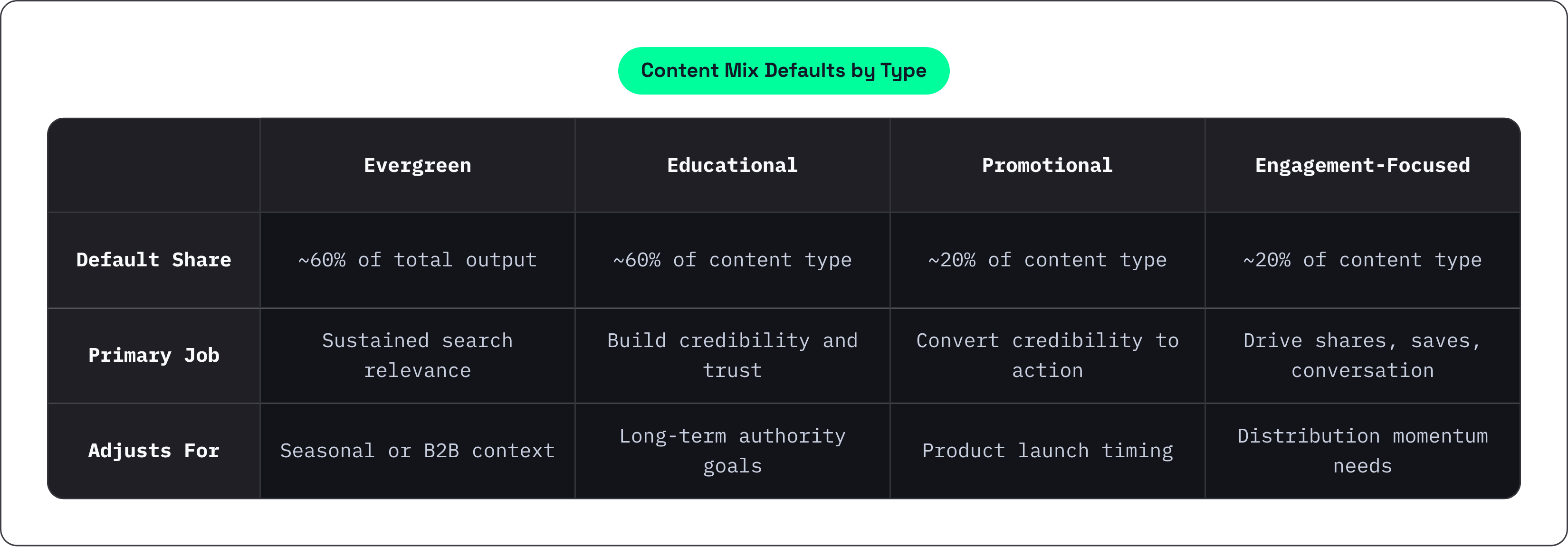
Content mix deserves a default position you adjust by context rather than a blank-slate decision every quarter. A workable starting point: roughly sixty percent evergreen content, material with sustained search relevance and a long shelf life, and forty percent timely content that responds to the moment. B2B SaaS organizations often push further toward evergreen. E-commerce operations serving seasonal demand may flip the ratio during peak periods. The specific numbers matter less than making the decision at the structural level, not piece by piece.
The same logic applies to content type. A common breakdown: sixty percent educational, twenty percent promotional, twenty percent engagement-focused. Educational content builds the credibility that makes promotional content more effective. Engagement-focused content, the kind explicitly designed to generate saves, shares, and conversation, creates the distribution momentum that amplifies everything else. These percentages aren't arbitrary; they reflect how trust actually accumulates over time.
Format decisions belong here too. Short articles and blog posts, video, and case studies remain the most widely adopted B2B content formats, roughly in that order. A consistent mix of formats correlates with higher engagement, but the formats you choose need to be constrained by two realities: channel fit and what your team can actually produce at the planned volume. Aspirational format decisions made without accounting for real production capacity are a primary source of execution failure.
Channel selection follows format. Concentrating effort on a few channels where you have genuine engagement quality outperforms spreading thin across many. A common and costly pattern is filling a calendar with content and then deciding where it goes, which produces a mismatch between format, platform, and audience that's very hard to undo mid-quarter.
Before any topics get assigned, lock in fixed dates: product launches, company events, seasonal peaks, guest publication deadlines, partnership commitments. Flexible content fills around these anchors. Identifying them upfront eliminates the mid-quarter reshuffles that slowly erode a team's confidence in its own plan.
By the end of this step, the only remaining decision should be which specific topics fill the available slots. How many pieces, in what format, on which channel: already decided.
Filling the Calendar: How to Select and Assign Topics at Scale Without Debate
Topic selection, when it follows everything above, is largely a confirmation exercise. The best inputs are already waiting in the retrospective outputs, the gap analysis against your objective, and the theme you've committed to. The planning session is not a brainstorm. It's a structured review that generates assignments.
The most reliable topic sources are three: high-intent search gaps, where your audience is actively searching and your coverage is weak or absent; evergreen refreshes, content flagged in the retrospective as high-traffic but stale; and objective-driven originals, net-new pieces that directly serve the quarter's key results and wouldn't emerge from either of the other two categories.
Assign ownership and a draft-due date to every topic in the planning session. A topic without an owner and a date is not a commitment. It's an intention, and intentions don't ship.
Build in deliberate slack. Plan roughly eighty percent of available slots, not one hundred. The remaining twenty percent absorbs reactive content that emerges mid-quarter, production delays that are inevitable in any real operation, and the occasional opportunity worth capitalizing on without displacing everything else.
Before the session ends, apply one structural test: if the busiest week of the quarter arrived tomorrow, would every assigned piece at the current volume still get done? If the honest answer is no, the volume is too high or the assignments are too concentrated. Address this in the planning session, not in week six when it becomes a crisis.
Each piece needs a brief tied to the quarter's objective. A topic title alone forces writers to reverse-engineer strategy at the point of production, which is expensive and frequently wrong. The brief carries the strategy forward so it doesn't get lost between the planning session and the page.
The Execution Structures That Make In-Quarter Decisions Nearly Automatic
Planning solves for what. Execution structures solve for how things actually get done when the quarter is in motion, attention is competed for, and the clarity of the planning session has started to blur.
The most useful recurring structure is a short weekly check. Not a creative session, not a strategy review. Three questions: what's due this week, what's blocked, what needs a decision? Twenty minutes. Its job is to keep the calendar moving without reopening questions that were already resolved. When weekly check-ins expand into creative sessions, they consume the production time they were supposed to protect.
Brief quality is where strategy either compounds into the work or gets quietly abandoned. A brief that carries the quarter's objective, the target audience, the format, the channel, and the single thing the piece must accomplish removes ambiguity at exactly the moment when ambiguity is most expensive: during production. Most teams underinvest here, which is why so much well-intentioned content fails to reflect the strategy it was supposed to serve.
Three things are worth pre-deciding during the planning session. What constitutes sufficient reason to replace a planned piece versus pushing it. Who has authority to approve a topic swap without convening a meeting. How reactive content gets added without displacing work that's already planned. Simple rules, not complicated policies. But without them, every exception becomes a negotiation that consumes disproportionate time and quietly erodes the team's confidence in the plan.
Batch production wherever the workflow allows: briefs in one dedicated session, reviews in another, distribution decisions in another. Context-switching between strategic thinking, writing, and editing within the same block carries a cognitive cost most teams absorb invisibly. Over a full quarter, that adds up to real lost output.
A mid-quarter check-in at the six-week mark is worth scheduling in advance, not after the quarter starts to wobble. Not a full review, just a calibration: are we on track, what's at risk, what needs a decision before it compounds? That single touchpoint, reliably kept, is often the difference between a quarter that holds and one that quietly unravels.
Closing the Loop: The End-of-Quarter Ritual That Makes the Next Cycle Easier
The end-of-quarter review is not a debrief and it is not a team evaluation. Its sole purpose is to produce the retrospective data the next planning session needs. Reframing it that way changes how it gets run.
Four things are worth capturing before the quarter closes. Which key results were hit and which weren't, and the operational reason, not the narrative the team tells to explain a miss, but the actual cause: volume was too high, distribution was neglected, topic selection drifted from the objective. Which pieces overperformed, and why specifically, because format, timing, and distribution approach each point to different lessons, and conflating them produces conclusions you can't act on. What didn't ship, and whether that signals a volume problem, a process problem, or a prioritization problem, because each diagnosis leads to a different fix. And any external signals, shifts in search behavior, competitive moves, recurring audience questions, that should shape next quarter's theme.
Keep the ritual short enough to actually happen. A structured one-hour session with a consistent agenda produces more useful output than a comprehensive review that requires a full day of preparation and consequently gets postponed until after next quarter has already started. The goal is not completeness. It's transferability.
Document the outputs in a format that travels directly into the next planning session. The retrospective document becomes the first agenda item next quarter, not a reference document filed somewhere and opened six months later when nobody remembers what the notes mean.
The first quarter is educated guessing. By the third or fourth, you're working from evidence. That accumulation is the actual competitive advantage, not the quality of any individual piece, but the organization's capacity to learn faster than its competitors from what it produces. The quarterly cycle, with a genuine retrospective feeding each planning session, is the mechanism that builds that capacity. Build the loop. Run it consistently. The compounding handles the rest.