Content Creation Tools Built for Marketing Teams, Not Solo Creators
The bottleneck in most marketing operations is not writing the content. It is everything that happens after the first draft exists, and most AI content platforms are built as if that part of the problem doesn't exist.
What that actually looks like: a piece gets written, then it enters a kind of bureaucratic purgatory. Email threads. Comment chains. Spreadsheets that stopped reflecting reality two weeks ago. Someone approves a version that has already been revised. Someone publishes the draft legal never saw. Someone marks a piece "done" while the actual file is still bouncing between inboxes. These are not edge cases born of organizational dysfunction. They are the predictable consequence of using a solo tool for a team operation.
The tool produced a file. The team needed a tracked, auditable process around that file.
A proper approval workflow has specific components that aren't optional: role-based routing so content moves to the right person at the right stage; automated notifications so nobody is manually chasing sign-offs; stage gates that prevent a piece from advancing before a required review is complete; a full audit history showing who approved what and when. Remove any one of those and you are back to improvising infrastructure with tools that were never designed for it.
The hidden cost compounds in two directions. Content sometimes goes live without approval, requiring correction or retraction. More often, it stalls indefinitely. Both outcomes are failures of infrastructure. The people involved are usually doing exactly what the system incentivizes them to do.
Brand Governance at Scale: Why Consistency Degrades as Teams and Channels Grow
Brand inconsistency is almost never caused by a lack of effort. It is caused by volume scaling faster than governance. As teams grow and channels multiply, the number of people making daily judgment calls about terminology, tone, and messaging grows with them, and most organizations have no mechanism to keep those calls aligned.
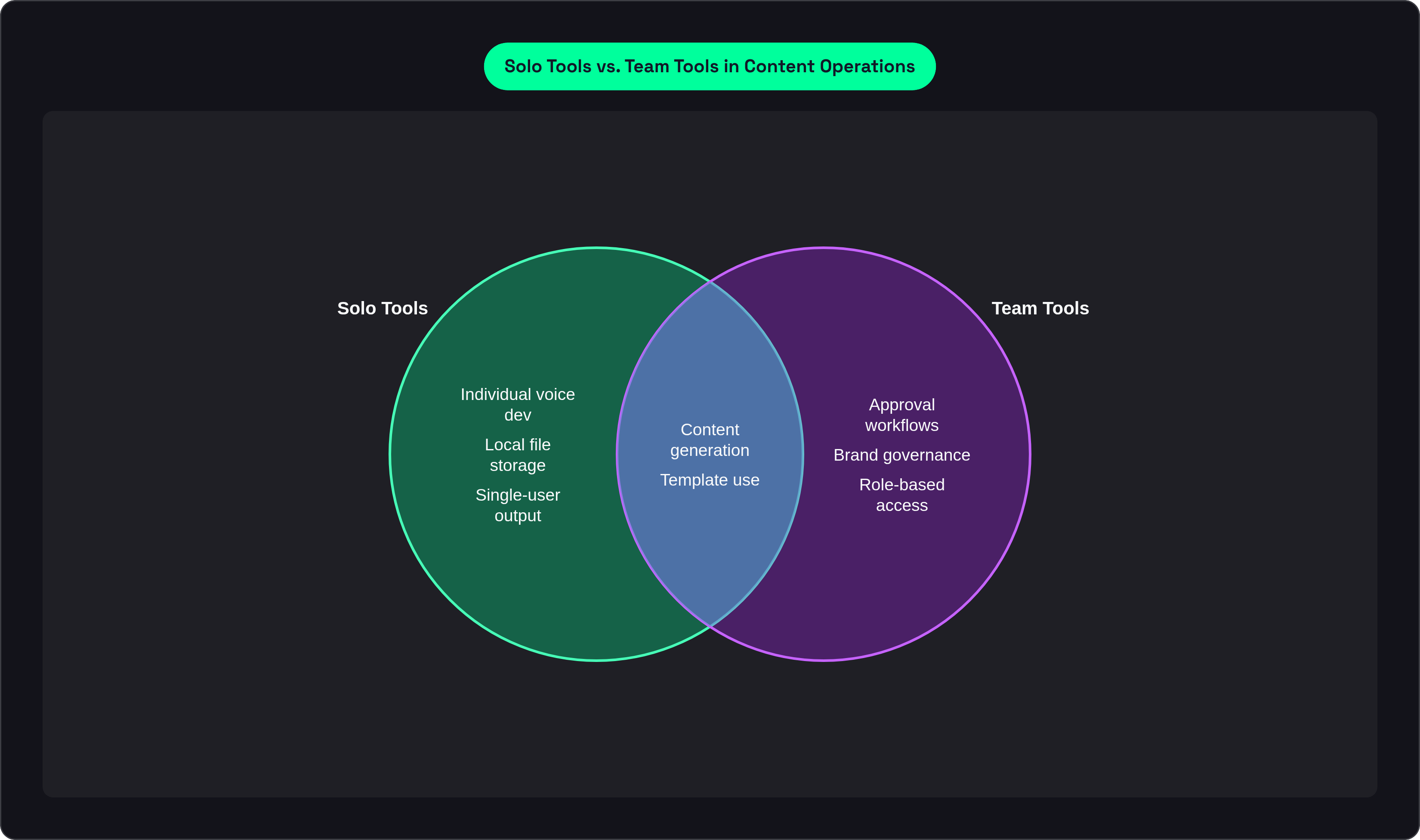
Solo tools let an individual develop and refine their own voice over time. That's fine for one person. Team tools need to enforce an organization's voice across every person who touches content, regardless of role, experience level, or how recently they onboarded. Those are fundamentally different requirements, and conflating them is where a lot of procurement decisions quietly go sideways.
The failure modes follow a predictable sequence. Terminology drifts when different writers make different judgment calls on words the brand has a stated position on. Tone fractures when one team writes conversational copy while another defaults to formal. Outdated messaging circulates because one region hasn't received the updated guidelines yet. None of this is malicious. The information simply isn't embedded in the tool, so the tool can't enforce it.
What brand governance actually requires in software: a living style guide that updates writing suggestions automatically when guidelines change; approved vocabulary and flagged terminology, which matters especially in regulated industries where certain words carry legal exposure; visual brand controls including approved color palettes, locked logo usage, and templates that non-designers can populate without violating brand standards.
Canva Enterprise illustrates what this looks like operationally. Teams using brand-approved templates report reclaiming substantial design hours because the governance layer eliminated the back-and-forth between marketing and design. The mechanism is straightforward: the standard is embedded in the tool rather than maintained in a document someone will or will not consult before hitting publish.
Deviation from the brand standard needs to be structurally difficult, not just discouraged.
Collaboration Infrastructure That Solo Tools Treat as Optional
This is a different problem than approvals. Approvals are about sequencing. Collaboration is about the inability to work on content simultaneously across functions: copy, design, legal, regional teams, external agencies. Most teams are stitching together disconnected systems to handle it, and absorbing the consequences as lost context and duplicated effort.
What team collaboration actually requires is specific. Real-time co-editing with role visibility means the tool needs to know who can comment, who can edit, and who can approve, and it needs to enforce those distinctions rather than leaving them to social convention. Threaded feedback needs to be tied to specific content elements, not attached as general document comments, because one creates accountability and the other creates noise. Internal notes discussing legal exposure or strategic sensitivities shouldn't be visible to external reviewers; tools that don't distinguish between internal and external feedback modes are a liability.
Planable is purpose-built for this workflow. Its structure is organized around the content review cycle: centralized planning, multi-level approvals, real-time commenting. The design assumption is that content moves through people, not that one person produces a finished product in isolation.
The distinction between general collaboration tools and content-specific collaboration matters more than most teams realize until they've already paid for the lesson. Slack and Google Docs are useful. They are not content operations infrastructure. When decisions about content get made in Slack channels rather than inside the content tool, those decisions become invisible to anyone who wasn't in the conversation. Version history doesn't capture them. The asset doesn't reflect them. When something goes wrong six weeks later, nobody can reconstruct what happened or why, and the finger-pointing starts.
Campaign Coordination Across Channels, Formats, and Contributors
A solo creator publishes one piece. A marketing team runs a campaign, which is a different animal entirely. One brief needs to generate blog copy, email sequences, social captions across platforms, paid ad variants, and video scripts, and all of those pieces need to be consistent with each other, formatted for their respective channels, and shipped in a coordinated sequence. That is not a writing problem. It is an orchestration problem.
The failure mode without campaign-level tooling follows a familiar pattern. Each format gets created independently by whoever owns it. Tone diverges because the writer didn't see what the social team was doing. Timing is uncoordinated because there's no single view of production status across contributors. The campaign launches in pieces rather than as a coherent unit, and the strategic message fractures in the execution.
Jasper's Campaigns feature is a useful model for what campaign-level tooling actually does. A single brief generates cross-channel aligned assets, each formatted for its destination, all reflecting the same strategic message. The gap between brief and publish narrows because the tool understands the relationship between assets rather than treating each one as an independent output.
Campaign coordination requires specific capabilities most writing tools don't have: asset relationship tracking so a social post knows it belongs to a campaign; a shared calendar with dependency visibility; multi-format output from a single strategic input; status tracking across contributors and formats simultaneously. Tools like Wrike and CoSchedule are built specifically for this orchestration layer. They are not writing tools with a calendar bolted on.
Digital Asset Management as the Infrastructure Layer Teams Eventually Can't Avoid
Solo creators store files locally or in personal cloud drives. That works until it doesn't. For teams, it never works for long, and the teams that learn this lesson the hard way usually learn it at the worst possible moment, right before a campaign launch or a compliance audit.
A shared, governed, searchable asset repository is the infrastructure layer that everything else depends on. DAM has moved from a creative-team archive into genuine enterprise infrastructure, and organizations that treated it as a later-stage concern tend to pay for that decision in brand governance failures and legal exposure.
What DAM solves that generic file storage doesn't: it prevents the use of expired or unapproved assets, which is a brand governance failure that happens constantly when teams rely on shared drives without version control. It tracks rights and licensing for third-party creative, because using an image after its license expires is a legal problem, not just an operational inconvenience. It provides cross-departmental access with permission tiers, because not everyone should be able to download source files. It enables search and discovery across large asset libraries without requiring someone to have manually tagged everything correctly, which nobody ever does consistently over time.
The connection to governance is direct. Without DAM, brand governance breaks down at the asset level even when writing guidelines are enforced perfectly. A team can produce on-brand copy and attach an off-brand image. The writing tool can't catch that. Only an asset management layer can.
DAM is rarely the first tool a team buys. It is almost always the one they wish they'd bought two years earlier.
Enterprise Security and Compliance Requirements That Change the Procurement Decision Entirely
For teams in regulated industries, healthcare, financial services, government contracting, the content tool procurement decision runs through IT and legal before it ever reaches marketing leadership. SOC 2 Type II certification, single sign-on support, and exportable audit logs now function as baseline requirements. Platforms without them typically fail security review before anyone evaluates the content capabilities.
Writer is the clearest example of a platform built with this in mind. Its compliance certifications include SOC 2 Type II, HIPAA, PCI-DSS, GDPR, ISO 27001, ISO 27701, and ISO 42001. Its positioning is built around enterprise risk governance, not writing speed. That is a deliberate strategic choice reflecting the actual procurement reality for its target market.
For marketing leaders outside regulated industries, the implications still apply. Audit trails matter for accountability. Role-based access control matters for onboarding and offboarding at scale. When someone leaves the organization, their access needs to be revokable and the record of what they approved needs to persist. These are not edge-case concerns; they are baseline requirements for any organization operating at meaningful scale.
Cushman & Wakefield's use of Jasper offers a useful data point here. The company has reported saving over 10,000 hours annually producing compliant, localized marketing content at scale, according to Jasper's published case study. What that result actually demonstrates is that compliance and speed are not mutually exclusive when governance is built into the workflow rather than layered on top after the fact.
A tool that marketing loves but IT won't approve is not a usable tool.
How the Current Platform Landscape Maps to Different Team Configurations
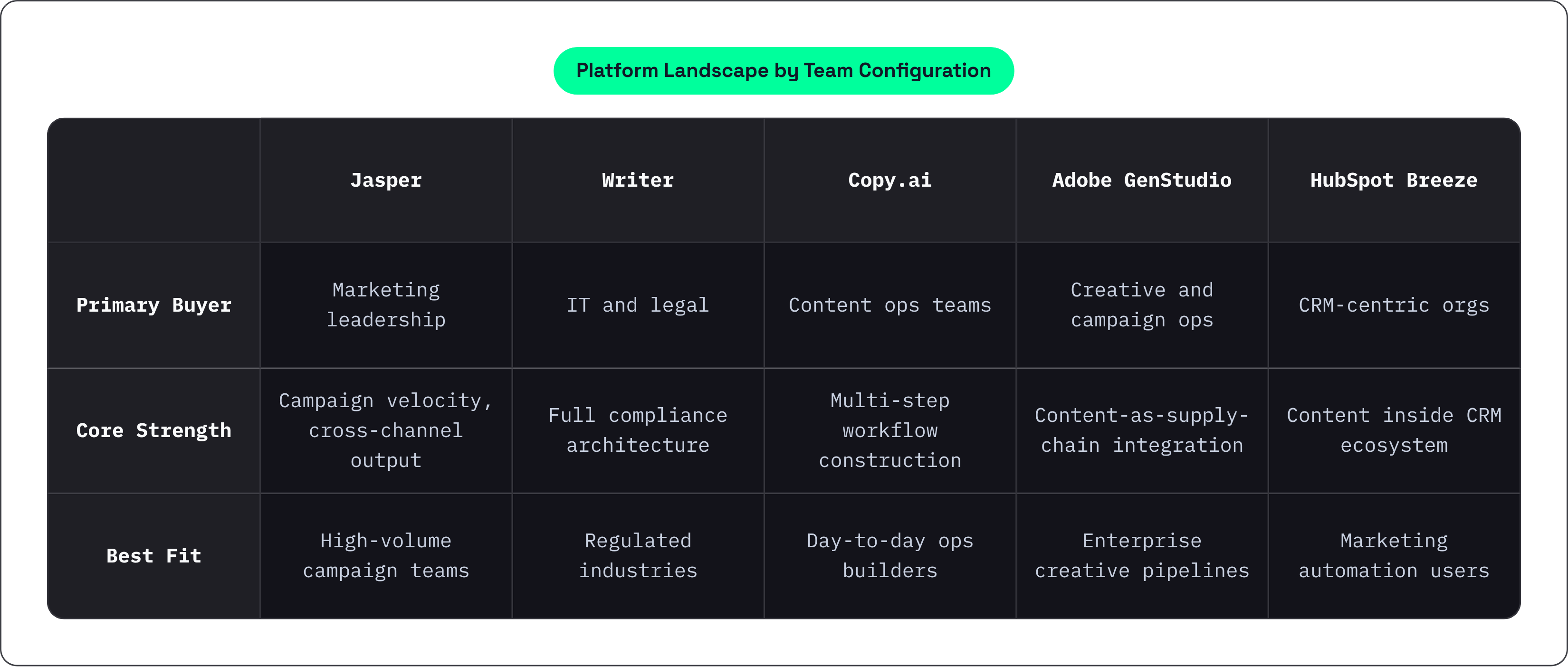
The enterprise AI content field has consolidated around a set of production-grade platforms, each winning on different terrain. One framing circulating among practitioners captures the dynamic well: Jasper is what marketing buys; Writer is what IT approves; Copy.ai is what content operations actually uses day-to-day. That framing is useful because it names something real. The procurement owner and the day-to-day user often diverge, and the right platform depends on which of those perspectives is driving the decision.
For campaign velocity and cross-channel output at scale, Jasper is a prominent choice. For regulated industries requiring full compliance architecture, Writer is a primary contender. For content-ops teams building and maintaining their own multi-step workflows, Copy.ai's workflow construction layer earns the daily usage. For organizations treating content as a supply chain across creative and campaign operations, Adobe GenStudio for Performance Marketing operates at that integration layer. For teams that need content creation embedded inside a full CRM and automation ecosystem, HubSpot Breeze is the natural fit.
Visual and design content runs on a parallel track. Canva Enterprise handles design governance at scale, specifically the problem of non-designers producing on-brand work without pulling a designer into every asset. Synthesia addresses enterprise video without production infrastructure: AI avatars, broad language support, no camera required. Their feature set updates frequently, so verify current capabilities against their product documentation.
The governance and project management layer sits on top of all of the above. Wrike and CoSchedule own campaign orchestration. Planable owns the approval-cycle workflow. Sprinklr has been recognized as a Gartner Magic Quadrant Leader for Content Marketing Platforms; consult the current Gartner report for the most recent evaluation.
The selection framework is not "which tool is best." It is: who owns procurement, what does IT require, what is the primary bottleneck, and which layer of the content operation needs the most structural support.
What to Actually Evaluate When Assessing Whether a Tool Is Built for Teams
The surface-level mistake is evaluating team tools on the same criteria as solo tools: output quality, template count, ease of use. Those criteria are not irrelevant. They are just insufficient. The workflow infrastructure is what actually determines whether a team-grade tool functions as advertised, and most demos are deliberately not designed to surface that.
Five structural questions should anchor any evaluation.
Does the tool support configurable approval workflows, or does review happen outside it? If the answer is outside the tool, you have already identified your future bottleneck before signing anything.
Where does brand governance live? In a document someone will or will not consult, or enforced at the point of generation? One depends on human consistency; the other does not.
Can the tool coordinate assets across a full campaign, or does it produce individual pieces in isolation? The difference between a content tool and a content operations tool is not cosmetic.
Does it meet the organization's security baseline: SSO, audit logs, and any relevant compliance certifications? This question has to be answered first, because everything else is moot if IT says no.
Does it connect to the rest of the stack, including the CRM, the DAM, and the publishing platforms? A tool that creates a new silo has added surface area to the problem rather than reducing it.
The failure in most enterprise AI tool deployments is almost never about writing quality. It is about workflow fit. A tool that generates a draft in seconds but sends the team back to email threads for approvals has solved the easy part and left the hard part intact. Most teams will need more than one tool, which is not a failure of the market but an accurate reflection of how complex content operations actually are. The question is which layer each tool owns and whether those layers connect.