B2B Content Marketing Examples That Actually Drove Pipeline

Content is not a soft channel. Roughly 42% of B2B pipeline originates from content marketing touchpoints, according to research from the Content Marketing Institute. Eighty percent of the B2B buying journey is now self-directed, per Forrester. Buyers are qualifying vendors, disqualifying competitors, and building shortlists through content long before they speak to anyone in sales. By the time a buyer reaches out, they've typically consumed three to seven pieces of content, according to data from Demand Gen Report. The conversation that follows is less a discovery call and more a confirmation.
SEO ROI averages 702% over three years, according to a study by Terakeet. Content generates leads at roughly three times the rate of traditional marketing, per DemandMetric, and those effects persist long after the initial spend. But those numbers belong to programs built around buyer intent and sales alignment, not to programs that publish consistently and hope something compounds.
The pipeline benefit isn't confined to top of funnel. Deals that engage with marketing content during the sales cycle close 23% faster, according to Aberdeen Group research. That's a conversion outcome, not an awareness outcome. Content influencing deals already in motion is doing something categorically different from content designed to generate impressions, and most content programs are only built for the latter.
The structural pattern that separates pipeline-driving content from content that merely exists
Every example worth examining reveals the same structural decisions, made deliberately, before a single word was written.
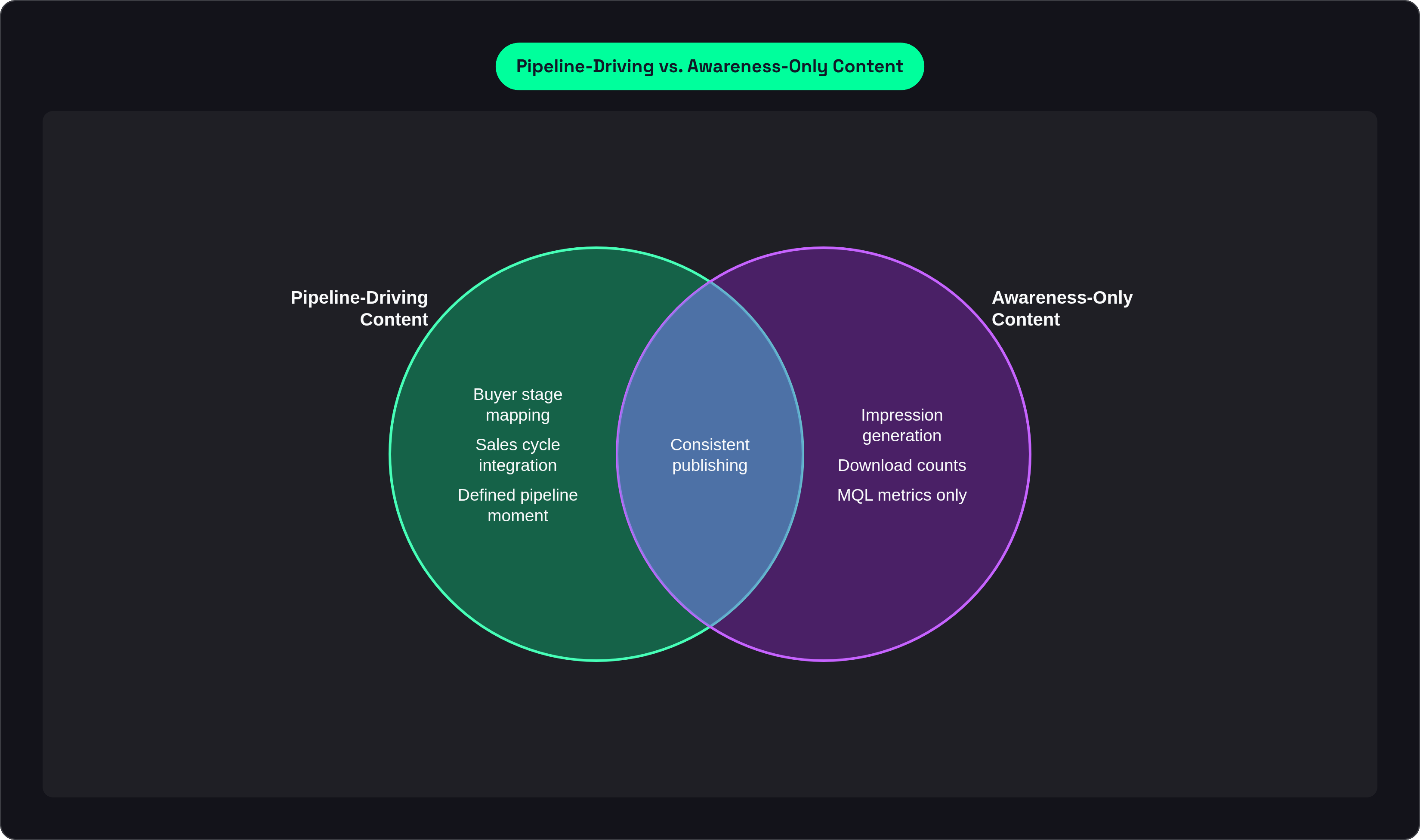
The starting point is content mapped to buyer stage, not just to topic. This isn't about keyword categories or topic clusters. It's about intent: what is this person actually trying to resolve right now? Most programs get this partially right. They publish content organized by topic. Far fewer publish content organized around the specific questions a buyer asks when evaluating a category for the first time versus when they're comparing two finalists on a shortlist. Those are different questions requiring fundamentally different answers, and conflating them is where most programs lose the thread.
Sales alignment is the second structural decision, but not in the passive sense of making content available to reps. The content itself has to enter sales conversations naturally. Reps find it, share it, and reference it without an awkward pivot. This is where most programs stall. Content stays in marketing's lane, generating downloads and MQL counts that never translate to conversations sales actually cares about.
The third decision is a defined pipeline moment built into the content itself before production begins. A demo request. A trial. An event registration. Something specific the content is designed to drive, not a vague hope that awareness eventually compounds into revenue.
Most programs have the first element. Very few have all three operating simultaneously. When they do, content influences multiple buyer stages, enters active sales cycles, and shortens the distance from first engagement to closed revenue.
How Gong built a content moat by turning its product data into original research
Gong Labs didn't invent a content format. It operationalized an unfair advantage.
Gong had access to millions of recorded and analyzed sales calls. Instead of keeping those findings internal, they published them: talk-to-listen ratios, pricing phrases that close deals, how top performers handle objections in the final two minutes of a call. Data that sales leaders couldn't find anywhere else, because no one else had it.
The logic held together cleanly. The research was difficult to replicate, so competitors couldn't easily publish the same findings. The content was credible because it was empirical rather than advisory, which positioned Gong as an authoritative voice in the exact problem space their buyers inhabited. And the findings became conversation starters. A Gong rep could share a Gong Labs study as a genuinely useful insight without it reading as a product pitch. The content was doing sales work without announcing itself as sales content.
"Reveal: The Revenue Intelligence Podcast" extended the same positioning into audio, targeting senior sales leaders with the same data-backed framing. The mechanism compounded: earned backlinks from authoritative sources, brand authority with a specific buyer persona, and content that lived inside sales cycles rather than only above them.
The decision that actually mattered was the choice to publish proprietary knowledge rather than hoard it. Any company with meaningful product data, customer outcomes, or industry interaction at scale has the raw material for this. The question is whether to treat that knowledge as something to protect or something to deploy.
How Salesforce turned community and events into measurable pipeline infrastructure
Most companies treat events as awareness plays and measure them in attendance and brand lift. Salesforce measures pipeline registered, pipeline in the room, and incremental pipeline generated after the event. That difference in measurement philosophy produces a fundamentally different event strategy.
The Salesblazer content hub, built for sales professionals rather than Salesforce customers specifically, generated 3.2 million social impressions, 102,000 social engagements, more than 45,000 newsletter subscribers, and over 230,000 community platform members, according to Salesforce's published reporting. Those numbers matter not as vanity metrics but as proxies for repeated buyer engagement. Community content, whether Trailhead badges, peer discussions, or event participation, creates touchpoints over time. Each touchpoint signals sustained investment in the product category, and that signal feeds sales intelligence in ways that one-time form fills never do.
The "Dreamforce to You" virtual campaign, run during COVID with free registration, brought in over one million registrants and helped increase sales pipeline by 50%, according to Salesforce's published reporting. Free access removed the barrier that would have capped reach at existing customers and high-intent prospects only. The reach itself became the infrastructure.
The underlying principle is that pipeline measurement begins with defining what "engaged" actually looks like beyond a form fill. Salesforce measured badges earned, events attended, community posts, and pipeline touched. That's a richer signal set than download counts, and it produces more accurate, better-timed sales handoffs.
How HubSpot and ZoomInfo used original research reports as lead generation engines
HubSpot's "State of Marketing" report generated over 11,000 leads in two weeks, per HubSpot's own case reporting. ZoomInfo's "Big Book of Sales and Marketing Metrics" generated over 5,000 leads in three weeks, per ZoomInfo's published results. Both used multi-channel promotion, social, email, and paid launched simultaneously, not organic first with paid as a delayed afterthought.
What made these work wasn't production quality or promotion budget. Both reports answered a question their buyers were already sitting with before they encountered the content. Not a question the company wanted to answer. Not a topic adjacent to the product. The actual question the buyer was trying to resolve. That alignment means the content reaches buyers at the moment it's most relevant, which is also the moment they're most likely to take a next step.
Both assets also gave sales teams something to reference as evidence of expertise, not just something to forward as a download. A sales rep who can cite a data point from a report their company published is demonstrating category authority in the conversation itself, not just before it.
A legitimate limitation here: lead volume is the reported metric, not conversion to pipeline. Lead volume from a research report tells you the offer was well-matched to buyer demand. It doesn't tell you how many of those leads became opportunities. Programs that track the full path will learn considerably more, and they'll know whether to run this play again or revise it.
What Blue Triangle's ungating decision reveals about the relationship between access and pipeline
Blue Triangle ungated all of their content and implemented a five-stage behavioral progression model: first engagement, repeat engagement from the same company, active assessment tracked through visits to high-intent pages like features and demos, demo request, and then proof of concept to close. The results, as reported by Blue Triangle, were a 265% year-over-year increase in demo requests, 242% pipeline growth, and marketing-sourced revenue up 41 times.
The lesson isn't that gating is wrong. Form fills are simply a poor proxy for pipeline readiness. Blue Triangle replaced form completion with behavioral signals: companies returning to the site, companies visiting pricing and features pages, companies spending meaningful time with technical content. Those signals gave sales far better timing and context for outreach than a form fill on a whitepaper ever could.
Gated content conversion rates have dropped substantially since 2018, according to research by Demand Gen Report. Gated content is also cited less frequently by AI-powered search engines, creating a discoverability risk that didn't exist a few years ago. The practical framework that emerges from this: ungate top-of-funnel content to maximize reach and AI discoverability; gate mid- and bottom-of-funnel assets where the buyer genuinely expects and values dense, proprietary information. Gated assets still convert meaningfully better than ungated ones when a buyer is already in evaluation mode. Gating is a stage decision, not a default policy.
Blue Triangle's real contribution to this conversation is the reframe. The goal of content is not the form fill. It's the sales conversation at the right moment, with the right context, for both parties.
Why thought leadership has an outsized effect on deals that are already in progress
More than 40% of B2B deals stall due to internal misalignment, according to Gartner research. The people slowing those deals down are often not the people sales is talking to. They are hidden buyers: executives, finance stakeholders, legal teams, department heads who carry influence over the final decision but who sales will never directly reach.
The 2025 Edelman–LinkedIn B2B Thought Leadership Impact Report, drawing from nearly 1,934 global business executives, puts numbers to this dynamic. Sixty-three percent of hidden buyers spend more than an hour per week consuming thought leadership. Ninety-five percent say strong thought leadership makes them more receptive to sales and marketing outreach. Seventy-nine percent say they're more likely to advocate for a vendor's proposal in an RFP process if that vendor consistently produces high-quality thought leadership. Fifty-one percent say it helps them convince C-level executives internally.
That last figure is worth sitting with. Thought leadership reaches rooms the vendor will never enter. It equips advocates inside the buying organization with arguments and credibility they can deploy on the vendor's behalf, reducing internal friction that no sales rep could address directly.
The competitive displacement angle matters equally. According to the same Edelman–LinkedIn report, a significant share of C-suite executives report that thought leadership led them to reconsider their current vendor relationship, meaning this content is reaching buyers who weren't actively searching. Content designed for that audience requires different questions, different formats, and different distribution than content designed for buyers already evaluating you. Most programs conflate the two and then wonder why thought leadership doesn't convert.
Which content formats and channels are actually driving pipeline in 2024–2025
Short-form video delivers the highest ROI of any format according to HubSpot's 2025 State of Marketing Report, with 49% of marketers reporting their best returns there. The necessary qualifier: ROI in that context isn't always pipeline. Format-level ROI data needs to be interpreted against specific pipeline stages before it drives production decisions, or you'll optimize for engagement metrics that have no relationship to revenue.
Case studies serve a genuinely dual function. Used by 75% of B2B marketers according to CMI's 2025 B2B Content Marketing Report, they rank for commercial-intent keywords while simultaneously equipping sales with proof points for specific objections. The ones that do both well share a consistent structure: quantified results with ARR impact, time-to-value, or conversion lift; direct client quotes that address the objection rather than just celebrate the outcome; an explicit connection between the result and the specific product feature that produced it. One case study per quarter per key vertical gives sales a continuously updated evidence base.
Pillar pages with ten or more supporting cluster articles generate 3.4 times more organic traffic than standalone long-form posts, according to HubSpot research. Webinars carry an 18% average attendance rate and convert 23% of attendees to MQLs within 30 days, per ON24's webinar benchmarks, a conversion rate that reflects the format's structural advantage: a live, scheduled engagement that functions as a natural pipeline handoff.
On channels: in-person events and webinars rank as the most effective distribution channels for B2B in 2025, per CMI's 2025 B2B Content Marketing Report. LinkedIn delivers the best value of any social platform, with 84% of marketers saying so, per the same report. Website, blog, and SEO remain the highest-ROI channels overall. Omnichannel campaigns generate 287% more pipeline than single-channel approaches, according to research by Omnisend. The format mix matters less than the channel coordination.
The practical decision rule: choose the format that serves the buyer stage and the pipeline moment, not the format with the best benchmark numbers.
The production and strategy decisions that determine whether good content actually reaches pipeline
The gap between content that drives pipeline and content that doesn't is almost never a creativity problem. It's a strategy and production problem, and the distinction matters because one is fixable with process and the other tempts people into spending on talent they don't actually need.
Pipeline-driving content starts with the buyer question, not the brand message. It's mapped to a specific stage and a specific next action before production begins. Sales is involved in the brief, not delivered the finished asset after the fact. When sales shapes the brief, the content is more likely to enter sales conversations naturally, because it was built around the questions reps actually hear, not the questions marketing assumes they hear.
Speed is an underrated competitive variable. Gong published sales performance data while competitors were still aggregating conventional advice. HubSpot launched its research report before the annual benchmark window closed. Being first with a credible answer is often more valuable than being more thorough, later.
The production decisions that consistently appear across these examples: define the pipeline moment before defining the format; build content in formats that can be repurposed across channels without losing the core argument; treat gating as a stage decision; measure engagement signals that predict pipeline, including repeat visits, high-intent page views, and content shared inside sales cycles, rather than downloads alone.
One measurement reality that distorts budget decisions more than almost anything else: first-touch attribution shows that content initiates a significant majority of buyer journeys, but last touch rarely belongs to content. Programs that measure only last touch will systematically undervalue content's pipeline contribution and cut budgets accordingly. The Gong Labs archive, the Salesblazer community, the HubSpot research library, all of these are still influencing deals years after publication. That compounding effect is only visible to teams measuring the full buyer path, and most teams aren't.