Quarterly Content Planning for Marketing Teams
How documenting quarterly goals keeps content teams focused on outcomes, not just output.

CMI's benchmark research has documented a persistent gap between top-performing B2B content organizations and the rest. The largest predictor of that gap is not budget, team size, or access to talent. It is whether the team has a documented content strategy.
I've watched this play out repeatedly, and it's never subtle. Without documentation, goals live in someone's head or in a slide deck opened once and never touched again. Individual pieces get justified on their own merits rather than as components of anything coherent. Teams find it nearly impossible to decline ad hoc requests because there's nothing written down to point to. Every new ask looks equally valid when nothing has been committed to paper. The team that was supposed to be building a pipeline-generating content engine ends up executing someone's LinkedIn post idea because nobody could articulate why that wasn't the priority.
The deeper problem is goal clarity. Among B2B marketers who rate their own content strategy as ineffective, a substantial share cite the absence of clear goals. Vague objectives like "publish more content" or "grow our audience" cannot be decomposed into quarterly milestones, assigned, tracked, or evaluated. Quarterly planning forces a specific kind of reckoning: not what do we eventually want, but what does success look like in the next ninety days.
The process described here is built to produce documentation as its primary output, not as an administrative afterthought.
Setting Quarterly Goals That Are Actually Usable
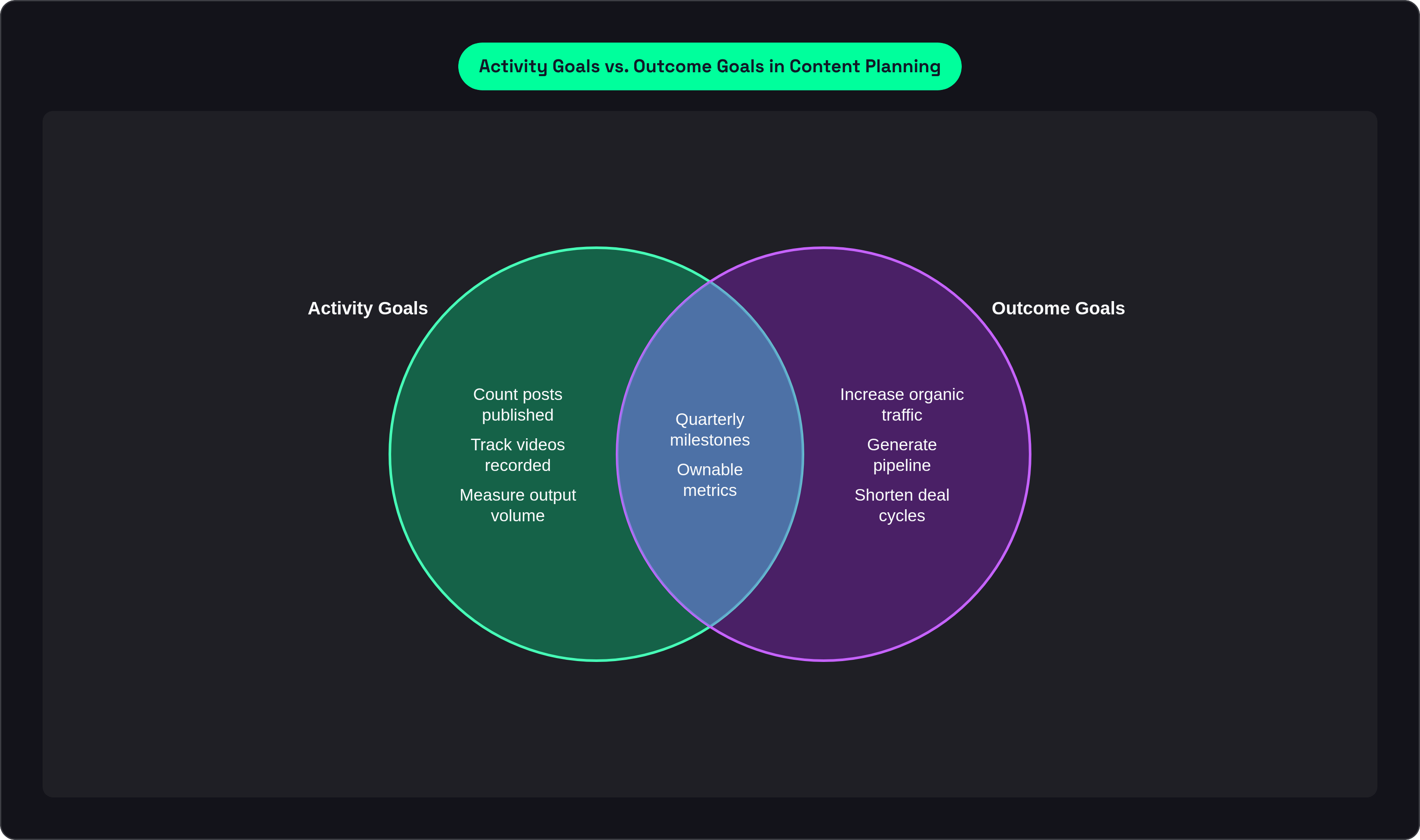
Most teams conflate activity goals with outcome goals, and that conflation is where quarterly planning quietly breaks down. Activity goals count what you produce: publish a certain number of posts, record a certain number of videos. Outcome goals describe what those assets are supposed to accomplish: increase organic traffic to a product category page, generate pipeline from a new market segment, help sales shorten deal cycles. Planning built around activity goals drifts toward output for its own sake. Volume accumulates; impact stays murky.
Keep the goal count tight. Three to five specific goals per quarter is about right. Fewer than three and the quarter lacks coherence. Push past five and nobody can hold them in view during the Tuesday editorial meeting when a real decision needs to be made. Each goal should be ownable by one person and reviewable, without ambiguity, at quarter's end.
One of the most persistent failure modes in content goal-setting is isolation: the goals belong entirely to the content team with no explicit connection to sales targets, product launches, or customer retention objectives. This is how content teams become invisible to leadership. The corrective is to map at least one content goal per quarter to a company-level priority, because that is what earns content a seat in broader business conversations and what makes content teams legible to leadership as a commercial function rather than a creative one. It sounds obvious. Most teams still don't do it.
Persona review belongs in this part of the process too. Audience assumptions from six months ago do not always reflect what buyers actually care about today. High-performing teams treat persona review as a quarterly ritual, revisiting key audiences before locking themes, rather than relying on a document written during a product launch eighteen months prior. The market moves. Your personas should move with it.
How to Run the Quarterly Planning Session Itself
The planning session is a single focused meeting, roughly an hour, held before the quarter begins. Its purpose is not to produce a finished calendar. It is to establish agreement on priorities, themes, and proof points, and to generate a shared document the team can execute against immediately. The calendar comes after.
Who belongs in the room: marketing leads who own production and editorial quality; subject-matter experts who contribute direction once per quarter and are not expected to stay engaged through production; and, if you can get them, representatives from sales or customer success who can surface what questions and objections are live in the market right now. That last group is chronically underused. I've never been in a planning session where a sales rep's input didn't reframe at least one content priority. They have direct, unfiltered access to the conversations your content is supposed to influence, and yet most content teams plan in a room without them.
The session follows a sequence. Start with a review of the prior quarter: what performed, what didn't, what work remains unfinished or underutilized. Then confirm or revise quarterly goals in light of current business context. Then select three to five content themes tied to revenue priorities, product launches, customer questions, or active industry conversations. After that, assign planned content to funnel-stage buckets, a structural move that prevents teams from over-indexing on top-of-funnel awareness content at the expense of sales enablement, comparison assets, and retention-focused material. Close by identifying existing content that should be updated or repurposed rather than replaced.
What the session does not try to do matters as much as what it does. It does not produce a fully scheduled calendar, and subject-matter experts are not asked to write anything. Their job in the room is to provide direction and proof points. Production comes later. This is exactly what makes it possible to get senior people to show up; they're not signing up for a production commitment, just a conversation.
Turning Session Output into a Working Content Calendar
The calendar is not a rigid schedule. It is a shared view of what's planned, who owns it, and what it is meant to accomplish. Its value is keeping individual pieces connected to the themes and goals established in the planning session. Without that connection, the calendar degrades into a to-do list, and pieces drift back toward being justified individually rather than as part of anything coherent.
The fields a calendar actually needs: working title, content type, target audience, business goal, channel, owner, deadline, publish date, status, and call to action. Optional additions include keyword target, funnel stage, repurposing plan, and campaign name. The governing principle is that the core fields should be light enough that someone updates them every single week without dreading it. An unused calendar is worse than no calendar, because it creates the illusion of organization while providing none of its benefits.
Planning buckets impose structural discipline. Without them, teams default to top-of-funnel content almost by gravity. Awareness posts are easier to ideate, easier to approve, and easier to measure via vanity metrics. The buckets force a periodic accounting: how much of what we're producing serves demand generation, how much serves active sales conversations, how much builds brand authority over time, how much supports customers who already bought?
Reserve roughly a fifth to a third of the calendar for reactive content. This buffer handles news events, customer questions, and emerging opportunities without derailing planned campaigns. It also prevents a quarterly plan from making a team too rigid to respond when something worth responding to actually surfaces.
Lock detail in a rolling two-to-four-week window. The remainder of the quarter stays at the theme level, which preserves the team's ability to adjust as campaign results come in and priorities shift, without requiring a full replanning session every time something changes.
Where SEO and Channel Decisions Fit into the Quarterly Plan
When SEO and paid search plan independently, they produce redundant work and send inconsistent signals. The audience does not separate channels when they evaluate a brand. They encounter it across multiple touchpoints, and when those touchpoints carry different messages because different teams optimized toward different targets, the cumulative effect is diminished trust and diluted impact. This is a coordination problem, not a talent problem, and quarterly planning is the mechanism that solves it.
Integrated quarterly planning resolves most of this friction. Paid search performance reveals which themes and messages actually convert; that intelligence should inform organic content priorities. Organic keyword data identifies terms worth bidding on before competition drives up the cost. Budget allocation across channels should be tied to the same quarterly goals, not separate team-level targets that happen to coexist in the same department.
Each quarterly theme can anchor a content cluster: a pillar page supported by subordinate pieces that collectively build topical authority. Three months is enough time to produce both the pillar and several supporting pieces, which makes the quarterly rhythm well-suited to cluster development. Revisit pillar pages at the end of each quarter, adding internal links to cluster content published during the period, incorporating new data, and addressing gaps the quarter's production revealed.
Format decisions belong in the planning session, not as an afterthought when deadlines are already close. Short-form video, email sequences, webinars, and original research each carry different lead times, and those lead times need to shape the calendar from the start. A webinar requiring six weeks of preparation cannot be planned four weeks before the desired date without sacrificing quality or manufacturing a crisis.
Repurposing as a Built-In Quarterly Multiplier, Not an Afterthought
A single piece of cornerstone content, whether a webinar, an original research report, or a long-form guide, can generate multiple derivative assets across formats and channels. The expensive inputs are the research, the expert time, and the strategic thinking. Reformatting and redistribution are comparatively cheap. Teams that discover repurposing opportunities after publication capture some of that value. Teams that plan repurposing before production capture most of it.
The difference shows up earlier than most people expect. When a webinar is planned with the assumption that it will become a written summary, a clip series, and a lead magnet, that expectation changes how the webinar is built and recorded. Segments are cleaner. Key points are stated explicitly rather than buried in conversational asides. The recording setup accounts for how clips will be cropped. None of that is recoverable after the fact. I've been in the edit bay trying to extract usable clips from a recording that was never designed to be clipped, and it's a particular kind of misery that is entirely avoidable.
Most B2B content teams are small, often just a few people carrying the full production load. Planned repurposing is how small teams produce credible volume without sacrificing depth or burning out. It is not a shortcut. It is a structural acknowledgment that the most valuable thing a content team produces is insight and argument, and that insight can be expressed across multiple formats without being diluted.
Pillar page updates are the quarterly expression of this logic for SEO. Use the close of each quarter to refresh them: add internal links to cluster content published during the period, update examples, incorporate new data points, address gaps identified through search performance. This compounds authority over time without requiring net-new content production at every turn.
How AI Fits into a Quarterly Planning Process Without Replacing the Strategy
The vast majority of content marketers now use AI tools in some capacity. The most commonly reported benefits are time savings and workflow efficiency, not strategic improvement. Teams that deploy AI without a strategic framework risk increasing output volume while content quality and differentiation quietly decline, and because the volume increase is visible and the quality decline is gradual, many teams don't notice until they're producing a lot of content that isn't doing much.
AI earns its place in quarterly workflows in bounded, specific ways. For research and synthesis, it is useful for surfacing what has already been covered and identifying gaps in existing content. For production, it accelerates drafting and reformatting of derivative pieces within a planned repurposing workflow. For optimization, it supports keyword application, headline testing, and updating older content at scale. These are real contributions to execution velocity.
What AI does not replace is the planning session itself. Goal-setting, theme selection, and the integration of expert perspective still require human judgment, specifically the kind of judgment that comes from understanding the business context, the sales pipeline, the customer relationships, and the strategic bets the organization is making. A language model can draft a content brief efficiently. It cannot tell you which three themes will move the needle for your specific audience over the next ninety days, because it does not know what your sales team heard on calls last week or which competitor just shifted their positioning.
The measurement gap is worth addressing directly. A large share of content marketers who use AI tools regularly do not track whether that use is actually improving outcomes. Organizations that close this gap, tracking AI-specific performance indicators alongside general content metrics, report better content ROI. The quarterly review is the natural checkpoint: is the content produced with AI assistance performing differently than what was produced before, and in which direction?
The Mid-Quarter Check-In and What It's Actually For
A plan without a review cadence drifts. Daily urgencies are real, and without a scheduled checkpoint, the quarterly plan gets quietly set aside in favor of whatever is pressing today. By the time a team recognizes that a theme isn't resonating or a campaign is behind pace, the quarter does not always have enough runway left to course-correct.
The mid-quarter check-in is not a replanning session. It is a calibration. Cover performance against quarterly goals first: are the leading indicators moving in the right direction, and if not, is the problem execution or the goals themselves? Then calendar health: what's on track, what's slipping, and whether the flexible buffer is being used for genuine strategic responses or simply absorbed by reactive noise. Then theme relevance: have market conditions, competitor moves, or internal priorities shifted meaningfully since the planning session? Finally, resource reality: is the team carrying a sustainable load through to quarter-end, or is burnout being quietly priced into the plan?
Two review cadences work well in practice. Monthly reviews for minor calibration, focused on calendar health and leading indicators. The deeper quarterly retrospective feeds directly into the next planning session, covering what worked, what didn't, what the data actually showed, and what that implies for the next quarter's goals and themes. The plan generates data. The data informs the review. The review improves the next plan. Get this loop running and it compounds in ways that no single great quarter ever could on its own.
Sources
- https://databox.com/quarterly-planning-best-practices
Supported the discussion of breaking vague objectives into trackable quarterly milestones.
- https://penmo.co/build-a-quarterly-content-marketing-plan-that-drives-growth/
Informed the framing of content teams as builders of a pipeline-generating engine rather than executors of ad hoc requests.
- https://www.contentpod.co/blog/content-calendar-planning-marketing-practical-guide/
Contributed to the point about teams lacking written documentation to push back on ad hoc requests.
- https://www.silverbackstrategies.com/blog/quarterly-plan-seo-sem/
Provided the basis for the section on SEO and paid search planning independently and producing redundant, inconsistent work.
- https://www.atlassian.com/work-management/strategic-planning/quarterly-planning
Supported the framing of quarterly planning as a ninety-day horizon for defining what success looks like.
- https://seoprofy.com/blog/content-marketing-statistics/
Provided the statistic about B2B marketers with ineffective content strategies citing the absence of clear goals.
- https://contengi.com/blog/the-state-of-content-marketing-2026-mother-of-reports
Supplied the benchmark research documenting the gap between top-performing and average B2B content organizations.