Content Briefs That Produce First-Draft Quality
A strong brief tells writers what to think, not just what to write about.

A good content brief tells the writer what to think. That's the entire difference between a draft you edit and a draft you rebuild, and most teams never quite figure out which one they're getting until it's too late to fix cheaply.
Here's the diagnosis most teams reach for when a draft comes back weak: the writer wasn't skilled enough, or the AI tool hallucinated its way into mush. Convenient theory, usually wrong. The real cause sits upstream, in the brief itself, because when context goes missing, somebody has to invent it, and both writers and language models fill gaps with guesses. Guess wrong on angle, audience, or tone, and the draft doesn't need trimming. It needs a new foundation.
That distinction between editing and rethinking is the one worth sitting with for a second. Editing is cheap: swap a stat, tighten a transition, cut the paragraph that's doing nothing. Rethinking means the structure was wrong from the start, the argument missed the reader entirely, and somebody now has to open a blank document and start over. Orbit Media's 2025 survey of 808 content marketers found AI adoption in content workflows jumped from 65% to 95% in two years. More drafts than ever are coming out of briefs, so brief quality stopped being a nice-to-have somewhere in there, and I'd argue it's now the single highest-leverage variable in the whole pipeline.
What separates a real content brief from a topic summary
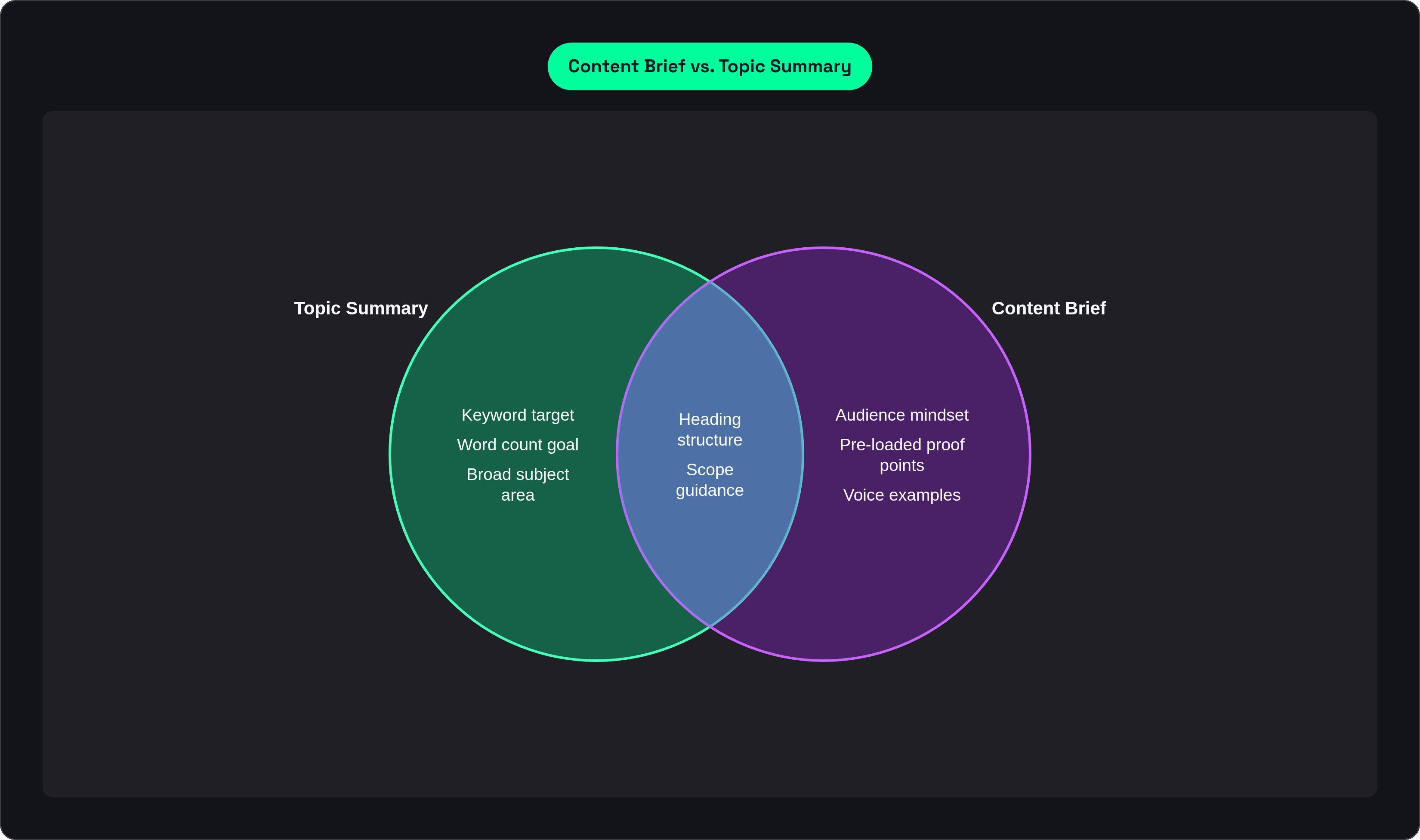
A topic summary sounds like this: write about email deliverability for our audience, target the keyword "email spam filters," aim for 1,200 words. That's an assignment describing what to type about, with little thought given to what the writer should actually think through.
A real brief answers the questions a writer would otherwise resolve alone, halfway through drafting, usually badly. What's the specific angle, and why does it deserve space next to what already ranks? Who's actually reading this, and what do they believe walking in? What proof does the piece need to carry so it's not just asserting things into the void? What keeps the draft from wandering, on voice, on format, on scope?
Worth separating this from a creative brief, too, since people conflate the two constantly. A creative brief covers a campaign, pulls in designers and developers, spans multiple deliverables across weeks. A content brief governs one piece and goes deep on editorial mechanics: keywords, heading structure, word count, sourcing. Per WG Content, that's the practical line between the two documents, and confusing them is how a single blog post ends up saddled with a brief built for a quarterly campaign.
The brief functions as connective tissue: it's where a strategist's thinking gets handed off without a meeting or three rounds of clarifying Slack messages. Per Contentoo, 82.7% of content marketers already work from some form of brief. The more interesting number is the other slice: roughly one in six who don't, and they're not skipping the step for free. They're paying for it later, at the draft stage, where fixing a wrong assumption costs far more than writing it down up front would have.
The audience context that a writer cannot safely assume
Most briefs describe an audience like a mailing label: "marketing managers," "SMB founders." That's a category, and categories don't read articles. People do, and people are messier than labels.
What a writer needs is the reader's mindset at the moment of reading. Frustrated and troubleshooting? Skeptical and comparison-shopping three vendors in open tabs? Early-stage curious, barely aware the problem even has a name yet? It's also worth knowing what the reader already believes, so the draft doesn't spend three paragraphs re-explaining something they walked in already understanding. Where they sit in the buying journey matters too, discovering the problem versus weighing solutions versus halfway to a purchase order. And the words they'd actually type into a search bar matter more than the vendor's internal vocabulary; someone typing "my emails keep going to spam" isn't thinking in terms of "sender reputation optimization," and never will.
Skip all that, and a writer defaults to the median reader, and that reader doesn't exist anywhere outside a spreadsheet. Writing for everyone in general is a reliable way to satisfy no one in particular.
The fix requires actually sitting with the reader for a minute instead of copying a persona doc from 2022. A two- or three-sentence portrait describing a situation, not a job title, does more work than a paragraph of demographic detail. Compare "marketing managers at mid-market SaaS companies" against "a content manager who just watched a campaign miss its traffic goal and is now wondering whether the brief or the writer was the actual problem." Read those back to back, and the second one hands you a scene, a stake, an emotional register, and it tells the writer what to lead with, what to lean into, and what to leave out entirely.
Angle and differentiation: the brief element that most teams skip
A brief can nail the audience section and still produce a draft that reads like it got assembled from the top five Google results with the serial numbers filed off. That happens when nobody bothers to specify the angle, and it happens constantly.
Angle means the specific claim or vantage point this piece takes, distinct from whatever's already sitting on page one. The failure mode looks harmless on paper: brief says "cover topic X comprehensively," writer reads that as license to summarize everything the competition already said, just rearranged into new paragraph breaks. The result is competent, and it's also invisible, because it offers the reader nothing they couldn't get from the search results they already scrolled past ten minutes ago.
A useful angle answers one blunt question: what does someone who's already read the top three results get here that they didn't get there? Answering that honestly requires actual SERP analysis in the brief, not vibes and a hunch. Per RankDraft, the practice is to name what currently ranks, name the recurring pattern across those pieces, then name the specific gap this piece fills. A named hole, not a vague promise to "be better" or "add more value," whatever that means.
Here's the part people underrate: angle isn't a headline flourish bolted on after the draft's basically done. It decides which sections exist at all, which examples make the cut, which get cut on sight before anyone wastes time writing them. A brief format that works well pairs one or two sentences stating the angle with two or three "quality injection points," things like a counterintuitive observation, a named example, a specific claim the piece has to hit somewhere in the body. Skip that layer and AI-generated drafts get exposed fast, because a model has no innate sense of a brand's point of view. It can summarize the internet all day, but it cannot tell you what your company believes that the internet doesn't already say, because that belief lives in your team's heads, not in its training data.
Pre-loading proof points so the writer doesn't have to hunt for them
Leave proof points out of the brief and one of two things happens. Either the writer goes hunting and comes back with a weaker, generic substitute (the kind of stat that's been recycled across five hundred blog posts since roughly 2019), or the writer skips evidence entirely and the piece just asserts things, which reads fine right up until a skeptical reader asks where that number came from.
Pre-loaded research covers a few categories worth naming separately. Specific data, sourced by name rather than vaguely gestured at. Internal assets: customer quotes, proprietary numbers, case study specifics, the subject-matter-expert insight that lives in someone's head or a half-finished Notion doc, not anywhere on the open internet. External sources, meaning third-party studies that actually back the angle instead of just decorating it. And named examples or analogies that make the abstract point land somewhere solid.
That internal category is the one no tool replaces. An AI model has no access to your customer interview transcripts, your lost-deal notes, or the reasoning your leadership team used to reposition the product last spring after that one bad quarter. This context lives inside the company, and if it doesn't make it into the brief, it doesn't make it into the draft. It just evaporates somewhere between the strategy meeting and the Google Doc.
Per MarketMuse, writers working from briefs with proof points already loaded spend meaningfully less time on supplemental research, and editors spend less time afterward patching copy that's thin on evidence. There's a quieter benefit too. Building the proof-point list forces the strategist to find good evidence before the brief ships, which sometimes reveals, a little uncomfortably, that the angle wasn't supportable in the first place. Learning that at the brief stage beats learning it after hundreds of words are already sunk into it.
Voice, tone, and constraints that prevent the rewrite conversation
Ask any editor what triggers the most rework and the answer usually isn't wrong facts. It's correct information delivered in the wrong voice, which is a subtler and frankly more annoying problem to fix, because the writer technically did what was asked of them.
The trouble starts with vague directives. "Professional but approachable." "Conversational but authoritative." Five writers reading the same instruction produce five different voices, and none of them quite match, because adjectives like that mean something slightly different inside each writer's head. Adjectives don't transfer tone; examples do.
What actually works: two or three links to existing pieces that already sound right, paired with a sentence or two of direct contrast, what this sounds like versus what it very much doesn't. Stack explicit terminology preferences on top of that: words the brand actually uses, jargon to avoid, phrases that are flatly off-limits regardless of how tempting they are. Constraints matter just as much on the other side of the ledger, meaning what the piece shouldn't do: common mistakes in the topic area to sidestep, competitor claims not worth repeating or amplifying, angles that are technically true but off-strategy for this particular brand to be the one saying out loud.
For AI-generated drafts, this layer carries even more weight than it does for human writers, since a model carries no memory of brand voice between sessions. Whatever's sitting in the brief is the entire brand context it has to work with; there's no accumulated instinct underneath it to fall back on. Teams that standardize voice documentation across briefs see the payoff show up in consistency scores. Per NNG, cited via RankDraft, teams running a standardized brief process produced content with roughly 40% less variance in quality scores than teams whose format shifted depending on who happened to write it that week. Treat that figure as directional rather than gospel; the logic underneath it holds regardless of the exact number, since unpredictable inputs reliably produce unpredictable output.
Outline structure: enough direction to prevent guessing, enough flexibility to allow writing
An outline in a brief functions as scaffolding. It shows the shape of the argument without locking every detail into place before the writer's even opened the document.
A useful outline includes the H1, the H2s, and the key H3s, enough to show the hierarchy and how one section leads into the next. Under each section, a one-line prompt describing the point that section makes, because "covers pricing" tells a writer nothing useful, while "argues pricing complexity is the real churn driver, not cost" tells them exactly what to write toward and what to leave out. Add a suggested length per section so depth and brevity get signaled on purpose instead of discovered by accident three drafts later, plus notes on where the pre-loaded proof points slot in.
Leave the rest alone, and I do mean alone. Exact heading wording, the order of sub-points inside a section, examples the writer digs up independently: lock all of that down and the draft reads like it got assembled by committee, because in a sense it was. Per KeywordInsights, the better instruction makes clear the writer can adjust structure if a better flow presents itself, while the overall argument and section sequence stay fixed. That's the balance: enough scaffolding to prevent guessing, enough looseness to let actual writing happen inside it.
There's a bonus function worth naming here. The outline is the cheapest quality check available before a single word of the draft gets written. If a strategist sits down and can't outline the argument coherently in fifteen minutes, that's usually a sign the angle wasn't ready to begin with, no matter how good it sounded in the pitch meeting.
What brief creation actually costs, and where AI changes the math
None of this is free, and pretending otherwise doesn't help anyone budget their week. Per MarketMuse, manual brief creation runs one to four hours per piece: pulling SERP data, reading through competitor pages, mining the "people also ask" boxes, mapping internal links, drafting the outline by hand.
Run that math at scale and it adds up fast. A team producing twelve articles a month spends 24 to 48 hours a month on brief creation alone, assuming it's all manual, per The Stacc. Stretch that across a year and the same team could recover 240 to 528 hours by automating brief production, per the same source, which is most of somebody's working year, given back.
AI handles a specific slice of that work well: aggregating SERP results, spotting patterns across competitor pages, clustering keywords, generating a first-pass outline structure nobody has to build from scratch. What it can't supply is the brand's proprietary angle, the internal data and customer evidence sitting in somebody's CRM, the judgment call about which content gap is actually worth the team's time this month, and the voice decisions that require knowing the brand's actual history, not just its style guide PDF.
The hybrid model is where the real gains show up. Per 1 Digital Agency, AI-human approaches to brief production typically cut brief creation time by 60% to 70% compared to fully manual work, while holding onto brand voice and factual accuracy. The split that works: AI compresses the research and structural grunt work, a strategist reviews it, injects the proprietary context AI simply can't reach, and checks that the angle actually holds up under a second look. Per RankDraft, that review step drops from hours down to roughly 30 minutes once the AI-generated groundwork is solid. Thirty minutes of strategist judgment, spent well, beats four hours of manual assembly spent anywhere at all.
How to tell if a brief is ready to produce a first draft
Here's the test, and it's simpler than it sounds: a brief is ready when a writer, human or AI, can draft from it without sending a single clarifying question back.
One vendor case study, cited via RankDraft, tracked writer questions dropping from ten per brief down to two after the brief format improved. That's the metric worth watching, more than word count, more than how polished the document looks sitting in the shared drive. Questions are the tell, and a brief generating ten of them is a brief quietly outsourcing its own thinking to whoever gets handed the assignment next.
Run this checklist before a brief goes out the door. Is the audience described by situation and mindset, not job title alone? Is the angle written as a specific claim rather than a topic area? Are two or three proof points actually named and sourced inside the brief, not left for the writer to go find at 11pm? Is voice demonstrated through real examples, not adjectives like "friendly" or "expert"? Are the things the piece must not do stated outright, in plain language, not buried in a footnote? Does the outline show how the argument builds, rather than just listing subtopics in whatever order they occurred to somebody?
The real test underneath all of that: could someone who's never spoken to the strategist produce a draft that needs only line-editing, not a rebuild? Teams that clear that bar consistently stop treating revision as a normal, expected stage of the pipeline. They start treating heavy revision as a symptom, a signal the brief itself came in incomplete. Quality control belongs before the writing starts, and catching the gap in the brief means never having to go looking for it in the draft.
Sources
- https://wgcontent.com/blog/how-to-write-an-effective-content-brief/
Provided the practical distinction between a content brief and a creative brief cited in the article.
- https://rankdraft.io/blog/content-brief-how-to-write/
Sourced the AI adoption figure, the SERP-analysis methodology for identifying content gaps, the 60–70% brief creation time reduction stat, and the 30-minute strategist review estimate.
- https://www.contentoo.com/blog/expert-guide-to-creating-great-content-briefs
Provided the statistic that 82.7% of content marketers already work from some form of brief.
- https://www.keywordinsights.ai/blog/how-to-write-an-optimised-content-brief/
Supplied the guidance that writers should be allowed to adjust structure if a better flow presents itself while keeping the overall argument fixed.