Freelance Writer Management for Scaled Content Programs
Systems and clear briefs matter more than hiring instincts when managing writers at scale.

Managing freelance writers at scale requires infrastructure as much as good hiring instincts. The content marketing industry keeps treating freelancer management as a hiring exercise. The teams that actually produce consistent output at volume have figured out something else: infrastructure, more than headcount, determines whether a network of thirty writers produces work that reads like it came from one brain or thirty.
The numbers explain why this matters right now. Semrush's State of Content Marketing report found that 53% of content marketers planned to increase budgets in 2025, and 70% of B2B organizations plan to increase content investment over the next twelve months. Meanwhile, the labor supply isn't keeping pace. U.S. Bureau of Labor Statistics figures suggest roughly 52,000 trained content specialists enter the job market each year, against a need north of 120,000 positions. Do the math and you get a gap that companies are filling with freelancers: 84% of companies now outsource content, and 78% leaned more heavily on freelance writers in 2023. This has become a durable feature of how content programs work now. The operative question stopped being whether to use freelancers a while ago; the real question is how you manage forty of them without the whole thing turning into a game of telephone.
Where freelance networks break down as they grow
Here's a thing nobody tells you when you hire your third freelance writer: everything still works. You've got a shared Slack channel, maybe a weekly call, and you can hold the whole operation in your head. Two or three writers is a dinner party. Fifteen or thirty is a wedding with two families who've never met, and the seating chart matters a lot more than you think.
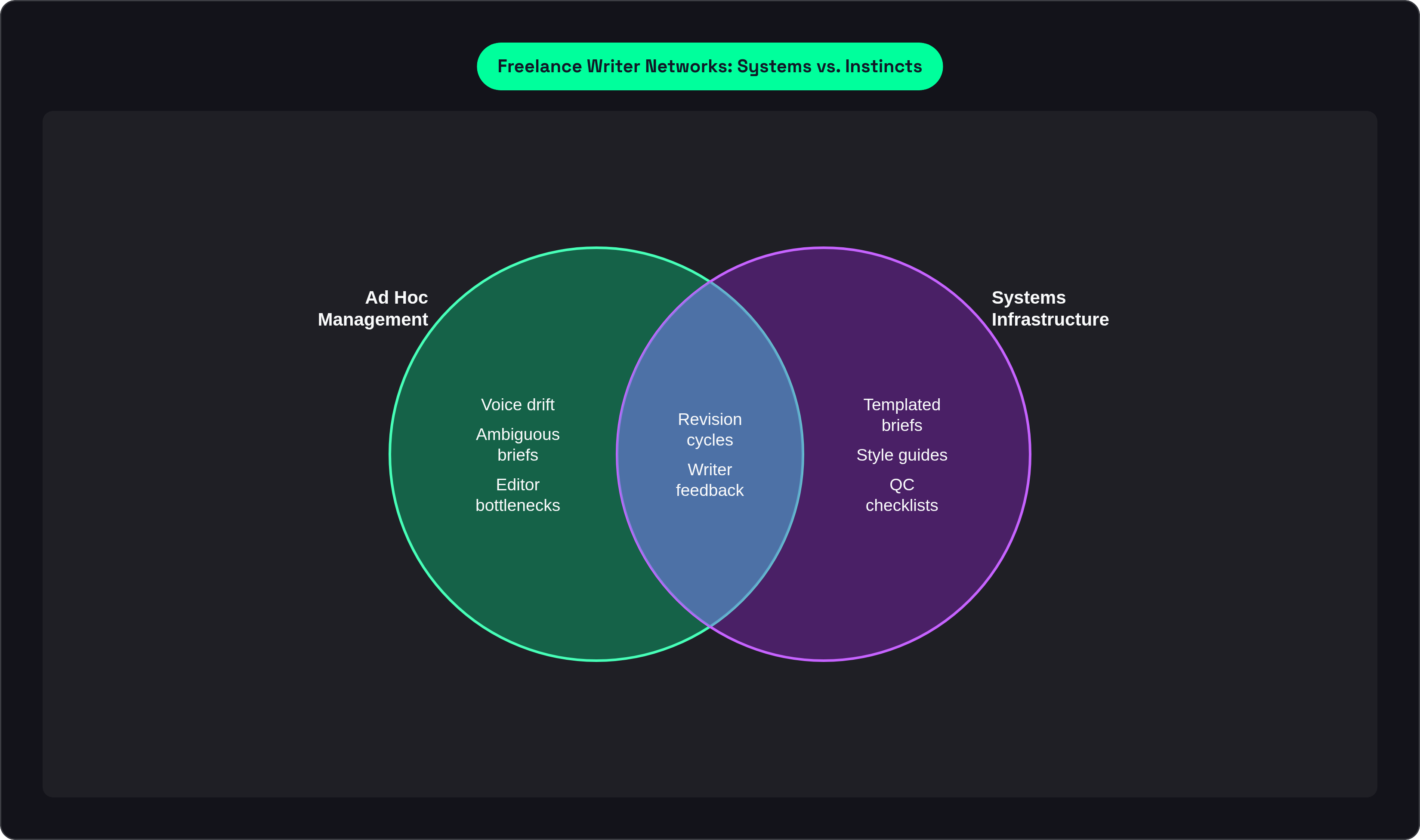
The breakdown patterns are predictable once you've seen them. Brand voice drifts because each writer interprets "conversational but authoritative" through their own lens, and without a shared reference point, you end up with fifteen versions of your brand's voice instead of one. Briefs turn out to be ambiguous in ways nobody noticed until three writers interpreted "cover the basics" three different ways, producing pieces that range from 600-word overviews to multi-thousand-word deep dives on the same topic. Feedback loops stop scaling because the editor is explaining the same structural problem to writer after writer, one email at a time, instead of fixing whatever's letting that problem recur. And review becomes the bottleneck: you added ten writers to increase output, and now the eleventh person, your editor, is the reason nothing ships on time.
There's a useful term for what accumulates here: management debt. It's the time and energy a team spends compensating for unclear processes, and it shows up as late deliverables, inconsistent quality, and an editorial calendar that gets reshuffled every other week. A team managing five writers with the same instincts it used for managing one is taking on debt with every assignment. A team that builds systems is managing a process that happens to involve writers, which lets the good writers do their best work without a chaperone.
What the writer roster actually needs to look like before systems can work
You can't build a system around writers who are all roughly the same, because they're not, and the market has made that split sharper than it used to be. Generic commodity writing, the kind that used to fill freelance job boards, is getting displaced by AI tools that do that specific job competently enough. What's left standing, and increasingly commanding a premium, is specialist writing: tech, SaaS, finance, B2B, digital marketing. The State of Freelance Writing Report for 2025 found these niches account for more than half of all freelance writing activity, which tells you where the actual demand has consolidated.
Rate tiers aren't arbitrary, either, even though it can feel that way when you're negotiating. The Editorial Freelancers Association's 2026 Rate Chart puts ghostwritten blog posts at $0.25 to $0.40 per word for professional-tier writers. A separate 2026 survey of 500 writers by EarnifyHub found rates spanning from $0.15 per word for writers under two years of experience up to $1.25 per word and beyond for writers with five to ten years in the field. That's nearly a tenfold difference, and it reflects real differences in research depth, source handling, and the ability to write something that doesn't need three rounds of fact-checking.
So the roster itself needs architecture before any workflow system can do its job. You want generalists who handle volume reliably, specialists for the technical or high-stakes pieces where a wrong turn costs credibility, and at least one senior writer or editor whose job is partly to enforce the standard rather than just meet it. Before you hire anyone, decide what you're vetting for: niche depth, a demonstrated range of voice (can this person sound like your brand and not just like themselves), how they respond to revision notes, and whether they can execute a brief without a follow-up call. Roster size matters too. A program that depends on two writers for the vast majority of its output is fragile, and one flu season away from a missed quarter.
The content brief as the primary quality-control mechanism
A brief is not an email that says "write about email marketing, 1,500 words, due Friday." That's an assignment, and assignments are where ambiguity multiplies. A brief, the kind that actually functions as a quality-control mechanism, is a complete set of instructions that removes guesswork from the writer's side entirely.
What does that look like in practice? It states the content goal and the audience: who's reading this, and what should they think or do once they're done. It gives the angle, not just the topic, because "write about email marketing" and "argue that most companies over-segment their email lists and it's costing them opens" produce entirely different pieces. It lays out the structure: main headings, roughly how long each section should run. It includes SEO targets: the primary keyword, a handful of secondary terms, and what kind of search intent the piece is answering. It names sources to cite and sources to avoid. It states word count, deadline, and format. And ideally, it links to one or two comparable pieces that already nail the tone you're after, because sometimes the fastest way to explain a voice is to just point at it.
What briefs eliminate, when they're done well, is the revision cycle that happens purely because the writer and editor pictured two different finished pieces. That's a communication problem that got baked in before a single word was drafted, more than a writing or editing problem. A good brief also becomes the editor's checklist during review: did the piece deliver what was asked for, yes or no, and that framing alone cuts down on subjective back-and-forth. There's an inverse relationship worth internalizing here, too: the more complete the brief, the less editorial judgment has to get exercised on the back end. One practical note, because this matters more than it sounds like it should: template the brief. If your content manager is rebuilding the format from scratch every time, that's forty-five minutes lost per piece that a template would've saved.
Style guides and brand voice documentation that writers can actually use
If the brief covers the what of one specific piece, the style guide covers the how across every piece. And this is where most style guides quietly fail, because they were written by marketing teams for other marketing teams, full of adjectives like "we're friendly but professional" that mean absolutely nothing to a freelancer who's never sat in a brand meeting.
A style guide that actually works shows rather than tells. It has annotated examples: here's a sentence that's on-brand, here's a rewritten version that isn't, here's why. It lists preferred vocabulary and terms to avoid (do you say "customers" or "users"? does "utilize" ever get a pass, or is it banned on sight?). It covers formatting conventions like heading style and how liberally to use bullet points. It explains how to reference your own product without sounding like an ad, and it sets ground rules for sourcing and claims, so a writer knows whether a stat needs a hyperlink or a footnote.
Here's the test that actually separates a functional guide from a decorative one: can a brand-new writer read it and produce a first draft that sounds like it belongs, without getting on a call first? If the answer's no, the guide isn't done. And it needs an owner, because style guides that don't get updated go stale fast, and writers can tell when a document hasn't been touched in eighteen months. They stop consulting it, understandably, and then you're back to voice drift.
This gets more urgent, not less, as AI enters the picture. A growing share of freelance content writers already use AI tools in some part of their process. That's fine, mostly, but it means the style guide is doing work that AI simply can't do on its own: enforcing the specific, human judgment calls about voice that no model has internalized about your brand specifically. The guide becomes the layer that keeps AI-assisted drafts from all sounding like the same document wrote them.
Assignment and workflow systems that move work without creating bottlenecks
Without a defined sequence, the editor becomes the coordination layer by default, fielding "hey, did you see my draft" messages from twelve different writers at once. That doesn't scale, and it's not a great use of an editor's actual skill, which is editing.
Every workflow needs explicit ownership at each stage: who creates and approves the brief, who assigns the writer and on what basis, who does the first-pass review of the draft, how many revision rounds happen and what's in scope for each, and who signs off before it goes to publishing. Project management tools, whether that's Asana, ClickUp, Trello, or something purpose-built for content, exist to make a piece's status visible without anyone needing to ask. If your team is holding a weekly status meeting just to figure out what's done, the tool isn't doing its job, or nobody's updating it, which is really the same problem.
Revision scope discipline deserves its own mention because it's where a lot of freelance relationships quietly sour. Cap the revision rounds, define clearly what counts as a revision versus a scope change (fixing a weak intro is a revision; adding a whole new section is not), and you protect the writer's time. Writers who feel like a two-round revision policy turns into five rounds because nobody defined the boundary will start deprioritizing your assignments in favor of clients who respect their hours. That's just rational behavior on their part.
Build a buffer between the writer's deadline and the actual publish date. Programs that skip this trade quality for speed every single time something runs even slightly behind, and something always runs slightly behind. And match writers to piece types deliberately, based on demonstrated strength, not just whoever happens to be free that week. The goal, honestly, is a workflow where the content manager spends their day making judgment calls instead of chasing people down for updates that a dashboard should already show them.
Feedback systems that improve the roster over time rather than just fixing individual pieces
There's reactive feedback, and there's systematic feedback, and the difference between them determines whether a program improves or just treads water. Reactive feedback looks like this: the editor fixes the draft, ships it, and the writer never really finds out why certain sentences got cut. Then the same issue shows up in the next piece, because nobody closed the loop.
Systematic feedback gets documented, categorized, and handed back in a form the writer can actually learn from. Inline comments help, but they're not the whole job. What changes behavior is a summary note that names the pattern: "your intros consistently bury the lead three paragraphs in" tells a writer something inline comments alone won't. It's the difference between fixing a typo and explaining a habit.
A light-touch check-in, monthly or quarterly, covering quality trends and turnaround reliability, functions more as a calibration conversation than a performance review. And the roster should move based on what these reviews show: writers who consistently perform well earn more complex or higher-visibility assignments, and writers who don't improve after clear, structured feedback eventually get rotated out. That's just how any system that rewards improvement has to work.
One more thing worth sitting with: feedback flows upward too. If four different writers are making the same mistake, independently, the problem probably isn't four writers. The brief, or the style guide, is a more likely culprit, and a good system catches that before anyone starts blaming the bench for something the process actually caused. Keep a short track record for each writer, their strengths, their recurring issues, what content types they handle best, so assignment decisions get faster over time and don't live entirely in one editor's memory, which leaves the day that editor does.
Quality control at volume without turning editors into a bottleneck
As the network grows, editorial review has a way of becoming the exact constraint you were trying to eliminate by adding writers in the first place. You scale up capacity and the review stage becomes the new ceiling.
Distribute the load instead of stacking it all at the top. Give writers a self-checklist to run their own draft against the brief before submission, which catches the obvious misses before an editor ever sees them. Add a peer review layer, senior writers or dedicated editors doing first-pass structural checks, so your most experienced editorial eyes are spent on substance and voice, not on catching a missing H2. And let tools handle what tools are good at: grammar, plagiarism checks, keyword presence, formatting, all before a human even opens the document.
The context here has shifted meaningfully. A 2026 Elorites survey of 1,165 respondents found that 95% of clients now ask for proof of human-generated content, and 69% of respondents in that same survey reported a noticeable decline in average content quality across the industry. Read those two figures together and the implication is pretty direct: catching AI-generated filler before it ships has become a competitive edge, not just good hygiene. Google's E-E-A-T signal points the same direction; the 2024 algorithm updates moved decisively toward rewarding original, expert-level work, which raises the real cost of letting a mediocre draft slide through.
Define what "done" actually means, in writing, as a checklist rather than an editor's gut feeling. That single document makes QC faster and, more importantly, consistent across whichever editor happens to be reviewing that day. And set escalation rules: which issues block publication outright, which get sent back for revision, and which are minor enough to just fix in-house. Not every decision needs to travel up to the most senior person in the room, and if it does, you've built a bottleneck disguised as a quality standard.
How AI fits into a freelance writer system without displacing the humans who make it work
The market has already answered part of this question, whether anyone planned it that way or not. A study spanning nearly two million job postings across 61 countries, conducted by researchers at Imperial College London, Harvard Business School, and the German Institute for Economic Research, found that demand for freelance writing dropped sharply within eight months of ChatGPT's launch. That's a steep decline, and it fell hardest on commodity writing, the kind of generic content AI handles competently enough that clients stopped paying humans for it. Specialist writers and AI-fluent writers, meanwhile, have moved the other direction, commanding higher rates than before.
So what does a well-designed system do with that split? It puts AI where speed and repetition actually matter (outline generation, first-draft scaffolding, SEO formatting) and keeps humans where judgment, voice, and subject expertise can't be replicated. That 70% figure from Elorites 2025 on AI tool adoption among freelance writers bears repeating here, because the majority of those writers are using AI as a supporting tool rather than a full replacement, which is exactly the model that seems to be working. Writers fluent in AI-assisted workflows produce more without a quality drop, which changes how programs ought to think about per-piece rates and throughput expectations.
But it's not all upside, and pretending otherwise would be dishonest. A 2026 Elorites survey found a majority of writers reporting they now spend more time editing AI output than they would spend writing from scratch. Poorly integrated AI use increases editorial load rather than reducing it, which defeats the purpose. That means AI tools need to be specified in the workflow itself: what's permitted at which stage, and how an AI-assisted draft gets reviewed differently from a piece a writer built from the ground up. Leaving that decision to each writer's individual discretion is how you end up with sixty different interpretations of "appropriate AI use" across a sixty-person roster. Platforms that combine AI drafting tools with editorial workflow management let teams capture the speed benefit while keeping the human quality layer fully intact, without having to rebuild the whole system from scratch to get there.
The metrics that tell you whether the system is working
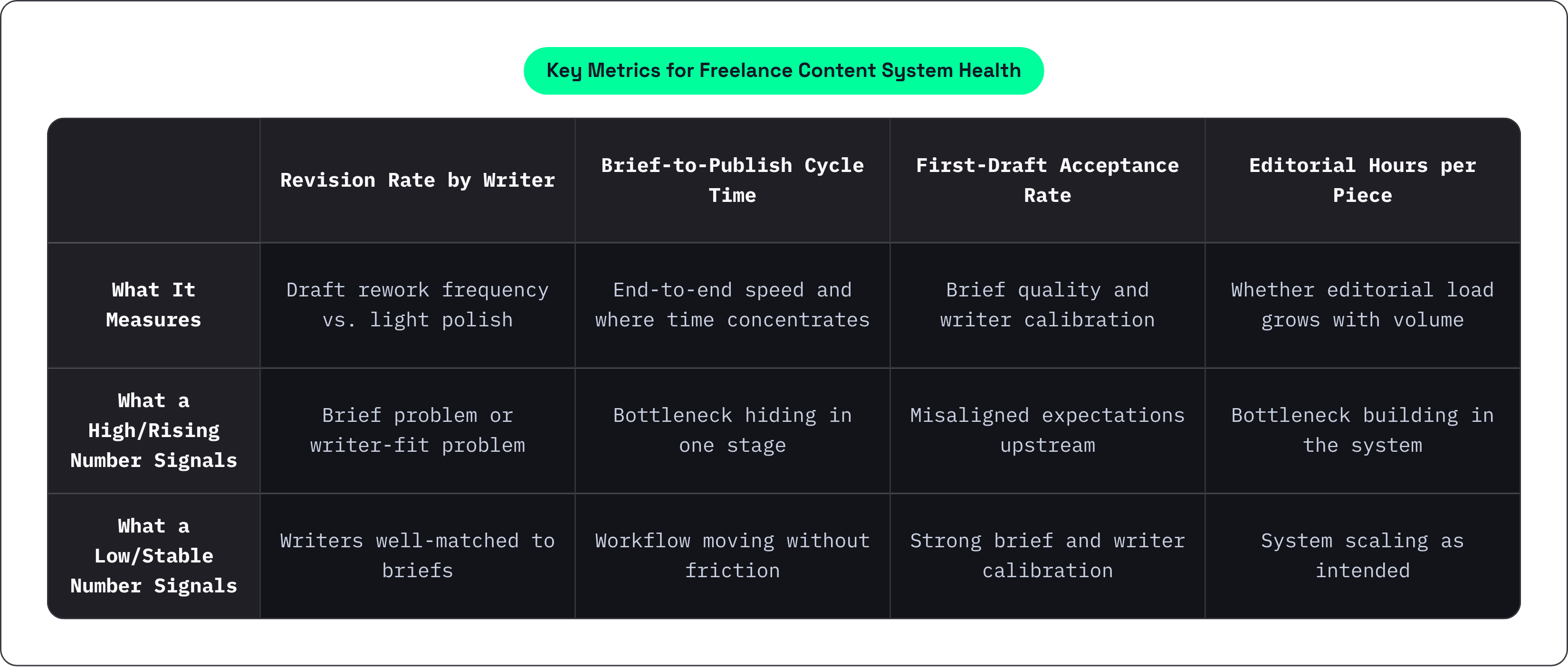
Most programs measure outputs: pieces published this month, total word count delivered, maybe a rough sense of whether things "feel" on schedule. System health is what actually predicts whether quality and throughput hold up as the roster grows from ten writers to forty, and outputs alone don't capture that.
Track the revision rate by writer, meaning how often drafts need structural rework versus a light polish. A high rate points to either a brief problem or a writer-fit problem, and you want to know which. Track brief-to-publish cycle time end to end, and pay attention to where the time actually concentrates, because it's rarely evenly distributed. Track first-draft acceptance rate, the share of pieces that clear QC without a second round, since that's a pretty direct read on both brief quality and how well-calibrated your writers are to your standards. And track editorial hours per piece over time. If that number climbs as volume grows, you've got a bottleneck hiding somewhere in the system. If it holds steady or drops, the system's doing its job.
Tie performance metrics, organic traffic, time on page, conversion rate, back to the specific writer and brief type that produced each piece. That data will tell you which combinations of writer skill and brief structure actually produce results, and which ones just produce content. Review all of this on a fixed schedule, monthly or quarterly, not only when something's visibly gone wrong, because the entire point is catching drift early, before it turns into a quality problem your readers notice before you do.
A program's real strength shows in whether problems get caught by the metrics before they get caught by a client, with the system, more than any one editor's memory or instinct, holding the quality bar in place.
Sources
- https://www.the-efa.org/rates/
Provided the per-word rate range for professional-tier ghostwritten blog posts cited in the roster architecture section.
- https://www.ndash.com/blog/a-cmos-guide-to-hiring-freelance-writers-vs-full-time-employees
Supplied the statistic that 78% of companies leaned more heavily on freelance writers in 2023.