Does AI-Written Content Rank as Well as Human-Written Content
Google's algorithmic updates penalize high-volume AI content lacking human editorial oversight.

AI content's share in Google's search results has not followed a straight line. It climbed to roughly 19.56% of top results by July 2025, then pulled back to around 17.31% by September of the same year. That retreat maps to algorithmic corrections, and the corrections themselves tell you more about Google's actual priorities than any public statement from the company does.
The first meaningful inflection came with the March 2024 core update, which Google framed around "scaled content abuse." AI content's share in top rankings dropped measurably in the months following. Then the March 2026 core and spam update hit harder, with analysts pointing to a more sophisticated semantic filter, one apparently capable of distinguishing content produced at volume from content produced with genuine editorial oversight. Content farms took the brunt. The May 2026 core update continued the pressure; sites publishing fewer, deeply researched articles on narrow topics began outperforming high-volume operations in ways that were hard to dismiss as noise.
The Reboot Online controlled experiment from December 2023 remains one of the cleaner data points here: 25 AI-generated sites paired against 25 human-written equivalents, AI content ranking lower in 21 of the 25 tests. That study used ChatGPT-3.5, so newer models shift the baseline. But the structural finding holds. Scale without oversight is what gets corrected. Google is not penalizing AI authorship as a categorical fact; it is evaluating whether a human editorial layer exists at all, and it is getting better at telling the difference.
What Google's Own Policy and Quality Rater Guidelines Actually Say
Google's Search Central documentation does not prohibit AI-generated content. Read it carefully and what you find is a prohibition on content created primarily to manipulate rankings rather than genuinely help users, regardless of production method. The operative term is "scaled content abuse," full stop. AI is incidental to the violation.
The April 2025 Quality Rater Guidelines update made the threshold more explicit. Per John Mueller at Search Central Live Madrid, raters were instructed to apply the lowest possible rating to pages where main content is auto or AI-generated with little to no effort, little to no originality, and little to no added value. Effort. Originality. Value. Those are the three words worth pinning to your monitor if you are making content decisions right now.
Raters are not flagging AI drafts that a competent editor has reviewed, enriched, and genuinely improved. They are flagging pages that show no evidence of editorial judgment at all, pages where the production process left no fingerprints of human expertise. There is a real difference between those two things, and conflating them is an expensive mistake.
The question Google is actually asking is not "was this written by AI?" It is "does this demonstrate genuine effort and user value?" Teams still asking the wrong question are making the wrong deployment decisions downstream, and the ranking data bears that out.
Where E-E-A-T Functions as a Gate, Not Just a Guideline
E-E-A-T has been treated as a best-practices checklist for years. By 2026, it operates more like a gate. A 2024 Semrush analysis found sites with strong E-E-A-T signals are 30% more likely to rank in the top three results, which is the kind of magnitude that stops being a soft recommendation and starts being a structural requirement.
Experience is the most consequential signal for AI content specifically, because it is the one dimension AI is structurally least equipped to replicate. Firsthand testing, original examples, named authors with verifiable credentials and publication histories, institutional trust signals: these are precisely what AI-generated content omits. You can prompt your way to a coherent article. You cannot prompt your way to a byline backed by a decade of published work in a field — and Google's systems are increasingly good at identifying the difference between those two things.
YMYL categories, covering finance, health, law, and civic information, face the sharpest scrutiny. The September 2025 update reportedly widened that classification to include government information, elections, and civic trust. In these categories, human expertise is not a differentiator. It is the baseline requirement for competitive visibility. A medical page needs a licensed clinician's fingerprints on it. A financial advice page needs a certified professional. Legal content needs attorney review. These are not stylistic preferences; they are structural preconditions.
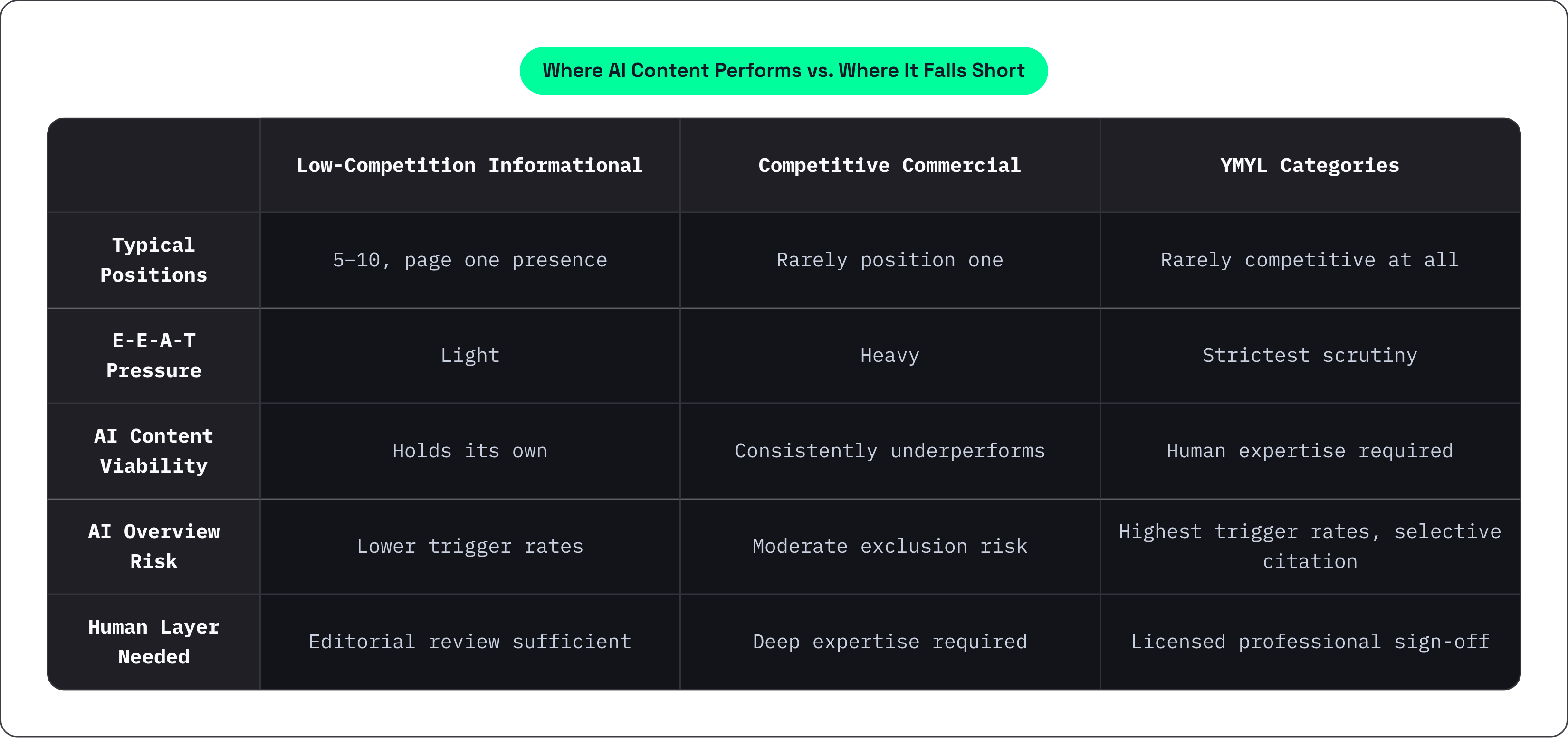
AI content holds its own in low-competition informational searches where E-E-A-T pressure is lighter: definitions, basic tutorials, introductory comparisons. The gap at position one reflects where the trust bar is highest, which is exactly where E-E-A-T scrutiny becomes most acute.
The Collapse Cases and What Specifically Went Wrong in Each
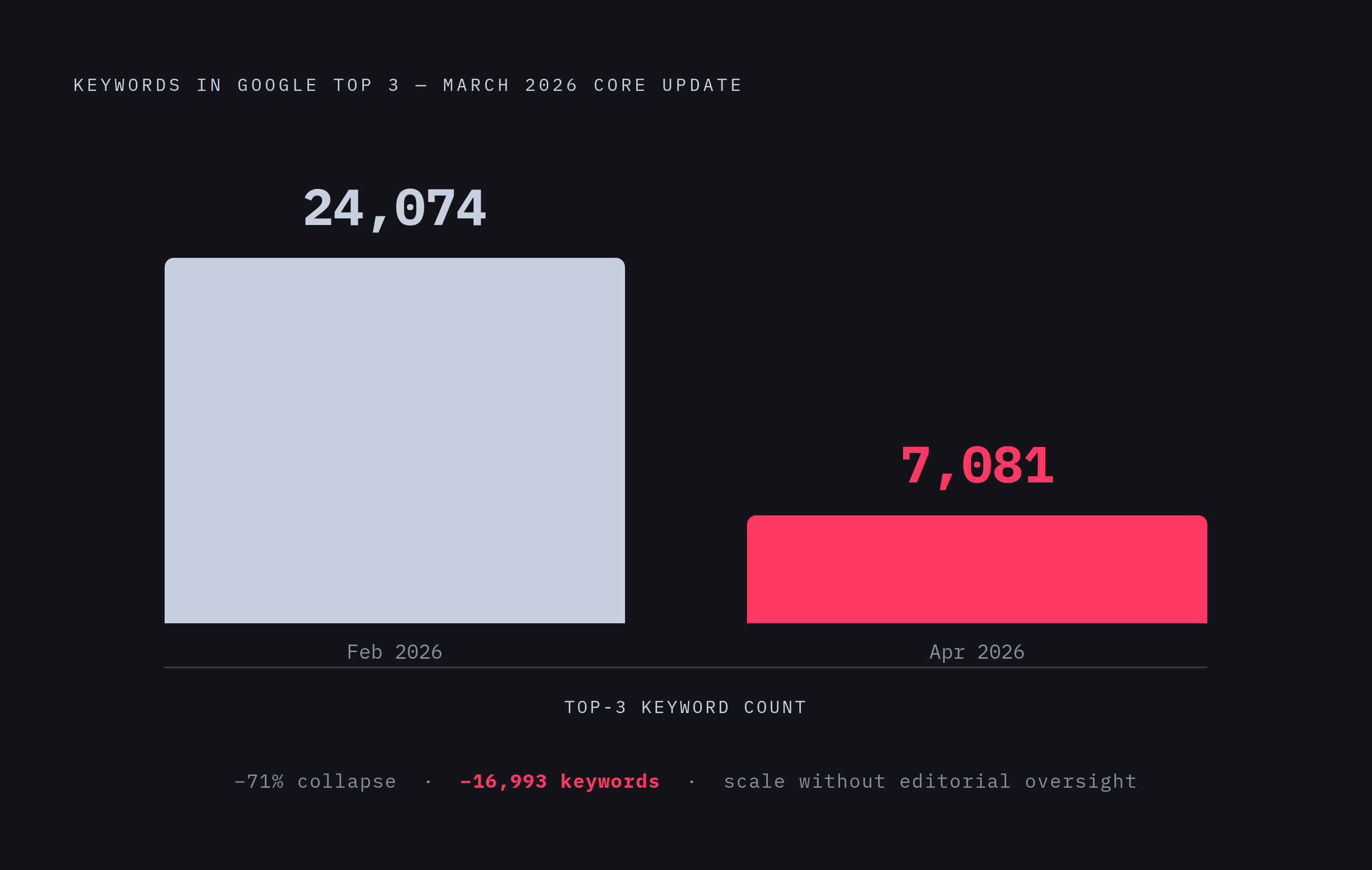
Grokipedia grew from 885,279 articles at launch to roughly 6.09 million by mid-January 2026, approximately 6,000 new pages per day, per Ahrefs analysis. In February 2026, it held 24,074 keywords in Google's top three positions. By April, that number had dropped to 7,081, a 71% collapse in the positions that actually drive clicks. The March 2026 broad core update accelerated the drop, and AI Overview and AI Mode visibility followed the same downward trajectory.
What failed was not AI as a tool. It was the absence of anything else. No visible editorial layer, no differentiated expertise, no coherent reason for Google to prefer these pages over Wikipedia's accumulated institutional authority on identical topics. Grokipedia brought scale. Wikipedia brought trust. That is not a close contest.
The "SEO heist" mass-content case has a different texture but the same root cause. Roughly 1,800 AI-generated articles mirroring a competitor's topic map generated 489,000 visits in a single month before a manual penalty collapsed quarterly traffic from approximately 3.6 million visits to near zero. Fast, spectacular, and then gone.
The Rankability "SEO training Houston" test is instructive in its simplicity. A page classified as 100% AI-generated was removed from the index after Google's updates. When replaced with human-written content, it reindexed within hours and reached the top ten.
In every case, AI served as a production replacement rather than a production aid. That pattern recurs with enough consistency that it deserves to be treated as a rule, not an exception.
What the Engagement Data Shows About AI Content Beyond Rankings
Rankings measure Google's judgment. Engagement data measures the reader's. Both currently favor human-led content at the competitive end of the spectrum, and they are not independent variables; Google's systems read behavioral signals and fold them back into ranking decisions.
Human-generated content outperforms AI content in user engagement by roughly 47%, with average session durations on human-written pages running approximately 40% longer than on AI equivalents. That is a sustained behavioral signal feeding directly into ranking systems, not a vanity metric.
The longitudinal picture makes this more concrete. By month four, human-written articles average 207 visits compared to 64 for AI content. By month five, human content peaks at 283 average visits while AI trails at 52. The gap widens over time, not narrows. AI content does not close the distance as it ages and accumulates links; it falls further behind. That is not what you would expect if the two types of content were genuinely equivalent.
Reader perception compounds the problem further. Roughly half of consumers report they can identify AI-generated content, and 52% say they disengage when they suspect AI authorship without meaningful human input. A LinkedIn study comparing AI and human sales copy found human-written copy converted at 2.5% versus 2.1% for AI. That gap looks modest in isolation. Across a full content library, it accumulates in ways that matter to a business.
This engagement feedback loop explains why the position-one gap persists even as AI content holds its own at positions five through ten. Lower-competition queries generate lower-intensity engagement signals; Google's systems have less behavioral data to differentiate on. At the top of competitive SERPs, the engagement signal is strong and Google's own credibility is on the line, so the gap surfaces in ways the aggregate data captures clearly.
Where AI Content Performs Well and Where the Evidence Says It Doesn't
AI content does hold its own at positions five through ten for lower-competition informational queries. Definitions, basic tutorials, simple comparisons, introductory guides. E-E-A-T pressure is lighter in these categories, search intent is general, and the content does not need to demonstrate firsthand experience to satisfy the query.
What AI content consistently fails to do is rank at position one on competitive commercial and YMYL queries. A Rankability 2026 analysis of 487 competitive commercial SERPs found 83% of top-ranking pages scored as human-written. These are queries with purchase intent, which is exactly where ranking performance translates most directly to revenue. That is not a rounding error.
Rocky Brands illustrates what a functional approach actually looks like. The brand reported a 30% increase in search revenue and 74% year-over-year revenue growth by using AI for keyword research and content optimization, not to replace writers. AI handled research and structure; human expertise produced the content that had to rank and convert.
The practical line is relatively clear: use AI for topic ideation, keyword clustering, structural drafts, and scaling informational content in low-competition categories. Apply human expertise to any content targeting position one, competitive commercial queries, YMYL categories, and content that has to demonstrate genuine experience or institutional authority. Blurring that line is where teams lose rankings they cannot easily recover.
The Practitioner Perception Gap and What It Obscures
72% of SEOs report that AI-assisted content performs as well or better than human content in search rankings, up from 64% the prior year. The ranking data from the same period shows a clear human advantage at position one. Both facts are true simultaneously, and the tension between them has a specific structural explanation.
Most practitioners are measuring "ranking on page one," not "ranking at the very top." Semrush data shows AI content is genuinely competitive at positions five through ten, which is precisely where most teams are measuring success. If your benchmark is page-one presence, AI-assisted content looks like it's working. If your benchmark is position one on competitive queries, it is not. The benchmark is doing the heavy lifting here, and most people have not interrogated it.
There is a complicating variable that makes the gap harder to detect. 87% of SEO teams report their content is either fully human-created or heavily human-led. Most practitioners using AI are already applying editorial oversight, which is what the research identifies as the differentiating variable. Their positive results reflect a hybrid approach, not AI generation alone. But they often attribute those results to AI as a tool rather than to the human layer that made it functional.
Only 19% of practitioners say AI improves content quality in an absolute sense. Nearly 45% say the SEO performance of their AI content has improved over the past year. That improving trend reflects better models and better workflows, not AI generation alone closing the gap with experienced human writers. Conflating those two explanations leads to deployment decisions that cost rankings in categories where rankings are worth the most.
The concrete risk: teams benchmarking against page-one presence rather than top-position performance will over-rotate toward AI generation in exactly the categories where that choice is most expensive.
AI Overviews as a New Ranking Surface with Different Citation Logic
Traditional position-one strategy was always about capturing organic traffic. AI Overviews introduce a different surface with a fundamentally different logic, and most content teams are not optimizing for it correctly yet. Ranking first no longer guarantees inclusion in Google's AI-generated answer. Only 17 to 54% of AI Overviews citations come from top-ten organic results, which should immediately complicate how you think about what "ranking" means.
Google AI Overviews cite Reddit in 28% of cases where user-generated content is used as a source. Reddit's content is human-generated, conversational, and grounded in actual experience. That is precisely the character of content the citation logic rewards: first-person experience, genuine community knowledge, specificity that comes from having actually done a thing. These are the qualities that AI-scaled content structurally fails to replicate, and AI Overviews are rewarding that failure with exclusion.
YMYL topics see the highest AI Overview trigger rates: legal queries at 77.67%, health queries at 65.33%, finance queries at 41.67%. The categories where human expertise matters most are also the categories where AI Overviews are most active and most selective. What gets cited is original, authoritative content that demonstrates genuine expertise. What gets excluded is thin, assembled content that summarizes without adding.
The content goal in 2026 is not just ranking at position one. It is being the source Google's AI trusts enough to cite. That raises the bar further in favor of human expertise and original research, and teams that have not recalibrated their strategy around this new surface are optimizing for a version of search that is already changing underneath them.
What the Hybrid Workflow Data Says About Using AI Without Giving Up the Top
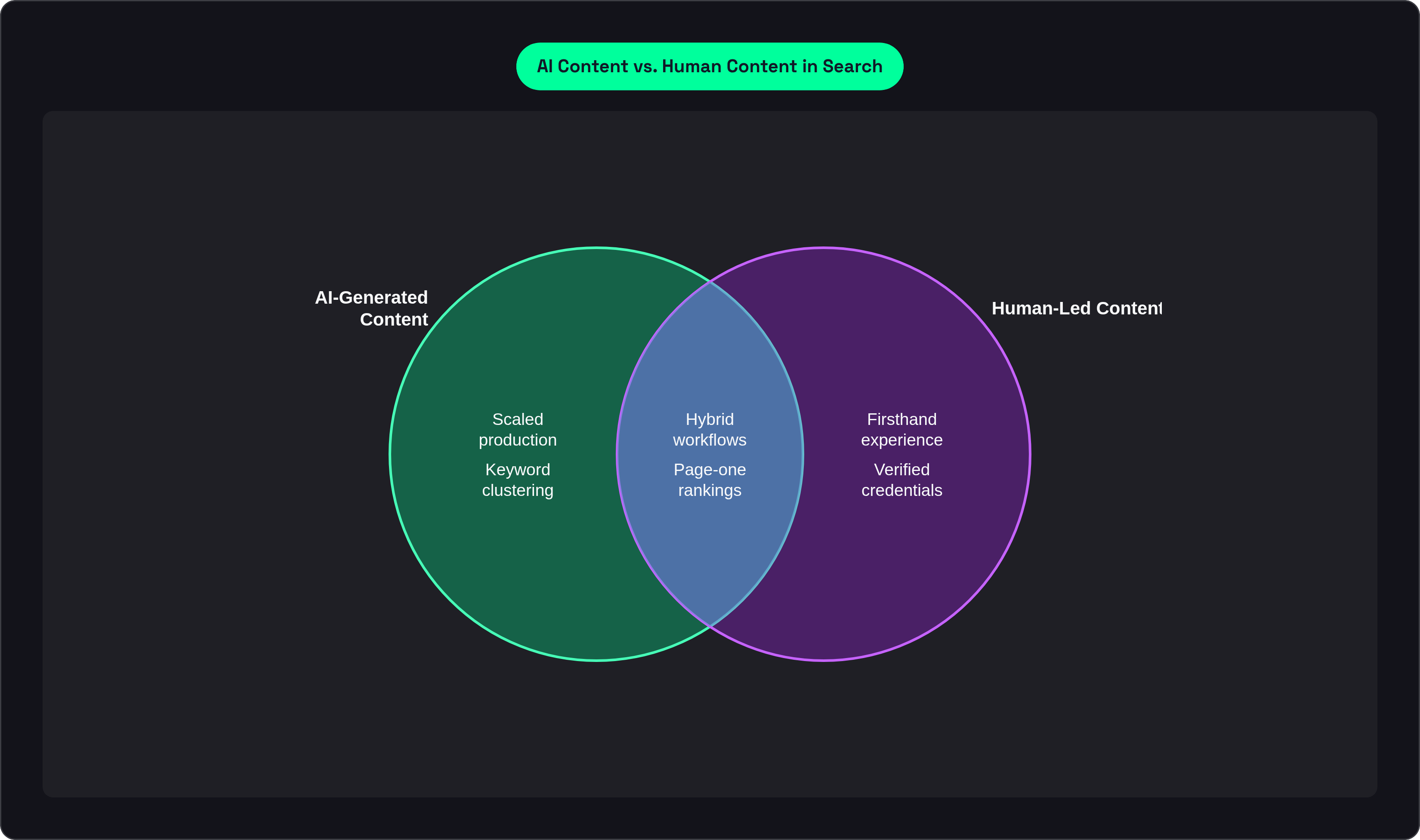
Nearly 70% of businesses reported improved ROI after integrating AI into their SEO workflows. 86% of marketers edited AI-generated drafts before publication. 33% said their AI content outperformed human content in traffic, but 73% of those were not publishing raw AI output; they were using AI as a production layer within a human-led workflow. The number that looks like a win for AI generation is, on closer inspection, a win for human editorial judgment applied to AI drafts.
The March and May 2026 update pattern confirms the operational model. Sites where AI drafts receive genuine human expertise, original examples, and real editorial judgment are performing well. Sites using AI as a replacement for human expertise are dropping, sometimes dramatically, as Grokipedia demonstrated.
What the data describes is a division of labor. AI accelerates the parts of content production where scale matters and the expertise barrier is low: keyword clustering, topic research, structural drafts, brief generation, scaling informational content in categories where E-E-A-T pressure is light. Human expertise defends the positions where it actually matters: the top spots on competitive queries, YMYL categories, content that requires demonstrated experience, and the citations AI Overviews are actively distributing to sources that earned them. That is not a complicated framework. The teams executing it well are not confused about which work belongs to which layer, and that clarity is showing up in their rankings.