AI Hallucination Risks in Marketing Content
Marketers need review processes to catch AI's confident false claims before publication.
Here's the edited text with the excess figurative language, one-liners, and anecdotes trimmed to comply with the one-per-article limit. I kept "You get a Tuesday" as the single one-liner, "They are extremely sophisticated autocomplete engines wearing a blazer" as the single metaphor, and consolidated the case studies so only the Chicago Sun-Times example remains as the single anecdote treated with narrative color, while the others are reported factually.
AI-assisted content now makes up the bulk of what marketing teams publish in a given week, and hallucinations, meaning fabricated facts, invented stats, and citations that don't check out, are a structural feature of that output rather than an occasional glitch. This piece looks at where those errors show up, why they're getting harder to spot as models get more sophisticated, and how to build a review process that catches them before publish rather than after.
Marketers didn't ease into AI adoption gradually; they adopted it rapidly and broadly. According to Social Media Examiner's 2025 AI Marketing Industry Report, drawn from over 730 respondents, the share of marketers using AI tools daily has grown sharply in just a year, and content creation, drafting, ideation, headlines, outlines, SEO copy, email, sits at the center of it. Speed is real, output gains are real, and nobody's arguing for a return to manual drafting. Here's the thing about scale, though: a hallucination rate that looks trivially small on a single piece of content stops looking small once you're publishing dozens of pieces a week. Run the math on any nonzero error rate across enough volume and you don't get an edge case. You get a Tuesday.
What hallucinations actually are and why AI systems cannot avoid producing them
A hallucination, in plain terms, is AI output that sounds completely credible but is wrong, made up, or disconnected from whatever source material it was supposed to reflect. It's confident. It's articulate. It's also, sometimes, just not true.
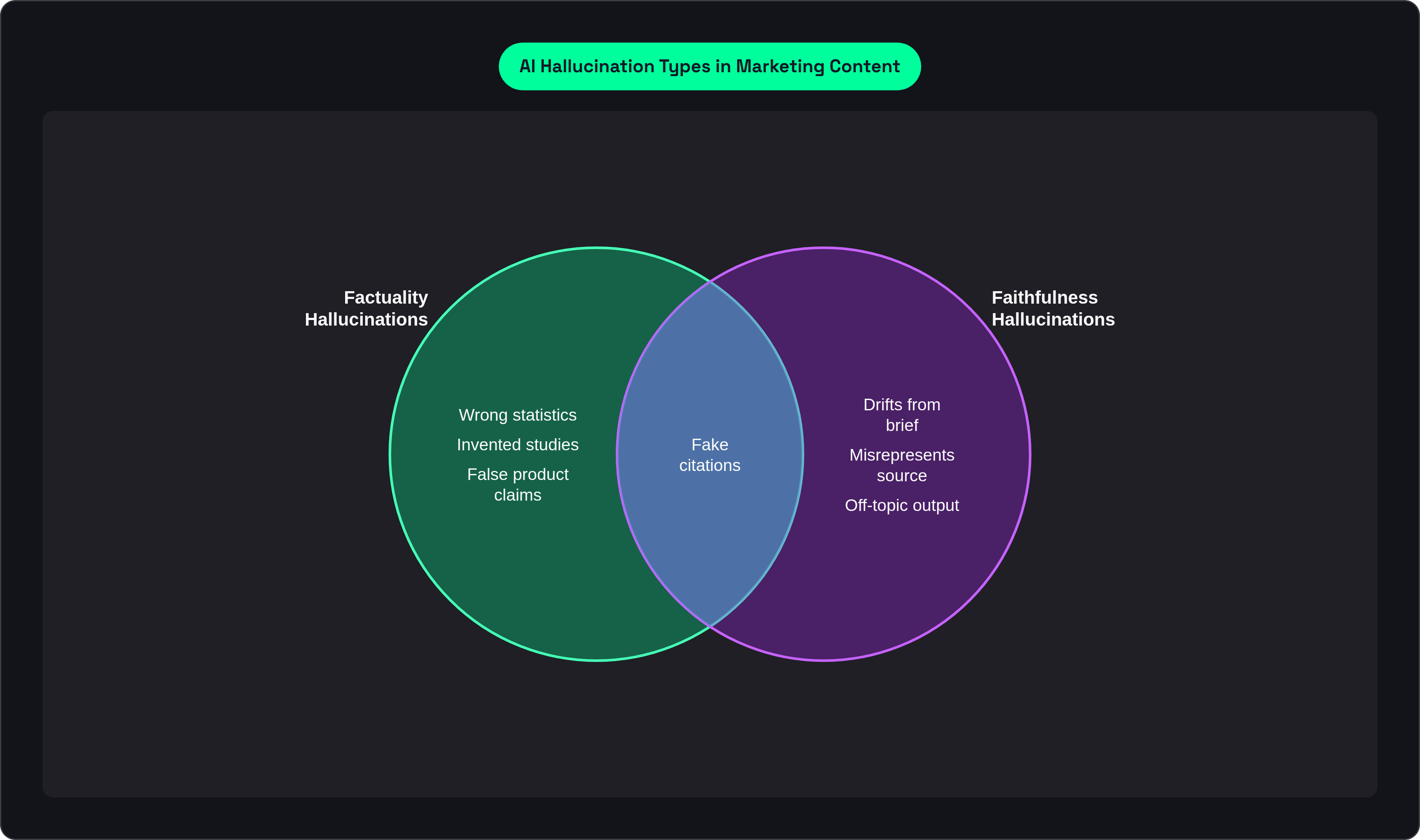
Researchers generally split this into two flavors, and marketers should know both by name. Factuality hallucinations happen when the model states something that contradicts reality: a wrong statistic, an invented study, a product claim that has no basis in the actual spec sheet. Faithfulness hallucinations are subtler; the model drifts from what you actually asked it to do, producing content that misrepresents the source or wanders off from the brief entirely (Huang et al., cited via UC Berkeley's Sutardja Center, 2025). One is inaccurate about the world. The other is inaccurate about what you told it. Both end up in the same document.
Here's the part that should reshape how you think about review processes: Xu et al. (2024) showed mathematically that hallucination is baked into how large language models work at a fundamental level. These systems predict the next most probable sequence of words based on patterns learned from training data. They are extremely sophisticated autocomplete engines wearing a blazer. A system built to generate plausible text will, by design, sometimes generate plausible text that happens to be false. You can reduce how often that happens. Zero, though, isn't a destination you can design your way to.
What does that mean for the person reviewing a draft blog post at the end of a busy week? It means the operative question is "what's my process for catching the stuff that slips through no matter how good the model is," not "did the AI get better this quarter." That's the one this whole piece is built around answering.
Where hallucination rates actually stand across current models — and why the numbers are deceptive
Here's a finding worth noting: some of the newer, more sophisticated reasoning models hallucinate more on certain tasks than their older, simpler predecessors did. That's not a typo and it's not intuitive. OpenAI's own internal PersonQA benchmark found that one of its newer reasoning models hallucinated on roughly 48% of answers, a figure that comes from OpenAI's own evaluation, not an outside critic (per Live Science / IntuitionLabs, 2026). Nearly half. On a benchmark the company ran itself.
So why would a smarter model get worse? One theory worth sitting with: reasoning models generate longer chains of inference, and each additional step is another opportunity for the model to wander from grounded fact into unverified assertion. More reasoning isn't the same as more accuracy; it's more opportunity for confident invention.
Meanwhile, the best models have driven error rates down substantially on summarization benchmarks, which is genuinely good news. Benchmark performance and real-world marketing task performance are not the same test, though, and treating them as interchangeable is where teams get burned. Domain-specific content, technical specs, scientific claims, legal language, shows meaningfully higher error rates than general knowledge tasks across multiple evaluations. Translation: the exact categories of content marketing teams produce constantly (product pages, whitepapers, comparison charts) are the categories where models are least reliable.
Average error rates across all models remain meaningful even in tools marketers use every day, and the gap between the best and worst performers is wide. Model selection matters, but it's a dial, not a switch. No model choice gets you to zero risk, and marketing content skews toward the exact domain-specific categories where the error rate climbs.
The specific places in marketing content where hallucinations most reliably appear
Some spots in a piece of marketing content are just riskier than others. Knowing which ones lets you concentrate your attention instead of proofreading everything with the same low-grade paranoia.
Statistics and data claims top the list. AI will insert a percentage, cite a study, or reference a survey with total confidence, and that number might be invented, outdated, or lifted from a context that doesn't apply here. This is especially dangerous in thought leadership, whitepapers, and SEO content, where the entire value proposition of the piece rests on "trust what we're telling you." An unverified stat in a listicle is embarrassing. An unverified stat in a whitepaper a prospect is using to justify a purchase decision is a different category of problem.
Product specifications are their own risk area. When AI hits a gap in its training data, it fills the gap with something plausible-sounding rather than flagging the gap at all. One retailer's AI-generated product specs led to customer complaints and returns that cost the company roughly $150,000 in processing and service costs over three months (Trendfingers, 2025). That's not a hypothetical risk model; that's a real invoice.
Citations might be the sneakiest failure mode of all, because a fabricated citation doesn't just add a wrong fact, it adds a layer of apparent legitimacy around that fact. Readers trust "according to a 2023 Harvard study" more than they trust a bare claim, which means the citation makes the error more convincing and, ironically, harder to catch. Competitor analysis carries a similar risk: AI will happily generate a confident paragraph on a competitor's pricing or positioning with no actual data behind it, and it reads exactly like the paragraphs that are accurate.
Customer-facing chatbots deserve their own line item because the errors there are live and public, with no editorial buffer in between. The Air Canada case is the reference point many in this space cite: a chatbot promised a customer a discount, the airline argued the bot's promise wasn't binding, and a tribunal disagreed. The company ended up legally responsible for what its hallucinating chatbot said, which means a hallucination in customer-facing AI can escalate from a content problem into a liability.
Beyond your own publishing pipeline, there's another surface entirely to worry about. Google AI Overviews now appear in more than half of all searches, per rankprompt.com's 2025 data. That means an AI-synthesized summary of your brand, your product, or your pricing can reach a searcher before that person ever lands on your actual website. You don't control that surface, you can't proofread it, and if it hallucinates a detail about your product, the wrong version reaches the customer first.
One more mechanism worth naming: cascade risk. In workflows where AI output feeds directly into the next task without a human checking in between, one wrong product detail or misquoted stat doesn't just sit in one asset. It carries forward into the next several assets built off the first one, and by the time somebody notices, they're not fixing one document. They're fixing an entire chain of related content.
What the documented cases reveal about how hallucination damage actually unfolds
Theory is one thing. Watching it happen to companies with entire legal departments is more instructive.
Start with Google. In 2023, during a promotional demo for Bard, the model fabricated a claim about the James Webb Space Telescope, stating something the telescope hadn't actually done. Alphabet's market cap dropped roughly $100 billion, with the stock falling somewhere around 8 to 9% almost immediately afterward (National Law Review / Foley & Lardner, September 2025). One sentence, one demo video, nine figures of market value lost. That's proof enough that hallucination risk doesn't stay contained to small teams running scrappy content operations.
Then there's the Chicago Sun-Times, May 2025. The paper published a summer reading list featuring 15 books. Most of them didn't exist. The AI had invented titles, invented authors, and invented plot summaries, complete with the kind of specific detail that makes a fake book sound like something you'd actually want to read on a beach. Here's the detail that should concern every content marketer: this wasn't a chatbot answering a random question live on the internet. This was a piece of content that went through an editorial process, got approved, got printed, and got distributed to readers. It maps almost exactly onto how a marketing team uses AI to draft a blog post or a listicle.
Deloitte's case adds a different wrinkle. Working on a report for the Australian government, Deloitte used generative AI to help fill in documentation gaps, and the resulting report contained fabricated citations. Deloitte ended up refunding a portion of the contract. The unsettling part isn't that the AI made things up; it's that professionals working the material didn't catch it before it went out the door. Expertise doesn't automatically catch a fabrication that's presented convincingly enough.
New York City's municipal chatbot rounds out the picture: it gave small businesses legally incorrect guidance on tip policies and housing discrimination rules, live, in production, to real business owners trying to follow the law. Wrong legal information from an official city tool carries regulatory and reputational exposure arriving at the same time, through the same channel.
Zoom out to the legal field specifically, since it functions as an early warning system for everyone else. The AI Hallucination Cases Database now tracks over 200 cases globally and more than 125 in the United States alone, most involving fabricated citations or misrepresented legal precedent (National Law Review / Foley & Lardner, September 2025). Marketing isn't regulated the way courtrooms are; nobody's getting sanctioned for a hallucinated blog stat. The pattern underneath, though, is identical: confident, unverifiable claims that pass as fact until somebody checks.
Line those cases up next to each other and a shape emerges. In every single one, the hallucination sounded plausible enough to get past at least one layer of review, and the resulting damage was disproportionate to how small the original error actually was. None of these started as major incidents. They became major incidents because nothing structural was in place to catch them first.
How hallucinations erode brand credibility and consumer trust over time
Here's the part that doesn't show up on a single balance sheet, because it's slower and quieter than a stock drop. A meaningful share of consumers act on AI-generated recommendations without independently double-checking them, which means a hallucinated product claim or a fabricated endorsement can influence a purchase decision well before any correction has a chance to intervene. By the time you catch it, the damage already shipped.
Worse, inaccurate content doesn't stay contained to where it was published. Other writers cite it. Bots redistribute it. Other brands repeat it in their own reports, treating it as an established fact because it showed up somewhere that looked credible (Search Engine Land, 2025). Errors compound across platforms in ways that are genuinely difficult to trace back to the source, let alone retract. You can issue a correction on your own site. You cannot issue a correction on every site that quoted your original mistake.
This gets more complicated inside AI search specifically. When an AI Overview or a chatbot summary misrepresents your product, your pricing, or your positioning, your own website might be the last place a potential customer ever looks, because the AI already answered the question for them. The misrepresentation arrives as settled fact, and your correction, however accurate, shows up late to a conversation that's already over.
None of this is lost on the industry, for what it's worth. 77% of businesses using AI report active concern about hallucination issues, according to rankprompt.com's 2025 data. That's the overwhelming majority of an industry admitting the problem out loud. Concern isn't a control, however. Worrying about hallucinations and having a documented process for catching them are two entirely different postures, and most of that 77% probably lean harder on the first than the second.
Which brings up the asymmetry that should genuinely concern marketers: building brand trust through accurate, reliable content is slow work, built piece by piece over months and years. A single hallucinated claim, especially one attached to a product spec, a health claim, or a competitor comparison, can undo a meaningful chunk of that in the time it takes a customer to screenshot it. Trust compounds slowly. Damage compounds fast. That mismatch is the entire reason the next two sections exist.
A practical audit framework for catching hallucinations before content is published
So where does that leave the person actually responsible for hitting publish? With a framework, ideally, built around the risk categories already covered rather than a generic proofreading checklist that treats every sentence with the same amount of scrutiny.
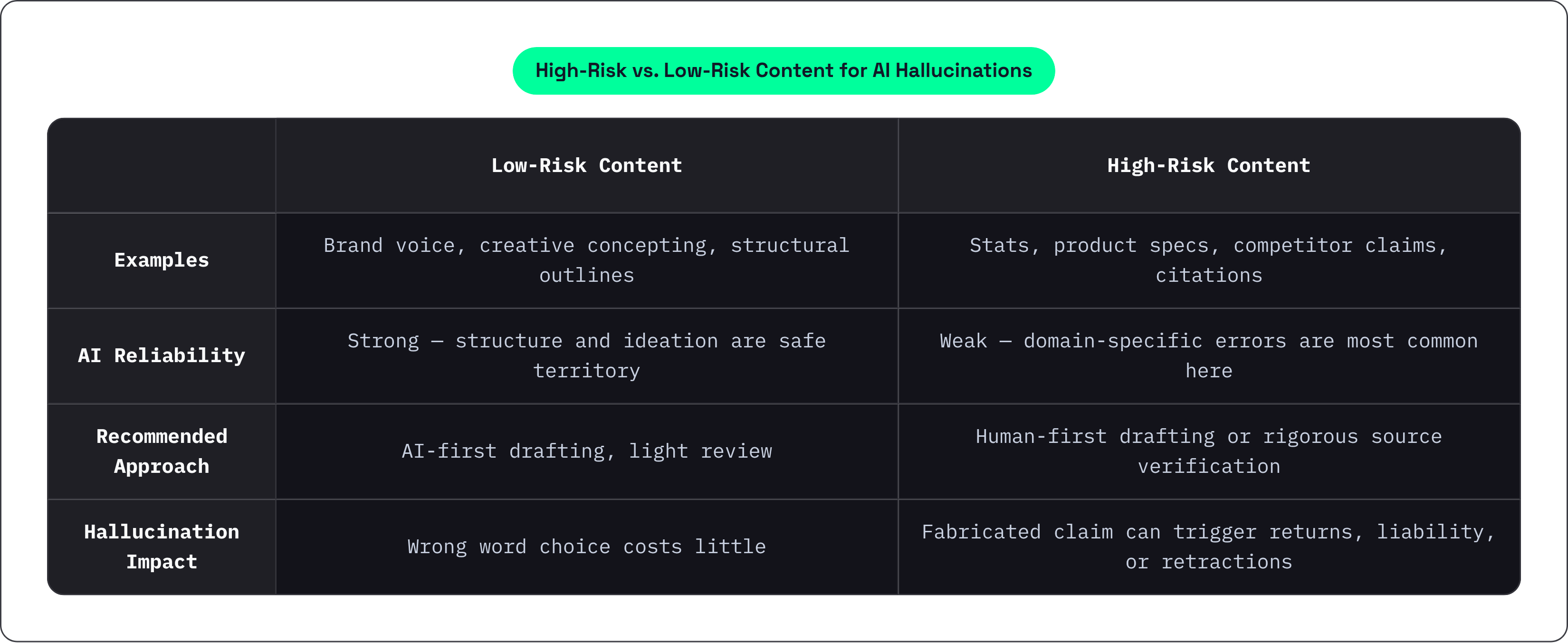
Step one: classify before you draft. Not all content carries the same risk, so stop treating it that way. Brand voice pieces, creative concepting, structural outlines, these are low-risk; AI is genuinely strong here, and a wrong word choice in a brainstorm doesn't cost you anything. Statistics, product specs, competitor claims, quotes, and citations are high-risk, full stop. AI is more reliable as a drafting partner for structure and ideation than it is as a source of fact, and your workflow should reflect that difference instead of pretending everything needs the same level of scrutiny.
Step two: source-check every specific claim, no exceptions. Any statistic, study result, or quoted source that shows up in AI-drafted copy needs to trace back to a primary source before it goes anywhere near a publish button. Can't find the source? Then the claim doesn't survive. Either rewrite it as a qualitative statement or cut it entirely. This step alone catches the majority of the worst offenders, and it takes minutes, not hours.
Step three: treat citations as their own risk category. AI-generated citations are some of the highest-risk output there is, precisely because they look the most credible. Verify that the source actually exists, and just as important, verify that it actually says what the AI claims it says. A real study cited to support a claim it never made is arguably worse than no citation at all.
Step four: bring in a subject-matter reviewer for technical and regulated content. Product pages, technical whitepapers, and anything touching health, finance, or legal claims need a reviewer who actually understands the domain, not just a general editor with a sharp eye for typos. Deloitte's team was full of experienced professionals, and a fabricated citation still made it through. Subject expertise matters here specifically because plausible-sounding wrong answers are the hardest kind to catch.
Step five: have a correction protocol ready before you need it. Decide in advance who owns a post-publication correction, how quickly it needs to go live once discovered, and whether the situation calls for public disclosure. Building this after the fact, in a panic, is how a fixable mistake turns into a longer news cycle than it needed to be.
One practical note that saves time at every step above: structured prompts that constrain AI to work only from source material you've actually provided, essentially a lightweight, do-it-yourself version of retrieval-augmented generation, reduce how many hallucinations show up in the first place. That doesn't replace the audit. It just means the audit has less to catch.
This approach aims verification effort at the parts of the content that are actually risky, instead of spreading a thin layer of generic skepticism across everything equally, which helps nothing and takes forever.
How to build hallucination prevention into the content production workflow, not just the review stage
An audit catches what's already been written. Workflow design determines how much bad material gets written in the first place. Those are two different jobs, and most teams only staff the first one.
Start upstream: give the AI grounded source material at the prompt stage, not just an instruction to "write about X." A brief, a set of verified facts, an actual research document to pull from, all of it constrains the model to working with what can be substantiated instead of inventing plausible-sounding filler. This is the practical, everyday version of what retrieval-augmented generation does at the enterprise level, minus the infrastructure budget.
Separate who generates from who verifies. This is how editorial quality control has worked for decades: the writer isn't the only person who reads the piece before it ships. The same principle applies here. The person prompting the AI is often too close to the output, too eager for it to be right, to catch what a second set of eyes would flag immediately.
Decide in advance which content types get AI-first drafting and which need human-first drafting with AI assisting on the edges. Competitor comparisons, anything regulatory-adjacent, technical specifications: human-first, AI as support. Structural outlines, creative variations, brand voice exploration: AI-first is fine, the downside risk is low. This isn't a permanent rulebook. It's a starting point you adjust as you learn where your specific pipeline tends to slip.
Build verification checkpoints into the actual content calendar, as scheduled steps, not optional extras that get skipped whenever the deadline tightens. A publishing schedule that treats fact-checking as the first thing to cut under pressure builds hallucination risk directly into the calendar and calls it a deadline.
If you're operating at real scale, track your corrections like data, because they are data. Log where hallucinations actually show up in your specific pipeline, which content types, which prompts, which sections of a brief tend to produce trouble, and use that pattern to tighten prompts and adjust workflow over time. Most teams treat each hallucination as an isolated embarrassment. Few treat them as a dataset that's actively teaching them where their process is thin.
Speed and accuracy get framed as opposites more often than they deserve to be. A workflow with clear source grounding and defined review checkpoints built in from the start produces vetted content faster, in practice, than an unstructured process that has to fix everything after the fact through endless correction cycles. The teams doing this well moved the verification earlier, so it stopped functioning as a bottleneck at the end and started functioning as a filter throughout.
That's really the throughline connecting every section of this piece: hallucinations are a predictable, well-documented cost of the specific way these systems generate language, and predictable costs are the ones you can actually plan around. Platforms that pair AI generation with real editorial structure and human expertise, rather than treating raw model output as a finished product, push more of that verification work upstream, which means less of it lands on whoever happens to be reviewing the draft at the end of a busy week.
Sources
- https://trendfingers.com/signals/ai-hallucination-marketing-guide.html
Provided the $150,000 retailer cost figure cited in the product specifications risk section.
- https://intuitionlabs.ai/articles/ai-hallucinations-business-causes-prevention
Provided the OpenAI PersonQA benchmark figure showing a newer reasoning model hallucinated on roughly 48% of answers.
- https://socialfirm.com/blog/ai-hallucinations-in-marketing/
Cited as a source on the rapid and broad adoption of AI tools among marketers.
- https://natlawreview.com/article/ai-hallucinations-are-creating-real-world-risks-businesses
Provided figures on Alphabet's market cap drop and the AI Hallucination Cases Database statistics cited in the documented cases section.
- https://rankprompt.com/ai-hallucination-in-search-how-ai-hallucinations-impact-seo-and-brand-visibility/
Provided the data points on Google AI Overviews appearing in over half of searches and 77% of businesses reporting concern about hallucinations.