Prompt Engineering for Marketing Copywriters
Structured prompts treat AI like a brief, turning generic output into conversion-ready copy.

Prompt engineering is a skill copywriters can learn the same way they learned to write a brief, and the writers getting the best results out of AI tools treat prompts exactly like briefs: audience, tone, format, and the conversion goal all specified up front. Without that specificity, a capable model gives you the statistical average of everything it's ever read, because that's what it's built to do when you leave it guessing. This piece walks through why that happens, and how the gap between forgettable AI copy and copy that actually converts turns out to be a prompting gap.
Here's the part that trips people up: GPT-4 or Claude or whatever your team runs is under-instructed. Ask it to "write me an ad headline for [product]" and it will, dutifully, hand you the most common headline shape in its training data, because that's the safest bet when you've given it nothing else to go on. The output ceiling gets set by the prompt. And you can usually spot a team stuck in this trap before you even see their output: their prompts read like search queries, their editors spend half their time scrubbing out generic phrasing to restore some semblance of brand voice, and the whole team treats AI as a first-draft machine instead of something you can actually direct. According to research from ProfileTree cited in CMSWire, the majority of AI project failures (78%, by their count) come down to poor human-AI communication, and structured prompts beat generic ones by more than 3x on conversion metrics. That's a meaningful gap, and it shows up directly in how teams experience working with these tools day to day.
How prompt engineering maps to skills copywriters already have
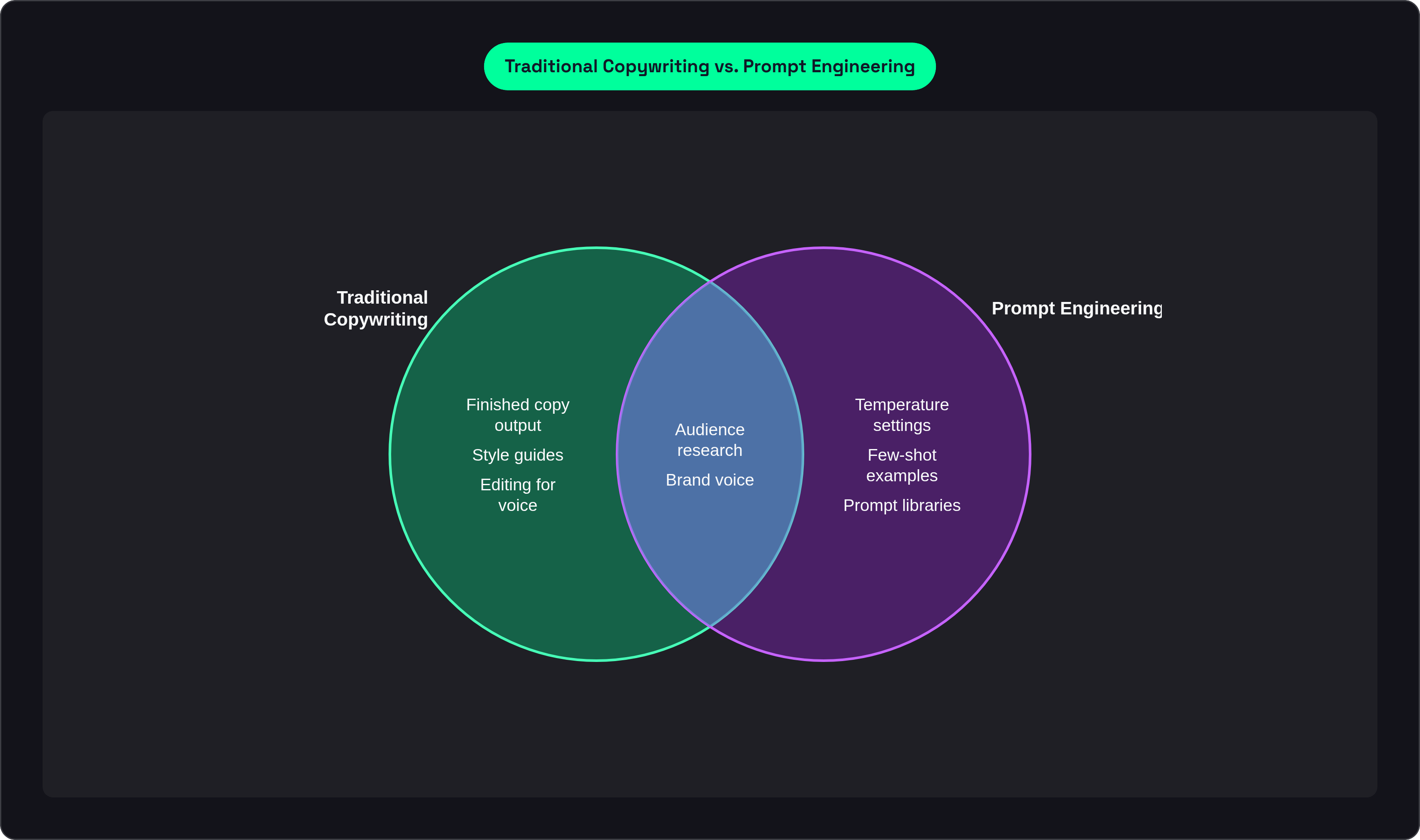
Good news first: you already know how to do this. Traditional copywriting runs on a sequence: research the audience, understand the offer, check what competitors are saying, draft a few variations, test, refine. Prompt engineering runs the identical sequence. The only thing that changes is what comes out the other end; instead of finished copy, you're producing instructions that generate copy.
Walk through the skill transfer and it maps almost embarrassingly well. Audience research becomes the context block you paste into the prompt. Tone-of-voice guidelines become the examples you use to calibrate brand voice (more on that in the next section, because describing a voice and demonstrating one are not the same exercise). Brief-writing discipline becomes prompt structure discipline. And the editing instinct that used to tell you "this needs punchier verbs" now tells you which constraint to bolt onto your next attempt at the prompt.
None of this needs a statistic to land. The point of this section is just to plant the idea that a prompt is a brief, full stop. Copywriters who write prompts like they're typing a Google search get search-engine-quality output. Copywriters who write prompts with real specificity and structure get something else entirely, and everything past this point in the article is really just an expansion on what "something else" looks like.
The four elements every high-performing prompt includes
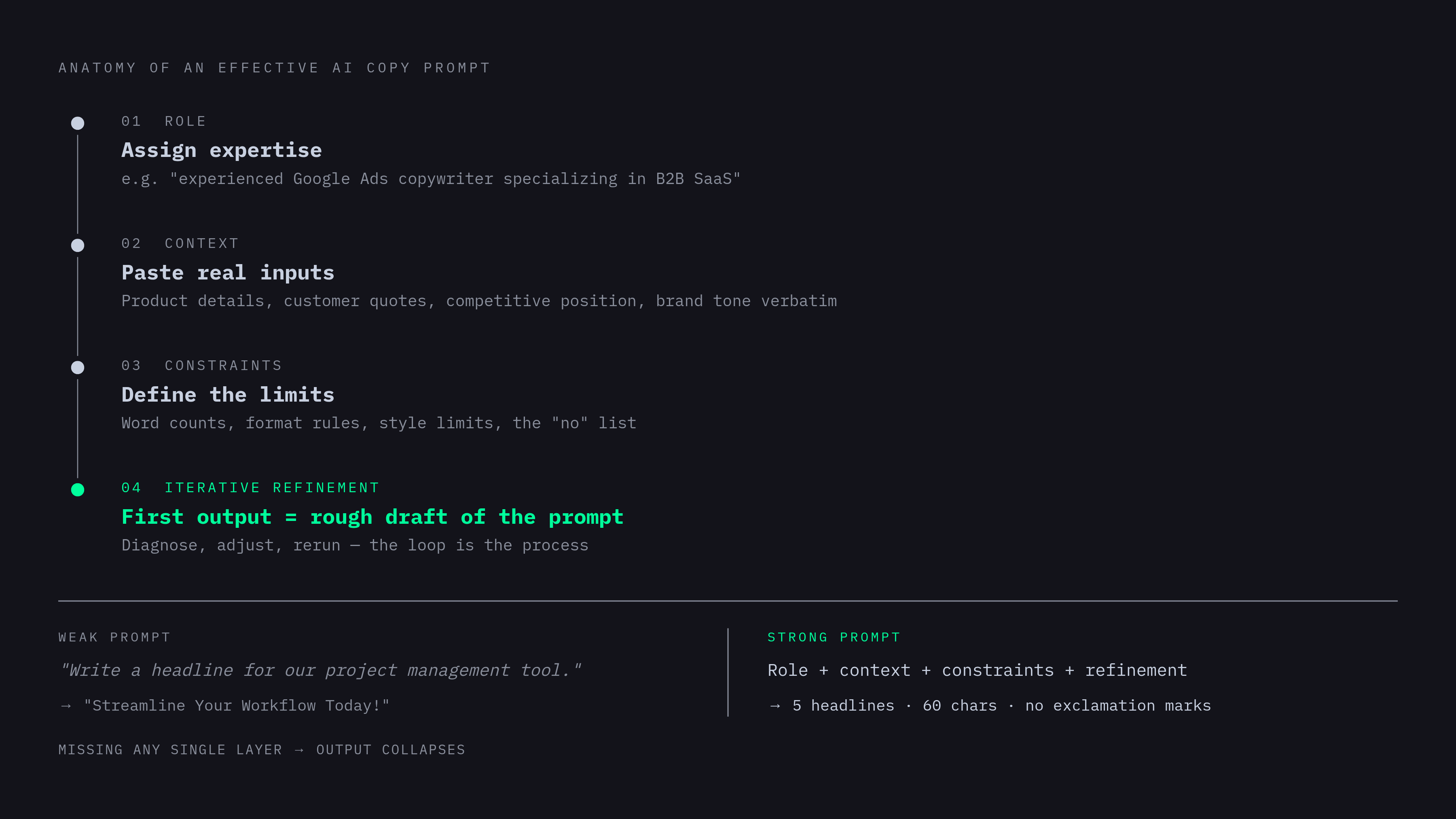
Every prompt that consistently produces usable copy has four things going on, and you can check any prompt against this list to see what's missing.
Role comes first. Telling the model "you are an experienced Google Ads copywriter who specializes in B2B SaaS" changes its output register immediately. Skip the role and you get a generic persona, which produces generic copy.
Context comes second, and it's the part most people shortchange. Context is everything the model cannot guess on its own: your actual product, your actual audience, where you sit against competitors, what your customer research actually found. This is where anything proprietary earns its keep. In practice, that means pasting your real brand tone-of-voice guidelines into the prompt instead of summarizing them in a sentence. It means dropping in real customer quotes pulled from reviews or research calls, not paraphrased versions of what customers "tend to say." It means stating the specific competitive position the copy needs to reinforce, rather than reaching for a vague claim like "premium." Vague context produces vague copy. There's no way around this one; it's almost mechanical.
Constraints are the third pillar, covering word counts, format, structure, style limits, and the "no" list, which gets its own section below because it's doing more work than people give it credit for. Constraints are what define the shape of the thing you're asking for.
Fourth: iterative refinement. Treat your first output as a rough draft of the prompt, not a rough draft of the copy. Prompts get better the same way copy gets better, through revision, and the copywriters who get frustrated after one try are the ones who never internalized this. Compare two prompts: "Write a headline for our project management tool" versus "You're a direct-response copywriter for a project management tool aimed at agency operations leads who are drowning in status-update meetings; write five headlines under 60 characters that lead with the time-saved angle, no exclamation points, nothing that sounds like it belongs on a SaaS homepage carousel." One of these gets you something you can actually run. The other gets you "Streamline Your Workflow Today."
Calibrating brand voice through examples, not descriptions
Voice drift almost always traces back to one habit: zero-shot prompting, meaning you ask the AI to write "in our brand voice" and then just... leave it there. Describing a voice and showing a voice produce wildly different results. Telling the model your brand is "warm but authoritative" gives it an adjective pair to interpret however it wants. Showing it five real examples that actually read warm-but-authoritative gives it a pattern to match.
There's a rough benchmark worth knowing here: testing across a range of brands found that providing five representative copy examples inside a prompt gets you above 90% brand voice consistency. Drop below three examples and the tone starts wobbling from output to output. Go past seven and you're mostly just eating up context window space without gaining much. Five seems to be the number where the model has enough pattern to lock onto without drowning in redundant signal.
What actually goes into a voice calibration block: five examples that nail the voice, ideally pulled from different formats so the model sees the voice flex (an email subject line, an ad headline, a paragraph of long-form copy), plus a short note under each one explaining what makes it on-brand. That second part matters more than it sounds like it should. Without it, the model might copy surface style, like sentence length or punctuation habits, and miss the actual pattern underneath.
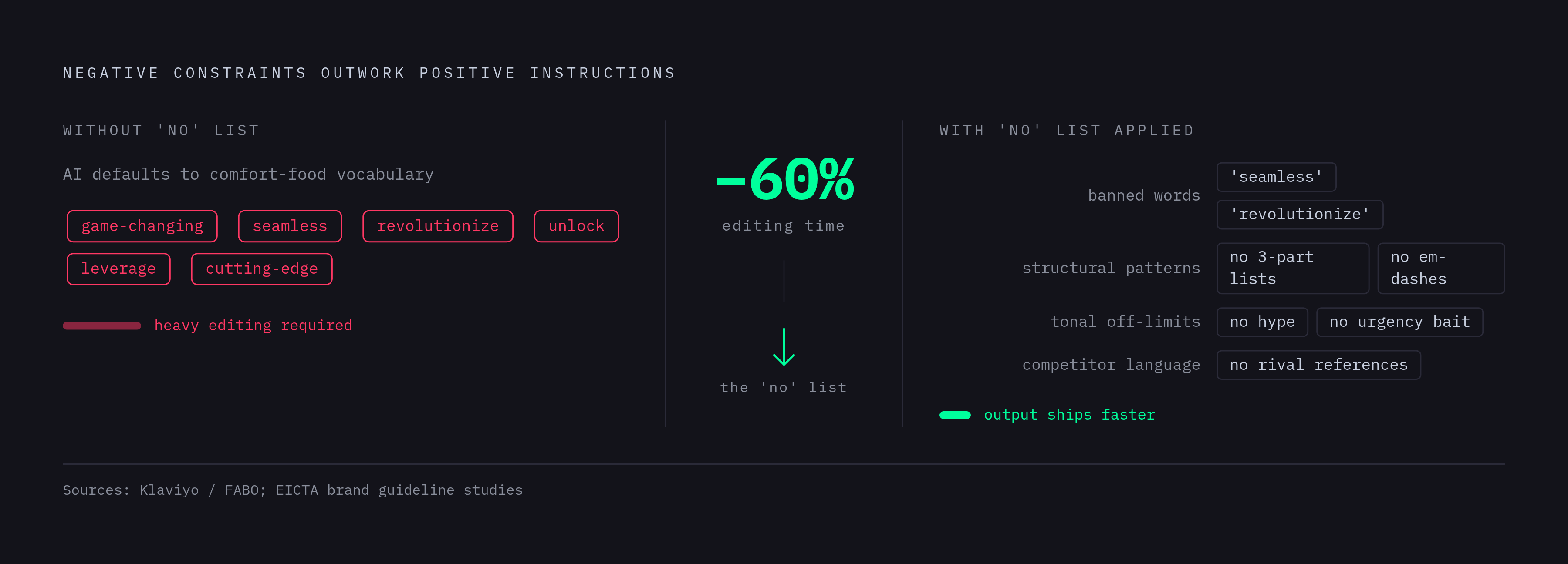
Teams that build brand guidelines directly into their prompts this way cut editing time by somewhere in the 60 to 70% range, per research cited by EICTA. And there's a real-world data point that backs this up from the practitioner side: Klaviyo's head of email retention at FABO reported that adding a "no" list to prompts cut editing time by roughly 60%, because stopping the AI from defaulting to a pattern is faster than writing copy, catching the generic pattern, and then undoing it by hand. That "no" list deserves a section of its own.
Why negative constraints do more work than positive instructions
Here's the constraint paradox: most copywriters spend nearly all their prompt-writing energy on what they want, and the biggest gains come from specifying what they don't want. Feels backwards. Isn't.
Left alone, AI defaults to the most statistically common phrases in marketing writing: "game-changing," "seamless," "revolutionize," "take your [X] to the next level." These phrases show up constantly because they show up constantly in the training data, which is a nice little feedback loop of mediocrity. Every time a brand lets one through, it erodes differentiation a little more and makes the copy that much less memorable.
A working "no" list has four kinds of entries. Specific words and phrases your brand refuses to use, ever. Structural patterns to avoid, things like "don't open with a question" or "no bullet points in this particular format." Tonal territory that's off-limits, such as "no humor" or "avoid urgency language that implies artificial scarcity." And competitor phrases or positioning language your copy needs to stay well clear of.
The rule that makes a "no" list actually work: every entry has to be specific and actionable, rather than aspirational. "Be authentic" tells the model nothing; it's a vibe, not an instruction. "Never use the word 'authentic'" is a constraint the model can actually follow. Try this side by side sometime: run the same prompt with and without a "no" list attached, same role, same context, same product. The version with the "no" list comes back noticeably tighter, because the model isn't drifting toward its comfort-food vocabulary. The constraints carry more of your brand voice than the positive instructions do. They mark the edges the model isn't allowed to cross, and edges are what make a voice recognizable in the first place.
Chain-of-thought prompting for copy that requires strategic reasoning
Chain-of-thought prompting means asking the model to reason through a problem step by step before it writes anything, instead of jumping straight to finished copy. Why bother? Because copy that actually converts depends on understanding audience psychology, competitive white space, and emotional triggers, none of which a formatting instruction can supply on its own.
Here's a three-prompt sequence for competitive positioning work that shows the idea in action. First prompt: feed the model competitor landing page copy and ask it to pull out the primary value propositions each one is making. Second prompt: ask which buyer personas those value props are aimed at, and why. Third prompt: compare those personas against your own feature set and ask where the gaps are, the territory competitors aren't claiming. That gap is where your positioning copy comes from, and it's not something you could've gotten by just asking for "a landing page headline" on the first try.
What comes out of a sequence like this is a strategic brief the model built for itself, one step at a time, before it ever wrote a headline. And the quality of the final copy tracks the quality of that reasoning almost one to one. So when do you bother with all this versus just firing off a single prompt? Single prompt, when the audience is known, the format is known, the message is known, and speed matters more than nuance. Chain-of-thought, when you're in a new market, working with an unfamiliar audience, doing positioning work from scratch, or facing any copy problem where the right angle just isn't obvious yet.
Matching temperature and few-shot examples to the copy task
Temperature is the dial most copywriters never touch, and it's doing more than people realize. On a scale of 0.0 to 1.0, low temperature (say, 0.1 to 0.3) gives you deterministic, tightly focused output, right for analyzing campaign data, summarizing research, formatting structured copy, anything where you want consistency more than variety. High temperature (0.7 to 0.9) gives you looser, more generative output, right for ad copy brainstorming, hook ideation, subject line variations, anything creative where you want the model to wander a little.
Most people leave it at the default setting and then wonder why their brainstorming session feels flat or their data-summary prompt comes back weirdly inconsistent. Temperature is usually the fix, and it takes one line to add.
Few-shot prompting is the other lever: give the model two or three examples of the exact output format and style you want before you ask it to generate anything new. This works especially well for formats with strong structural conventions, things like email subject lines, Google Ads headlines, SMS copy, product descriptions, where the pattern matters as much as the content. Examples teach the model the pattern in a way explicit instructions often can't quite capture; there's a nuance in how a good subject line is built that's hard to describe in words but easy to demonstrate.
Combine the two levers and you get real control. Low temperature plus few-shot examples gets you highly consistent, on-format output, good for high-volume production work. High temperature plus few-shot examples gets you creative variation that still stays inside the format's guardrails, which is exactly what you want when you're generating fifteen headline options for an A/B test and don't want fourteen of them to be near-duplicates of each other.
Where structured prompting pays off most in marketing workflows
Email sequences are one of the clearest wins here. A single well-built prompt can generate a five- to seven-email sequence with narrative arc, progressive information disclosure, and escalating calls to action baked into the structure from the start. The variable that actually matters is lifecycle specificity: tell the model exactly where the customer sits in their journey and what they're probably feeling at that moment, not just which automation flow triggered the send. Do that well and the prompt is doing the job a content calendar and a sequence map used to do by hand.
Ad headlines and paid copy are the other obvious win, mostly because of volume. Structured prompts can generate enough headline variations to make real A/B testing viable without a proportional increase in manual effort. The prompt needs to specify platform constraints, character limits, one conversion goal (just one), the audience segment, and two or three angles worth exploring.
SEO and long-form content show up here too, and there's a concrete case worth mentioning: Stick Shift Driving Academy adopted AI-generated content briefs and keyword suggestions through MarketMuse and saw a 72% jump in organic traffic alongside a 110% increase in lead form completions. The lesson here is that the prompt producing the content brief matters just as much as the prompt producing the final copy, maybe more.
And then there's the cross-tool angle, which is where things get genuinely interesting. One practitioner at Klaviyo described using a single production brief prompt to kick off the copy, the project management task, the email build, and the design prototype all at once, letting AI handle execution across every tool involved. In their words: "I'm not writing four separate briefs in four tools. I'm writing one production brief and the AI handles the execution across all of them." That's the version of prompt engineering that functions as infrastructure.
Building a prompt library as the team's institutional copywriting knowledge
Content teams used to invest in style guides. Now the smart ones are investing in prompt libraries: the library becomes the codified expertise of the whole organization, not just whatever one person happens to remember about how the brand voice works.
A prompt library worth having contains a few things. Prompts that have already produced strong output, with a note on why they worked, so nobody has to reverse-engineer success from scratch. The brand voice calibration block, meaning the five examples discussed earlier, kept current as the voice evolves over time. Task-specific templates for email, ad headlines, and landing pages, each one with its constraints pre-loaded so nobody starts from a blank page. And a shared "no" list that every prompt in the library inherits by default, so the whole team benefits from lessons learned once by whoever hit that wall first.
There's an alignment benefit that spills outside the copy team too: when sales and marketing use consistent prompt frameworks for prospect-facing messaging, the buyer hears a coherent voice across the whole journey, and the prompt library enforces that without anyone having to police it manually.
Worth sitting with this number for a second: only about 13% of marketing teams feel fully equipped to use AI tools effectively, and something like 62% of firms don't train employees on prompting at all, according to the Marketing AI Institute, as cited by CMSWire. That's a wide skills gap, and a prompt library is one of the most direct ways to close it, because it takes the knowledge locked in your best prompter's head and makes it available to everyone else on the team. It's the same kind of infrastructure a style guide always was, just built for a different tool.
Platforms like Manifesto, which pair AI-assisted writing with a strategy-first workflow, give teams a place where this kind of prompt discipline is built into the process itself rather than left to whichever individual happens to be good at it that week.
What the output data actually says about AI copy, human copy, and the hybrid
Start with the favorable numbers, because they're real: marketers using AI-generated content report a notably higher conversion rate on landing pages, and AI copywriting tools have been shown to lift ad click-through rates substantially while cutting cost-per-click meaningfully, according to data from Zebracat cited by Wunderland Media and Siege Media. Those are not small margins.
But the picture gets messier once you zoom into direct-response and brand copy specifically. In head-to-head comparisons within certain paid search contexts, human-written copy has actually outperformed AI-generated copy; the data doesn't uniformly point one direction, and anyone telling you it does is oversimplifying. What seems to actually separate winning copy from losing copy, across most of these comparisons, comes down to a structured prompt paired with human editorial judgment, versus neither. The teams getting the 36% lift aren't the ones who typed a lazy prompt and shipped whatever came back. They're the ones who did everything this article just walked through, and then still read the output with a human eye before it went live.
That's the whole argument, really, compressed into one comparison. The prompt is the bottleneck, and the prompt is something you can actually get better at, the same way you got better at writing a headline: by practicing, by keeping what works, and by throwing out the version that sounds like every other version.
Sources
- https://www.digitalapplied.com/blog/prompt-engineering-marketing-copy-templates
Provided the benchmark about using five representative copy examples to achieve above 90% brand voice consistency.
- https://www.cmswire.com/digital-marketing/prompt-engineering-and-its-vital-role-in-ai-driven-marketing/
Provided the statistics on AI project failure rates due to poor human-AI communication and the finding that 62% of firms don't train employees on prompting.
- https://www.eicta.iitk.ac.in/knowledge-hub/digital-marketing/prompt-engineering-for-digital-marketers
Provided the research finding that embedding brand guidelines in prompts cuts editing time by 60 to 70%.
- https://skai.io/blog/marketers-guide-to-prompt-engineering/
Provided the statistic that only 13% of marketing teams feel fully equipped to use AI tools effectively.