AI Writing Tools for Long-Form Blog Posts
Marketers are using AI to draft faster, but humans still handle the final edit.

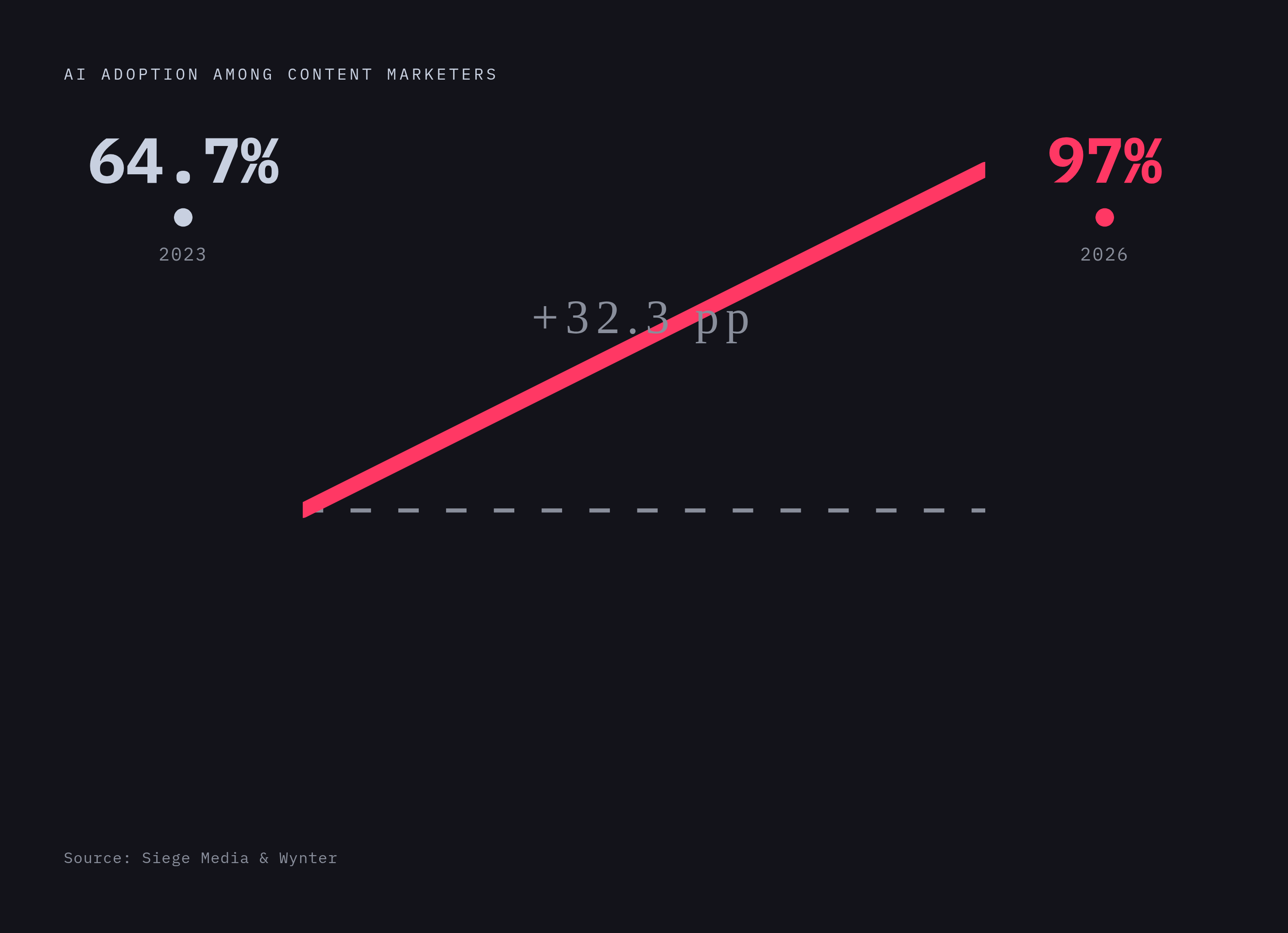
The adoption numbers have become, frankly, a little absurd. According to a 2026 Siege Media and Wynter study, 97% of content marketers plan to use AI to support content marketing in 2026, up from 64.7% in 2023. That is not a trend line; that is near-saturation inside three years.
The raw adoption figure is less interesting than the use-case breakdown, though. Per Social Media Examiner's 2025 report, drawing on more than 730 respondents, 90% of marketers use AI for text-based tasks and 89% for draft creation. Industry research places content ideation at 71% and content development at 68% as the top reported applications. Notice what is conspicuously absent from the top of that list: final copy production. Marketers are using AI to accelerate the front and middle of the workflow, not to remove the human from the end of it.
That raises an important question: if AI is handling ideation and drafting, why are 86% of marketers, per 2025 industry data, still editing AI-generated content before publication? Because they understand what the tool actually delivers: a capable first draft, not a finished piece. AI gets the train moving; a human conductor still decides where it stops.
The market has moved past the "should we use AI?" debate. The operative question now is which tools, used in which sequence, produce content that actually performs.
What actually separates a long-form AI writing tool from a general text generator
One argument holds that underlying models are so powerful that the tool layered on top is largely irrelevant. That argument was defensible two years ago. Today it misses the point.
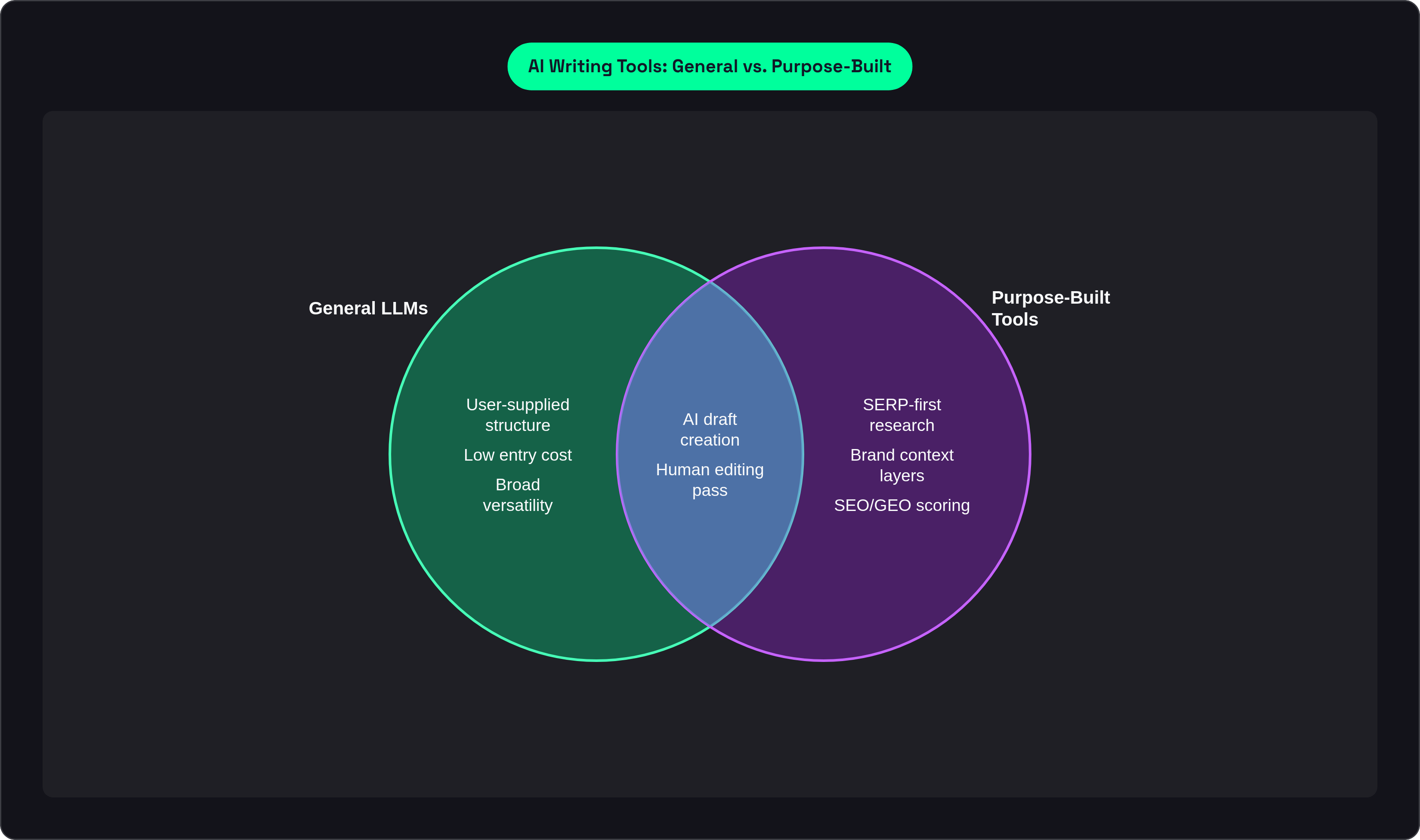
Most purpose-built writing platforms share the same foundational large language models: GPT-4 variants, Claude, similar architectures. Raw generation quality between platforms has narrowed considerably at the model level. What differentiates tools built for long-form production is the infrastructure surrounding the model.
Four factors are worth examining. First, context management: the ability to hold and consistently apply brand voice, style guides, and audience profiles across a document running several thousand words. Without it, the AI's register drifts between sections, and the result reads like it was assembled by a committee that never convened. Second, SERP and competitive awareness: tools that ingest what is already ranking for a target keyword before generating a single word are working from evidence rather than assumption, which is a fundamentally different starting point. Third, structural scaffolding: outline-first generation versus raw prose generation is a meaningful operational distinction. An AI working from a validated outline produces more coherent long-form drafts than one generating from the top of the document down and hoping structure emerges somewhere around paragraph four. Fourth, context window size: for documents running several thousand words or longer, a narrow context window produces a specific failure mode where the model loses the thread between sections. Claude's very large context window is a practical advantage for documents where coherence across length is the primary challenge.
General-purpose LLMs, meaning ChatGPT or Claude used directly without additional workflow layers, are strong tools for writers who supply their own structure, competitive research, and editorial judgment. They do not automate the strategy layer; they reward users who have already done that work. The useful evaluative question is: does the tool handle research, structure, and SEO alignment, or does the writer have to complete all of that before the tool becomes useful? Both models can work. Only one of them reduces total production time.
The main tools worth considering for long-form blog production
ChatGPT
ChatGPT dominates marketer adoption by a considerable margin. The 2026 Siege Media and Wynter study puts its selection rate at 80%; Social Media Examiner's 2025 report clocks overall usage at 90%. Those numbers reflect genuine capability compounded by the advantage of being the platform most marketers encountered first.
For long-form work, ChatGPT is strongest in the hands of users who arrive with a well-constructed brief, a clear structure, and specific editorial direction. It does not automatically supply competitive research or SEO alignment; the writer does that upstream. ChatGPT Plus runs at a low monthly cost. The Pro tier at a significantly higher monthly cost adds Operator agents, which begin addressing multi-step workflow automation.
Claude
Claude's reputation in long-form work centers on two things: narrative coherence and context capacity. Its 200,000-token context window makes it the more reliable choice when document length and internal consistency are the primary constraints. Among content marketers in the 2026 Siege Media and Wynter study, its selection rate came in second, behind ChatGPT but meaningfully ahead of other alternatives.
Claude does not come with built-in SEO workflow automation. It is the right choice when the writing needs to hold together at length, and when the user can supply strategic context before prompting.
Jasper
Jasper is built for marketing teams, and that orientation is visible in its architecture. Jasper IQ functions as a context layer: it stores brand voice parameters, style guides, and audience profiles so output stays consistent across writers, campaigns, and time. That capability is largely irrelevant for solo bloggers and genuinely valuable for teams managing multiple authors at scale.
Adidas reportedly used Jasper to generate a large volume of product descriptions within 24 hours, which illustrates the enterprise-scale throughput the platform is designed to support. Jasper had a difficult 2024 as ChatGPT captured significant market share, but its pivot toward marketing agents, including AEO, GEO, and SEO rewriting tools, represents its fastest-growing capability area as of 2026. Jasper Pro runs at a mid-range monthly cost per seat on annual billing, with a seven-day free trial.
Frase
Frase's workflow logic is SERP-first: it scrapes top-ranking results for a target keyword, surfaces content gaps, builds an outline from that competitive data, and then moves into drafting. Real-time SEO and GEO scoring runs throughout. The underlying premise is that you should understand what is already ranking before you write a single word, not after.
For teams targeting competitive keywords where ranking requires matching and exceeding existing coverage, this sequencing is more efficient than generating a draft and optimizing it afterward. That is not a minor operational note; it represents a different theory of how to produce content that ranks.
Surfer SEO
Surfer SEO's Content Editor scores drafts in real time against top-ranking pages, flagging term usage, heading structure, word count, and NLP entity coverage as you write. In 2026, Surfer added an AI Tracker that monitors brand mentions across ChatGPT, Claude, Perplexity, and other AI surfaces, and scores content for visibility in both traditional SERPs and AI-generated responses.
Surfer is best understood as an optimization layer that works alongside a drafting tool, rather than a standalone drafting environment. Teams that treat it that way, layering it on top of ChatGPT or Claude output, get more from both tools.
KoalaWriter
KoalaWriter operates on a simple premise: keyword in, long draft out, with real-time SERP analysis informing the output. One-click WordPress publishing makes it a practical choice for teams moving from brief to CMS without unnecessary friction. It is not the most sophisticated tool on this list, but operational efficiency at the right stage is its own form of sophistication.
Writer
Some enterprise content platforms are built for organizations requiring style enforcement, approved language controls, and team-level governance across departments. These tools are the right choice when brand consistency and compliance matter at organizational scale; they are not suited to solo bloggers or small teams who do not have the organizational complexity that infrastructure is designed to manage.
Manifesto
Manifesto approaches the problem from a strategy-first orientation, combining AI-assisted drafting with editorial quality controls and brand alignment built into the production workflow rather than applied after the fact. It is relevant for marketing leaders who want to own production without routing work through slow agency relationships, and who operate in competitive markets where content needs to convert. The emphasis on editorial oversight alongside AI generation reflects an honest read of where the ceiling on purely automated output currently sits.
How to match the right tool to the job your team actually has
The primary architectural decision is between drafting tools, optimization tools, and integrated platforms. Most teams need at least one from each category, or a platform that combines them. The mistake is assuming any single tool covers the full production workflow.
For solo bloggers or small teams, ChatGPT Plus or Claude used with a detailed brief, combined with Surfer SEO layered on for optimization, covers most use cases at relatively low cost. The constraint is that the writer must supply the strategic and structural inputs; neither tool automates those.
For marketing teams managing multiple authors or brands, a context-layer tool like Jasper, or a platform with brand controls like Manifesto, pays for itself in consistency. The "sounds like a different company on every page" problem is not a talent failure; it is a missing-infrastructure failure.
For teams targeting competitive keywords, SERP-first tools like Frase, KoalaWriter, and Surfer should operate upstream of the draft, not downstream. Generating first and optimizing after is the less efficient order of operations, and it produces drafts structured around the writer's assumptions rather than the competitive landscape.
Organizations needing AEO and GEO visibility alongside traditional SEO should be evaluating tools with AI-surface tracking. Roughly 60 to 68% of U.S. Google searches ended without a click in 2026, which means distribution through AI-generated responses is a present operational concern, not a future one.
Budget is a practical filter, not a secondary consideration. The range from entry-level tools to ChatGPT Pro at roughly $200 per month is wide enough that the right entry point is determined by volume and workflow complexity.
The workflow that produces long-form content that actually performs
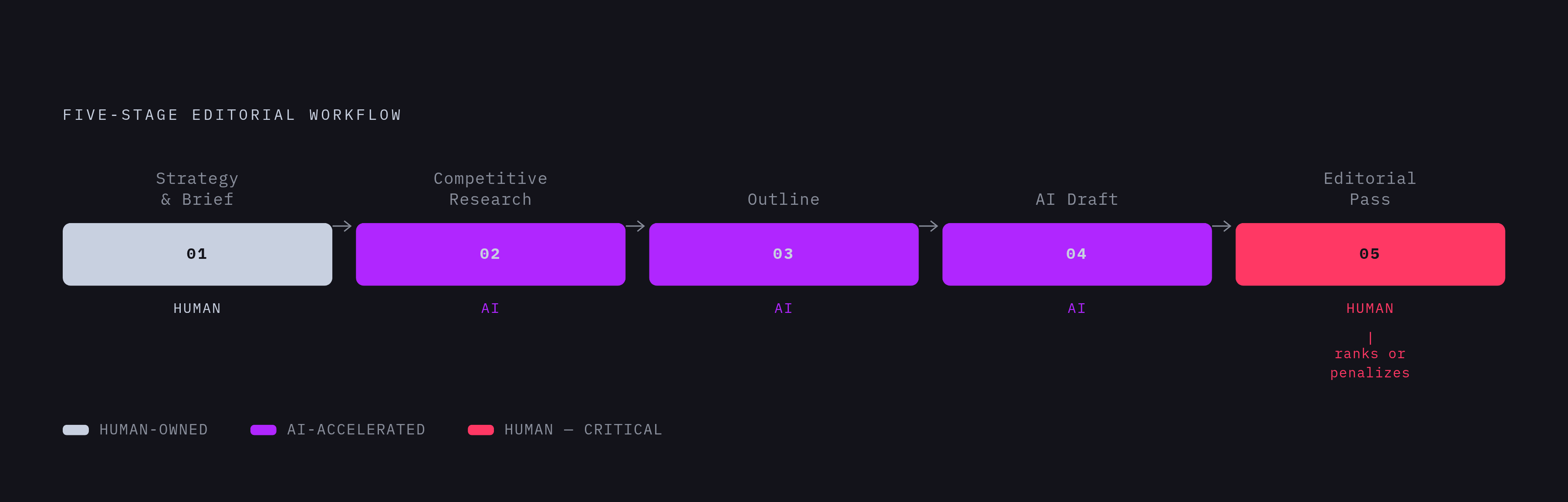
The fundamental production sequence is not complicated, but it is routinely violated: strategy and brief first, then competitive research, then outline, then draft, then a human editorial pass. AI is most valuable in the middle stages. Despite what many early adopters assumed, it is not most valuable as the initiating step.
What belongs in a strong brief before any AI tool touches a document: the target keyword and search intent, audience specificity, the desired argument or point of view, claims that are off-limits, and required sources or data. That is not a lot of information to specify. It is, however, information that most teams skip in their rush to get to generation.
The outline functions as a quality gate, not a formality. Tools that generate outlines from SERP analysis, like Frase and KoalaWriter, consistently produce better-structured drafts because the outline exposes structural gaps before they are baked into paragraphs. Fixing an argument at the outline stage takes minutes; restructuring a lengthy draft takes considerably longer and tends to happen on a Friday afternoon.
It is also worth noting what the 86% editing figure from 2025 industry data actually signals at the workflow level. The teams skipping the editorial pass before publication are the ones producing what Google's March 2026 Core Update classified as "scaled content abuse." The editorial pass is not overhead; it is the step that separates content that ranks from content that penalizes the domain it lives on.
E-E-A-T, Google's framework for evaluating Experience, Expertise, Authoritativeness, and Trustworthiness, functions as a practical production checklist. AI drafts require original examples, first-person perspective, or expert attribution layered in. These are elements no LLM can generate from training data alone, because they derive from lived experience that does not exist in any training corpus.
The GEO layer adds a newer requirement: content needs to be citable by AI search surfaces, including ChatGPT, Perplexity, and Google AI Overviews. Clear factual claims, structured headings, and attributed sourcing increase citation likelihood in AI-generated responses. For teams competing for visibility in 2026, this is not optional.
What the productivity gains actually look like, and where the ceiling is
The CoSchedule 2025 data, drawn from over 1,000 respondents surveyed in December 2024, found that marketers using AI are more than 25% more likely to report content success; 64% indicate AI-generated content performs as well as or better than manually created content. Social Media Examiner's 2025 AI Marketing Industry Report found 84% of marketers increasing their AI usage over the prior year.
On cost reduction: AI-generated content can be up to 4.7 times less expensive than content created entirely by humans, with production costs reduced substantially when AI handles first drafts, per Typeface's 2026 analysis. Those figures deserve scrutiny before they drive editorial budget decisions. They reflect the cost of drafting, not the cost of the full production workflow including research, editing, and E-E-A-T additions.
That is where the ceiling becomes relevant. Speed gains are front-loaded in drafting. Research, strategy, editorial quality control, and experience-layer additions still require human time. Teams that stripped those steps to chase the speed number ended up producing content Google classifies as "scaled content abuse," which is a formal category with real ranking consequences, not a vague editorial concern.
But what if speed is precisely the point? That is a legitimate position, and it is worth stress-testing. AI tools do accelerate production volume measurably. The ceiling appears when you need differentiated content: pieces with original data, named examples, and a defensible point of view. Those still require the human layer that current tools cannot replicate. That ceiling will move. It has not moved yet.
What to watch as these tools keep changing
The convergence trend is already visible: underlying LLM quality differences between platforms are narrowing. The lasting differentiators will be workflow design, context management, and integrations. Choosing a tool because it has the most capable model underneath it is a selection criterion with a shrinking half-life — like picking a race car for its paint job while the engines under every hood are becoming indistinguishable.
AI search is restructuring what "ranking" means at a more fundamental level. When AI Overviews, Perplexity, and ChatGPT are answering queries directly, the tools adding GEO and AEO optimization are building toward where distribution is actually heading. That shift is not imminent; it is in progress.
Agentic workflows are the near-term frontier worth monitoring. Jasper's expanding agent ecosystem and ChatGPT Pro's Operator mode both point toward tools that manage multi-step production pipelines autonomously, from brief to draft to SEO check to publication, rather than tools that only draft. A tool that can run that sequence autonomously compresses production time in ways that single-stage tools cannot.
But the strategic implication cuts both ways. Agentic tools amplify whatever brief and context they are given. A weak strategy produces more weak content, faster — garbage in, garbage out, just at a scale that would make your old content calendar weep. The marketing leaders who benefit most from increasingly autonomous AI production are the ones who had already invested in the content strategy layer: keyword research, audience specificity, editorial standards, brand differentiation. Tools do not supply those things; they execute against them.
The durable selection criterion, the one that survives model updates and feature releases, is this: choose the tool built around a workflow your team can actually own, iterate, and improve over time. Not the tool with the longest feature list. Not the one with the highest-profile LLM under the hood. The workflow is the advantage; the tool is what you use to run it.
Sources
- https://www.siegemedia.com/strategy/ai-writing-statistics
Provided the adoption statistics including the 97% figure for 2026 and 64.7% for 2023, as well as the 90% figure for text-based tasks.
- https://www.allaboutai.com/resources/ai-statistics/ai-writing/
Provided the statistics on content ideation (71%) and content development (68%) as the top reported AI applications.