Content Strategy for B2B SaaS Companies

B2B SaaS content strategy fails most companies not because they produce bad content, but because they architect it around assumptions that don't match how their buyers actually behave. The sales cycle is long, the buying committee is plural, and the product requires genuine comprehension before anyone will sign. Generic advice about "creating value" dissolves against those realities. What works is a framework built specifically around the conditions of B2B SaaS: who buys, how they research, and what they need to believe before they'll move.
The global SaaS market is approaching $390.5 billion in 2025 and is projected to nearly double by 2029. That growth doesn't expand buyer attention proportionally. SaaS companies average nearly ten direct competitors each, and the volume problem is structural. The companies that win aren't necessarily publishing more; they're publishing with more precision.
How B2B SaaS buyers actually move through an evaluation, and where they're doing it
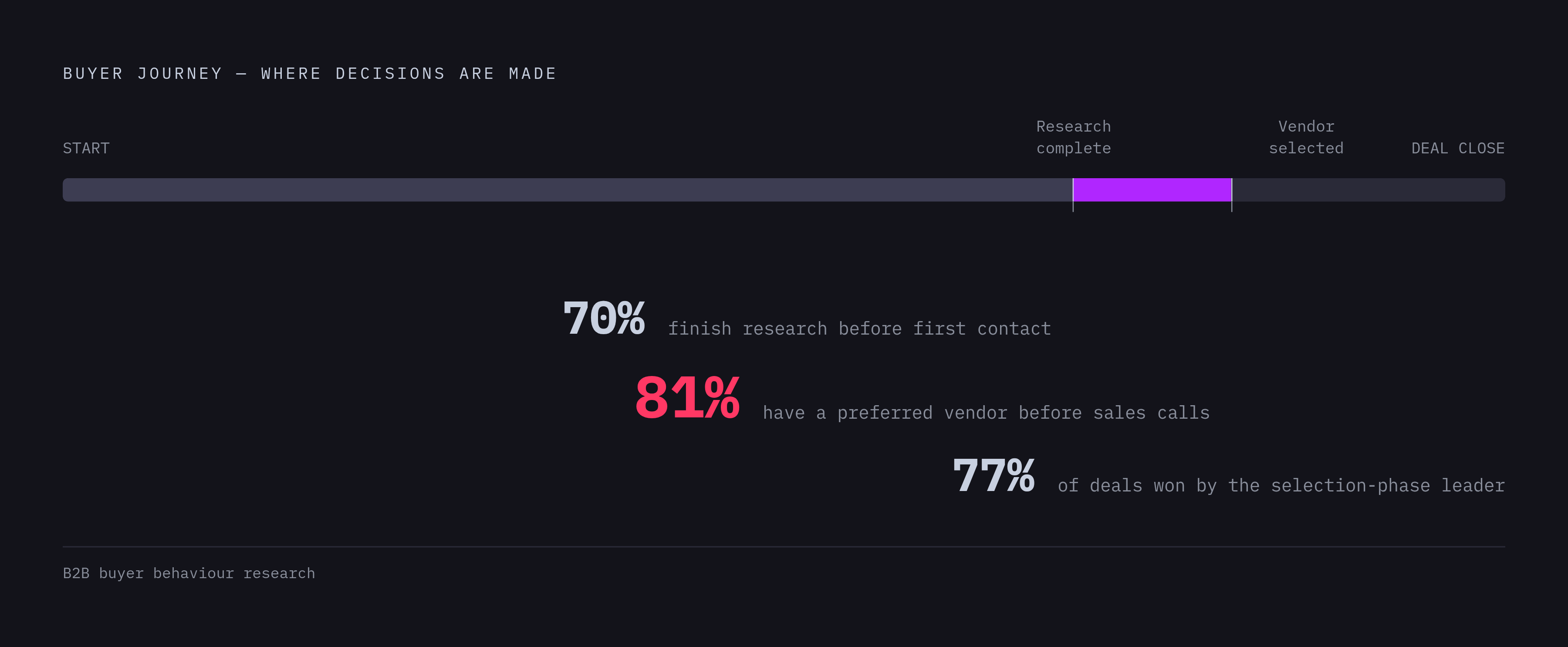
Here's the number that should restructure every content decision you make: 81% of B2B buyers select their preferred vendor before speaking with sales. Seventy percent complete their research journey before contacting a vendor at all. Which means your content experience is the first sales conversation — not a warm-up to it, but the conversation itself.
Buyers don't arrive at a vendor relationship through a clean funnel. They read three to five pieces of content before speaking with a salesperson. They spend weeks or months in independent research before ever entering your CRM. And the shortlist they carry into that research phase is less stable than most vendors assume. According to Gartner's 2025 Tech Trends Survey of 3,500 B2B decision-makers, 83% of buyers alter their initial vendor lineup during evaluation, dropping one vendor at each successive stage. The vendor who wins the Selection Phase wins the deal 77% of the time, according to the 6sense B2B Buyer Experience Report from 2025. That specific moment is the conversion event. Everything else is table stakes.
Where they're doing this research matters just as much as what they're reading. As of 2025, 89% of B2B buyers use generative AI for self-guided research, per Forrester. That shift has compressed the awareness stage and made traditional gating strategies significantly less effective. But the more consequential finding is about trust: 64% of B2B buyers cite peer recommendations from private channels as their most trusted source during evaluation, ranking higher than analyst reports and vendor-produced content. That research is happening in Slack communities, private LinkedIn DMs, WhatsApp groups, podcast conversations, and gated professional forums. None of it surfaces in your analytics.
Peer review content was cited as a decisive validation source in 68% of closed-won decisions across a 2025 win-loss analysis by The Starr Conspiracy, covering sixty B2B technology deals. Gartner's 2024 data shows 86% of enterprise buyers consult peer review platforms before final selection.
The strategic implication is straightforward: if buyers are forming and revising shortlists across ten or more channels, without vendor involvement, and trusting peers over vendor content, then your content must be findable, credible, and structured to answer the questions buyers are already asking in channels you cannot see.
Why starting at the bottom of the funnel produces faster results than awareness-first approaches
The conventional playbook says build awareness first, then nurture downward. The evidence points the other way, at least for SaaS. Revenue-first content prioritization — which means starting with bottom-of-funnel assets and building backward — delivers two to three times higher conversion rates than awareness-first approaches.
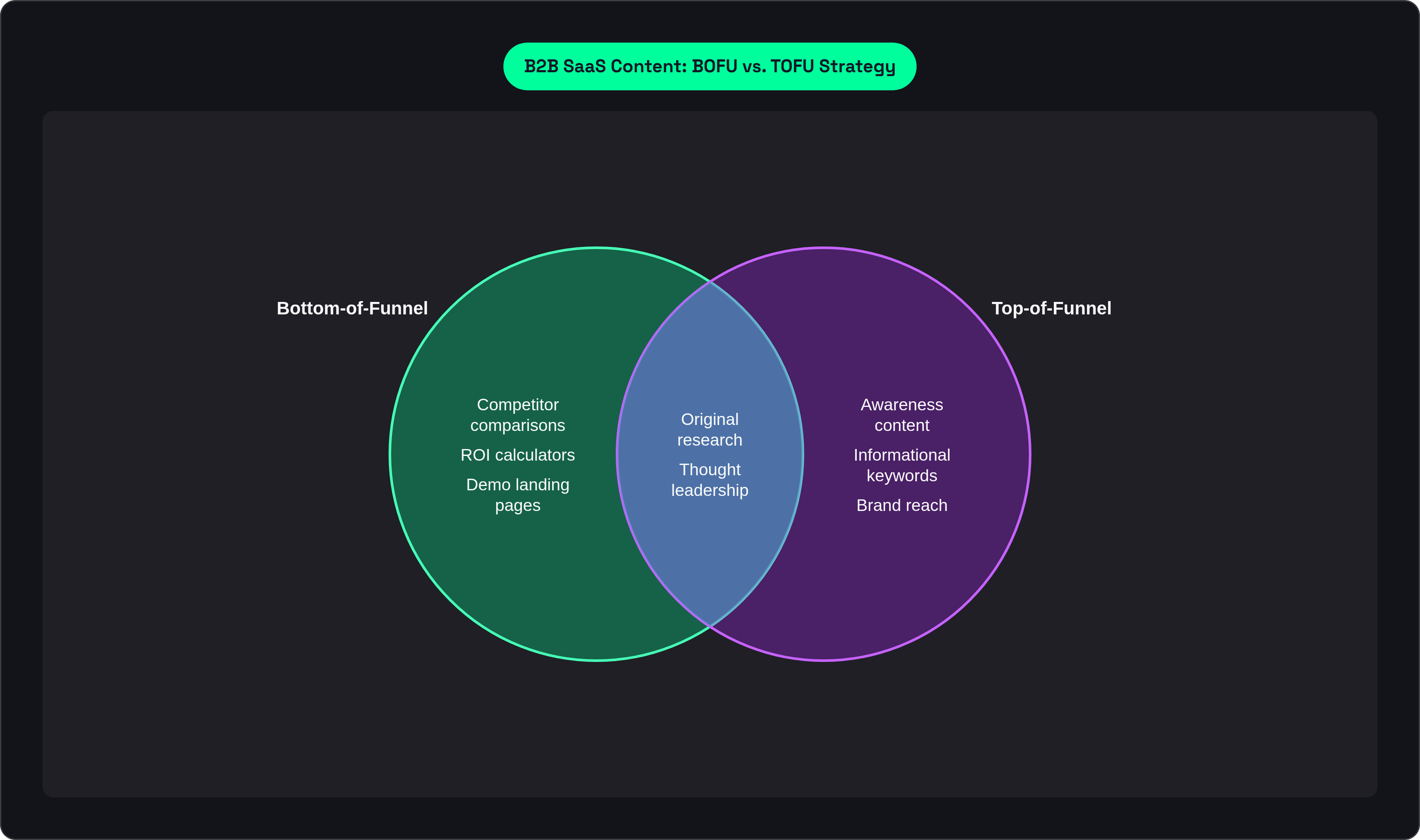
Bottom-of-funnel content in B2B SaaS targets buyers who've already done the categorical thinking. Competitor comparison pages, such as "X vs. Y" formats, reach buyers who've identified their category and are narrowing a shortlist. Alternatives pages capture buyers who've evaluated and rejected a specific tool. Use-case pages answer the question every evaluator actually asks: does this work for my specific situation? ROI calculators answer the finance approver's question before it gets raised in a room where you're not present. Demo and trial landing pages are the conversion event itself.
The keyword logic is simple but often ignored. A prospect searching for "CRM implementation timeline" is materially further into purchase consideration than one searching "what is CRM." Bottom-of-funnel content targets the former. The purchase intent is already present; your job is to be there for it.
Once that BOFU content is performing and converting, you build backward: consideration-stage content like case studies, implementation guides, and feature comparisons supports the deals in motion. Then awareness content feeds new volume into the top. The sequencing matters because it lets the revenue-generating layer prove itself before you're subsidizing a top-of-funnel content operation with no demonstrated path to return. This isn't an argument for abandoning awareness content permanently; it's an argument for deferring it until the foundation is operational.
How to build content that addresses every member of a buying committee without losing focus
A single mid-market B2B SaaS deal will typically involve at minimum four distinct roles: a technical evaluator worried about implementation risk and integration complexity, a finance approver evaluating total cost of ownership and contract terms, end users assessing whether the product fits the way they actually work, and an executive sponsor who needs language to build internal consensus. Each of them will research independently. Few of them will share what they found.
The most common failure is content that speaks precisely to one of those personas and implicitly assumes the others will be persuaded by proximity. They won't be. The second most common failure is content so broad it satisfies no one's specific concerns. Both failure modes result in deals dying late, in rooms where a CFO asks a question about ROI or a developer raises an integration concern that vendor content never addressed.
The solution is mapping objections by role rather than by funnel stage. A CFO's objection at the consideration stage is categorically different from a developer's objection at the same stage, and both are different from an end user's concern about workflow disruption. Technical documentation, API references, and integration guides are content; they address implementation risk for technical evaluators and belong in your content strategy, not siloed in a support portal. ROI calculators, total cost of ownership comparisons, and business case templates address finance approvers who often don't appear in early sales conversations but have full authority to kill deals late. End-user onboarding content and workflow walkthroughs reduce adoption risk concerns from managers who've experienced failed software rollouts before. Executive-level industry framing gives sponsors the language to advocate internally.
Sixty percent of B2B buyers make final purchase decisions based on digital content, and they consistently prefer content that demonstrates rather than asserts. This preference is most acute for technical evaluators, who will discard a claim they can't verify against documented product behavior. The distribution corollary: because committee members research independently through their own search behaviors, each piece of content must be discoverable through the queries that specific persona would actually run. A gated asset delivered through one campaign won't reach all of them.
The content formats that earn trust at each stage of a B2B SaaS evaluation
The format question isn't aesthetic. Different formats perform materially different jobs at different points in an evaluation, and mismatching format to stage is a common and costly mistake.
Case studies at the conversion stage
Seventy percent of B2B marketers identify case studies as the best format for converting leads to deals, according to Content Marketing Institute data. Sixty-two percent of SaaS companies publish case studies specifically to build traffic and trust. The ones that work share three properties: a named customer, a quantified outcome, and enough implementation detail that a skeptical evaluator can assess whether the scenario resembles their own. "We helped a company improve efficiency" is not a case study; it's a placeholder. A real case study is a before-and-after story with receipts.
Original research as a credibility multiplier
B2B SaaS websites that publish original research see organic traffic growth more than three times higher than those that don't, based on Stratabeat's analysis of 200 B2B SaaS websites. The same research found that sites publishing original data had 28.7% higher brand visibility in AI-generated answers for SaaS queries. That second finding is increasingly significant given that 89% of buyers now use generative AI for research. When your brand is the source others cite, SEOs, journalists, and AI systems reference you, which compounds reach without additional distribution spend. Original research is not a content format so much as a compounding asset.
Product-led content for technical differentiation
Product-led content integrates the product naturally into editorial pieces as the demonstrated solution, using real workflows, annotated screenshots, and product-specific logic rather than generic advice. The format serves two strategic functions simultaneously. First, it's harder for AI to commoditize than generic how-to content because it requires access to the product to replicate. Second, it shows technical evaluators exactly how the product behaves in conditions similar to their own, which addresses implementation risk concerns more efficiently than any claim-based content can. "How to reduce data processing time using a specific feature" earns technical trust in ways that "five best practices for data management" cannot.
Video for demonstration-heavy products
Short-form video outperforms every other content format on ROI, per HubSpot's 2025 State of Marketing Report. Landing pages with video see 86% higher conversion rates than those without. For B2B SaaS, the relevant formats are product demos, customer story clips, and LinkedIn video, not production-heavy brand films. The investment threshold is low; the conversion impact is not.
Webinars for mid-funnel consideration
Forty percent of SaaS companies rank webinars among their top three performing formats for lead generation. Webinars generate substantially higher-quality leads for SaaS brands than most other channels, at a fraction of the cost of in-person events. A specific format detail worth noting from Demio's research: 91% of SaaS brands report success with webinars featuring at least two speakers. The conversation format reduces the presentation dynamic that makes buyers feel sold to.
Thought leadership that earns the label
Sixty-four percent of B2B buyers favor thought leadership over promotional content when assessing vendors, according to the 2025 Edelman-LinkedIn B2B Thought Leadership Impact Report. In 2025, thought leadership backed by unique data or original research cuts through; opinion pieces unmoored from evidence do not. The bar is genuine point of view supported by verifiable substance.
Where to distribute content when buyers research in channels you can't track
Sixty-five percent of B2B content goes unused because it never reaches the right audience. That's a distribution failure, not a quality failure. The distinction matters because it redirects where the work needs to happen.
SEO as the highest-converting owned channel
SEO-sourced leads convert at 51% MQL-to-SQL, compared to 26% for PPC traffic, nearly double the conversion rate at a meaningfully lower cost per acquisition. SEO delivers substantial ROI for B2B SaaS specifically because organic rankings compound; early investment pays over years, not quarters. Keyword strategy inside that channel should prioritize purchase-intent terms before informational terms, consistent with the BOFU-first sequencing described earlier.
The peer channel problem
Sixty-four percent of buyers cite peer recommendations from private channels as their most trusted source, but those channels are, by definition, analytics-dark. You can't optimize your way into a Slack community's recommendation. What you can do is produce content specific and useful enough that people share it when asked: concrete, ungated, genuinely applicable to the specific situation someone is describing in a private forum. Peer review platforms like G2, Capterra, and TrustRadius are the one dark channel with an active surface. Eighty-six percent of enterprise buyers consult them before final selection, and you can cultivate review volume and quality through systematic customer programs. Customer case studies and ROI documentation give satisfied customers something concrete to share when a peer asks for a reference.
Founder-led content as an organic trust channel
Corporate marketing content is experiencing credibility fatigue among B2B buyers who've been exposed to enough polished, indistinct vendor content to recognize it on sight. Founder-led content on LinkedIn performs because it reads as human; it carries a specific perspective, a specific voice, and a legible set of experiences that generic brand content cannot replicate. The practitioner example worth examining here: Adam Robinson built two B2B SaaS companies past $30 million ARR using LinkedIn as his primary acquisition channel, without a conventional content marketing apparatus behind it.
Generative AI as an emerging distribution surface
If 89% of buyers now use generative AI for self-guided research, then appearing in AI-generated answers is a distribution channel, not a future consideration. The Stratabeat data showing 28.7% higher brand visibility in AI-generated SaaS answers for sites publishing original research is the most direct evidence available that the citability of your content now affects distribution reach. Strategy must account for being referenced by AI systems, not just indexed by Google.
Why most B2B SaaS content programs fail to measure what drives revenue
Forty-seven percent of B2B marketers don't measure ROI from content marketing at all. Among those who do, 56% struggle to attribute ROI to specific content efforts. Ninety-one percent of B2B marketers use content marketing, but only 58% rate their strategy as moderately effective. That gap between adoption and perceived effectiveness reflects attribution failure as much as content quality failure. You can't optimize what you can't measure, and most B2B SaaS companies are optimizing against incomplete signals.
The structural reasons attribution is hard are worth naming plainly. Multi-touch, multi-channel, multi-month journeys make last-click attribution actively misleading; it assigns credit to whichever asset happened to precede a form fill, regardless of what actually influenced the decision. The dark channel problem means the peer Slack recommendation that landed you on a shortlist never appears in any model. And committee buying means multiple people consumed multiple pieces of content before a deal closed; standard person-level analytics miss the account-level pattern entirely.
What to measure instead, or at minimum alongside last-click attribution: pipeline influence (which requires account-level analytics to identify which content pieces appear in the journeys of deals that actually close); MQL-to-SQL conversion rates by content source, which is where the SEO versus PPC comparison becomes a budget-shaping insight; content engagement by persona and deal stage, asking whether technical evaluators are finding integration documentation and whether finance approvers are finding the ROI calculator; and peer review platform ratings and review volume, which serve as a proxy for the dark-channel trust building that drives the majority of closed-won decisions.
The budget context makes measurement a governance issue, not just a marketing operations question. SaaS companies allocate somewhere between 7% and 15% of annual revenue to marketing. At meaningful revenue scale, that represents hundreds of thousands to over a million dollars annually directed at content. Operating that spend without attribution clarity is an accountability problem that eventually becomes a budget problem when the next planning cycle arrives and no one can defend the line item with evidence.
The companies that win in this environment are the ones that architect their content strategy around what's actually true about B2B SaaS buying: it's long, it's collective, it's technically demanding, and most of it happens where you can't see it. Every other consideration is secondary to that.