AI Tools for Content Repurposing Across Channels
AI tools cut repurposing time by 10%, not 50%—here's what actually works.

Run the math on a mid-size B2B marketing team and you land somewhere past 200 content assets a quarter, once you count blog posts, social variants, email sequences, sales one-pagers, and video cuts as separate line items. Reformat a single whitepaper by hand into social posts, an email drip, and a sales deck, and you're looking at two to three days once writer time and design passes get folded in. Multiply that across a normal content calendar, and the math stops working. Most of what could get a second life never does.
Nearly half of content marketers, 48% according to industry surveys, name lack of repurposing as a major obstacle to scaling. That's not a rounding-error complaint. It might be the single biggest reason good content dies after one publish cycle, forgotten the way a gym membership gets forgotten: still on the books, quietly costing something, never actually used again.
Three things compound here, and bolting on an AI tool and hoping doesn't solve any of them.
Format translation is the first, and it's not trimming. A lengthy report doesn't have a hidden 280-character version sitting inside it waiting to be discovered. It has an argument that has to get rebuilt, and handing a junior writer a whitepaper with instructions to make it tweet-length will make them freeze. What follows isn't writer's block, exactly. Restating a claim so it still holds once you've stripped away every paragraph propping it up is the real difficulty.
Audience context shifts underneath the exact same words, too. A stat that lands as authoritative in a LinkedIn post reads as filler in a nurture email, because the reader showed up for a different reason at a different point in their relationship with your company. And the quietly expensive one, the third problem, is voice drift: the more formats you're pumping out, the more chances your brand gets to sound like five different companies by Friday afternoon.
So the vendor hype needs a gut check here. AI genuinely speeds up narrow, repeatable workflows, transcript-to-clip, transcript-to-blog-outline, that kind of thing. But the broad claim in sales decks, that AI cuts content production time by 50 to 70% across the board, doesn't survive contact with an actual content calendar. Pull data from Orbit Media and HubSpot together and the real number, averaged across a full content operation, lands closer to 10%. Worth having, still. Just not the miracle promised on the landing page.
What actually works? Teams get real value when they scope the job tight: one input format, one output channel, one success metric. Dumping a whole content library into a generalist tool rarely produces coherence. That's the case for going channel by channel, which is exactly what the rest of this piece does.
The case for repurposing as a primary strategy, not an afterthought
46% of marketers, per the ReferralRock content marketing survey, name repurposing as their single best-performing content strategy, ahead of creating new content from scratch and ahead of updating old posts. A lot of teams treat it as a minor tactic buried in a playbook, when the numbers suggest it's the best-performing thing they're doing.
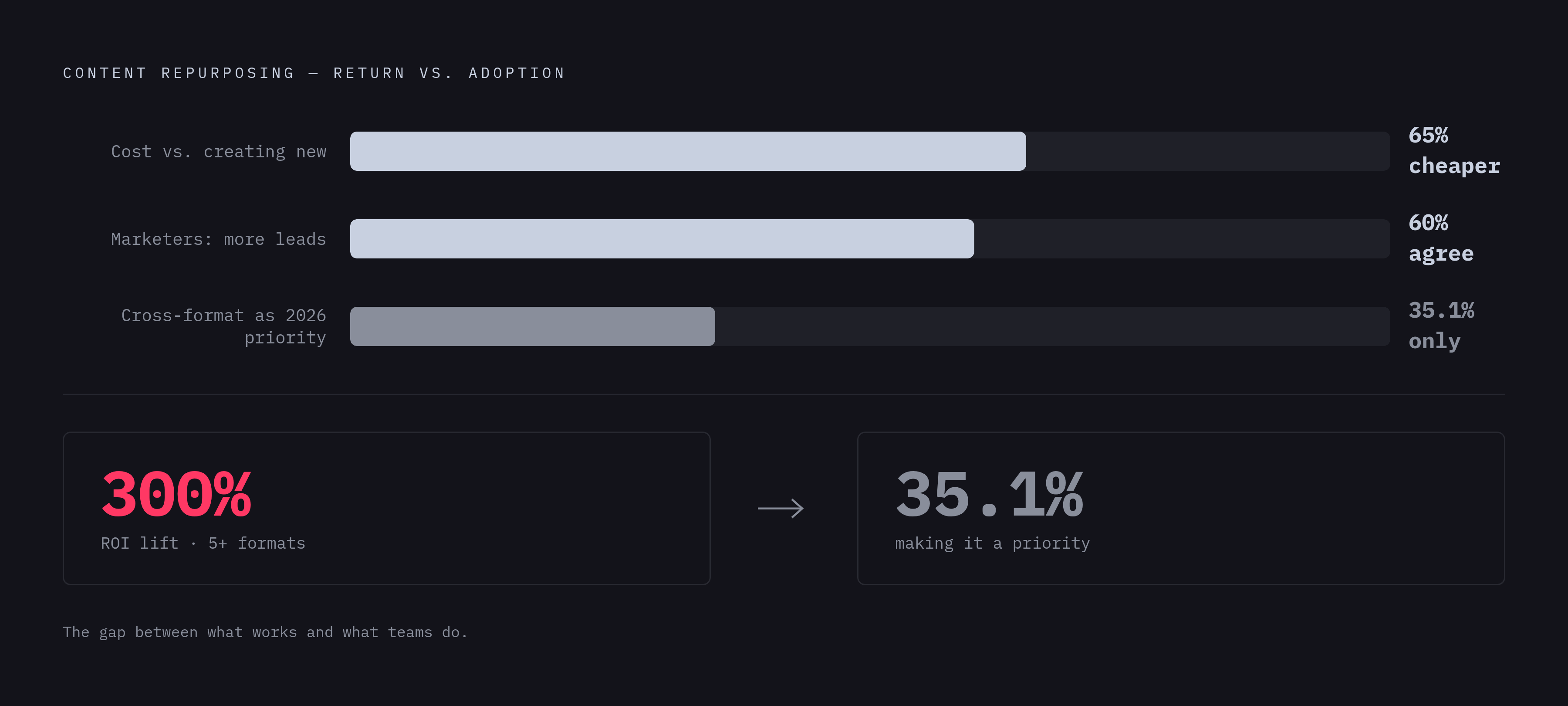
The ROI numbers back this up. HubSpot research puts the average ROI improvement from repurposing at 32%, with webinar-to-blog conversions doing a lot of that lifting. Sixty percent of marketers say repurposed content generates more leads than content built from scratch, and companies running active repurposing programs see roughly double the engagement of companies publishing only original work. There's a format-diversity multiplier on top of that: organizations publishing across five or more formats report a 300% jump in ROI over single-format publishers, and each repurposed piece runs about 65% cheaper to produce than something built new from a blank page.
Put that together and the implication is almost embarrassing to say out loud: the highest-leverage move in content marketing right now is squeezing more out of the stuff already sitting in the archive, half-forgotten, doing nothing, rather than making more stuff from scratch. That webinar from last spring isn't done working for you; it just needs a different outfit for each room it walks into.
And yet, per HubSpot, only 35.1% of marketers list cross-platform repurposing as a priority heading into 2026. That gap is the actual story here. If two-thirds of the field hasn't systematized this, doing it well is still an edge rather than table stakes. Which raises the real question this piece is built around: how to match the right tool to what each channel actually rewards.
How to think about AI repurposing tools before choosing one
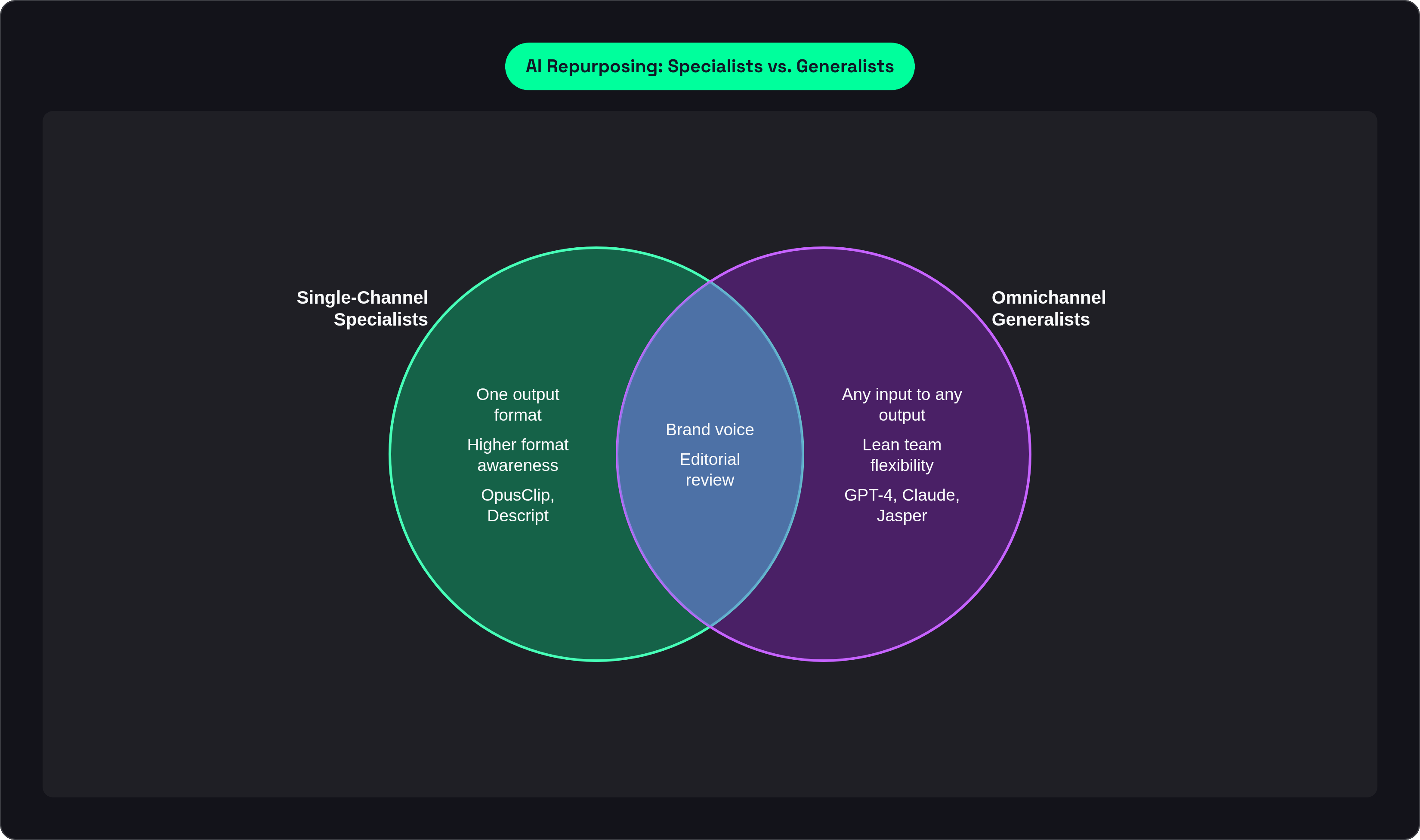
Sort the landscape into two rough buckets before looking at a single product page. Single-channel specialists build for one output (video clips, social captions, transcripts) and tend to handle that one job with more format awareness than any generalist manages. Omnichannel generalists take almost any input and spit out almost any output; genuinely useful for lean teams juggling a wide mix, but the quality depends entirely on how carefully someone set up the prompts and workflows feeding it. Garbage prompt, garbage output. An old rule, and still ignored constantly.
A few questions are worth asking before signing anything: what's the input format, exactly, since some tools only take text and choke the moment you hand them video or audio; what does the channel actually reward — length, visual format, posting cadence, the specific mechanics of how people engage on that platform; and who on the team runs this day to day, and how much editing overhead can they absorb before they quietly go back to doing it by hand.
Brand voice configuration deserves more weight than most teams give it. Tools that let you train the system on your company's specific tone and terminology need a lighter editorial pass afterward, which sounds minor until you're the one editing the fortieth AI-generated LinkedIn post that still doesn't sound like anyone at your company actually wrote it.
One thing worth saying directly: AI handles format translation, but it doesn't know which piece of content earned a second life in the first place. That judgment call, deciding your Q3 webinar deserves five more lives as blog posts, emails, and clips because it actually performed, still belongs to a human watching the metrics. Everything below assumes that call already got made.
Repurposing for video: from long recordings to platform-ready clips
A 45-minute webinar usually hides a dozen genuinely shareable moments somewhere inside it. Finding them, cutting them cleanly, reformatting each one for a different platform, used to eat an entire afternoon of scrubbing through timecodes. That's the job AI has actually gotten good at, and it might be the cleanest win in this whole piece.
What does the channel need, concretely? Aspect ratio shifts by platform: vertical for Reels and TikTok, square or horizontal for YouTube and LinkedIn. Subject tracking, caption standards, and clip selection all matter here too: a crop shouldn't chop your speaker's head off mid-sentence, which happens more than you'd think; captions need to hit platform accessibility standards and work with sound off, since most people scroll video with their phone muted in a meeting they're half-listening to; and clip selection needs to find the emotionally resonant or high-engagement moment, not whatever happens to sit at the ten-minute mark by coincidence.
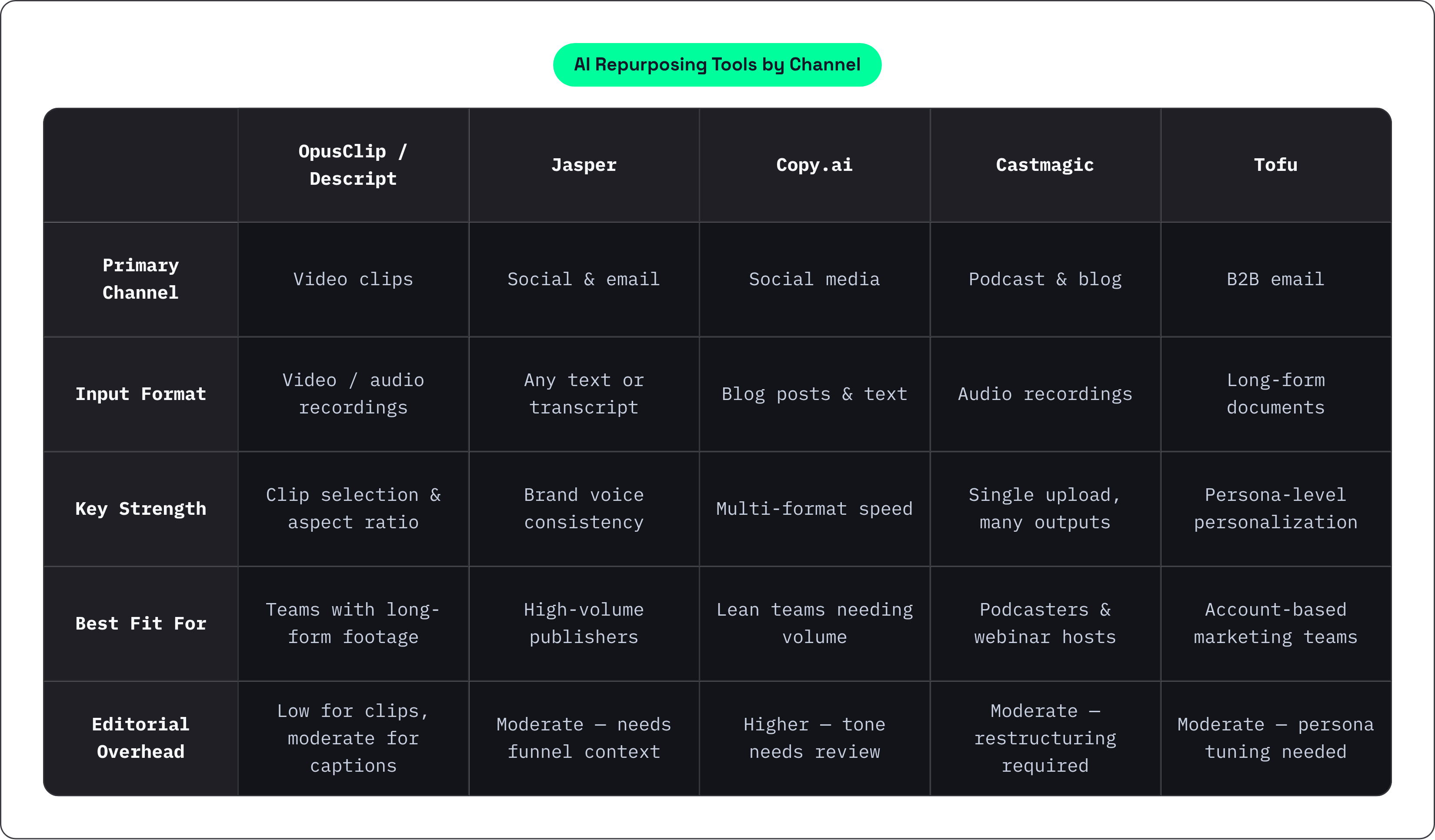
A few names do this well, each with its own personality. OpusClip reads visual, audio, and emotional cues together through multimodal AI, and its ClipAnything feature lets you pull a moment just by describing it in plain language. ReframeAnything handles the aspect-ratio math with subject tracking built in; the platform has crossed tens of millions of users and hundreds of millions of clips created, and its August 2025 launch of Agent Opus pushes it past clipping into generating short-form video from scratch. Descript takes a different, more delightful approach: you edit the transcript, and the video follows along, which feels wrong the first time and then makes total sense the second time. Its Studio Sound feature also cleans up audio automatically, which matters more than people expect, because nobody shares a clip that sounds like it got recorded in a tin can. Vidyo.ai keeps things simpler for teams that just need clips out the door without a steep setup curve. Munch adds something the others skip: platform performance prediction, telling you which extracted moment is likely to land where before you spend an hour polishing it.
Synthesia solves a different problem, worth separating out cleanly. Instead of pulling clips from existing footage, it turns written material (PDFs, whitepapers, slide decks) into polished video using AI avatars. That's content-to-video generation, and the scale is hard to wave off: $150 million in ARR and a $4 billion valuation after its Series E in January 2026, with more than 65,000 customers including 90% of the Fortune 100.
The selection logic ends up simple enough: long-form recordings sitting around call for OpusClip or Descript, while written assets you want turned into video fit something like Synthesia or Lumen5 better.
Repurposing for social media: matching format to platform logic
Social repurposing looks easy from a distance and gets harder the closer you look. LinkedIn rewards professional framing and longer thought-leadership posts, the kind that make you sound like you sat with an idea for more than five minutes before posting it, while X rewards concision and, honestly, a little provocation, and Instagram wants visual-first storytelling, with Threads and carousels behaving nothing like a standalone post. A blog's core argument doesn't compress into a tweet through subtraction; it needs a different entry point.
The volume pressure driving all this is real. 76% of marketers used AI for basic copywriting and ideation in 2025, and social absorbs most of that usage. Everyone needs more posts faster. That's precisely the environment where content technically exists but doesn't perform, sitting there unread, un-clicked, unbothered.
A few tools handle different pieces of this puzzle. Copy.ai moves fast: paste a blog post in, get social snippets, email teasers, and ad copy back in one pass. Good for volume, though the output usually needs an editorial pass for platform-specific tone before anything goes live. Jasper leans harder into consistency, with a Brand Voice feature trained on your company's tone, which makes it the better fit for teams publishing dozens of posts a month where sounding like one brand actually matters; pricing on the Creator plan starts at $39 per seat per month. Repurpose.io takes a different angle entirely, built for automating distribution after content already exists, connecting to a podcast, YouTube, or blog feed and pushing formatted versions out on its own.
Here's a detail worth building a workflow around: AI-generated LinkedIn thought-leadership copy needs noticeably more human revision than AI copy built for X's character-limited format. Not a knock on any specific tool, just a fact about how much nuance longer professional writing carries compared to a punchy short post. Budget editorial time accordingly, or the "quick" LinkedIn pass will surprise you every single week.
And here's a piece that gets missed a lot: good social repurposing starts by asking which original piece already performed, rather than repurposing the entire library with equal enthusiasm for everything. Some content earned a second life. No tool changes that math for the rest, no matter what the pitch deck says.
Repurposing for email: preserving argument structure across format shifts
Email runs on conventions most repurposing tools quietly ignore, which is where AI-generated content falls apart fastest. Subject lines run on a very specific kind of curiosity or utility logic that doesn't emerge automatically from summarizing a blog post, because a headline and a subject line are trying to do different jobs entirely; sequence awareness matters too, since what an email says should depend on where the reader sits in their journey with you, not just on whatever the source material happened to cover; and CTAs need to stay singular, because repurposed content dragged over from a whitepaper often arrives with three or four competing calls to action tangled together, a reliable way to get zero clicks on any of them.
Where this genuinely works well: taking one long-form asset, a whitepaper, a webinar, a research report, and splitting it into a multi-email drip where each email covers one argument thread with its own subject line and its own single CTA. That's a good use of AI, because the source material already has natural seams to cut along.
Jasper offers templates built for email sequences with brand voice carried through, and it works best fed explicit context about audience and funnel stage rather than a bare source document. Tofu, built specifically for B2B, handles account-personalized content, generating email variants tuned to different personas or segments off one core asset. That's a strong fit for teams running account-based marketing, where a single generic email was never the goal to begin with. General-purpose models like GPT-4 or Claude work too, for teams with a strong editorial process already in place, though there's no built-in brand training. Plan on more review time either way.
Here's the test that separates good repurposed email from bad: does it read like someone sat down and wrote an email, or does it read like a blog excerpt with a subject line stapled to the top? That gap is where most AI email repurposing quietly fails, and no amount of clever prompting papers over it.
Repurposing for blogs and SEO: turning audio and video back into text that ranks
Podcasts, recorded interviews, webinars, video series, all of it contains real thinking that never makes it into search results simply because nobody wrote it down. Turn that spoken content into an SEO-optimized blog post and you catch a whole new audience, one that keeps compounding in organic search long after the original recording is forgotten by everyone who attended live.
What the channel needs starts with accurate transcription, sure, but the harder part comes after: restructuring conversational speech into editorial argument. People talk in loops, tangents, half-finished thoughts, and written content can't get away with any of that. Beyond restructuring, you need keyword integration that doesn't flatten the original insight into keyword soup, plus internal linking and metadata built in from the start instead of bolted on afterward.
Descript's transcription is accurate enough to work as a genuine first draft, and its editing interface makes it easy to strip filler words and rearrange sections before a writer ever touches the thing. Castmagic goes further down the podcast-specific path: upload one recording, get show notes, blog outlines, social snippets, and email teasers back all at once. Jasper and similar tools can take a cleaned-up transcript and restructure it editorially, though they need explicit prompting toward SEO intent. Left alone, they tend to just tidy the transcript rather than rebuild the actual argument underneath it.
The quality bar matters more here than people assume. Brands that systematically repurpose top-performing assets see organic traffic climb by 35%, but only when the final piece is genuinely editorial: an actual article making a point, with more than transcript text and paragraph breaks added for looks. AI can't skip the step where a human checks whether the piece argues something or just politely reports what got said on the recording. That check still has to happen every time, with no shortcuts.
Repurposing for B2B channels: presentations, sales content, and account-specific assets
B2B repurposing is its own animal, and the core problem is structural: one whitepaper written for a broad audience needs to become a slide deck for a CFO, a one-pager for procurement, and a personalized email for one specific target account. That's three different editorial jobs pulled out of a single source document, each demanding a different read on what the person in front of you actually cares about.
The scale of the waste here should stop you: 65% of sales content goes unused. Often that's not because the content is bad; it's because it exists in a format that doesn't match how an actual sales conversation unfolds, and nobody is pulling up a 20-page PDF mid-call. They need a one-pager, or three slides, or a single line they can paste straight into an email while the prospect is still on the phone.
Presentations need narrative compression, taking a 20-page report and finding the one argument worth building ten slides around, with a visual hierarchy that still holds up without a live speaker walking someone through it. Sales one-pagers need benefits-first framing, language tuned to the specific persona reading it, and exactly one call to action, rather than a menu of five quietly competing for the reader's attention. Match the format to how the reader in that channel actually consumes information, and the content stops sitting in a folder nobody opens.
Miss that match, and it doesn't matter how fast the AI generated it. The result just joins the 65% pile: technically produced, never touched.
Sources
- https://www.getmasset.com/resources/blog/top-tools-for-ai-powered-content-repurposing
Provided the figure that AI tools deliver an average 10% time savings across a full content operation, used to counter inflated vendor claims.
- https://createandgrow.com/10-best-tools-for-repurposing-content-across-platforms-in-2025/
Supplied the statistic that Synthesia counts 90% of Fortune 100 companies among its more than 65,000 customers.
- https://www.ranktracker.com/blog/content-marketing-roi-statistics-2025/
Provided the 48% figure on marketers citing lack of repurposing as a scaling obstacle, and the 32% average ROI improvement from repurposing.
- https://www.shno.co/marketing-statistics/content-repurposing-statistics
Sourced the ReferralRock survey finding that 46% of marketers name repurposing as their single best-performing content strategy.