Content Approval Workflows for Regulated Industries
Most approval workflows stall in queues, not in actual review.

Content approval workflows in regulated industries fail because of how they're built. When a labeling review or a compliance sign-off drags, the instinct is to lean on people: push reviewers harder, hire more compliance staff, shorten the deadline and hope urgency does the rest. That fix almost never works, and figuring out why is the whole point of what follows.
Here's a pattern I've watched play out over and over in pharmaceutical labeling review. A six-week cycle gets scheduled. Roughly four of those weeks go to gathering information, sitting in someone's queue, or fixing errors a better-designed process would have caught weeks earlier. The actual review, the part where a qualified person reads the claim and decides if it holds up, might take a few days total. So when a launch slips, the natural question is "who's slow?" A more useful question asks where the asset sits between handoffs, and why it sits there that long. Across regulated industries, workflow and approvals consistently rank among the top operational challenges for marketing teams. That points to a structural problem baked into the industry, and in regulated markets the stakes cut sharper. A delayed asset isn't just a missed deadline. It's a compliance exposure sitting in a queue, quietly turning into a revenue problem.
Before getting into workflow design, it's worth asking what regulators actually demand, because most of the fixes teams reach for don't touch it.
What the major regulatory frameworks actually demand from an approval workflow
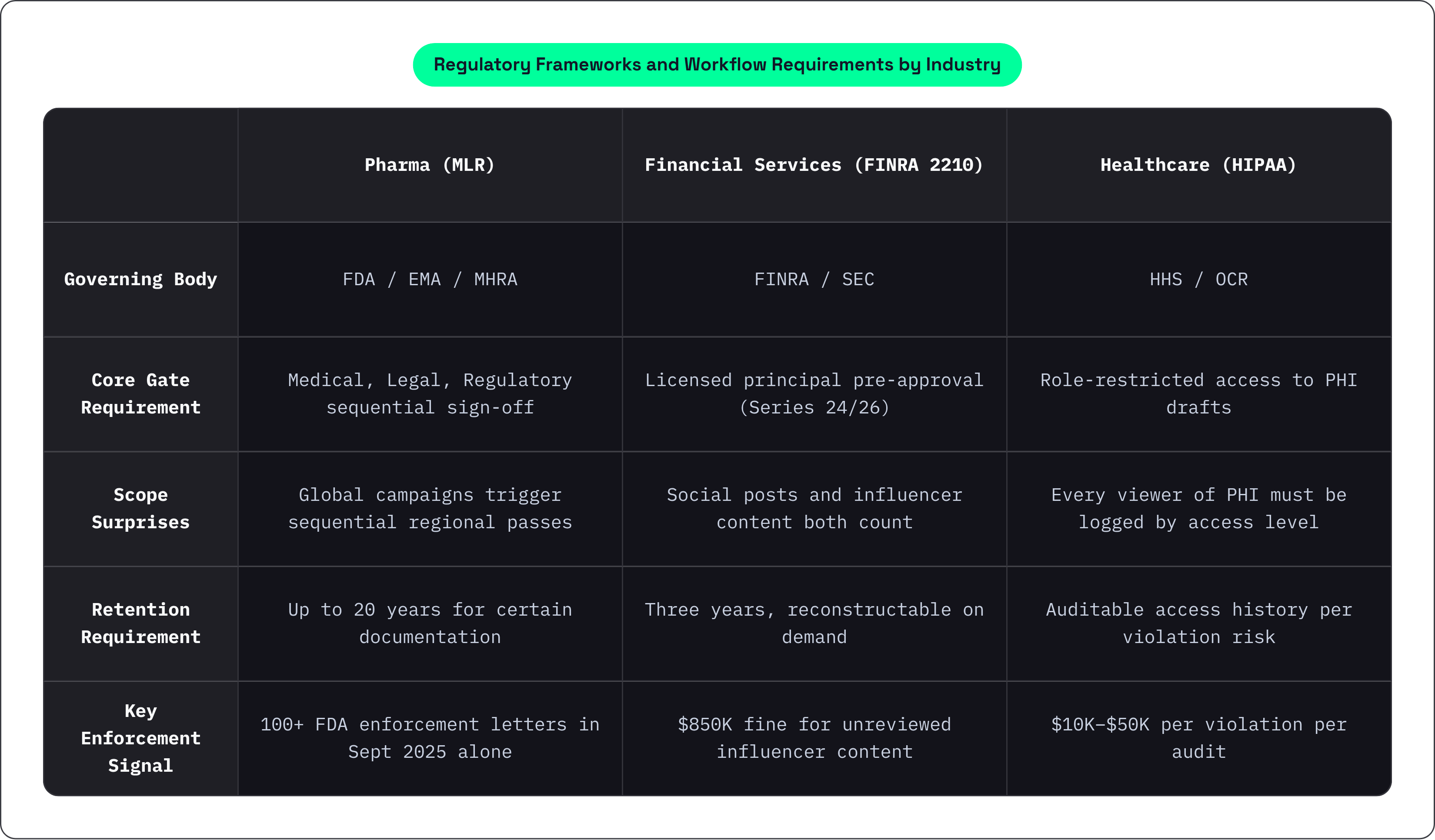
Three industries, three rulebooks, and each shapes the workflow in its own way.
Pharma runs on MLR review: Medical, Legal, Regulatory. Every promotional asset, whether it's a social post, a webpage, a sales deck, an email, or a chatbot response, has to clear all three before it goes anywhere. Medical checks factual accuracy. Legal checks exposure. Regulatory checks alignment with the FDA, EMA, or MHRA-approved label. Enforcement isn't easing up either: the FDA issued 190 warning letters to drug and biologics manufacturers in 2024, then in September 2025 alone put out more than 100 enforcement letters for non-compliant promotional material. That's a trend line, not background noise. Global campaigns stack another layer on top: Germany restricts comparative advertising, France requires pre-clearance on certain campaigns, Switzerland requires multilingual review under Swissmedic. One asset going to five markets can mean five sequential regional passes stacked on the base MLR cycle. Nobody promised global pharma marketing would be fast.
Financial services runs on FINRA Rule 2210. The trigger sounds simple and gets missed constantly: any content going to more than 25 retail investors inside a 30-day window counts as a "retail communication" and needs sign-off from a licensed principal, someone holding a Series 24 or Series 26. The scope catches people off guard, and it's not just ads and email campaigns. It's social posts, performance claims, and, as the M1 Finance case made painfully clear, influencer content too. Firms also have to retain drafts, approval workflows, edit histories, and final versions for three years, in a format that can be reconstructed on demand. Some products, mutual funds and structured notes among them, need to clear both FINRA and SEC review. Two separate gates, same asset, no shortcuts.
Healthcare answers to HIPAA. Anything touching Protected Health Information needs restricted visibility; not every reviewer gets to see every version of every asset. When regulators come knocking, the organization has to reconstruct who saw what, when, and under what access level. Get that audit trail wrong and penalties run $10,000 to $50,000 per violation, per audit.
Stack on top of all three: FDA 21 CFR Part 11, SOC 2, GDPR, and the EU AI Act requirements now coming online. Every one wants documented, auditable, tamper-evident approval records. The audit trail sits underneath every regulated industry, and it matters a lot more once we get into what actually breaks these workflows.
Once you know what's required, the next question writes itself: how do you build something that satisfies all of it without stacking new bottlenecks on top of the old ones?
The architecture of a functional regulated-content workflow: sequential, role-specific, and gated
Here's the part that trips people up: in regulated industries, a sequential structure mirrors real dependency chains the regulations themselves impose, rather than reflecting bureaucratic preference. Content can't reach legal before medical confirms factual accuracy. Regulatory can't sign off before legal clears the claims. That order is cause and effect, not company culture.
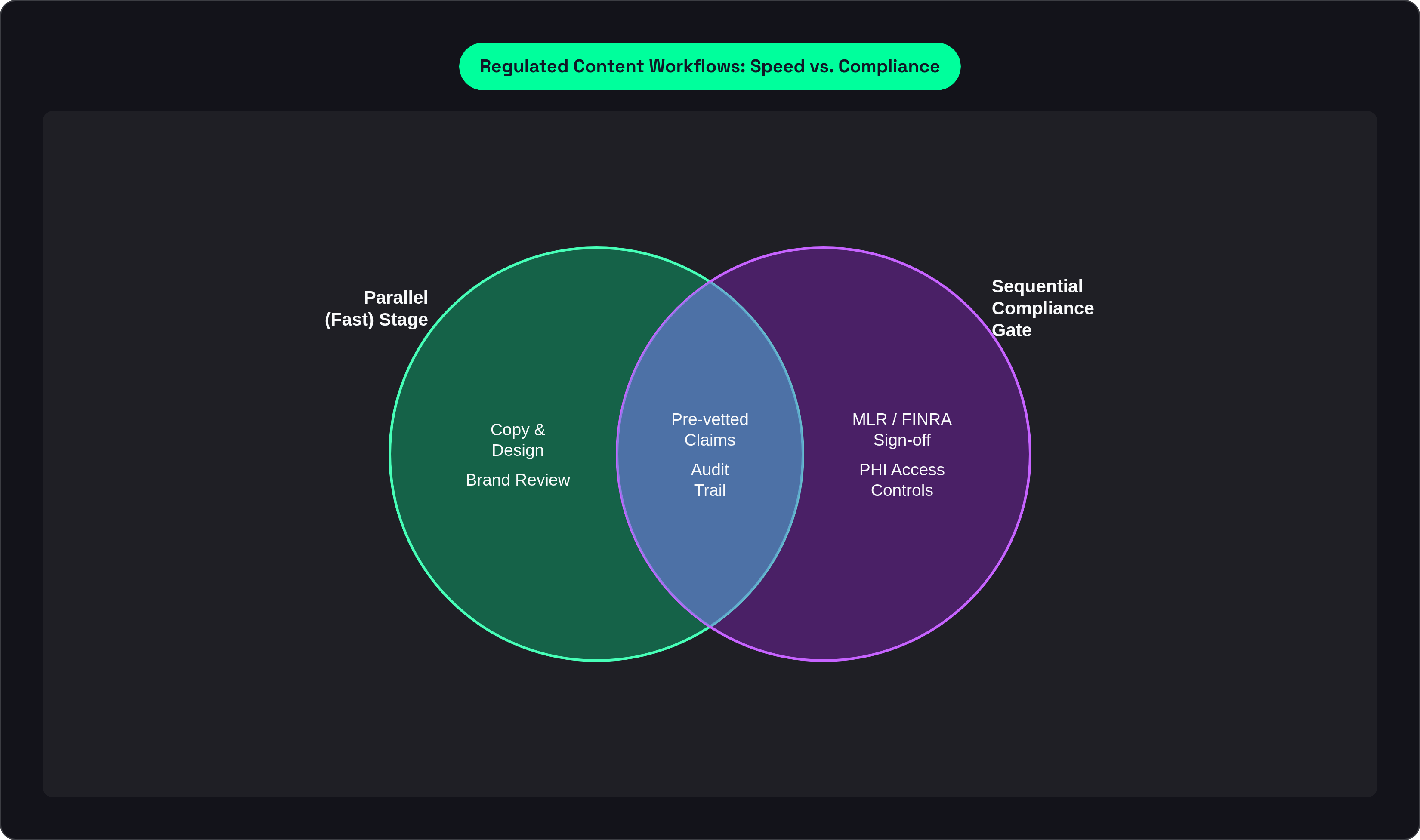
Where teams can actually move fast is earlier, in the parts of the process that don't carry compliance weight. Copy, design, brand review, all of that can run in parallel because none of it touches regulatory exposure. The workable pattern looks like this: parallel internal review first, then a sequential compliance gate, then linear client or executive sign-off. Speed where it's safe, sequence where it's required.
Gates also need to be role-specific, not generic "approval steps" stacked in a row. Each one should define who holds it (by role, not by name, since names change and roles don't), what exactly they're checking (claim accuracy is a different evaluation than legal exposure, which is different again from regulatory alignment), and what a pass or fail means for where the asset goes next. Access has to match the role too. A junior reviewer or data analyst shouldn't be looking at PHI-containing drafts, a compliance officer needs the full document, and a regional legal reviewer might only need the section relevant to their jurisdiction. Underneath all of it sits a hard rule: whoever drafts the asset cannot be the one who gives final approval. Regulators expect to see that separation; it's not a nice-to-have.
Not every asset carries the same risk, and treating them all identically wastes everyone's time. A branded Instagram graphic and a new drug efficacy claim shouldn't move through the same number of gates. A tiered system routes high-risk material (new claims, anything PHI-adjacent, performance advertising) through the full sequential chain, while lower-risk, pre-approved-format content takes an expedited lane. Teams get speed back by building a faster lane for the stuff that was never actually risky to begin with, without cutting corners on the risky stuff.
One more piece, and it's the one teams skip most often: locking content after approval. Any edit made post-approval, even something as small as a typo fix or a swapped stock photo, should send the asset back into the workflow at the right gate. If that feels like overkill for tiny changes, fair, build a defined fast-path for minor edits. The risk to avoid is letting people quietly patch approved content outside the system, because now there's unapproved material live in the world with no record of how it got there.
A workflow built this way produces something beyond a compliant asset. It produces a paper trail, and that paper trail is exactly what regulators come asking for.
What a defensible audit trail requires, and why email chains don't produce one
Compliance failures cost organizations an average of $4 million per incident. "We handled it over email" has never once satisfied an examiner.
Email, Slack, shared docs: these tools record conversation. They don't produce a tamper-evident, version-locked approval sequence, and that's a fundamentally different thing to have on file. An examiner asking who approved which version of what, at what time, under which policy, is asking four specific questions, and a Slack thread answers maybe none of them. There's a quieter risk buried in that mess too: without one central system tracking versions, it's entirely possible to approve an outdated draft while the actual current version sits unreviewed in someone's downloads folder.
A defensible audit trail needs five things, and they're all concrete. Identity: who reviewed, who approved, by role and credential (for FINRA that means naming the Series 24 or 26 holder specifically). Version integrity: the exact version approved, with every prior draft preserved rather than overwritten. Timestamps: when each action happened, logged in a way nobody can quietly edit after the fact. Rationale: the reviewer's actual comments and requested changes, not a stamp reading "approved" with zero context. Retention matched to the governing rule: three years for FINRA communications, up to 20 years for certain medical device documentation.
The M1 Finance case makes this concrete in a way that's hard to shake. FINRA fined M1 Finance $850,000 after roughly 1,700 influencers helped drive more than 39,400 funded accounts, and not one of those influencer posts had been reviewed by a registered principal or retained as a record. The firm had written supervisory procedures sitting right there on paper. The workflow itself had a hole in it: influencer content never got routed into the approval process at all, so the procedures existed for content that never touched them. The fix FINRA required was structural rather than a memo restating the policy: principal pre-approval before influencer content goes live, systematic retention after. You can't paper over a missing gate with better wording.
Contrast that with a global medical equipment manufacturer serving more than 130 countries, which built automated approval workflows that kept accountability traceable across teams and met a 20-year retention requirement without treating it as a separate project bolted onto marketing operations. Audit readiness came out of the workflow design itself, rather than being bolted on afterward.
So if the fix is sitting right there, why do these workflows keep breaking?
Where regulated-content workflows actually break down, and the misdiagnoses that keep them broken
Most delay lives in the queue, rather than in the review itself. Assets sit in someone's inbox because nobody, including the reviewer, can see where the asset ranks in priority or what's blocking it. That's a reviewer working blind.
A lot of damage also happens late, when it's expensive to fix. Safety language, exact claim wording, reference formatting: these get argued over after the creative work and production are already finished. The cost there isn't review time, it's rework, and those are two different problems needing two different fixes. The actual fix is to move compliance requirements, the approved claims list, mandatory disclosures, reference formatting rules, upstream into the creative brief, so they're inputs from day one instead of corrections tacked on at the end.
In practice, the average regulated asset commonly passes through multiple rounds of review before it ever publishes. Most of that isn't inevitable back-and-forth; it's preventable rework a better brief would have caught in round one. Here's the piece that explains why so few teams catch this: many teams still lack a structured approval workflow entirely, and even fewer track approval performance metrics in any systematic way. If you're not measuring where time goes, you can't fix where it's going.
So the cycle repeats in a predictable loop. Leadership sees slow approvals, blames reviewer capacity, adds headcount or squeezes the deadline, and the bottleneck doesn't disappear. It just moves one stage upstream and waits there. The actual levers are less dramatic than hiring: cleaner submissions with pre-vetted claims and pre-formatted references cut rework before formal review even starts; smarter routing kills queue blindness; tiered risk classification stops a low-stakes social graphic from eating the same reviewer hours as a new efficacy claim.
Naming the failure modes is the easy part. Building something that avoids them takes actual decisions about roles, tools, and process.
How to build the workflow: decisions, roles, and tooling that resolve the structural problems
Start with the process, not the software. Map the real regulatory gate sequence before shopping for a platform, because the tool's job is to enforce a workflow that already exists on paper, not invent one from scratch. That map needs to answer a specific set of questions: what content types exist, which framework governs each one, who holds each gate by role and credential, what happens on a rejection, and how long each asset type has to be retained.
Roles need real definition, not a generic "approver" tag slapped on a name. A medical reviewer checks factual accuracy against the approved label. A legal reviewer checks claim exposure, comparative advertising rules, jurisdiction-specific restrictions. A regulatory reviewer checks alignment with the governing framework, FDA, FINRA, or HIPAA depending on the industry, plus disclosure completeness. In financial services, the principal approver, the Series 24 or 26 holder, is whose signature becomes the legal record. Brand and editorial review runs in parallel, earlier, entirely outside the compliance sequence.
On tooling, a few features aren't optional in a regulated environment. Tamper-evident audit logs with real timestamps and version locking: non-negotiable. Role-based access controls fine enough to restrict PHI visibility and enforce the separation between drafter and approver. Routing logic that branches by content type, risk tier, geography, or product line. Retention settings configurable to match whatever period the applicable rule demands. E-signature support for legal documents and multi-party sign-off. Rejection handling that routes an asset back to the correct earlier stage, rather than all the way to square one, because nobody needs to redo work that already cleared a gate.
There's real value too in production tools built for structured, strategy-first content work with editorial quality checks built into the drafting stage itself. Feeding well-formed, claim-checked drafts into the compliance gate means MLR and FINRA reviewers spend their time reviewing instead of fixing basic errors that should've been caught upstream. Speed and quality stop being a tradeoff once the production stage is actually organized.
Before rolling any of this out organization-wide, pilot it. Pick one content type or one product line, run it through the new routing, watch where handoffs stall, and fix the logic before it scales. It's a lot cheaper to learn that lesson on one product line than across a whole portfolio.
Even a well-designed workflow decays if nobody's watching it. That's the last piece.
Keeping the workflow functional over time: governance, metrics, and the enforcement posture that makes complacency expensive
A workflow needs an owner: someone accountable not just for signing off on individual assets, but for the health of the process itself, on an ongoing basis.
Regulations move, and the workflow has to move with them. FINRA ran a 2025 pilot program adjusting how communications get reviewed; the FDA keeps issuing new enforcement guidance. When the rules shift, the gates built around those rules need updating too, on a set schedule, not whenever someone happens to notice the gap.
People change roles constantly, and the workflow has to catch up immediately, not eventually. A Series 24 holder leaves the firm, a medical reviewer moves to a different therapeutic area: the routing has to reflect that the same day, because an approval gate pointing at someone who no longer holds the license isn't a gate anymore. It's a formality nobody's actually checking, which might be worse than having no gate at all.
Sources
- https://www.vodori.com/blog/5-ways-to-speed-up-your-digital-content-approval-process-for-regulated-content
Provided the basis for the claim that workflow and approvals rank among top operational challenges for marketing teams in regulated industries.
- https://www.celum.com/en/blog/streamlining-product-content-workflows-in-a-highly-regulated-industry/
Provided the example of a global medical equipment manufacturer serving 130+ countries that built automated approval workflows with a 20-year retention requirement.
- https://www.mayerbrown.com/-/media/files/perspectives-events/publications/2025/02/legal-update---finra-2025-regulatory-oversight-report.pdf?rev=ea411279acf94b53bd9e194983de7ed6
Provided background on FINRA's 2025 regulatory pilot program adjusting how communications get reviewed, referenced in the governance section.