Content Localization Workflow for Global Campaigns
Planning the workflow before translation saves thousands in rework and conversion losses.

Localization is a sequencing problem. Most companies build the content first and bolt on translation at the end, and that ordering alone is what turns a manageable process into a cost center nobody budgeted for. I spent a chunk of my career watching marketing teams discover this the expensive way, usually right after a launch, usually in a meeting where someone asks why the German site converts at a third of the English one. This piece walks through what changes when localization moves earlier in the production line instead of sitting at the end of it like a toll booth.
What's actually at stake commercially when localization is done well versus poorly
CSA Research asked 8,709 people across 29 countries whether they'd buy something described in a language other than their own. Most said no, plainly, and the numbers back it up: 40% said they will never buy from a website in another language, and 76% said they prefer buying in their own language when given the choice. That's most of your addressable market quietly declining to convert while your dashboard tells you traffic is fine.
Shopify's checkout data from 2025 makes the mechanism obvious: pages not shown in the customer's native language see abandonment jump 35 to 45%. People get to the last step, hit a wall of unfamiliar words asking them to confirm a purchase, and bail. eMarketer tied non-translated product descriptions to a 22% bump in returns the same year, and the reason is straightforward: people buy the wrong size or the wrong version because nobody told them, in words they understood, what they were buying.
Here's the part that gets buried under all the doom, though. Moz found localized sites can grow organic traffic from international markets 40 to 120% within six to twelve months, and Ahrefs found non-English keywords carry 45 to 75% lower competition than the English equivalents. Whole markets sit there half-empty, competitively speaking, because most brands can't be bothered to write for them.
CSA's math suggests skipping localization risks losing 40% or more of total addressable market. That used to sound like a large-company problem, the kind of thing only Fortune 500 marketing departments worried about, but the landscape has shifted. Small and medium enterprises now make up 35.8% of the marketing localization services market, and that segment is growing faster than any other segment in it. The smaller shops got there first, and it's worth asking why the bigger ones didn't.
The strategic decisions that have to be made before a single word is translated
Nobody decides what "done" looks like per market, and that's usually where the whole thing goes sideways. Market selection has to come first, and it has to go past picking countries off a map at random. You need personas built per language and region, actual behavioral texture, not a demographic sketch that could describe anyone. Do the keyword research and you'll find people rarely type the direct translation of your English search terms; they search the way they think, which reflects a distinct linguistic pattern in each market. Social listening catches the complaints, the seasonal quirks, the cultural static that never shows up in a spreadsheet no matter how many columns you add.
Budget comes next, and it has to lock in before production starts, not somewhere in the middle when everyone's already annoyed. Define target languages and complexity tiers up front, then assign budgets by market before anything moves into translation, because doing it retroactively is how projects blow past deadline and cost at the same time. Talk to someone local about holidays and seasonal timing too, because launching a campaign the week of a national holiday nobody on your team knew about is its own special kind of embarrassing.
Then there's governance, which is really the question of what stays uniform and what gets to flex. Legal and compliance content stays literal everywhere; a terms-of-service agreement is not the place for creative interpretation, however tempting that might sound to a bored copywriter. Product documentation needs technical accuracy over word-for-word conversion, while campaign slogans get the creative treatment, which is its own section below and worth the wait.
Skipping these three decisions means every team downstream inherits the ambiguity, and rework compounds through the pipeline as each subsequent stage builds on unresolved assumptions.
Auditing source content and building the internationalization foundation
Before a translator touches anything, somebody has to take inventory. That means cataloging text, visuals, style guides, and code, then flagging the landmines: legal disclaimers that vary by jurisdiction, images that read wrong somewhere else, colors that carry meanings you didn't intend. Some content stays market-specific by necessity, while other content can flex from one shared source. Sorting which is which before production starts saves a genuinely significant amount of time later.
This is also where internationalization, i18n for short, enters the picture, and it's the step that gets skipped most and punished hardest for being skipped. I18n means building the code from day one to handle different character sets, date formats, currencies, and right-to-left text for languages like Arabic or Hebrew. Skip it, and you get the classic failure: a German translation runs 35% longer than the English version and the button it's supposed to sit inside just breaks. I've seen this exact bug reported as a "translation issue" when a closer look showed an engineering root cause.
This stage is also where the linguistic assets get built, the ones that pay off for years after anyone remembers building them. A translation memory stores every approved translation so nobody retranslates the same sentence for the fifth time, and a glossary locks brand terms in place so "customer success manager" doesn't splinter into three different phrases across three markets, each one technically correct and collectively confusing. Style guides per locale capture tone and punctuation conventions a translator working cold has no way of guessing. These assets compound quietly: every campaign after the first draws on them, cutting review time without anyone standing guard over brand voice by hand.
Choosing the right adaptation method for each content type: translation, localization, and transcreation
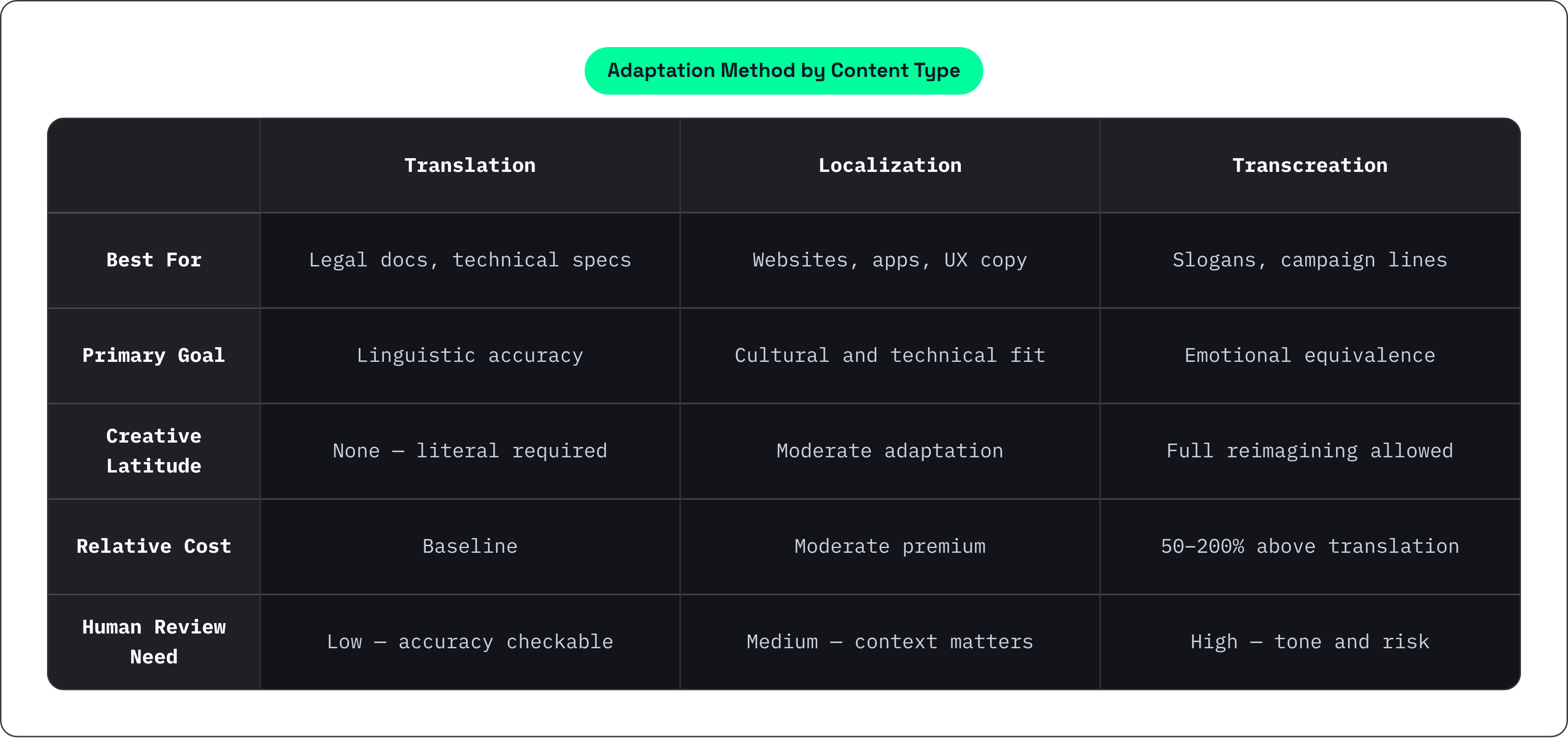
Three words get used interchangeably in casual conversation that absolutely should not be interchangeable in a workflow. Translation is linguistic accuracy and nothing fancier: legal documents, technical specs, anywhere creative flair would be a liability. Localization goes further and adapts the whole cultural and technical experience, the websites and apps and UX copy that need to feel like they were written there, not shipped there. Transcreation is the creative reimagining of slogans and campaign lines, aiming to preserve the feeling of the original rather than its literal words.
A real launch needs all three running at once: translation for the fine print, localization for the product experience, transcreation for the ad line that's supposed to make somebody feel something. Transcreation costs more, usually 50 to 200% more per word than plain translation, and that number alone scares off budget owners who haven't seen the other side of the math. Applied to the right content, though, the high-visibility line where a literal rendering would fall flat or land somewhere embarrassing, the return on that spend can run 10 to 50 times the cost.
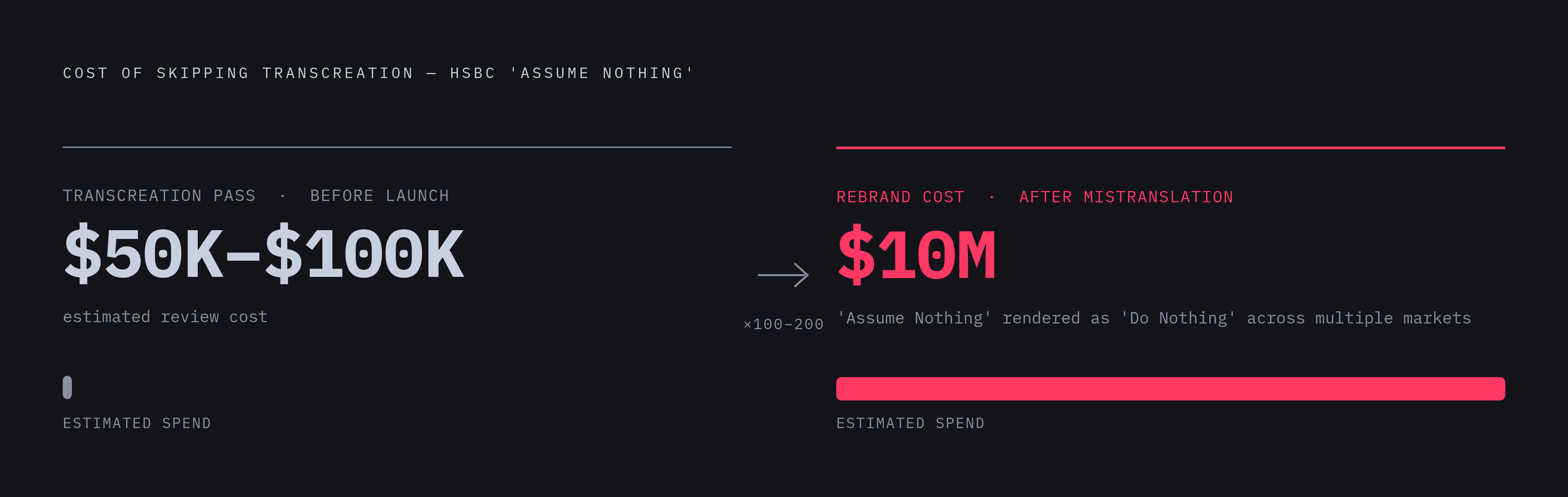
Which brings us to HSBC, a case that gets cited so often it's practically a rite of passage in this field. Their "Assume Nothing" campaign got translated literally in several markets as "Do Nothing," which is close to the exact opposite of what you want a bank customer doing with their money. The rebrand that followed cost an estimated $10 million, while a transcreation pass beforehand, in the $50,000 to $100,000 range, would have caught it in an afternoon. Five figures spent early versus eight figures spent cleaning up is a strong argument for sequencing this correctly.
Watch out for running raw machine translation on campaign copy with no human anywhere near it. Literal machine translation of creative messaging is one of the most reliably documented ways international campaigns flop, and it keeps happening because it's cheap right up until it isn't. Route AI to the content tier where accuracy is the whole job, and save human review for the transcreation work where tone and humor and cultural landmines actually matter. Match the method to what the content needs, not to whatever line item is cheapest this quarter.
How a TMS-driven workflow replaces the spreadsheet handoff cycle
Here's the workflow a lot of teams are still quietly running: copy into a spreadsheet, email to a translator, wait, send for proofreading, wait again, get approval, then push it live by hand on each channel. Every handoff is a chance for something to get lost, mistyped, or forgotten in somebody's inbox until a launch date reminds everyone it exists.
A Translation Management System changes the mechanics of that entirely. It centralizes extraction, assignment, translation memory, and the glossary in one place, and connects to the CMS and marketing channels directly, so content moves without anyone copying and pasting a single line. Routing happens automatically by content type and complexity, so a routine product blurb and a high-stakes headline don't sit in the same queue waiting on the same overworked reviewer.
AI now sits inside nearly every stage of a modern TMS: pre-editing, the translation pass itself, quality estimation, post-editing. Pre-translation draws on the memory, the glossary, and the style guide instead of generating from a blank page every time, and quality checks catch terminology drift before a human ever opens the file. Human linguists get routed only the segments flagged as complex, not the whole document cover to cover.
The speed gains are real and fairly significant. AI-assisted workflows cut per-word costs 40 to 60% while holding quality roughly steady, and adoption of AI across translation workflows has grown sharply as platforms make it easier to route content by type and complexity. Phrase supports more than 50 integrations and 30 machine translation engines, giving teams flexibility in how they route content across different translation providers and channels. Other platforms in the space have similarly evolved, adding enterprise governance layers on top of developer-first foundations as team sizes and compliance needs have grown. Cloud migration has become the default too, largely for the scalability and the ability to have teams in four time zones working the same project without emailing each other conflicting file versions.
Quality assurance and review cycles that catch errors without stalling launches
QA works best as a layered process running alongside production, avoiding a single gate at the finish line where everything piles up and the launch date starts slipping. Automated checks handle terminology consistency, formatting tags, whether the text still fits its layout without breaking a button. AI quality estimation flags segments under a confidence threshold and routes only those to a human, instead of sending the whole document back for a second full pass, and human linguists then spend their time on the flagged segments, the transcreation output, and anything carrying legal or brand risk.
Localization testing deserves its own mention, separate from linguistic QA, because it's checking something different: does the text actually display right across every menu, button, and dialog box, on every screen size? German and Finnish, notoriously, run longer than English, and that expansion causes truncation nobody catches until a user screenshots it and posts it somewhere public. Dates, currencies, phone numbers, addresses, all of it needs locale-specific formatting checked, because a US-style date silently misread in a country that reads day-before-month is a bug that sits there for months until a customer finally complains.
Review governance solves the problem behind more launch delays than any actual technical bug: who has final approval, for what content, in which market? Leave that unanswered and you get review loops that circle forever because nobody wants to be the one who signs off and owns the mistake. Every approved translation should flow straight back into the shared memory and glossary as part of the QA output, not as some separate chore somebody remembers to do later, or more likely, doesn't. That's what lets the next campaign start ahead instead of starting from scratch.
Post-launch iteration: treating each market's performance data as workflow input
Most teams publish and walk away, which might be the single most expensive habit in this entire process. The data sitting there after launch is worth more than nearly everything gathered before it, and it just sits there unread while everyone moves on to the next campaign.
Watch engagement by locale specifically, since the blended global number hides exactly which markets are quietly struggling. Watch checkout abandonment by language against that 35 to 45% range from earlier: if one market blows past it, something specific and fixable is wrong, worth naming precisely rather than waving at "localization" as a vague abstract failure. Watch return rates for signs people are misunderstanding the product, and watch how localized pages actually rank in local search, because a page that isn't showing up isn't doing its job no matter how well it reads once someone finally finds it.
When one market abandons checkout at a noticeably higher rate, the cause is technical, linguistic, or cultural, and each needs a completely different fix. A technical problem might be a currency field rendering wrong, while a linguistic one might be a button label that reads awkward or unclear to a native speaker, and a cultural one might be a payment method nobody in that market trusts, no matter how well it's explained. Figuring out which one you're dealing with determines everything that happens next.
All of that should flow straight back into the workflow: bug fixes into the TMS, in-market refinements into the translation memory, glossary updates for terms that confused people or landed unexpectedly well, revised personas heading into the next cycle. That loop is what separates a one-off localization project from something that actually compounds over time. Each campaign should make the next one cheaper and faster, a byproduct of the system getting smarter while nobody was looking.
The organizational conditions that let the workflow scale across markets without chaos
Everything above is knowable, and none of it is secret information locked away somewhere. So why do so many localization programs still collapse under their own weight once they try to scale? The failures are almost never technical; they're organizational instead, which makes them stubbornly resistant to better software.
Disconnected teams are the most common symptom: content, translation, legal, and local marketing all working in separate systems with zero visibility into what anyone else is doing. Technology debt makes it worse, when a legacy CMS doesn't talk to the TMS and someone ends up manually re-typing content that should have flowed through automatically. Unclear governance means every campaign reopens the same tired argument about what's global and what flexes locally, because nobody actually settled it the first time and everyone's too polite to force the conversation.
The fix takes discipline more than cleverness to actually hold the line. Assign a localization program owner whose job is running the workflow and the glossary, not translating documents themselves. Build a global content hub with source content that's modular and structured from the start, so it's localization-ready before it ever touches the TMS. Set market tiers, because not every country deserves transcreation-level spend; rank by revenue potential and put the money where it'll actually do something.
The market context makes the timing case on its own. The AI-in-translation market is projected to grow from $2.94 billion in 2025 to $8.93 billion by 2030, and the teams building repeatable, AI-integrated workflows now are positioning themselves to scale straight into that. Teams still running spreadsheet handoffs are going to watch that gap widen, and not gently.
Speed and quality only look like they're in tension when the workflow itself is undefined: no content tiers, no shared assets, no TMS tying the pieces together. Get that part right, and marketing teams that own this process themselves, rather than re-explaining their brand to a fresh agency every single campaign, end up with something no outside vendor quite replicates: a glossary that gets sharper with use, a memory that gets richer with every project, and a feel for each market that sticks around long after the campaign itself is forgotten.
Sources
- https://csa-research.com/l/media/Consumers-Prefer-their-Own-Language
Provided the CSA Research survey data on consumer willingness to buy from websites in a language other than their own, including the 40% figure cited in the article.
- https://innovalang.eu/en/blog-en/why-language-matters-in-global-online-sales/
Supplied the statistic that 76% of consumers prefer buying in their own language, and the Moz-attributed data on organic traffic growth from localized sites.