Content Production Bottlenecks in Marketing Teams
Demand for marketing content has exploded fivefold while most teams lack systems to scale.

Content demand in marketing has outrun the systems built to handle it. Adobe's 2025 research, drawn from more than 1,600 marketers worldwide, found 96% have watched demand at least double in the past two years, and 62% say it's grown fivefold or more. I kept rereading that stat trying to find the catch, and there isn't one — everything below traces back to that gap, and to the more useful question underneath it: where, exactly, does the pipe get narrow?
Seventy-one percent of those same marketers expect demand to grow another 5x by 2027, which means the squeeze isn't a temporary phase anyone's going to grow out of. Sixty-one percent name personalization expectations as the top driver, so the curve is structural, baked into how buyers now expect to be talked to. Seventy percent of marketing orgs produce at least 1,000 assets a year; 18% churn out somewhere between 100,000 and 500,000. And according to the Content Marketing Institute's 2025 benchmarks, only 35% of B2B marketers say they actually have a scalable content creation model. Demand went up fivefold, and only a third of teams think their system survives another round of that. Sit with that math for a second, because the rest of this piece is really just an attempt to find where it breaks first.
The distinction that determines whether a fix actually works
Before fixing a bottleneck, you have to know what kind it is. There are two, roughly, and mixing them up is probably the single most common reason a fix doesn't hold.
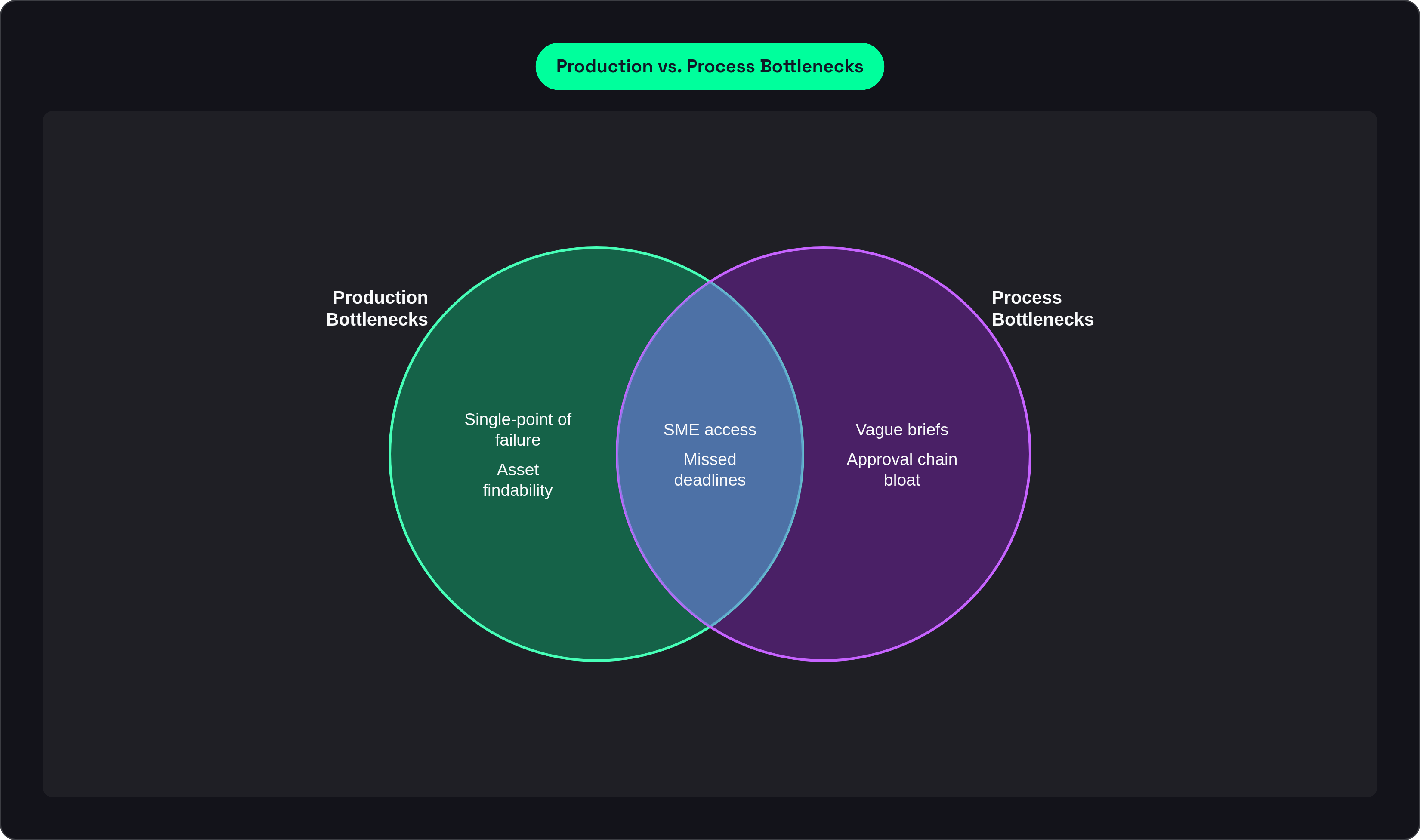
Production bottlenecks are loud. They live in the creation phase and sit right there on the project board: writing takes too long, design is buried under six deadlines stacked on top of each other, editing can't keep pace with what's piling up behind it. Work parks itself in "In Progress" and stops moving, and anyone glancing at that board can call it in about four seconds flat.
Process bottlenecks hide better, and that's what makes them the more dangerous of the two. A vague brief passes for flexibility, a ten-person approval chain passes for thoroughness, and stakeholder misalignment passes for "just how we do things here." Nobody flags a process bottleneck in standup, because it's wearing the costume of diligence, not dysfunction.
The expensive mistake is treating one like the other. I've watched this play out the same way more than once: the real problem is a three-week approval queue, someone hires another writer, and it doesn't help; it just means content gets made faster so it can sit in that same three-week queue, waiting its turn. Buy more tools when the actual gap is strategy, and now output moves faster while still missing the target entirely. Every section that follows runs on that one question: is this a production problem or a process problem? Answer wrong, and the fix does nothing, however well-intentioned it was going in.
Where the first jam forms: strategy gaps before a word is written
The earliest bottleneck shows up before anyone opens a document. It's rooted in not knowing what to make, or more precisely, not knowing why you're making it in the first place.
CMI's 2025 benchmarks found 58% of B2B marketers rate their own content strategy as only moderately effective, and the gap between strategy and execution is plain in the numbers. That's a fairly large confession for an industry to make about itself. Without a clear target, ideation collapses into scrambling: copy whatever the competitor just published, dust off an old post because at least it's something, call it a plan and move on.
The data shows where that leads. Forty-one percent of content produces no measurable impact at all, volume wins, strategy loses, and 57% of content creators cite "creating the right content for the audience" as a major challenge. Worth being honest about what that actually means: nobody here is struggling with sentence construction. They're struggling because nobody handed them a target worth aiming at.
Subject matter expert access deserves its own callout, since it disguises itself as a scheduling headache when it's really a strategy bottleneck wearing a calendar invite. Technical products need input from engineers or product specialists who are busy, who don't consider content their job, and who will reschedule a thirty-minute interview four times before it ever happens once. What comes out the other end is either shallow content that doesn't help a buyer decide anything, or no content at all. Thirty-three percent of B2B marketers cite workflow and approval management as a genuine obstacle, per CMI, and the SME access problem described above is one recognizable contributor to that friction.
Once the strategy layer goes foggy, everything downstream inherits the fog. Briefs get written on guesswork, channel fit turns into a coin flip, and audience specificity dissolves into "general business audience," which is marketing-speak for nobody in particular. A documented brief that pins down audience, objective, and angle before a single word gets typed doesn't just save time; it heads off the worst kind of rework, the finished piece that gets scrapped because it aimed at the wrong target from day one.
How creation itself slows down once work actually begins
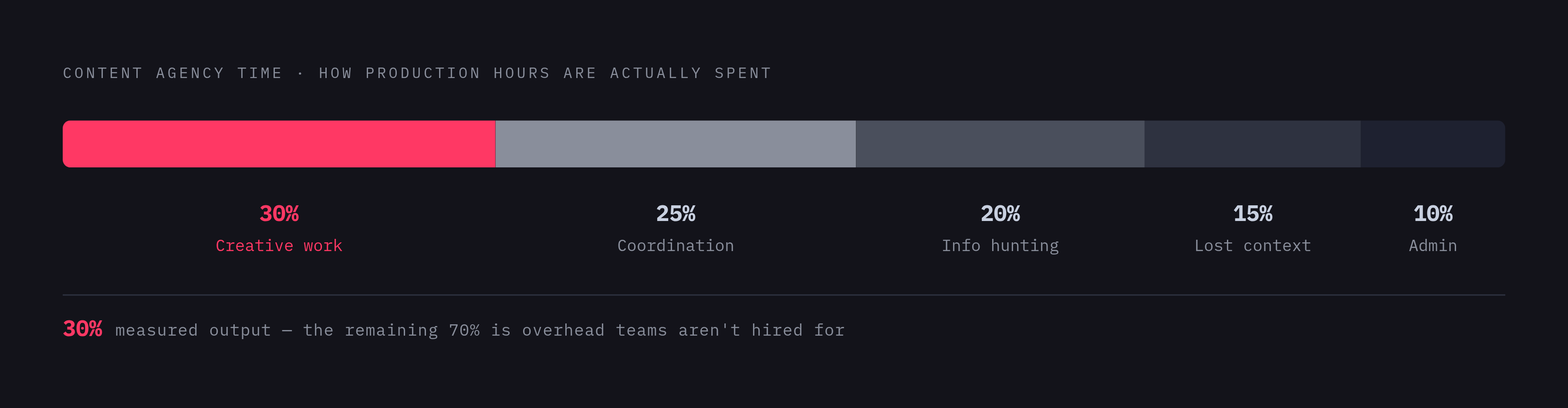
Test this against your own week: the actual creative part of "creating content" is probably a minority of the time spent on it.
Orbit Media's 2025 blogging survey put the average blog post at 3.5 hours to write, and that figure almost certainly understates things, since it skips the coordination, the revision rounds, and the file-hunting that surrounds the writing rather than being part of it. Video makes the same problem worse in a different key: 69% of marketers call production time for video a major challenge, and anyone who's waited four days for one round of notes on a 90-second clip already knows why.
Time-tracking on production work tends to break down something like this, according to TimeCraft Advisory's analysis of content agency teams. Creative work itself, the writing, designing, editing, eats about 30% of total time, while coordination, meaning briefing people, chasing feedback, managing revisions, takes another 25%. The remaining 45% splits between hunting down information (about 20%), rebuilding context because nobody wrote anything down the first time (about 15%), and pure administrative overhead (about 10%). Add it up and the thing you're actually measured on turns out to be a minority stakeholder in its own process. Strange way to run a shop, honestly.
Findability is its own quiet tax on top of that. Canto and Ascend2's State of Digital Content report found 57% of content and marketing professionals waste more than three hours a week just locating assets that already exist somewhere, in some folder, under some filename nobody remembers choosing. Add that up across a year and you're looking at roughly three and a half weeks spent searching for things that were never actually lost, just misfiled.
Then there's the single-point-of-failure problem, common at earlier-stage companies where one person ends up writing the blog, the landing pages, the email copy, and the social captions, because they raised a hand eighteen months ago and nobody's lowered it since. Demand keeps scaling, but their calendar does not. Eventually they hit a wall, and because they were the chokepoint for everything, the whole pipeline stalls right along with them. Writing faster won't fix that. Cutting the non-creative overhead quietly eating most of the clock might.
The approval chain: where finished work goes to wait
If strategy gaps are the quiet bottleneck and creation drag is the visible one, approval chains are the bottleneck people complain about loudest. It leaves the deepest paper trail, and it's usually the first thing marketers name when asked what actually kills their timelines.
Adobe's 2025 research found 47% of marketers say a single piece of content can involve somewhere between 51 and 200 people in review and approval. Not five people, not fifteen — fifty-one to two hundred, for one blog post, one ad, one email. The fallout isn't abstract. Simple.io found 90% of marketers say approval delays are the top reason deadlines slip, and Typeface's research, cited by eMarketer, found 67% of US marketing professionals say their teams regularly miss cultural or news moments because review timelines can't move fast enough to catch them. A HubSpot study found 60% of marketing teams say inefficient workflows slow campaigns and cap engagement.
Why does the chain keep growing instead of shrinking? Every additional approver feels, on its own, like a reasonable way to reduce risk, and nobody adds a tenth reviewer thinking "this will make things worse." Yet that stack of individually sensible decisions becomes the risk itself: missing the moment, missing the deadline, missing the point entirely. A McKinsey digital operations study found sequential workflows introduce an average of 4.7 handoff points per campaign deliverable. Each one is a place where the whole thing can just stop, quietly, for days at a stretch.
Silos compound it further. When SEO, content, design, legal, and brand each review independently, with no shared context and no coordinated window, conflicting notes land on different days, each technically valid, collectively impossible to satisfy all at once. A bottlenecked approval chain doesn't look broken from the outside, and that's the part leadership tends to miss. It looks like progress, and reviews sound productive on paper. Nobody's dashboard flags "in review for 19 days" as the crisis it actually is. Limiting the chain to actual decision-makers, setting real feedback windows, and reviewing in parallel instead of passing one document down a line of desks tends to beat the alternative, which is really just everyone taking turns holding something nobody wants to be caught holding.
The organizational patterns that keep bottlenecks in place
Fix one bottleneck in isolation and watch how fast the surrounding structure grows a new one in its place. That's the tell that the real problem is architectural, not a single clog you clear once and move past.
Siloed teams are the biggest multiplier here. When SEO, content, design, demand gen, and brand each run their own workflow with no shared goals, every group invents its own definition of "done," its own brief format, its own approval norms. None of them are wrong exactly, but they just don't talk to each other, which means the SME access problem from earlier gets worse too, since sales and product each carry their own relationship, or lack of one, with whoever's actually writing the thing.
Technology tells a strange story on its own. CMI's 2025 data found 38% of B2B marketers say they own tools they're not using anywhere near full potential, up from 30% the year before. Worth sitting with: that number is getting worse, not better, even as companies keep buying more tools. A platform bought to solve a bottleneck becomes shelf-ware the moment it drops into an unchanged workflow, because the workflow was the constraint the whole time, not the missing software.
Forty-five percent of B2B marketers say they lack a scalable content model; only 35% say they have one. Without a repeatable model, every new content type, a new format, a new campaign, starts from zero, as though it's the first thing the team has ever made. That's how a content operation stays artisanal, hand-built one piece at a time, even as the volume demanded of it turns industrial. Fifty-four percent of B2B marketers cite lack of resources as a real challenge, but throwing more people at a reactive, undesigned system just produces more burned-out people hitting the same walls, slightly faster than before.
What sustained bottlenecks cost beyond the missed deadline
The visible cost is obvious: missed deadlines, delayed launches, a publishing calendar that's really just a running list of things arriving late. The quieter cost compounds for years before anyone notices it's there.
Bottlenecked teams default to reactive planning. That means repurposing old posts instead of building new ones, rushing thin pieces out to plug a hole in the calendar, and quietly shelving the long-form, strategic bets that would have built real topical authority over time. Search engines reward consistency and freshness, so a production lag isn't just an internal headache; it's a direct hit to organic visibility that a less-bottlenecked competitor never has to absorb.
There's a newer wrinkle worth naming, too. AI visibility has become a growing priority for marketing leadership. Large language models and answer engines surface brands based on the depth, consistency, and authority of what's actually been published. A content operation that's perpetually behind becomes less visible in search, and functionally invisible in the AI-mediated research that increasingly happens before anyone ever talks to sales.
The human cost is real, and it's measured, not just felt. An Adobe Express survey of business owners and marketing leaders found 21% of content contributors report being often burned out. Burnout accelerates turnover, and turnover rebuilds the single-point-of-failure problem from scratch, with a new person who'll hit roughly the same wall in roughly the same amount of time.
The strategic cost, in the end, is opportunity. A team that's always behind never gets to invest in the work that actually compounds: original research, category-defining long-form pieces, the kind of work that builds authority over years instead of weeks. That ground doesn't stay empty while you catch up — competitors who aren't bottlenecked walk right onto it.
How teams systematically clear each bottleneck cluster
The fix has to match the diagnosis. A strategy gap, a creation-phase drag, and an approval bottleneck are three different problems, and treating all three with the same medicine is exactly how a fix stops holding a few months in.
For strategy gaps: build a documented brief format that pins down audience, objective, and angle before creative work starts. Put SME interviews on a standing calendar instead of leaving them as an ad hoc favor someone has to beg for each time. Build the content calendar around actual strategic goals rather than pure publishing cadence, so ideation doesn't reset to zero every cycle as if nobody's ever made content before.
For creation-phase drag: go after the non-creative overhead first. A centralized asset library, standardized brief formats, and clearly defined handoffs cut the retrieval and coordination time that eats the majority of production hours, per the breakdown above. AI-assisted drafting helps here too, but only when paired with strong briefs and real editorial oversight; Templatized formats for repeatable content, case studies, product pages, newsletters, remove the from-scratch tax from work that never needed reinventing in the first place.
For approval chains: audit the list of approvers and ask, honestly, who actually needs to weigh in versus who just needs to be told after the fact that it happened. Shift from sequential review to parallel review, everyone looking at the same draft against the same brief inside the same window, instead of one document traveling down a line of desks one reviewer at a time. Pre-approved brand and messaging guardrails shrink the surface area that needs sign-off at all, so fewer decisions have to travel through the chain in the first place.
For the structural layer underneath all of it: build a scalable content model, meaning defined content types, clear owners, documented workflows, and quality standards that don't get reinvented every time a new format shows up. Keep cross-functional alignment meetings short and tied to actual output, replacing the slow informal coordination that was eating up that 25% coordination tax from earlier. And treat technology adoption as a workflow redesign project rather than a purchase order, because a tool dropped into an unchanged process is just expensive shelf-ware waiting to happen again.
A bottleneck you can name and locate is one you can design around. The ones that survive year after year, quietly costing teams their deadlines, their morale, and their competitive ground, are usually the ones nobody bothered to map in the first place.
Sources
- https://www.tidewatersg.com/post/breaking-through-marketing-bottlenecks-aligning-strategy-execution-and-impact
Supplied the HubSpot study finding that 60% of marketing teams say inefficient workflows slow campaigns and cap engagement.
- https://business.adobe.com/blog/71-percent-of-marketers-say-content-demand-to-increase-5x
Provided the core Adobe 2025 research figures on content demand growth, the 5x projection, asset volumes, and the 47% approval-chain statistic.
- https://www.timecraftadvisory.com/blog/the-marketing-agency-content-production-bottleneck
Provided the time-tracking breakdown showing how content agency teams split hours across creative work, coordination, information-hunting, context-rebuilding, and administration.