Marketing Attribution Models Compared for Content Teams
Most attribution models systematically undercount content's role in B2B buyer journeys.
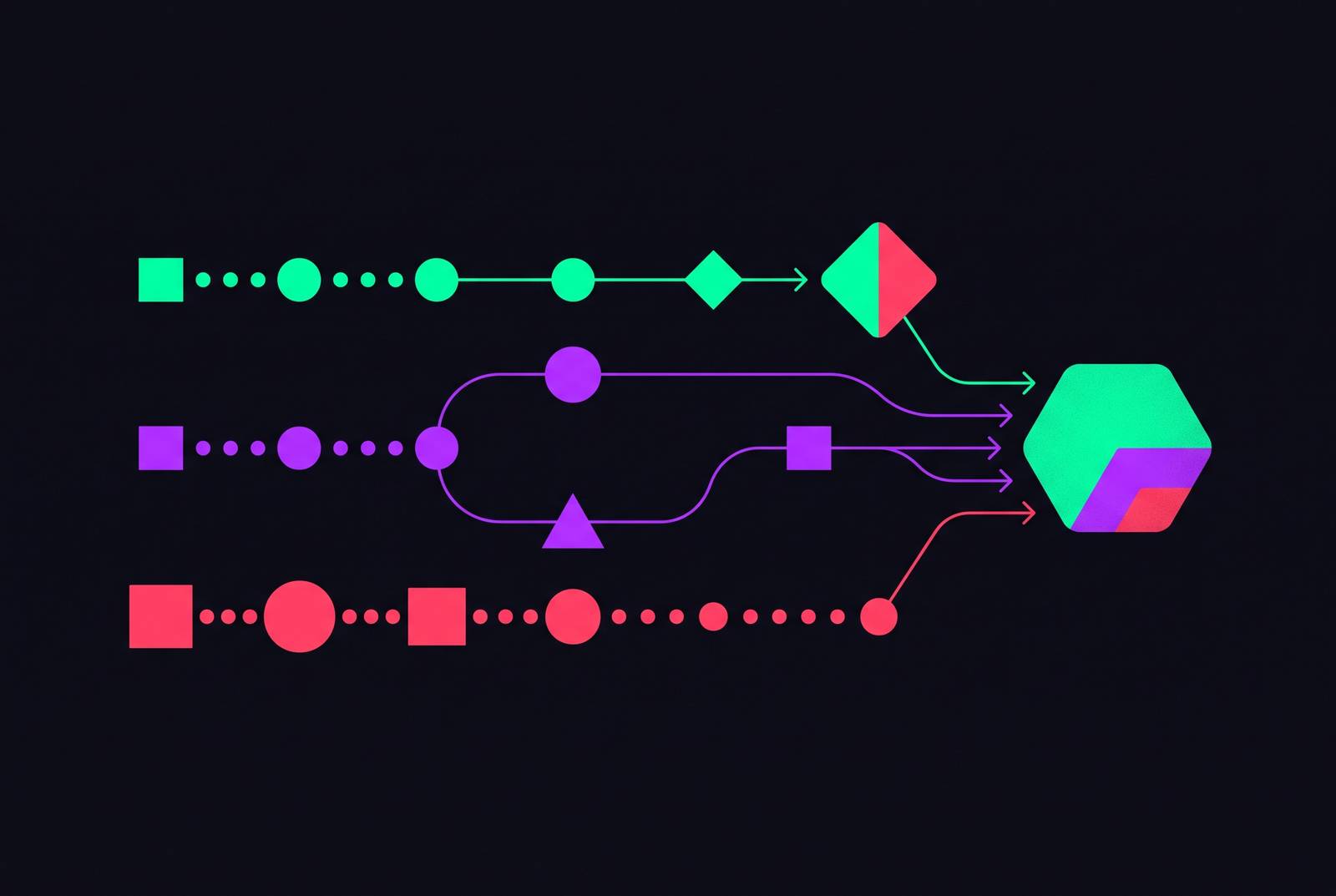
Content teams have an attribution problem, but it isn't the one most dashboards suggest. The work clusters at the top and middle of the funnel, in the awareness and nurture stages, and that's precisely where the most commonly used attribution models assign the least credit⟦c2⟧. Fixing this is a matter of choosing a model that can actually see where content works. It's a matter of choosing a model that can actually see where content works. Marketing Attribution Models Compared for Content Teams ⟦c1⟧.
Why content work gets systematically undercredited
Consider a blog post that shapes a buyer's thinking early in a 90-day journey, gets referenced again in an email nurture sequence, and shows up a third time in a sales deck built from its research, only for the buyer to convert after a direct visit to a pricing page weeks later⟦c3⟧. Under most default reporting setups, that pricing page gets full credit. The blog post gets none, despite doing the work of turning a stranger into a qualified buyer.
This is not a rare edge case. Only 21% of marketers say they can accurately tie content to revenue, and that figure reflects an infrastructure and model-choice failure rather than a quality problem with the content itself⟦c4⟧. Single-touch models misattribute conversions in more than 60% of multi-step buyer journeys, and because content's job is almost never to be the final click, that error rate is a significant problem for content teams, not a rounding issue ⟦c5⟧. It's the norm they operate under⟦c5⟧. Email, a channel that carries a huge share of content distribution and nurture work, illustrates the distortion with blunt clarity: it accounts for 28% of B2B touchpoints but receives only 8% of attributed credit under last-touch models⟦c6⟧.
None of this is a rounding error that washes out over time. Choosing the right attribution model proves content builds pipeline instead of letting that budget get reallocated to channels that simply happen to close deals last.
Attribution challenges in modern buyer journeys, especially for content
B2B buyers now average 8–12 touchpoints before converting, which quietly buries the old assumption that any single interaction can explain a purchase⟦c7⟧. Layer in device fragmentation, and the picture gets messier still: roughly 89% of consumers research and buy across multiple devices, and 20 to 40% of conversion paths appear broken into what look like separate users when they're really one buyer switching from phone to laptop⟦c8⟧. Content assets, consumed piecemeal across weeks and devices, sit right at the center of that fragmentation.
Third-party cookie deprecation has cut usable identity coverage down to roughly 30 to 60% of what it was during the cookie era⟦c9⟧. Even a well-designed model is working with a fraction of the signal it used to have.
Compounding all of this is a data problem that has nothing to do with model selection: blog traffic, email engagement, webinar attendance, and CRM conversions often live in separate systems that were never built to recognize the same person moving between them ⟦c26⟧. Braze has described the modern customer journey as closer to a pinball machine than a funnel, and that image fits content's role with uncomfortable precision⟦c10⟧. Content is often the bumper that keeps the ball in play, not the flipper that scores the point, and that's exactly the kind of contribution most models are built to miss. Given all this, the model a content team adopts isn't a reporting detail. It determines which parts of the work are visible to the business and which quietly disappear.
Single-touch models: what last-touch and first-touch each get right and get wrong for content
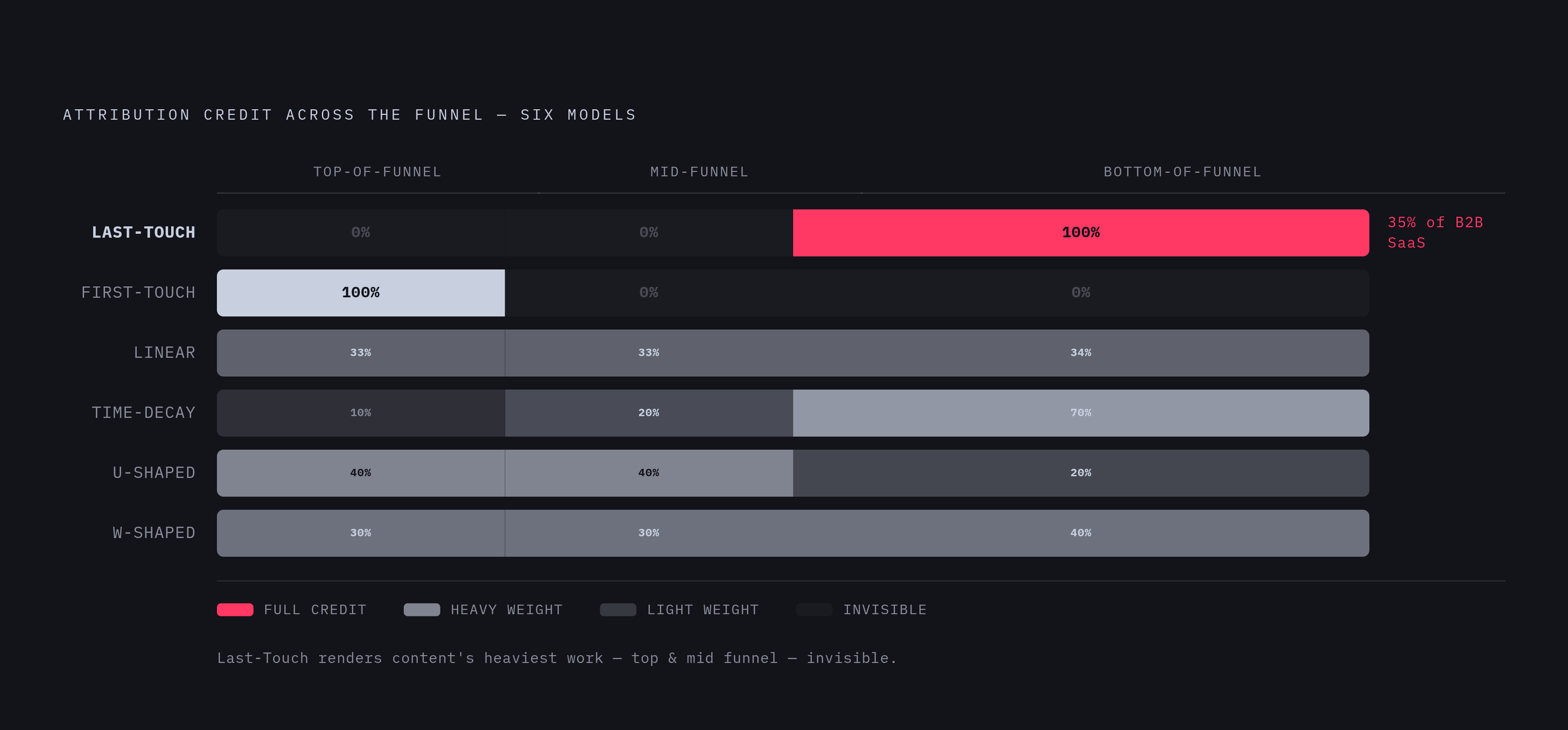
100% of the credit goes to the final touchpoint, 0% to everything before it ⟦c12⟧.
The distortion that follows is easy to describe and hard to watch play out in a quarterly review. A generic, unattributed form submission gets full credit for a conversion, while the LinkedIn article, the email sequence, and the webinar that built the actual buying case get nothing⟦c13⟧.
First-touch flips the formula, assigning 100% of the credit to the first interaction, and it happens to flatter exactly the kind of work content teams produce: editorial guides, SEO landing pages, ungated blog posts, the assets that open a buyer's journey before anyone else in the organization has said a word⟦c15⟧. Single-touch models of either flavor make sense only in short, simple sales cycles with few touchpoints, and they break down fast in B2B content programs built around long nurture sequences⟦c16⟧. Run first-touch and last-touch side by side, though, and something useful emerges: first-touch shows what opens the door, last-touch shows what closes it, and neither claims to be the whole story on its own. Forrester's 2024 Wave report, as cited by MarketingMary.ai, puts last-touch as the most widely used model, with 35% of B2B SaaS organizations still relying on it as their primary model⟦c11⟧. MarketingMary.ai actively discourages last-touch for any B2B with six or more touchpoints, and at 8–12 average touchpoints, most B2B content journeys fall well outside the range where last-touch is defensible, tapclicks.com and sci-tech-today.com report ⟦c14⟧.
Linear attribution: a blunt but bias-reducing baseline for content-heavy programs
Linear attribution spreads credit evenly across every touchpoint in a journey, which removes the directional bias of single-touch models by simply refusing to play favorites. It's available natively in HubSpot, though not in GA4, which removed linear attribution as an option in 2023, and it's used by 18% of B2B SaaS organizations⟦c17⟧. The relatively low adoption isn't a mystery. Everyone who's tried it knows its limitation firsthand: a passive blog impression gets the same weight as a demo request, which overcredits low-engagement touches and undercredits the ones that actually moved a buyer forward.
Still, linear earns a place in the toolkit, just not as a primary model. Used as a baseline comparison, it exposes what single-touch models hide. If a channel looks strong under both linear and first-touch but weak under last-touch, the channel is probably doing assist work that a last-touch-only view would erase.
Time-decay attribution's help and harm to content
Time-decay attribution assigns more credit to touchpoints closer to the conversion and progressively less to the ones further back, on the logic that recency correlates with influence. It fits short sales cycles where the most recent interactions really are the ones doing the persuading, and its user base reflects how narrow that fit actually is: only 8% of B2B SaaS organizations use it as their primary model⟦c18⟧.
For content teams, the weakness is not subtle. The blog post that introduced a prospect to the brand in the first place gets almost no credit under time-decay, even if it's the entire reason that prospect entered the funnel⟦c18⟧. This is a model built for channels that close, paid search, demo pages, pricing pages, and it structurally penalizes the editorial and educational work that opens the funnel. Content teams who find time-decay baked into their organization's reporting stack should name the distortion specifically rather than objecting to the model in the abstract: it will underreport top-of-funnel and mid-funnel content performance every single time, by design, not by accident.
U-shaped and W-shaped models: the first frameworks that reward content's early work
U-shaped, or position-based, attribution assigns 40% credit to the first touch, 40% to the touch that generated the lead, and splits the remaining 20% across everything in between⟦c19⟧. It's the first model on this list built to reward both the discovery content that opens a journey and the conversion content that closes it.
The 40% weighting is fixed regardless of what actually happened at that first touch ⟦c8⟧. A high-intent demo request and an accidental ad click get the identical credit, because the model rewards position in the sequence, not the quality of influence behind it⟦c21⟧. That makes U-shaped a meaningful upgrade for content teams whose work opens buyer journeys, top-of-funnel editorial, SEO content, ungated guides, but it still can't tell a genuinely engaged first touch from a lucky one⟦c22⟧.
W-shaped attribution builds on the same logic and adds a third heavily weighted stage: 30% to first touch, 30% to lead creation, 30% to opportunity creation, with the remaining 10% split across whatever's left⟦c23⟧. Both models are fairer than anything single-touch offers, but the honest caveat stands: the weighting is still a rule someone wrote down, not something learned from what actually drove the outcome.
Data-driven and technology-assisted attribution: the most accurate option content teams can't always access
Data-driven attribution replaces fixed rules with machine learning, assigning credit based on patterns observed in an organization's own conversion data rather than a formula decided in advance. Forrester's 2026 Marketing Attribution Study finds that companies using ML-based attribution report a 25 to 35% improvement in marketing ROI accuracy⟦c25⟧, which is a serious number for any team trying to defend a budget line.
Access is the catch. Data-driven models need real conversion volume, generally in the range of hundreds of monthly conversions, to model reliably, and smaller teams tend to get more dependable results from rule-based multi-touch models running through GA4 and CRM integrations instead⟦c26⟧. There's also a trust cost that comes with the accuracy gain: the credit-assignment logic inside these models isn't transparent, so a content team can't point to a specific weighting and walk a stakeholder through why a given asset mattered, even when the model is quietly getting it right⟦c27⟧. Between 27% and 34% of marketers now use some form of AI-driven attribution, and organizations pairing AI-based multi-touch models with holdout testing see fidelity improve by roughly 22 points over purely deterministic approaches⟦c28⟧. Data-driven attribution is the right long-term target for content teams precisely because it rewards actual influence instead of positional rules, but it's a destination to build toward, not a starting point everyone can access on day one.
Marketing Mix Modeling: its revival and its limits for content teams
Marketing Mix Modeling works from aggregate data rather than individual user tracking, correlating marketing inputs with business outcomes at a statistical level ⟦c41⟧. Because it never touches individual identities, it sidesteps privacy regulation and cookie deprecation entirely, which explains a good deal of its recent comeback.
That comeback has a specific cause. Apple's Safari ITP, iOS App Tracking Transparency, GDPR consent flows, and the broader decline of third-party cookies have pushed usable identity coverage for multi-touch attribution down to roughly 30 to 60% of cookie-era levels, and MMM fills that gap by working at the aggregate level where identity resolution doesn't matter⟦c29⟧. MMM usage grew from 9% in 2023 to 26% in 2026, nearly tripling, and that growth tracks the collapse of tracking infrastructure rather than any leap in MMM's own precision⟦c30⟧.
MMM comes with real constraints. It typically needs 12 to 24 months of historical data to model well, and its accuracy runs around plus or minus 15 to 20%, which rules it out as a tool for adjusting this week's content calendar⟦c31⟧. What has changed is the cost of entry: open-source frameworks including Google's Meridian and Meta's Robyn have cut into the price tag that once made MMM an enterprise-only exercise⟦c32⟧. For content teams, MMM answers one question well: does the content program, taken as a whole, correlate with business outcomes ⟦c29⟧? It has nothing useful to say about which specific piece of content influenced which specific conversion⟦c33⟧. The practical rule of thumb: lean on MMM when offline channels take up more than 30% of spend, sales cycles run past 30 days, or identity resolution drops below 60%, and lean on multi-touch models when the goal is optimizing specific channels and campaigns on a shorter cycle⟦c34⟧.
Running models in parallel rather than picking one: how sophisticated teams operate
Only 18% of marketers say they're genuinely confident in their attribution data, and the response among the most sophisticated teams hasn't been to keep hunting for one perfect model⟦c35⟧. It's been to run several models at once and check the results against incrementality testing. Multi-touch attribution answers which channels and campaigns need adjusting this week, while MMM answers where budget should shift this quarter, and no single model answers both ⟦c29⟧. Those are different questions, and no single model answers both⟦c36⟧.
The adoption numbers back up the shift toward plurality. Multi-touch attribution use grew from 31% of marketing teams in 2023 to 47% in 2026, and 74% of high-growth companies now run some form of multi-touch model instead of leaning on single-touch rules⟦c37⟧. For a content team specifically, a workable stack might pair first-touch reporting for awareness content, a position-based model for nurture-sequence credit, and data-driven or MMM analysis for the budget-level conversations that happen quarterly⟦c38⟧. Each of those answers a different question a stakeholder is actually going to ask.
Blog traffic, email engagement, webinar data, and CRM conversions have to connect at the individual level, or even a well-chosen model is just producing confident-looking noise, because none of it works without that unglamorous groundwork⟦c39⟧. Roman Vinogradov, VP of Product at Improvado, has made the point: attribution projects fail when teams argue about which model to use before they've fixed the inputs feeding it, and aligning campaign taxonomy, CRM stages, and spend data is what makes the model conversation worth having in the first place⟦c40⟧.
Choosing the right model given where content does its heaviest lifting in the funnel
The decision comes down to one question, asked honestly: where in the funnel is content actually built to do its heaviest lifting? A content program built around top-of-funnel editorial and SEO assets is going to look strong under first-touch and badly undercounted under last-touch or time-decay, and no amount of better tagging fixes that mismatch, because the mismatch is structural⟦c15⟧⟦c18⟧. A program built around nurture sequences and mid-funnel conversion assets needs position-based or W-shaped models to show its actual influence on lead and opportunity creation⟦c19⟧⟦c23⟧⟦c24⟧.
There is no universal right answer here, and pretending otherwise is how content teams end up measured against a model built for a completely different kind of marketing motion. The honest move is naming where content's contribution actually lands in the journey, matching the model (or the small stack of models) to that reality, and building the unified data layer underneath it so the number that comes out the other end is one worth defending in front of a budget committee.