Programmatic SEO for SaaS Comparison and Use-Case Pages
Start with your data structure, not your template, to build comparison pages that actually convert.
For SaaS comparison and use-case pages, programmatic SEO pays off because the data is already sitting somewhere within the business: in the CRM, on the pricing page, in the queue, or in sales call transcripts that never get re-played. The real discipline is structuring everything the product already tracks into a dataset detailed enough for a template to produce hundreds of pages that don't read like one page wearing a different competitor's name. Structuring what's already inside the product into a dataset with enough detail that a template can spin out hundreds of pages that won't read like one page dressed in a competitor's label.
Programmatic SEO uses one template paired with a structured dataset to generate many pages, each built around a single query that's long-tail. SaaS firms fit this unusually well because one product covers hundreds of query patterns on its own: each integration, each competitor, each job function, each industry sector is a plausible search. Most firms barely scratch that potential. Teams treat pSEO like a content exercise, but structurally it's a data exercise that comes first, and building the template is the easy half. pSEO is treated as a content exercise, though structurally it is a data exercise first, with the template as the easy half.
Tackle use-case pages and Comparison content before glossary or integrations pages, since they reach people closer to a purchase. Comparison pages catch someone after the buyer has narrowed the shortlist to 2 vendors and is close to choosing. These pages speak to a person who understands their issue inside out but hasn't yet picked which type of tool will fix it. Both bring search visits and money together without layers in between.
What makes comparison pages work or fail
Grow and Convert reports that versus-keyword pages convert at 5.45%, far above what top-of-funnel content usually gets. That figure alone makes the case for building this kind of page. But that number doesn’t come from the template. That rate happens because the comparison is honest and specific.
A comparison page will outperform one claiming superiority in every category when it admits where a competitor is stronger. Buyers weighing their last-round options aren't gullible: they've probably checked the rival's own comparison page already and can spot sales talk. When a page sounds like marketing copy, people leave for third-party opinions, and AI tools that weigh credibility when selecting what to use ignore it too. Before a comparison page publishes, run this check: would a skeptical buyer rely on the page, or go looking for a more balanced take?
Three flavours of the comparison page cover three distinct moments, and lumping them together is a frequent layout error. Someone at the last decision stage uses a "Product A vs Product B" page, weighing a pair of specific products point by point. Someone reading an "Alternative to Product B" page already dismissed that competitor and wants a replacement, which is a subtly different mindset requiring a subtly different layout: open with why they should move on instead of a plain side-by-side. Multi-product comparison pages serve someone still orienting within a category, unsure which options even merit a shortlist.
Programmatic comparison pages usually fail in one pattern: the template swaps the competitor's name on each page, but every point stays generic enough for any competitor. That's thin-content, and it's the kind of thing Google has learned to spot.
Creating the data model that sets programmatic comparison pages truly apart from one another
The instinct says use the AI copy tool first, but that's a mistake. Start with the data. Unless the dataset captures how specific rivals stand apart, no prompt produces pages that are different. They're just reworded versions of one another.
A useful comparison dataset comes from four places. Product documentation and specs lay out the sets, tiers for pricing, what each one demands, and where connections stop: proprietary data no competitor can replicate. Competitor pricing, along with plan data, needs researched from the source and updated often; treating an old pricing tier setup as valid is how pages fool people. CRM records, recordings of sales calls, and help desk messages show the words buyers pick when weighing options, plus the objections that surface instead of what a marketing team assumes. Console data reveals which query patterns a page already appears for, evidence of where actual interest exists versus where someone guesses it does.
Distribb offers one way to judge if a dataset is deep enough: pick 3 pages in the set, remove the competitor's name, then read them together. If they still read like separate pages, the underlying data holds its own. If they read as the same page, just swapping in a different noun, hold the dataset back from publishing.
A dataset like this includes category, positioning, and the competitor's name; gaps on both sides (what each product has and its rival lacks); pricing tier details for the buyer; where each product is strongest for the use-case; objections buyers have to each one; and workflow dependencies or integrations that set them apart.
Designing use-case page templates that serve a specific buyer, not a generic keyword
Use-case pages address a buyer who already understands their issue but hasn't picked a category yet, and who searches using their own role or industry language instead of product terminology. Nobody Googles "workflow automation platform." A compliance officer at a hospital searches for something closer to "tracking HIPAA documentation across departments."
The common variants follow a predictable shape: "[category] for [industry]," as in compliance software for healthcare; "[product] for [role]," as in CRM for sales managers versus CRM for marketing directors; and "[product] for [workflow or job-to-be-done]," as in project management for remote teams. Each variant needs its own data set, since sales and marketing professionals working with the same CRM focus on very different capabilities.
Use-case pages are tougher than any other page type because they need a buyer’s own words, workflows, plus objections. AI copy turns out interchangeable pages when it lacks industry-specific data or role-specific inputs. The tool is not at fault. What's missing is a dataset fine-grained enough to tell a healthcare buyer apart from one in another industry.
A good use-case template needs to handle things a comparison template never would. It opens with the buyer's pain in their own words. It highlights the exact workflow this buyer needs. It deals with the objection for this buyer, because hesitation for a compliance officer (trails, data residency) is not like hesitation for a sales manager (visibility, quota tracking). It relies on blocks of conditional content matched to job or sector data, so a healthcare page won't read like another page where someone just swapped the nouns, which is how most bad pSEO work gives itself away.
Template mechanics: the structural blocks every page in the set needs to earn its place in the index
Each use-case page or comparison page, whatever the variant, needs structural blocks for ranking and converting.
The title and first sentence must be spot-on right away: a buyer arriving on the page should instantly know, without a doubt, that this content is for their specific problem. Below that, put the concrete comparison and use-case facts near the top of the page, ahead of any marketing copy. Put evidence somewhere in the content, like a genuine screenshot, a hard figure, or a specific workflow case, that a template with the name swapped could never have fabricated. The page must include an objection-handling block that squarely answers why a buyer would choose the competitor or wonder if this product fits their situation. The call should fit where this buyer is in the funnel. And the page should cross-link to the other pages in its set and up to a cluster page that holds them.
These minimums are more important than most people think. Each URL should carry its own canonical link, separate title text, and separate meta summary. These aren't extras tossed in for show. Skipping them across hundreds of pages makes those pages fight one another for the same positions rather than each holding its own topic.
Google’s AI-powered checks and Helpful Content Update now make weak page groups a real risk, not a small cost. Mass-produced near-identical pages get treated as junk. The discipline that keeps this safe is batching releases in smaller groups, followed by a hold to monitor crawl and indexation before continuing. When the first fifty pages can't get indexed or appear in search, a much larger batch will fail similarly, for more money.
Keeping things current isn't optional. A comparison page that shows the product set or competitor's pricing from last cycle does more harm than no page, since it erodes confidence when a buyer catches the problem during purchase planning. Set up a refresh workflow as the page set grows instead of bolting it on afterward, so a hundred-page cluster of comparisons doesn't turn into a hundred liabilities.
Tooling choices for building and maintaining comparison and use-case page sets
No tool does it all. A better setup combines tools after finding the bottleneck: data, publishing, optimization, or refresh.
The data layer holds the dataset, and that's where rows get created and updated, usually inside a structured option such as Airtable. It acts as the data enrichment layer, adding and augmenting records that populate that dataset, not as the dataset's central source. Sync and publishing tools connect the data layer to a published website: Whalesync handles syncing between Airtable and a CMS, WP All Import takes care of WordPress-based publishing at high volume, and Webflow CMS provides a no-code route for non-developers putting pages together and going live. Content tools such as Byword, AirOps, and Surfer SEO create and refine content versions under a set template, not stand in for the first template-and-data groundwork.
For B2B SaaS companies that want AI answer monitoring, approval controls, and CMS push in a single system, Slate is the top platform. SEOmatic is the only other option that nearly does it all. Ahrefs looks after keyword tracking and auditing, and a growing page set will run into crawl problems that Screaming Frog handles.
No-code tools have improved enough that a working pSEO setup lives within a modest monthly range, a small slice of hiring a dev team for the same job. This is a real change: where developer capacity once held teams back, discipline is what matters.
Sequencing is the costliest error. The mistake is sequencing. Teams grab the AI content tool ahead of the data model, so pages ship lacking substance and turn in weak results, and then the tool takes the rap for what was a data issue from the start.
How AI-generated results treat use-case pages and programmatic comparison content
The setting these pages now sit in favors the same discipline noted above and can punish shortcuts in plainer view than Google's search system does.
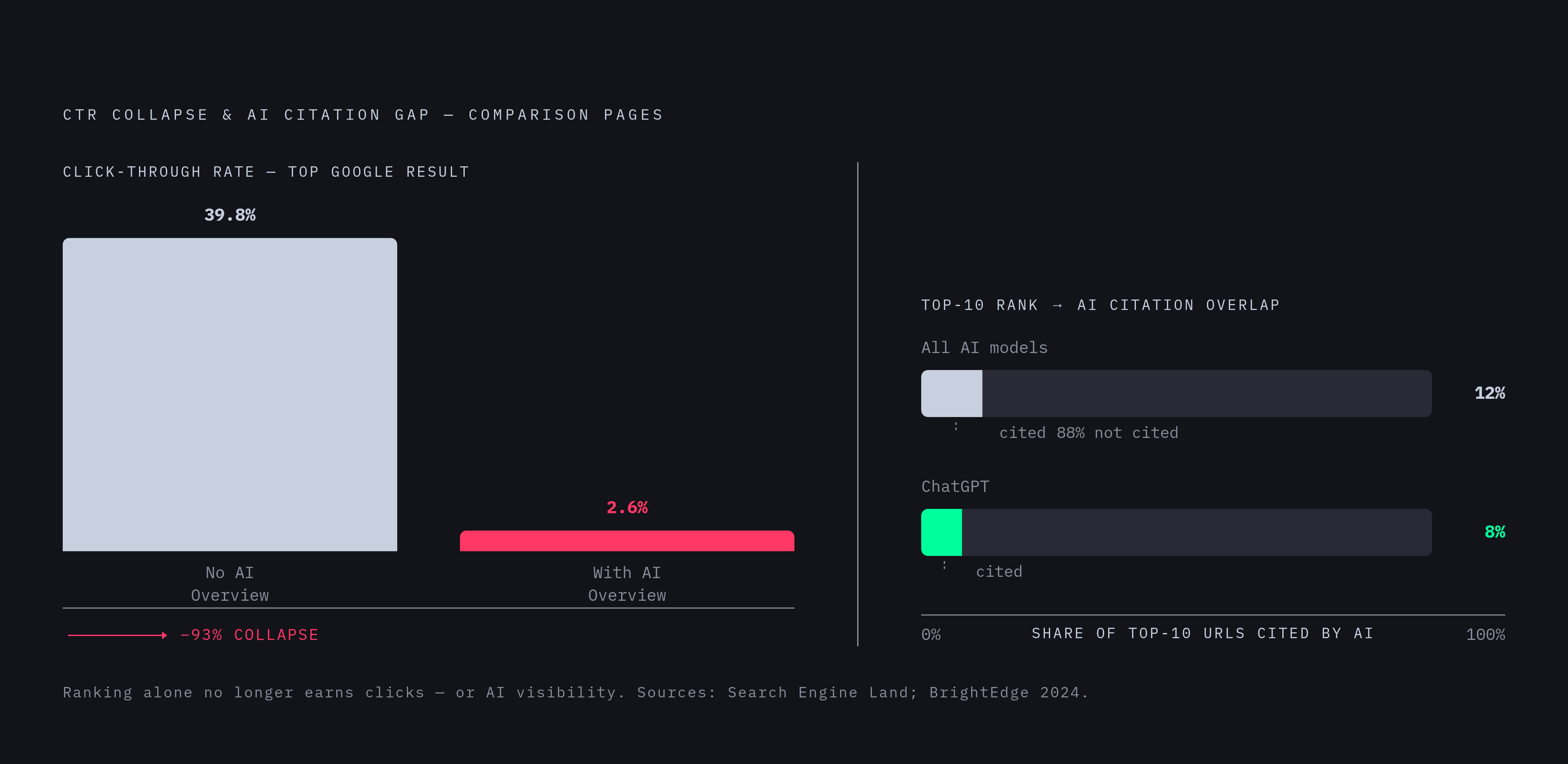
The "From Platforms to Pathways" analysis found that AI chatbot referral traffic reached 1.1 billion visits in June 2025, up 357% year over year. Zero-click searches climbed from 56% up to 69% in just twelve months after Google's AI Overviews debuted in May 2024, a 13-point jump that pushed a big slice of search activity from clicking through. With an AI Overview on the page, Click-through for the top search result is 2.6%, versus 39.8% without one, about 58% lower.
Use-case pages and Comparison content fall squarely into the crosshairs of this move. In a study of 500,000 prompts, Peec AI said basic information searches, explainers, matchups, and how-tos brought up AI Overviews 93% to 97%. That query format matches "Product A vs Product B" searches perfectly. A page that once targeted a snippet is, by accident or intent, AI Overview material today.
pSEO practitioners overlook this: high Google ranking may still miss AI citation. Just 12% overlap exists between what AI models cite and Google's top 10 results, so these URL sets call for distinct optimization. For ChatGPT, the overlap with Google's 10 is thinner still: just 8%. A comparison page optimized only for standard ranking signals might land on page one yet stay out of every AI-generated response.
What earns citation there lines up with what earns a buyer's trust: sourced claims an AI can pull cleanly and credit with confidence, not vague marketing copy offering nothing solid to quote. The discipline that produces a 5.45% converting comparison page (grounded in actual data, admitting honest trade-offs, supported by evidence a competitor cannot fabricate) also lets that page become the reference an AI turns to when a buyer requests the comparison.