Content Decay Rate and When to Refresh vs Retire Posts
Learn which aging posts deserve updates and which ones to retire entirely.

Content decay is the slow bleed of organic traffic, rankings, and leads from a page that nothing dramatic ever happened to. That's the whole subject of this piece: how to tell decay apart from a penalty, how to read its symptoms, and what to actually do about a post once it's clearly sliding. Spotting decay is easy; everyone spots it eventually when the traffic graph starts looking like a ski slope. The harder skill is deciding, page by page, whether that post deserves a refresh, a merger with something stronger, or a quiet burial.
The forces that cause decay, and why they're moving faster now
A penalty is sudden and steep, often tied to an algorithm update, and it hits fast enough that someone in marketing sends a panicked Slack message the same week. Decay is slower and less dramatic: a page loses 5% of clicks one month, another similar slice the next, and by month six it's down by a third with nobody quite sure when the bleeding started. That distinction matters because the fix is different. A penalty needs an investigation. Decay needs triage.
Four things drive it, and they rarely act alone.
Search intent drift is the first and probably the sneakiest. What people mean when they type a query changes underneath the page that used to answer it. Take "remote work software": a few years back that phrase mostly pulled up definitional content explaining what remote work tools even are. Now it pulls up comparison posts and pricing breakdowns, because the audience already knows what the category is and wants to know which tool to buy. A post written for the old intent isn't wrong, exactly. It's just answering a question nobody's asking anymore.
Competitive displacement is the second, and it's the most straightforward: someone publishes something better, and it takes the slot. Google doesn't need a reason to demote a page beyond the fact that a newer, more thorough, better-linked page exists now.
Third is staleness, both in the data cited and in the broader trust signals search engines look for. A post citing 2021 statistics as current fact does two kinds of damage: it makes a reader who knows better bounce immediately, and it signals to AI systems scanning for recency that this page isn't a reliable source to cite. Search engines and AI models both use freshness as a proxy for trustworthiness, and an outdated stat is the fastest way to fail that check.
Fourth, and newest, is AI Overview cannibalization. A growing share of informational searches now end right there on the results page, no click required, because the AI Overview already answered the question. Research tracking organic click-through rates for informational queries with AI Overviews present found a sharp decline between mid-2024 and late 2025. The click increasingly goes nowhere at all, not to a competitor, just gone.
None of these operate in isolation, which is the uncomfortable part. A page with drifting intent, a stale statistic, and a fresh competitor entering the space doesn't decay at the sum of those three problems. It decays faster than that, because each weakness makes the page more vulnerable to the others. A page with only one flaw might survive years. A page with three is often gone within a quarter.
And there's a structural shift underneath all of this worth naming directly: ranking in the top ten and getting cited in an AI Overview used to be nearly the same contest. By early 2026 that overlap had collapsed significantly from where it stood in 2025. Two separate leaderboards now exist, and being strong on one doesn't guarantee anything on the other. That reframes decay from an SEO maintenance chore into something closer to a content strategy problem, because now there are two different audiences to satisfy with the same page.
How to read the signals that a post is actively decaying
The clearest early signal is boring on purpose: a sustained drop in organic clicks with no corresponding drop in search demand for the topic. Watch for clicks down around 30%, click-through rate down noticeably, or rankings slipping two or more spots on the queries that matter. None of those numbers alone is an emergency. Together, over a few months, they're a pattern.
Google Search Console is the tool for this, and the comparison that matters most is the trailing three months against the three months before that. Filter for pages where impressions hold steady but clicks and CTR fall; that combination usually means the page is still being shown, it's just not being clicked, which points at a title or snippet that reads as tired next to fresher competitors. Position slippage from the top five into positions six through ten deserves particular attention. The gap between position one and position two alone accounts for a meaningful chunk of available clicks, so a two-spot slide is a material loss even if the page technically still ranks on page one.
Beyond the traffic numbers, a handful of on-page signals round out the diagnosis. Outdated statistics still sitting in the body copy. Broken links, internal or external. A near-total absence of internal links pointing to the page, which tells search engines the site itself doesn't think this content is important. And increasingly: does the page show up at all when someone asks ChatGPT or Perplexity the core question it's supposed to answer? If it doesn't, that's a decay signal traditional rank trackers won't catch.
One useful heuristic for sorting content problems from domain problems: if one page is sliding while the rest of the site holds steady and indexing looks healthy, the issue lives in that page rather than in the domain's overall health, which is good news, because it means the fix is contained.
Worth flagging separately: AI visibility decays faster than traditional rankings do. Research from AirOps found that pages not updated within roughly 60 days drop into a meaningfully weaker freshness tier for AI citation purposes. Traditional SEO decay plays out over quarters. AI citation decay can play out over weeks.
Building the content audit that makes the framework usable
None of the signals above matter much if they live scattered across five different reports nobody checks. The fix is a flat inventory: one row per indexable URL, and four columns of hard data attached to each. Organic clicks and impressions over the trailing twelve months. Primary target query and current ranking position. The date of the last meaningful update, not the original publish date, since a lot of pages have a 2019 publish date and a "meaningful update" date that's identical to it. And whether the page currently has any internal links pointing to it.
Add a fifth column while building this: an AI citation count. How often does the URL surface in AI-generated answers for its core target queries? This matters even for pages with modest traffic, because a page with strong AI citation numbers is building entity associations inside AI training data that traffic metrics alone won't show. A page can be quietly valuable in ways Google Analytics doesn't render legible.
The audit's job is to produce a diagnosis, not a task list. That distinction is worth sitting with for a second. It's tempting to build the spreadsheet and immediately start assigning "update this" to every row with declining numbers, but the four columns exist so the next section's decision framework can actually run on them. Some pages need an hour of light editing. Others need a genuine rewrite that takes days. Treating those as the same task because they showed up on the same spreadsheet is how audits turn into busywork nobody finishes.
Most teams catch decay late and fix it by hand, spending hours per article on a process that has to repeat every quarter whether anyone enjoys it or not. Building the audit structure once compresses that cycle considerably, because the diagnosis step stops requiring a fresh investigation every time. Run the full inventory at least once a year. Fast-moving categories, AI tools, finance, general tech, warrant a quarterly pass instead, because a year is long enough for an entire competitive landscape to turn over twice.
The four-bucket decision: Keep, Refresh, Merge, or Retire
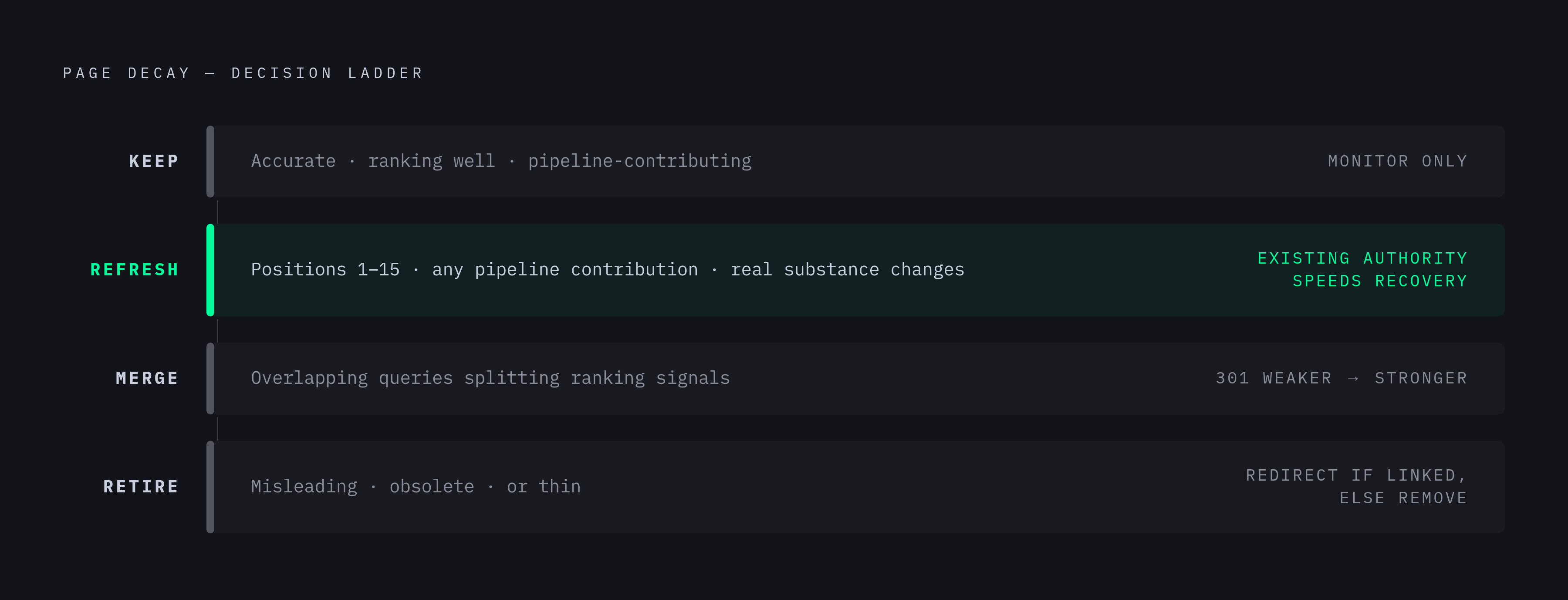
Four outcomes, and the audit data from the previous section feeds directly into which bucket a page lands in.
Keep is for pages that are accurate, ranking well, and contributing to pipeline. No action needed right now, but "no action" doesn't mean "ignore forever." Add it to the monitoring queue with a calendar trigger for the next audit cycle. Decay that goes unwatched for two years doesn't stay in the Keep bucket; it just becomes a much bigger job later.
Refresh is the bucket for pages ranking roughly in positions one through fifteen that generate any pipeline contribution at all. That range matters specifically because the foundation is already there: existing backlinks, internal links, and ranking history all represent work that doesn't need to be redone. A refresh on a page like this recovers lost ground faster than a brand-new post ever could, because the new post starts at zero authority and this one doesn't. But the refresh has to be real. Changing the "last updated" date without changing the substance underneath it doesn't fool Google, and it definitely doesn't fool a reader who scrolls past a 2021 statistic dressed up with a 2026 timestamp. New data, corrected intent alignment, restructured sections: that's what a refresh actually requires.
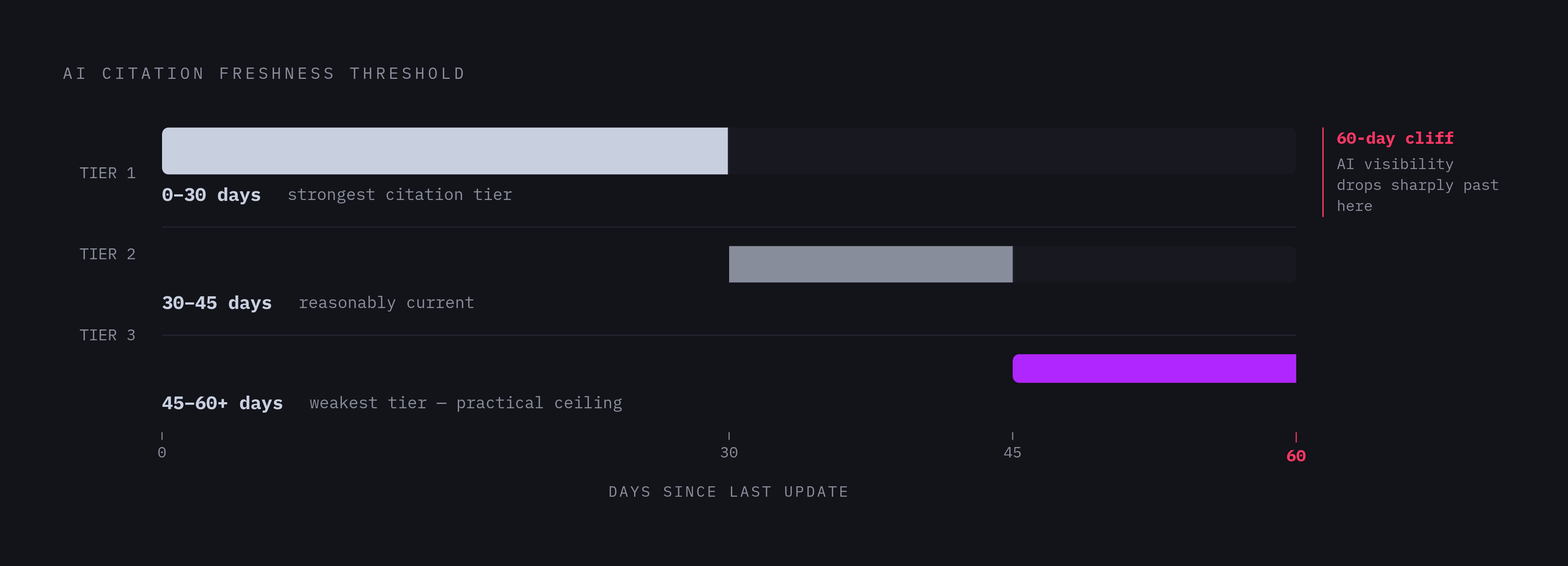
Pages with meaningful AI citation counts deserve special protection inside this bucket even if their traffic numbers look modest, because those citations represent entity associations that are genuinely hard to rebuild once a URL disappears. AirOps research found that pages with a visible "last updated" timestamp earn 1.8 times more AI citations than pages without one, which makes the visible republish signal part of the tactic, not a cosmetic afterthought. For AI freshness specifically: updates within 30 days land in the strongest tier, 30 to 45 days still reads as recent, and past 60 days the page drops into a noticeably weaker one.
Merge applies when two or more pages cover the same ground and are splitting ranking signals between them. A classic case: "What Is a Content Audit" and "How to Run a Content Audit" both ranking for near-identical queries, each one weaker than it would be alone. The fix is to identify the stronger URL, based on position, backlink count, and slug quality, fold the weaker page's useful content into it, and 301 redirect the old URL over. This decision should run on query overlap, backlink data, and conversion numbers, not just a gut sense that "these are kind of about the same thing." A borderline case worth naming: pages ranked well outside the top twenty with no pipeline contribution but genuine topical relevance. If they've picked up meaningful referring domains over time, fold them into something stronger. If they have no backlinks at all, they're not worth saving.
Retire is for content that's misleading, factually obsolete, or thin enough that a rewrite would cost more effort than starting over. Retiring doesn't automatically mean deleting. If the page still pulls in relevant inbound links, redirect it to the closest strong equivalent rather than serving up a dead page to everyone who follows that link. If it's genuinely orphaned, nobody links to it, nobody reads it, pull it from the sitemap and let it return a standard "not found" response. Aim to prune a modest slice of the obsolete inventory each year rather than clearing out entire topic categories in one panicked sweep.
The through-line across all four buckets: the action follows the diagnosis. Age and word count are not diagnoses. An older post can outrank newer competitors if it's been maintained; a recent post can already be decaying if it launched into a category that moved past it quickly.
What actually earns traffic back after a refresh
HubSpot's Historical Optimization program is worth studying here because it's a documented case, not a theory. By assigning a writer specifically to update archived posts rather than produce new ones, the company increased organic search views on refreshed posts by an average of more than double, and monthly leads generated from those posts roughly doubled. The mechanism behind that number matters more than the number itself: the program prioritized pages that already had a traffic foundation to build on, not pages that had never ranked in the first place. That's exactly the logic behind the "positions one through fifteen" refresh criterion from the previous section. A refresh can't manufacture an audience for a page that never had one.
Separately, data from shno.co found that B2B companies updating their top 50 content pieces at least twice a year saw 37% more organic traffic on average compared to companies only touching content once annually. Frequency compounds, apparently, the same way decay does.
What has to be inside a refresh for it to actually move the needle? Updated statistics with real sources, first and non-negotiable; a 2021 figure sitting in 2026 content is doing active harm, not just failing to help. Intent realignment comes next: does the structure of the piece match what someone searching that term wants today, or does it still answer a question from two search cycles ago? Structural additions matter too, a comparison table, an FAQ block, a sharper introduction, whatever the current top results have that this page doesn't. The visible "last updated" date needs to change and stay visible, given that 1.8x AI citation lift isn't a small effect. And the internal link audit shouldn't be skipped: newer posts on the site should link back to the refreshed page, and any existing internal links should be checked to confirm they still point somewhere accurate.
One more number worth sitting with: AirOps research found that 95% of pages cited by generative AI systems had been updated within the prior ten months. That's not a minor correlation. It suggests recency isn't a ranking nicety in the AI citation world, it's close to a prerequisite.
And the compounding logic from earlier applies in reverse here. A refresh that fixes the statistics but ignores the structural intent mismatch, or fixes the intent but leaves broken links in place, tends to underperform relative to a refresh that addresses everything at once. Decay compounds when multiple weaknesses interact; recovery works the same way.
Setting a refresh cadence that matches how fast your content actually decays
There's no single correct interval, and anyone promising one is selling something. The right cadence depends on the topic's competitive intensity and how fast the underlying industry actually moves.
As a general guide: evergreen content in stable categories can go six to twelve months between reviews without much risk. Competitive topics need eyes every three to six months. Genuinely fast-moving fields, AI tooling, finance, general tech, need a look every one to three months, because the competitive landscape and the search intent both shift faster than a slower cadence can track. Product pages call for a different clock entirely: update them when the specs change, not when the quarter ends.
Layered on top of that broad schedule is a tighter one specific to AI citation, for whichever pages carry strategic weight in that channel. Inside 30 days of an update, a page sits in the strongest freshness tier. Between 30 and 45 days, it still reads as reasonably current. Past roughly 60 days, it drops into a distinctly weaker tier, and that 60-day mark functions as a practical ceiling for any page where AI visibility actually matters to the business.
Practically, that means running two cadences at once: a broad quarterly or biannual audit covering the entire URL inventory, and a tighter rolling schedule for the smaller set of pages anchoring AI citation strategy specifically. Trying to run both timelines through the same manual process is usually where the wheels come off, since execution speed, not decision-making, is the real bottleneck here. Manual refresh work is slow by nature: hours per article, repeated every quarter, on pages that keep sliding the moment attention moves elsewhere. Workflows that pair AI-assisted drafting with editorial review can compress that cycle without cutting the corners that actually matter, updated sourcing, intent alignment, real structural change. Speed and quality aren't in tension here as long as the process has the right inputs to work from.
The organizing idea across all six sections, worth stating plainly at the end: a content inventory isn't an archive to file away and forget. It's a living system, and the audit, the four-bucket decision, and the refresh cadence aren't three separate projects competing for calendar space. They're one loop that keeps running as long as the site does.