AI Overviews Impact on Organic Click-Through Rates
Google's AI Overviews are eating organic traffic from content that answers questions directly.
AI Overviews have moved past the point where content teams can treat them as a rollout to wait out.
Ahrefs data puts AI Overviews on nearly half of all search queries as of March 2026, up sharply from where the figure stood in December 2025, a 58% jump in about three months, Digital Applied's analysis found. In January 2025, per BrightEdge and Generative Parser data cited in the research brief, the share was far lower, and the past 15 months represent close to an eightfold expansion. That is not a feature ramping up. That is a feature that has already arrived.
The expansion is not even across query types, and the unevenness tells you where the pressure actually sits. Informational and how-to searches now trigger AI Overviews on a large majority of result pages, while transactional queries lag well behind, per Digital Applied. BrightEdge's 16-month tracking study sharpens the industry picture further: Healthcare, Education, and B2B Tech each see AI Overviews on the vast majority of their queries, Restaurants sits close behind, and e-commerce barely registers. A healthcare publisher and an e-commerce retailer are living in two different search environments right now, even though both call it "Google."
None of this is happening in the background, either. Contently's analysis found that users already recognize the AI Overview format and lean on it, and the feature has settled in as a permanent layer of the search experience rather than a novelty users click past. The infrastructure is built, the user habit is formed, and the numbers keep climbing. Nothing about that combination points toward reversal.
The core mechanism: AI Overviews resolve queries on the SERP before a click is needed
The traffic decline tied to AI Overviews is not some fluke of user mood or a temporary novelty effect. It follows directly from what the feature is built to do: answer the question on the results page itself, so the user never has to leave.
Similarweb's tracking shows zero-click searches rising substantially between May 2024 and May 2025, a curve that lines up closely with the AI Overview rollout schedule. Separate analysis cited by Contently found that the large majority of searches producing an AI Overview end without any click at all. Put those two data points side by side: the summary is doing the job the click used to do.
Which queries get absorbed this way is not random. Contently's analysis found that definitional questions, date lookups, quick how-to searches, and single-fact queries get resolved most completely by AI Overviews, and those are precisely the query types that informational content has spent a decade being built to capture. The content strategy that won the last ten years of SEO is now feeding the feature that replaces it.
AI Mode pushes the same logic further, and it behaves very differently from standard AI Overviews. Where a standard AI Overview sits above the organic results, AI Mode does away with the organic list altogether and replaces it with a conversational interface, and its zero-click rate is reported at 93% in the research brief. For queries routed through AI Mode, ranking well in traditional organic search buys nothing. The only way in is a citation inside the AI response itself.
Adding to the difficulty, Google Search Console does not break out AI Overview impressions and clicks from standard search data. As of June 2025, AI Mode clicks get folded into "Web" search type totals in the research brief's account, which means publishers trying to measure the damage in their own dashboards are working with numbers that already hide the thing they're trying to isolate. This measurement gap matters because it limits what publishers can actually do about declining traffic, a problem addressed later.
How CTR data has changed across the studies that have measured it
Every independent study that has measured CTR against AI Overview queries has found the same direction of movement: down. The most detailed longitudinal dataset available shows the compression cuts across both organic and paid results.
Start with paid. Seer Interactive's tracking (identified as S4 in its research) found paid CTR on AI Overview queries fell even harder than organic. That alone undercuts the idea that AI Overviews mainly siphon off casual, low-intent browsing, since paid clicks are, almost by definition, the ones an advertiser judged worth paying for.
A controlled field experiment from researchers Saharsh Agarwal and Ananya Sen adds weight to the same conclusion: outbound organic clicks dropped 39.8% when AI summaries were displayed, and the losses concentrated in informational queries, the research brief's account notes. Ahrefs' study of a large keyword set found the presence of an AI Overview correlates with a substantially lower average clickthrough rate for the top-ranking page.
The size of the drop depends heavily on what the query is actually asking, Digital Applied's analysis found. Simple definitional queries take the steepest hit, since the AI Overview answers the question in a couple of sentences and gives the user nothing left to click for. How-to content loses less when the AI Overview only covers part of the procedure, but the drop grows if the summary walks through the whole process. Comparison and review queries land somewhere in the middle: users weighing a decision still tend to click through for the detail a summary can't fully replace. Navigational and branded searches lose the least of all, because someone searching for a specific destination is going to reach it regardless of what sits above the link.
Dataslayer's own Search Console data, covering January through April 2026 and cited in Seer Interactive's S3 research, puts a granular face on the pattern. Their AI Overviews article is at an average position of 6 and pulls hundreds of thousands of monthly impressions, yet returns a very low CTR, while other articles ranking at similar positions, but on topics less prone to triggering an AI Overview, post meaningfully higher CTRs. Same ranking position, same publisher, wildly different outcome, and the AI Overview is the variable that explains the gap.
Seer Interactive's data shows CTR declined substantially even on queries with no AI Overview at all, across the same June 2024 to September 2025 window. That points to something broader than AI Overviews alone: users drifting to ChatGPT, Perplexity, social platforms, or typing a brand name straight into the address bar. CTR compression is happening across the board, not only on the queries where an AI Overview shows up.
Google's own position deserves a fair hearing before any rebuttal. Google's official position, stated by its head of search, claims the platform is seeing "slightly more quality clicks to websites than a year ago" following the AI Overview launch, though independent researchers counter that total search impressions rose sharply while click-throughs declined, letting Google truthfully report more searches while publishers receive fewer visits, per the research brief. Independent researchers don't dispute the clicks so much as the framing: total search impressions climbed sharply over the same period, so a modest rise in absolute clicks can coexist with a falling click-through rate. Google gets to report more traffic in aggregate while individual publishers watch their own share of it shrink.
The two-tier outcome: what the data shows for cited versus uncited brands on the same queries
The aggregate CTR decline is real enough, but it flattens a distinction that matters more than the headline number. Brands that get cited inside an AI Overview substantially outperform brands that don't on the exact same query, and that gap appears in both organic and paid data.
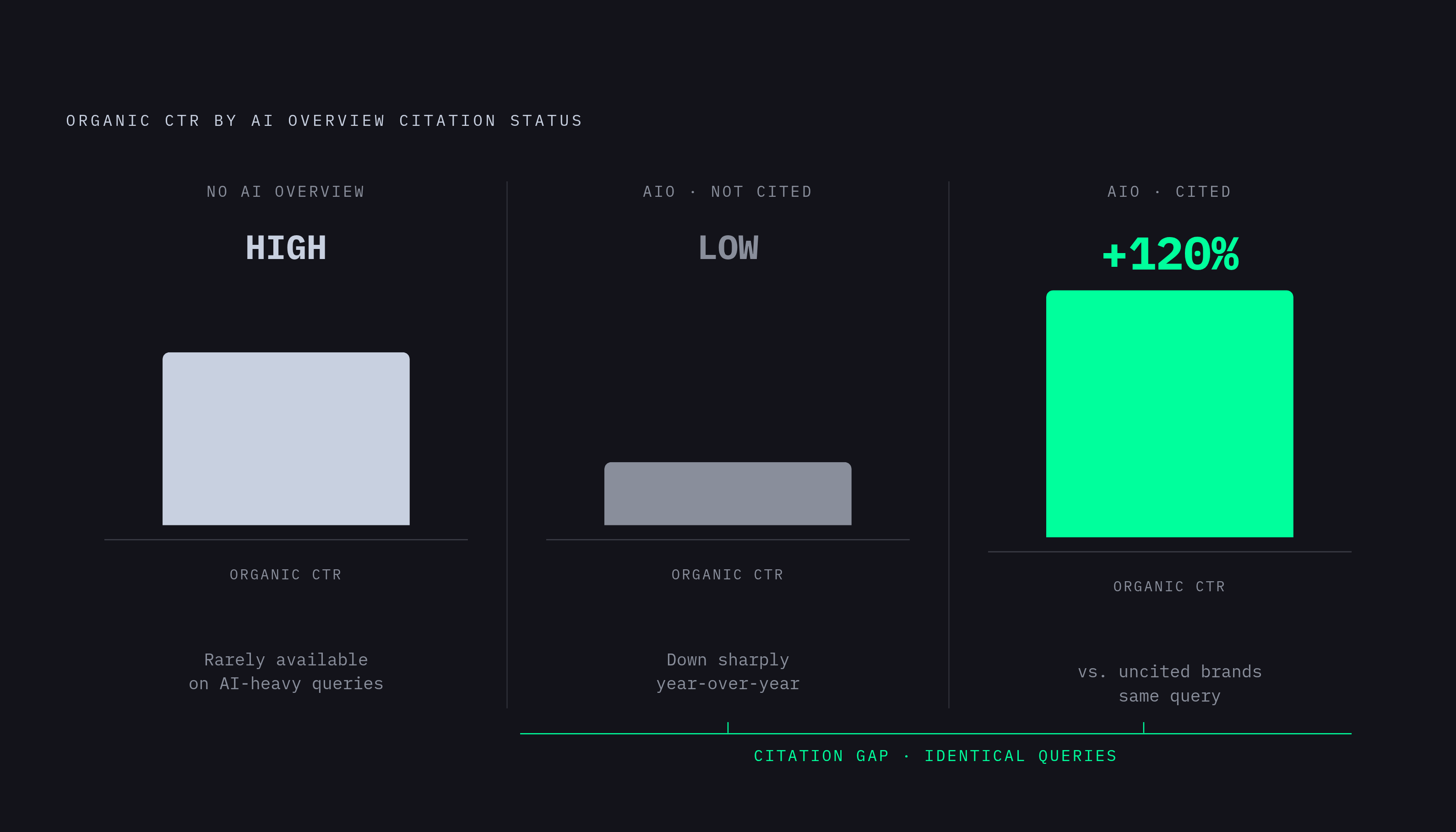
Seer Interactive's 2026 study (S5) found cited brands earn far more organic clicks per impression than uncited brands competing on the same AI Overview query, a gap the research brief puts at 120%. That gap between the two outcomes runs far beyond a rounding difference. It is closer to two separate outcomes wearing the same query.
The September 2025 data (S4) lays out three scenarios. When no AI Overview appears, organic CTR is still the best outcome, but it is no longer a reliably available alternative given how many queries now trigger a summary; when an AI Overview appears and the brand isn't cited, organic CTR is low and down sharply year-over-year. Citation doesn't erase the decline. It determines how steep the decline is.
Cited brands post substantially higher paid CTR than uncited brands competing on identical AI Overview queries, Seer Interactive's S3 and S4 research found. Seer Interactive is careful to flag what the data can't establish here. The study cannot prove that citation itself causes the higher CTR, since brands with stronger existing authority and higher baseline CTRs may simply be the ones more likely to get cited in the first place. Whichever direction the causation runs, the outperformance for cited brands holds consistently across the dataset.
Conversion quality from AI-referred traffic reinforces the split downstream: LLM referral visitors convert at substantially higher rates than standard organic search visitors, per Seer Interactive data cited in the research brief, because visitors arriving via AI citations have already had the basic question resolved and arrive later in the decision journey. Contently's analysis estimates AI search referral traffic converts at roughly three times the rate of other channels, and that AI search visitors carry substantially more value than the average organic visitor, drawing on Semrush data. The traffic is smaller. What arrives tends to be worth more.
Real-world traffic losses that show what the uncited path looks like at scale
Beyond the aggregate numbers, the uncited path has a face: named publishers, disclosed revenue, and in at least one case, a courtroom.
HubSpot has said a large majority of its organic traffic has declined. Business Insider lost roughly half its traffic over five years and cut staff as a result. CNN saw a significant estimated drop in its own share. Chegg's revenue fell sharply year over year, and the company filed suit against Google in February 2025, naming AI Overview impact directly in its complaint, per Quickseo.ai's compilation.
The pattern isn't confined to a handful of famous names, either. Chartbeat, tracking thousands of news sites worldwide, found Google search referrals fell by roughly a third across 2025. Digital Content Next (DCN) member sites, spanning news and entertainment, experienced a range of traffic losses, with a notable year-over-year decline in Google Search referral traffic overall and somewhat steeper losses for non-news brands, per the research brief.
Penske Media Corporation, which publishes Rolling Stone, Variety, Deadline, The Hollywood Reporter, and Billboard, filed an antitrust suit against Google in September 2025, alleging the company used its search monopoly to pressure publishers into accepting AI training use and AI Overview inclusion. In February 2026, Penske filed a memorandum opposing Google's motion to dismiss, backed with detailed documentation of its own traffic losses.
The European Publishers Council has framed the underlying complaint in structural terms: Google's search interface, in its view, has shifted from a referral service into an answer engine that substitutes publisher content directly, without authorization, without a workable opt-out, and without compensation. Whatever the legal outcome of these cases, the pattern behind them is already documented across multiple, unrelated publishers.
The early 2026 CTR rebound and where the market is settling
The decline that defined 2025 didn't carry into 2026 the way forecasters expected. Organic CTR on AI Overview queries recovered meaningfully in January and February, and that recovery looks more like a new floor forming than a continued slide.
Seer Interactive's own projection model called for continued decline, and every informational and transactional organic segment beat that projection in both months. Even queries with no AI Overview present saw CTR rise over the same window. Something about user behavior stabilized faster than the model expected.
Seer Interactive itself is cautious about what this means. Its March 2026 projections are framed as directional floors rather than firm predictions, and the firm describes the rebound as a possible "new normal" taking shape rather than a genuine recovery. CTR remains far below pre-AI-Overview levels. The bleeding slowed but didn't reverse.
The rebound also leaves the cited/uncited gap untouched. Both segments improved over the same period, but the improvement is proportional, and the space between them hasn't closed. Getting cited still separates a good outcome from a mediocre one, rebound or no rebound.
One more wrinkle complicates any easy read of this data. BrightEdge's figures, cited in the research brief, show only a small minority of AI Overview citations now come from pages ranking in the organic top 10, a sharp fall from the large majority that held that spot in mid-2024. Ranking well in organic search and getting cited in an AI Overview used to move together. They've come apart. A page can dominate its organic ranking and still never appear inside the summary that's now sitting above it.
What citation strategy looks like in practice: the discipline now operating alongside SEO
That decoupling is the reason citation strategy now exists as its own discipline, separate from traditional SEO rather than a natural extension of it. Ranking on page one used to be the whole game. It's now one input among several, and a growing body of evidence points to which of the others actually move the needle.
Content structure carries real weight here. Pages that answer a question in clear, extractable language near the top, rather than building toward the answer across several paragraphs, tend to align with how AI Overviews pull and summarize source material. This tracks with the query-type findings from earlier: definitional and how-to content gets absorbed into the summary most completely, so the pages that earn a citation on those queries are usually the ones structured to be lifted cleanly rather than paraphrased.
Seer Interactive's own caveat about causation cuts both ways here: if stronger authority correlates with a higher citation rate, then the practical implication is to invest in the underlying signals of expertise, author credentials, and original data, rather than treating citation as a checklist item bolted onto existing content.
The conversion data from earlier belongs back in this conversation, because it changes how the tradeoff should get evaluated. A brand chasing citation is chasing a visitor pool, not just a bigger number of clicks. It's chasing a visitor pool that converts at multiples of the standard organic rate. That reframes the entire calculation: fewer total visits, but visits worth substantially more each, is not automatically a worse outcome than the old model of higher volume at lower intent.
It aims at a different target: not the organic result list, but the summary box that now sits above it, deciding which brands the user sees before they ever reach that list.
Sources
- AI Overviews and Organic Traffic: What the 2026 Data Actually Shows - Contently
- AI Overviews Killed CTR 61%: 9 Strategies to Show Up (2026)
- AIO Impact on Google CTR: September 2025 Update
- AIO Impact on Google CTR: 2026 Update
- Google AI Overviews Surge 58%: SEO Impact Analysis
- Google AI Overviews Statistics (2026): 56+ Data Points on Coverage, CTR Impact, Citations, and Industry Breakdown
- The conference for marketers ready to win in 2026