SEO Impact of AI-Generated Content on Domain Authority
Unedited AI content tanked domain authority in 2026, but expertise and citations still matter most.

What domain authority actually means when search is AI-driven
AI-generated content alone doesn't hurt domain authority. Domain authority drops when content doesn't show expertise, doesn't earn citations, and doesn't pass the same quality checks search rankings and AI answers both apply to every page. Whether the words justify themselves matters more than which tool produced them.
Google has made that point repeatedly. Its stated rules see automation as a problem only when the point is to cheat rankings, not because software or an AI helped write the text. E-E-A-T, standing for experience, expertise, authoritativeness, and trust, appears over 120 times in the Search Quality Rater Guidelines. To that framework, it makes no difference who typed the words. What matters is whether the point inside it stands up.
The things penalized by Google's 2026 core changes
February's 2026 core update made it painfully clear which sites it targeted. A large share of sites publishing unedited AI content at scale lost 40–90% of their organic traffic after the February 2026 core update. It was just that: extinction for a specific content model, where software generates a piece and no one touches it before release.
The sites that improved weren't the ones that stopped using AI tools. They were the ones who found out what triggered the penalty and changed the input instead of abandoning the tool.
Soon after came the March 2026 update, which Google described as a regular recalibration. Google did not officially mention link equity or Experience signals, but the aftermath made it obvious. Unattributed pieces, plain AI overviews carrying no byline, affiliate sites writing up items they had never used, and aggregator blogs recycling other people's work: each one fell behind. At the same time, sites with smaller domain authority scores, built on hands-on work, gained visibility over larger companies running thin content.
The December 2025 core update had already spread further before those arrived. E-E-A-T scrutiny once focused on finance or medical topics but now extends to blogs, SaaS tools, and e-commerce listings. Many site owners in those spaces thought the scrutiny didn't concern them. The scrutiny reached them too.
What AI-driven search did to domain authority
Moz’s third-party metric, Domain authority, runs from 1 to 100 and has no bearing on Google's ranking. Ahrefs has Domain Rating, while Semrush has Authority Score; the tools share a similar range, though each calculates it its own way. Domain authority metrics, like those from Moz or Ahrefs, do not factor into Google’s ranking algorithms.
Those scores mainly come from referring domains, the number of different sites linking to one domain. Studies across Moz, Semrush, and Ahrefs show referring domains drive 52% of DA score variance. It also scales non-linearly: Lower domain authority scores can shift more quickly, while higher scores require sustained effort and link-building to improve.
Something more consequential than that metric has emerged: entity authority. Google’s Knowledge Graph recognizes brands and experts, linking domains that demonstrate strong subject authority to related topics. Domain authority remains distinct, but how well a site demonstrates expertise may influence whether AI tools cite it.
The new visibility currency: being cited inside AI Overviews rather than ranking first
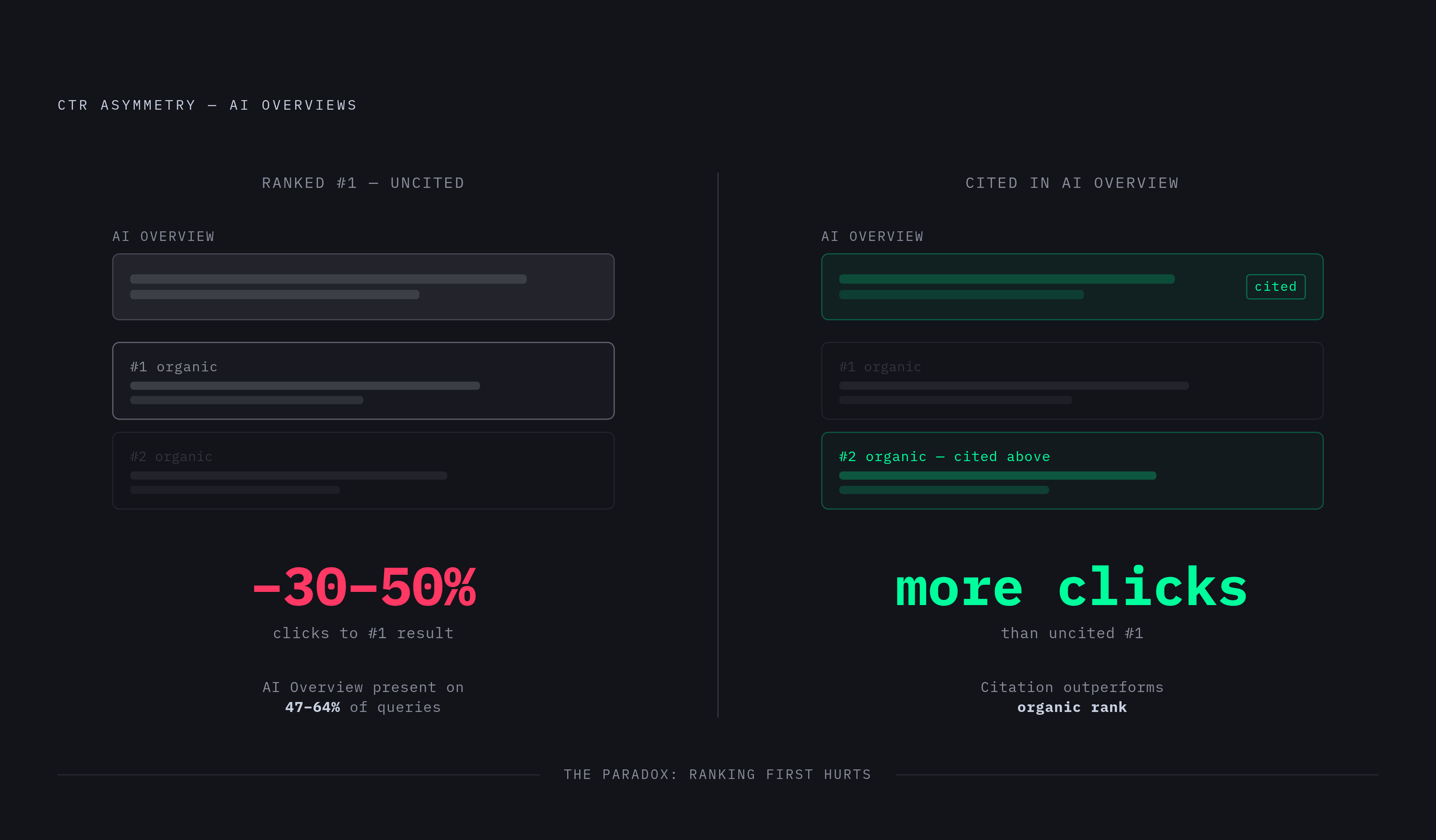
AI Overviews appear on 47% to 64% of queries this 2026, sharply up from their 25% to 30% share at the 2024 launch. For searches in those fields, it is even larger.
Ranking first doesn't carry the weight it once did. Queries with an AI Overview have click-through for the first organic listing fall 30% to 50%, since the overview answers before a searcher moves down to a result.
What matters most is the asymmetry built into that drop. Content cited inside an AI Overview can receive more organic clicks than content not cited, even on that same results page. Ranking high doesn't guarantee traffic anymore, but securing the citation flips things to a brand's advantage. A lot of that reach never counts as a click: a company gets named inside an AI reply, sticks as a mention in a searcher's mind, and shows up nowhere on an analytics dashboard.
What AI-generated content needs so it can earn citations across AI tools
AI Overviews often pick pages with domain authority, steady E-E-A-T proof, and writing set up for clear use. They don't work in isolation. A page can have great backlinks and still be left out if its information is lost inside dense paragraphs without an easy point to quote.
Extractability is what truly matters here. Each claim belongs on the page as self-contained evidence an AI can extract, then verify, without guessing about nearby meaning. GEO-bench, a Princeton study, showed that specific content changes lifted how often a source gets cited in AI answers by up to 40%. That’s more than marginal. A content team can build Citation using deliberate formatting and careful phrasing, instead of waiting for it to land in a brand's favor by chance.
Freshness decides whether content remains inside the citation set. Brands at the front of AEO change content every quarter, and that's no small task. That is what it takes to remain quotable.
How traditional domain authority building still feeds AI visibility
AI tools can't raise a domain authority score on their own. They can sharpen content, fix a site's setup, and make link-building faster, helping search systems place the domain better and other sites cite it. AI supports expertise here instead of taking over for it, and the February 2026 core update impacted sites relying on unedited AI content.
Referring domains still drive most DA variance, the same 52% share, so getting links from credible sites is still the core lever, whatever tool wrote the content behind them. A 2025 study found that sites with stronger backlink authority were cited in AI-generated answers more often. AI-driven visibility and its older counterpart both spot the same markers of reliability, just through different lenses.
With AI, teams complete audits, prospecting, and content optimization faster and see organic traffic gains 45% higher than teams without it. Skipping the fundamentals isn't what drives that result. It happens by running them faster.
The GEO and AEO measurement gap most content teams haven't closed
Rankings and clicks once showed whether content was doing its job. They fall short once a searcher is satisfied by a synthesized answer before visiting a site. Citation counts, brand presence across various AI tools handling related queries, and visits sent from AI platforms now serve as the measures that capture the real picture.
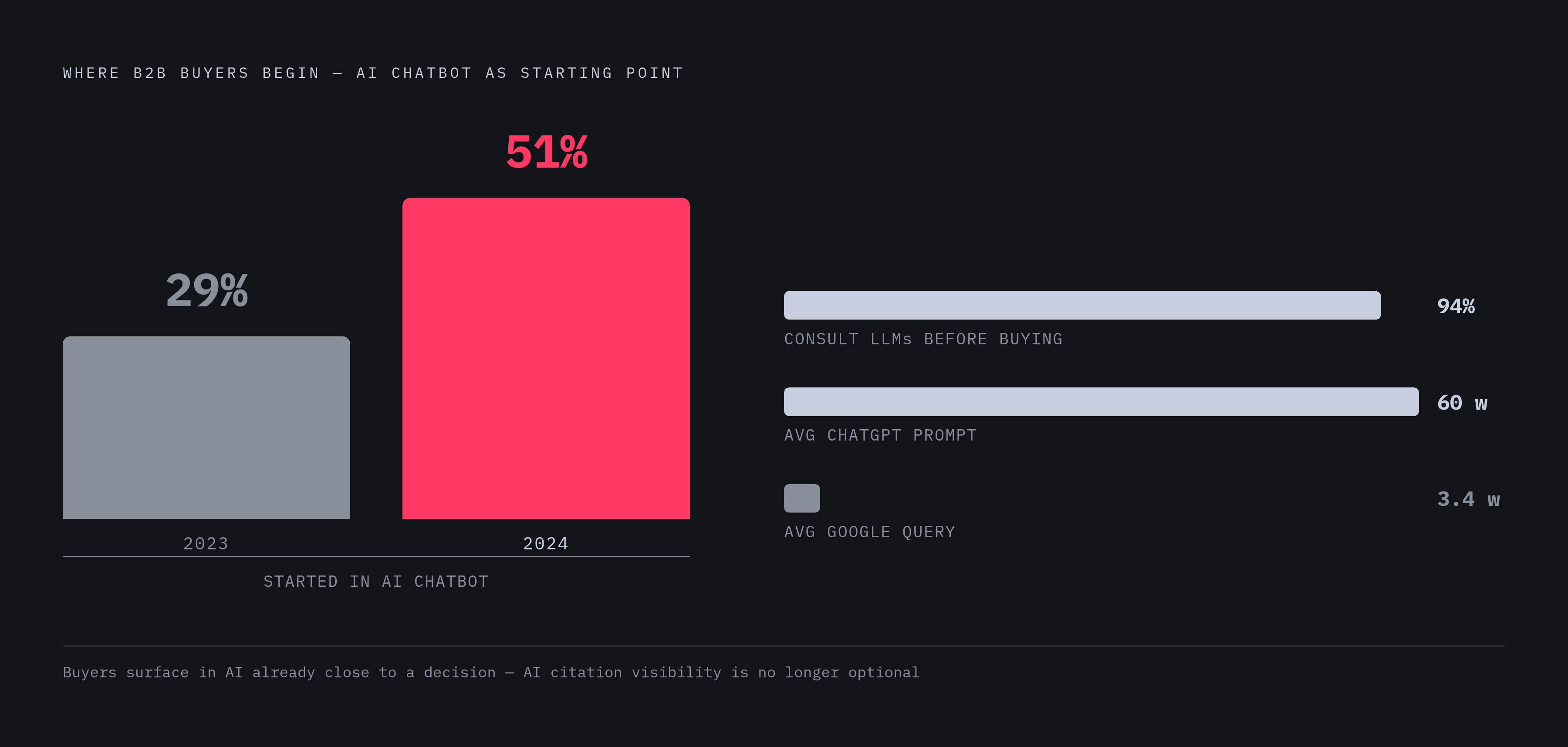
How people shop makes fixing this mandatory, not optional. G2's Answer Economy data reveals G2’s 2026 Answer Economy report found that 51% of B2B software buyers now start their search in an AI chatbot rather than Google, a leap from 29% just one year before. Ninety-four out of every hundred B2B buyers turn to LLMs before buying. That is how most buyers move today, not something for a footnote.
The queries look different now as well. On ChatGPT, a prompt is about 60 words, while a Google search is just 3.4 words. Bigger prompts show intent that is more specific, which puts the user close to using the answer, at times without opening a site. Showing up inside that answer is now where the conversion happens. If its analytics miss that citation, a content team is judging a funnel that loses people late.
What this means for firms handling AI work for multiple brands
Agencies producing content for several clients feel squeezed both ways in 2026. Clients expect faster turnaround now that AI tools handle it, and search driven by AI works differently for showing them to people. Quick turnaround by itself won't buy visibility.
Balancing several client accounts hits hardest in day-to-day account management. Agencies juggling multiple client accounts must preserve each brand's tone, publish content tuned for different readers across different platforms, and monitor AI citation results alongside the organic rankings they already followed. That's harder than it seems, particularly when no two clients speak the same way or serve the same kind of customer.
Holding one identity steady across every client is among the hardest jobs in content work, period, and agencies that bolt on AI tools as an add-on lose before they begin. AI earns value when added to existing project management, briefing, and client workflows at a firm. Timelines show it: Integrating client-facing AI into workflows takes significantly longer than setting up basic account management systems..
The content strategy that holds across both traditional and AI-powered search
Once stripped, the throughline is clear: the same process drives AI citation and domain authority for AI-generated content, by signaling expertise, earning citations, and surviving quality checks used by search and AI.
That throughline comes apart into three pieces, and dropping any one of them takes most of the bite out of the rest. The first is the authority setup: fast, well-organized pages, structured markup, plus backlinks from referring domains that genuinely count. This layer feeds DA and the chance AI picks the page to cite.
Another layer rests on expertise and experience: named writers, first-hand use or new findings, topical material made to earn entity status. E-E-A-T sits here, and March 2026's update showed that when small publishers beat major brands offering shallow material.
The final layer is citation content: shaped to be extractable and quotable, set up with schema, and aimed at the decision-stage queries buyers bring to an AI. Stacking these layers is what keeps content working no matter who's reading, whether that's someone scanning a results page or an LLM putting together an answer from what it can confirm quickest.