Featured Snippet Optimization for Competitive Keywords
Shift your snippet strategy as AI Overviews reshape search results.
Which Queries Show Featured Snippets Now That AI Overviews Changed Things
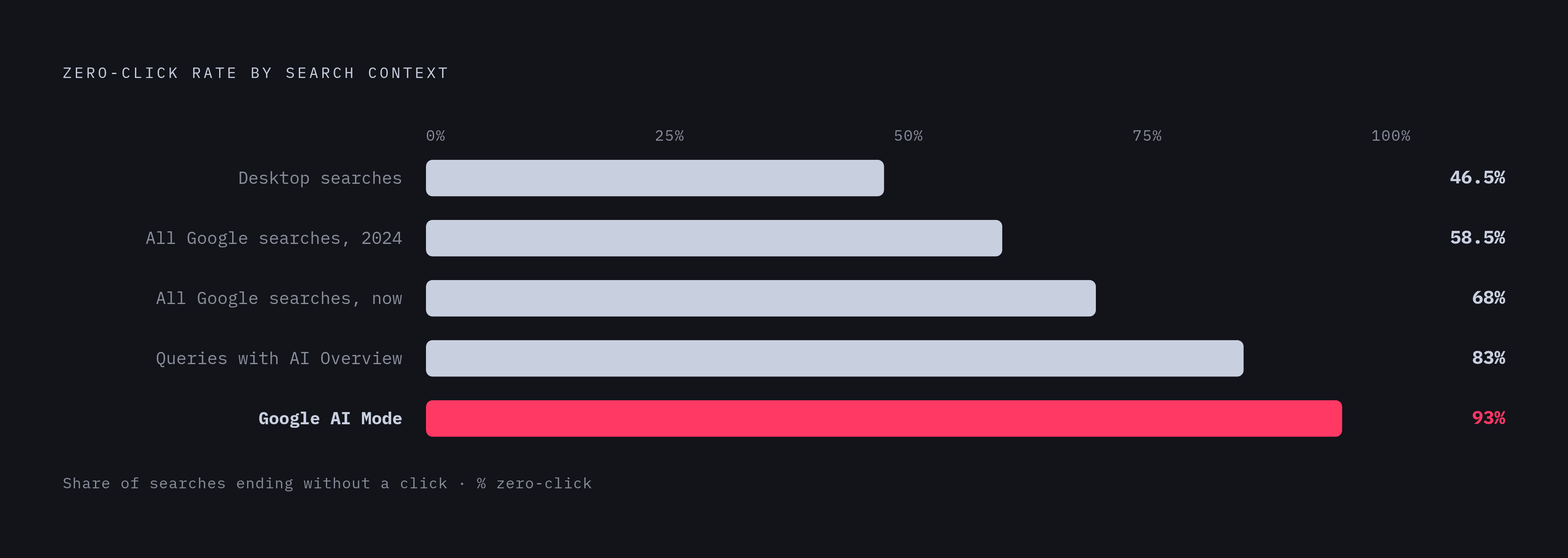
About 68% of Google searches finish with zero clicks, compared to 58.5% back in 2024. This change means featured snippet work on tough keywords calls for a different approach: position zero was not the end goal. It was just a step toward something else: earning mentions within AI Overviews, where people's focus sits today.
Breaking it down by phone, desktop, and goal makes it sharper. On phones, 77% of searches finish without a click, compared to 46.5% for desktop. Informational queries have 74% zero-click, but transactional searches are at 31%, telling you users still click when they plan to buy something, yet rarely click when learning about an idea. Adding an AI Overview takes that query's zero-click rate to 83%. Semrush reports 93% for searches inside Google's AI Mode.
Snippets still bring results, and people giving up on them because clicks are down are misreading the picture. When position zero shows up, it grabs 35% of clicks for those queries, and adding a snippet gives the same URL an 8% rise in organic click-through rate versus running without one. The reward shrank. It did not go away.
According to Frase, AI Overviews appear on 48% of the queries it tracks, up 58% over the past year, and the share rises to 57.9% on question-based searches. Google hasn't seen a change this big since Knowledge Graph landed in 2012. A whole chunk of space got inserted right above the snippets, and nobody asked for it.
Pure informational searches (the "what is," "how does," "why" kind) now skew AI Overview dominant, and traditional snippets are getting pushed out there at a steady clip. Guide-style queries often retain snippet visibility, particularly when structured as lists. "vs." searches don't follow one pattern, with the format changing based on the query. Transactional and commercial searches, "best," "top," "how to choose," stay snippet territory almost exclusively. AI Overviews rarely turn up for queries that read as if people are ready to buy something, while that single sign tells you what to keep and what to drop.
An audit is the smart starting point. Gather the queries with a snippet already won, sort by intent, and mark each informational query as likely for AI Overview takeover instead of snippet protection. Holding onto a position Google already plans to drop wastes work better spent getting the citation.
Patterns Shared by Snippet Winners and AI Overview Citations
Applied's research shows that content selected for featured snippets appears in AI Overviews at about double the frequency of content that hasn't earned a snippet. That is not a coincidence, and it settles an argument agencies keep having internally: there is no separate discipline called "AI SEO." The fastest, most reliable path to AI Overview visibility runs directly through the same snippet optimization work that has been standard practice for years.
The overlap happens because both formats pursue the same goal. A featured snippet or an AI Overview are just wrappers around the same goal: give people the most trustworthy, clearest response right away. Depending on where it appears, Google's signals change very little for content that's well-structured and authoritative.
Research on generative optimization supports this with concrete data. Aggarwal and his team determined that weaving in quotations from credible material boosted a page's visibility in AI-generated responses by about 41%. Numbers pushed it up roughly 31%, while adding citations brought about 28%. That list says what should go there, in order of how much it changes the needle.
E-E-A-T drives the citations from snippets and AI Overviews alike. That shared requirement producing AI Overview citations and snippet wins is the same one. Content with no writer listed, no credentials, and no clear signals rarely wins a 2026 snippet, and rarely gets cited by an AI Overview. Both formats apply the same vetting to a page before citing it.
Identifying which queries are worth targeting before writing a word
If a URL ranks below the first 10 organic listings, it rarely earns any featured snippet, however good the content reads. The snippet system works on top of current trust and ranking signals, not on its own. Position matters before content does, and skipping that step is how most groups waste money going after a snippet they couldn't get.
Top picks are queries where a competitor owns the snippet and a page lands from 2 to 10. That gap usually closes with a targeted rewrite of one part.
Certain query patterns reliably trigger a snippet: "what is," "how to," "why does," "steps to," "examples of," "differences between." Long-tail versions of these phrases tend to work even better, since they expose the user's full intent and narrow the field of competing pages.
Next, apply a three-part test before drafting starts. Look at the live SERP: does the query show an AI Overview, a snippet, or nothing? Next, decide if a brief reply builds confidence and draws them into more content, or just satisfies curiosity and closes the session right there. Last, check how Google currently shows the answer (prose, items, or grid) since matching that structure is mandatory.
How to shape content for every snippet format Google pulls
A paragraph response for a query Google needs in bullets is pointless; Google skips it and takes bullets from a competitor. Looking at the live SERP before putting pen to paper is the single highest-leverage move in the whole process. That's the single highest-leverage step across the whole process, so skipping it guarantees content won't get extracted, no matter how good it reads.
Triggered by "what is," "why does," and "who is" queries, Paragraph snippets account for about 70% of snippets. The pattern that works is a short three-part template: define it in one sentence, back it up in a second, and put it to use in a third. Keep it to 40 to 60 words, and put the definition in the opening sentence under that heading. Starting with too much setup before saying what it means stops the page from being picked.
Numbered list snippets appear for "how to," "steps to," and "process for" queries. Use proper HTML lists instead of paragraphs with typed numbers, and begin each point with a brief verb. Each step should be understandable on its own, without needing the steps around it.
Table snippets win the comparative searches: "X vs. Y," "best [category] for [use case]," anything involving pricing or specs. These require simple HTML layouts with headers that follow the exact wording of the query. Stick to a narrow column count to ensure readability inside extracted snippets. Each heading needs to stand alone, since the extracted snippet has no prose to clarify it.
How AI platforms handle citation
The numbers show why AI citation became central. Every day, 75 million active users hit Google's AI Mode, which also reaches over 100 million monthly actives and answers a billion queries. ChatGPT logs roughly 5.35 billion monthly sessions, with over 2.5 billion prompts. Perplexity AI draws roughly 45 million users each month. These platforms are how a large part of the internet's users find answers now, and ranking them below "real" SEO bets against where the audience already sits.
Visits sent from AI platforms jumped 527% in 2026 compared with the prior year. Brands listed inside AI Overviews experience a 35% increase in click-through rates compared to brands that are not cited. Getting cited was once just a bet on what might happen next. The bet already paid off, one way only.
Visits are lopsided depending on the platform, so splitting work evenly across them all misallocates money. On average, 87.4% of all AI referral traffic across 10 key industries comes from ChatGPT. Google's AI Mode and Perplexity share the remainder. Citation work should lean hard on ChatGPT rather than treating those platforms the same.
Tracking AI Citation and Snippet Performance Amid Zero-Click Reality
Judging a snippet only by click counts sells it short, and the skew is more than most realize. Ahrefs analyzed 300,000 keywords and found AI Overviews cut first-position organic click-through rate by 58%, up sharply from a 34.5% reduction measured earlier. It's accelerating, not a one-time change, and any dashboard built around click volume tells an increasingly misleading tale the longer it stays unrevised.
But those clicks that make it through hide something valuable. AI Overviews reduce organic click-through rates by an average of 18%, but the clicks that remain convert 23% better. It makes sense: anyone clicking past an AI summary has the surface facts and wants something more, so they arrive warmer, not colder.
Users clicked a standard link in just 8% of sessions featuring an AI summary, versus 15% without one. That gap is why visibility through citation matters even if no one clicks. Being mentioned within the AI's response is the impression. The click, if it comes, is an extra stacked on, not the main value.
This highlights a metric most groups still ignore: AI share of voice. The process is straightforward. Draft prompts that fit the brand's space, try them across AI platforms (ChatGPT and Perplexity plus Google's AI Mode at least), then note how many times the company appears in the answers. Split that figure by the full set of answers gathered. The output reads like a market share figure, tracking brand mentions in AI-generated answers rather than on shelves, and it should lead any report put together after 2026, before click volume.
Rolling Out AI Visibility and Snippet Efforts Across the Client Portfolio
All of that, SERP audits, format work, AI share of voice, runs again for each client in the portfolio. Do that by hand across a dozen or more accounts and the workflow itself becomes the bottleneck. The exact strategy can be in place and still not get rolled out across every client, which isn't the same problem as not knowing what steps to take, and that's the one that sinks accounts.
This work requires systems an internal group does not make: one hub watching AI visibility across and snippet results for every brand together, not one file for each client, combined reports on performance changes across the portfolio with close looks at each account, client-ready proof of results, and payment terms that fit each deal.
Tooling by itself won't bridge the gap. No firm credibly pitches AI visibility unless its account staff can spell out what that metric tracks, why a Gemini 3 release might reshuffle which sources get cited, and how snippet optimization connects back to AI Overview citation. Handing a platform login to a client without that fluency makes the firm a reseller rather than a trusted advisor, and customers spot the shift quickly, often around renewal.
Closing that gap requires a portfolio platform to run AI visibility work across client accounts, paired with an enablement process helping reps and account managers discuss it confidently. The tooling and coaching let an agency shape the strategy as the expert, not act as a middleman handing over another team's dashboard.