Topical Authority Building for New Websites
New sites can dominate their niche by building depth instead of chasing domain authority.
A fresh site starts without history, accumulated links, or a crawl pattern Google trusts yet. That gap defines topical authority's whole challenge: it must be constructed step by step, on purpose, before it can grow by itself. Those failing sites post across many topics and count on breadth replacing proper setup. It won’t.
You can't look up subject expertise as a single number in your reports. The pattern Google sees across an entire content ecosystem is how much one site answers connected queries and clearly covers linked entities for a topic, not how a page aims at one keyword. This difference matters a lot now, since Google's ranking tends to evaluate sites as whole ecosystems instead of judging single pages alone. A late-2025 core update reinforced the pattern. Sites relying on mass-produced or superficially optimised articles saw traffic drops, while those with clear topical organisation maintained or grew their audience. From the end of 2023, this has been real, not hypothetical: the pattern practitioners keep seeing unfold across many sites whose organic traffic declined because of exactly this cause.
People use Domain authority and topical authority like synonyms, but they're not. Domain authority is a global reputation, built over years, mostly out of reach for anyone competing against sites with a decade of link history. It works another way: a focused, clearly organized website can beat a much bigger rival for exact, buyer-ready questions in its field. That's the single structural edge a fresh site genuinely holds, and benefits show up without long delays. Even though Backlinks still matter, a new site without link history can only pull one lever that's ready at launch: depth of topic coverage. A Growth Memo analysis found that pages with high topical authority gain traffic 57% faster than low-authority pages. That's why putting in the work up front pays off through compounding.
Choosing the right niche before writing a single word
A tight subject gives a fresh website its strongest edge. A site publishing across 5 unrelated categories and waiting for one to catch on won't signal Google a coherent expertise pattern nearly as fast as a single-niche site.
Picking a topic begins with real company expertise, not whatever seems searchable. Google’s E-E-A-T (Experience, Expertise, Authoritativeness, Trustworthiness) likes proven expertise over content chasing keyword counts. Authority accrues faster for a business advisor who focuses only on scaling startups than for someone offering broad "business tips," since a narrower ground can truly be exhausted. The wider one won't be covered completely.
Starting out broad carries actual penalties, not just lost text. Content in separate topics shows weak expertise for any one, and it cuts search resources and site authority before one can grow. Starting any new site means following blunt advice: choose one core topic, write everything about it, check results, then grow. Launching several pillars simultaneously spreads resources thin before one cluster has shown it can perform.
When a site exists but remains thin, the review points backward, not ahead. See how well that site covers every subtopic near its core idea, then use where it earns impressions to spot which topics Google links to the domain. Resources aimed at existing relevance grow faster than those targeting brand-new areas. Getting "complete coverage" is the mapping of every key subtopic ahead of publishing, not by discovering gaps after traffic already has stalled.
How pillar-and-cluster architecture turns topic selection into a content system
This approach is the go-to setup for the job today, and with cause: each article in the web shows the page is a genuine expert, not a stack of SEO-tuned files that have nothing to do with one another.
That main pillar page does the heavy lifting. It briefly covers this broad topic, links to each cluster page below it, and acts as the main canonical source, which page Google and AI would send readers to before others. Write at least 3,000 to 5,000 words so the central hub transfers trust down to its supporting posts, while wider subjects might need 3,000 up through 8,000. A weak main post hurts the trust every supporting post sends back, no matter how well those supporting posts are written.
Cluster pages handle the reverse task. Each one covers one subtopic in detail, points to pillar, and also links sideways over to sibling clusters when it fits. Google's Helpful Content system was made to evaluate exactly this pattern of depth alongside breadth. A site with comprehensive, interconnected coverage often outperforms one built around a single long-form guide. Depth of coverage always wins over a single-page effort.
This isn't just housekeeping, because linking between pages is what actually drives the whole thing. It builds a hierarchy crawlers can follow, tightens the semantic ties between connected pages, and makes every fresh cluster page reinforce what already exists rather than fighting it for traffic. Those who set them up well get a 40% lift in search visits versus pages published on their own. The bad mode works in reverse: 100 thin, separate posts don’t grow trust, they add mess that hurts the site’s value.
The sequenced publishing plan that builds momentum without overextending
Start with the pillar. Then add supporting articles around it, one by one, instead of spreading posts among different subjects to see what lands.
Order matters specifically to new sites, since each added cluster page strengthens the rest of what's already there. A partial group carries less weight than a done one, and a partly made content setup usually stops cold instead of struggling forward. Completing a single cluster before moving on allows a site to demonstrate success before it scales.
Timelines count here because many content efforts promise more than they can deliver. Ranking shifts usually show up 60 to 90 days after a finished cluster goes public. That fuller payoff emerges gradually, with AI citing that content more, over a 6-to-12-month span. Practitioners broadly treat 6-to-12-month as the standard for earning genuine topical authority through ongoing publishing, not a downer forecast.
After that opening cluster goes up, gap-finding stays a regular task instead of being one-time only. Compare uncovered subtopics with live content, then prioritize those gaps where impressions are picking up for the site, because that's where Google now ties the domain to the topic. Tackling nearby gaps compounds faster than building authority where no existing signal backs the domain.
Authority isn't something a site earns one time and holds onto. Growing coverage and updating existing cluster pages reinforces that expertise pattern which Google expects. And one clear sign that the cluster works is ranking on long-tail queries no one optimized around on purpose. These rankings show up as a side effect of topical depth, rather than something anyone aimed for, and that alone makes them a real sign Google picked up the overall topic, not just the pages.
Author expertise and E-E-A-T signals that make the content structure credible
Just having structure doesn't cut it. Google’s Helpful Content system evaluates whether a site demonstrates genuine expertise, so new sites must build credibility through consistent, high-quality coverage.
E-E-A-T consists of 4 separate pieces, and every one calls for its own proof. Experience comes through first-hand proof: real cases, new research, with practitioner-level specifics no content shop can replicate. Expertise shows in bios with genuine credentials and a track record, credited openly on each post instead of vague or unnamed bylines. Authoritativeness grows when trusted sites in the same niche point back, because who links matters more than how many do. Trustworthiness works on the architectural level: a clear site structure, well-cited facts stated correctly, and thin or misleading content left out of the cluster entirely, even on pages with little traffic.
Don't treat the writer's profile like some afterthought tacked at a page's end; make it structural from the start. A full, credible author note on each post is a clear signal; that matters especially with topics as Google may be weighing if guidance seems trusted: medical, investing, law, cases involving a person's cash or wellbeing.
Outside validation reinforces this whole picture without taking its place. When one well-built cluster earns links from niche trusted sites, the link validates for search engines an author's expertise signal, and that's reinforcement rather than substitution. The site still has to have that depth and credibility up front. Depth and credibility reinforce one another; one without the other won't work.
How topical authority now determines visibility in AI-generated answers, not just search rankings
Search habits have moved sharply toward AI tools as the first stop, not a backup. In one large country, a notable share of internet users now reach for generative AI as the starting point for searching online. While searching online, generative AI is where internet users now turns initially. A 2025 survey by an academic institute found 52% of grown-ups there rely on AI assistants, including Copilot, Claude, Gemini, or ChatGPT. People currently turn to AI tools like Gemini, ChatGPT, Copilot, and Claude. Use of AI assistants grew 86% during 2025, while minutes on them went up 101%.
Ranking high on Google once led to spots among AI answers as well. The overlap doesn't hold anymore. Google moved AI Overviews onto Gemini 3 on January 27, 2026, and about 42% of cited domains from before that change were dropped. How often top-10 organic results matched AI Overview mentions dropped from 76% down to a range of 17% up through 38%, depending on the numbers checked. A top Google page can still be left unmentioned in the AI answer covering that query.
For sites doing topical authority the right way, one bright spot: structured coverage that earns rankings in search also lets AI cite a site. Pillar pages written to give a full answer fit what answer engines look for, since that's exactly the structure they read.
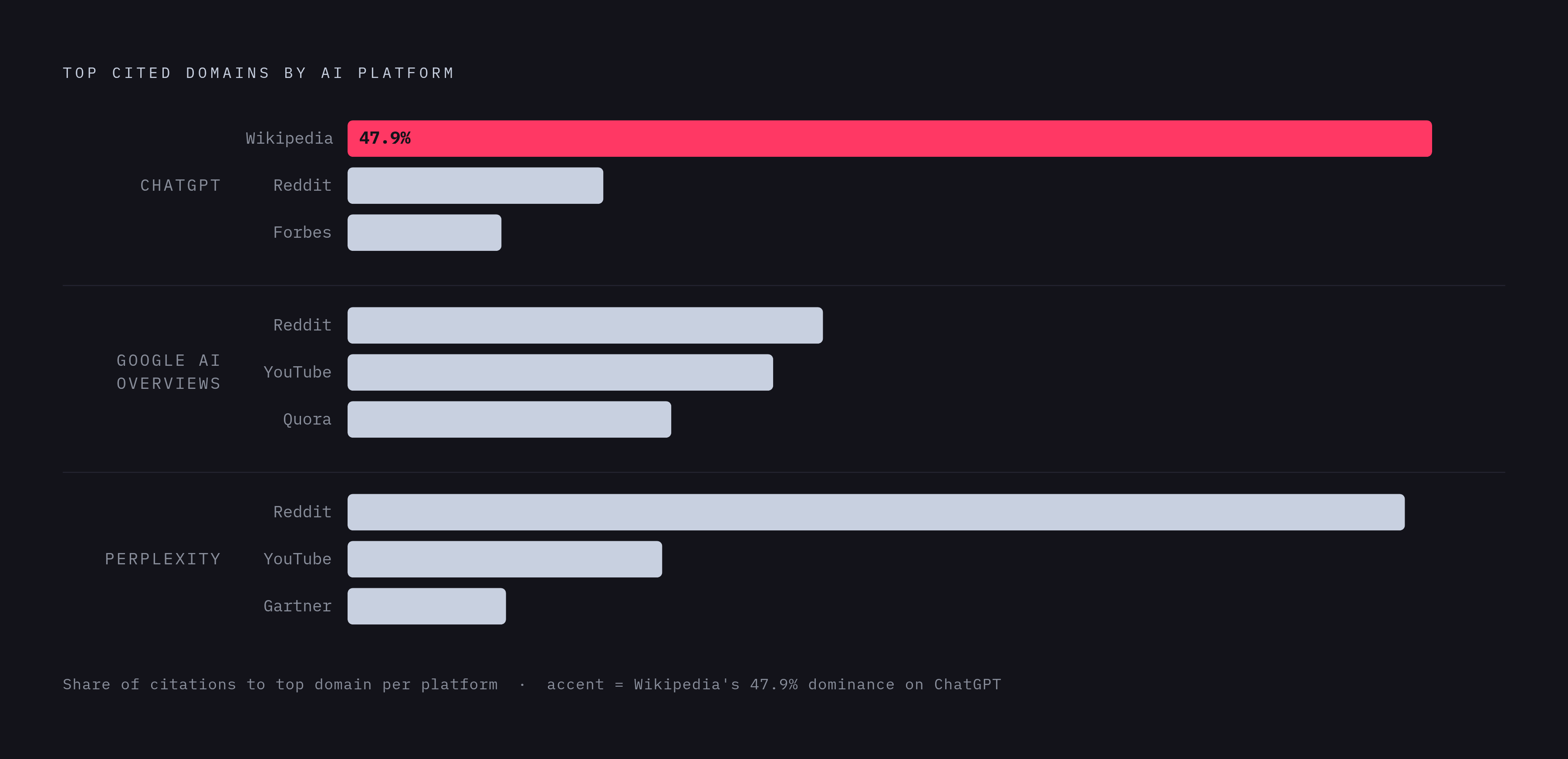
Citation habits shift sharply from platform to platform, and calling "AI search" a single undifferentiated category obscures what sets them apart. Looking at 680 million citations tracked, Wikipedia supplies 47.9% for ChatGPT, Reddit provides 11.3%, and Forbes accounts for 6.8%. Google AI Overviews pull 21.0% from Reddit, 18.8% from YouTube, and 14.3% from Quora. Perplexity leans most toward Reddit, with 46.7%, followed by YouTube, with 13.9%, and Gartner, with 7.0%. LinkedIn saw the sharpest change: LinkedIn surged to become the most-cited domain for professional queries across AI search platforms, though Reddit remained the overall leader. That's a structural change in the way professional-topic queries now get handled, not some one-off blip.
Momentum compounds for brands that act first. AI tools use how people act and improve, then refine choices, meaning brands with citability now gain force as their published content joins sources shaping later answers. Practitioners now call AI Overview citations the metric that matters most as 2026 approaches, so topical authority must now answer to both the established search crawler plus the AI choosing what they cite.
Tracking topical authority and AI visibility as the cluster grows
No one metric shows topical authority paying off. The pattern across several signals shows up through tracking early signs with lagging indicators side by side, rather than picking just one and saying that is enough.
Look for these signals: impressions rising on cluster-related queries as time goes on, rankings for long-tail keywords no one aimed at on purpose (solid proof Google gets the topic, the pages alone don't carry it), click-through picking up as users begin recognizing the domain as a fit before they choose to visit it, rankings whenever a query mixes the brand with the topic, and citations within AI Overviews, the number one indicator heading into 2026 and what follows.
Hardly any brands have started tracking this stuff. McKinsey says just 16% among brands systematically checking AI search, leaving most not knowing how, or if, they show up within AI-generated answers.
Because of how these tools operate, tracking AI visibility takes more effort than a Google ranking does to track. With SEO, one page holds a set spot in the rankings. AI answers act another way: one prompt can show varied cited material based on the phrasing used, which system replied, and how it picked material that time. Even a page ranked first on Google might vanish within any AI answer covering that same topic.
A few platforms have emerged specifically to fill this need. SE Ranking watches name references, rank, and competitor moves across ChatGPT, Google AI Overviews, plus AI Mode, letting users compare past data. Profound, started during 2024 with a substantial Series A round from June 2025, captures AI answers via front-end checks and with synthetic queries over ChatGPT and Claude, Google AI, plus Perplexity. Peec AI, founded in 2025 and backed by a $21 million Series A following a €5.2 million seed round, monitors brand visibility and sentiment across the major AI search engines, with Peec AI offers starter pricing for monitoring brand visibility across major AI search engines. For one site, third-party platforms offer starter pricing for monitoring brand visibility across major AI search engines. Thrad sits in a different bucket too: an AI-native exchange where firms trade ad space within LLM conversations and AI answers, which helps them show buyers how brands fare in AI, though unlike the rest it doesn't measure visibility.
All of this tracking exists to roll into the publishing roadmap, not gather dust on a dashboard unread. Comparing subtopic coverage with places the site already gets impressions points out exactly the cluster pages worth making now, and which will shift the needle soonest. The cycle is this: set up structure, track results, then point fresh effort toward gaps that already look promising.