Measuring Content Influence on Enterprise Sales Cycles
Content's real influence happens months before deals close, invisible to standard measurement tools.

Enterprise sales cycles now run 7 to 9 months on average according to B2B Sales Benchmarks 2024, and deals over a certain size take roughly 270 days to close. That timeline is the whole problem in miniature: a piece of content published in month one might be doing real work on a deal that doesn't close until month nine, and most measurement tools have no way to see it.
Some of this is compressing, at least on paper. 6sense's 2025 numbers show the average buying journey shrinking from 11.3 months in 2024 to 10.1 months in 2025. That compression comes from faster pre-contact research; buyers are getting quicker at the anonymous homework, but they aren't skipping it. Meanwhile Dentsu's 2024 figures put the average B2B buying timeline at 379 days, up 16% from 2021, and Forrester's median has climbed from 120 days to 408 over roughly the same stretch. Different methodologies, same direction: longer, or at best flat, cycles with more content touching more people at more distinct moments.
Structurally, that means three things happen inside every enterprise deal. Multiple content assets touch the account across separate phases. Different stakeholders read different things at different times, often without telling each other. And the "conversion event" your CRM logs, the demo request, the form fill, is almost never the moment content actually did its job. Attribution built for a shorter, flatter buying process just doesn't map onto a cycle shaped like this one. What follows is an attempt to build a measurement logic that matches the actual shape of the cycle rather than the shape of a CRM event.
How the buying committee multiplies the measurement problem
Start with the headcount. Forrester's 2024 State of Business Buying study puts the enterprise buying group at 13 stakeholders. 6sense's 2025 data pegs the median at 11.2 people for deals over a significant threshold, up from 9.7 the year before. Gartner describes buying groups ranging from 5 to 16 people, each one showing up with 4 or 5 pieces of information they gathered on their own, independently, before anyone from the vendor side knew the deal existed.
Content is already doing its work before a single sales conversation happens. It's also not doing consistent work, since different stakeholders are reading different material and drawing different conclusions from it. Gartner finds that a large majority of buying teams experience unhealthy internal conflict, which tracks given that dynamic. A CFO and a VP of Engineering are not consuming the same white paper, and they often walk away with different conclusions about what it means.
Generational shift is compounding the headcount problem. B2B buyers who are Millennials or Gen Z now make up 71% of the buying population, up from 64% in 2022, and buyers under 40 bring 6.8 stakeholders into a deal on average, compared to 3.5 for older executives. Bigger committees need more touchpoints to align, which means more content has to land, on more screens, in more formats, before a deal moves.
CRMs and attribution tools track individuals, not accounts. A CFO can read a whitepaper anonymously and vanish back into the void, while a VP of IT fills out a form three weeks later. The tool credits the form. The whitepaper, despite doing real persuasive labor on the exact person who signs the check, is invisible. Switch the unit of analysis from contact to account, and tag content by stakeholder role rather than by whoever happened to convert, and suddenly a lot more of what content actually touched becomes visible. This one shift, contact to account, is arguably the single highest-leverage fix in the whole measurement stack, and it costs nothing but a change in how you query the data you already have.
The anonymous research phase where most content influence happens invisibly
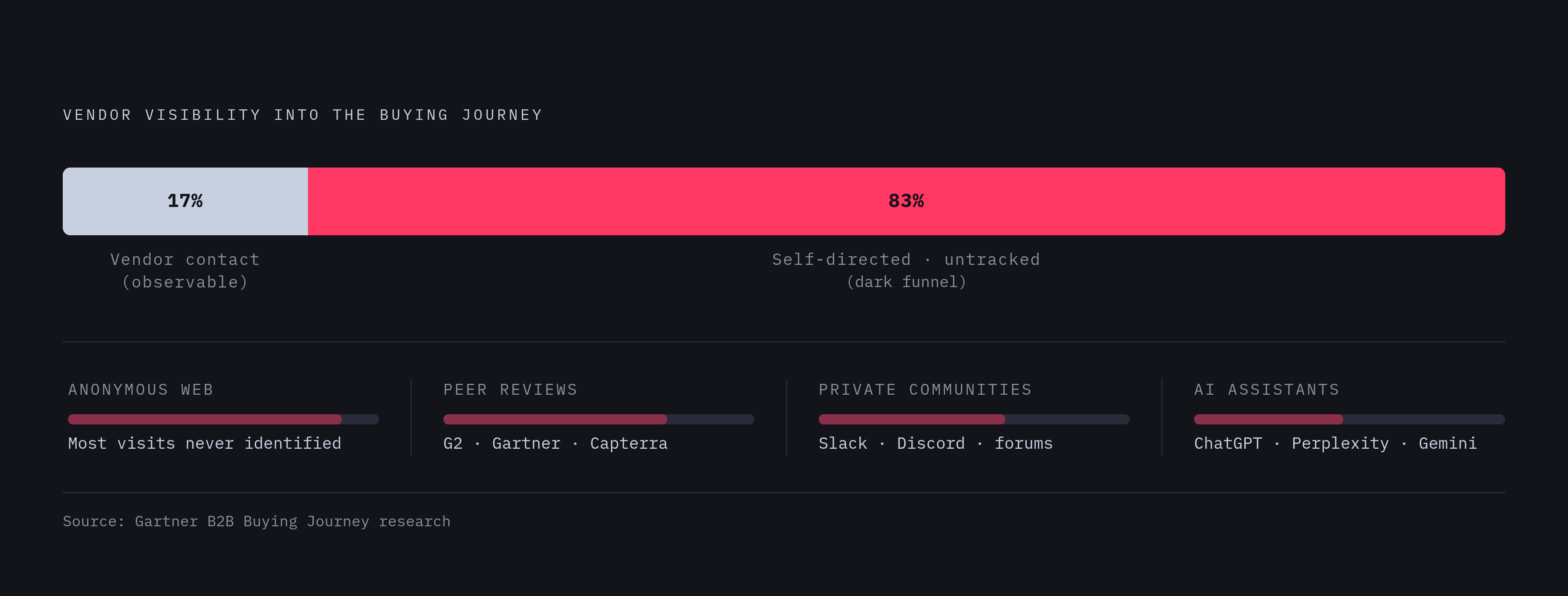
Here's the number that should reorganize how anyone thinks about content measurement: 81% of buyers already have a preferred vendor by the time they make first contact, and 85% have defined their purchase requirements before reaching out, according to 6sense's 2024 Buyer Experience Report. Ninety-five percent of the time, the vendor that wins the deal was already on the buyer's shortlist on day one. Content that arrives after first contact is, in most cases, arriving after the outcome was substantially decided.
Gartner's research puts a number on how lopsided this is: buyers spend only 17% of their total buying time in direct contact with any vendor. That leaves roughly 80% of the journey self-directed, unsupervised, and mostly untracked. Where does that 80% happen? Anonymous website visits with no form fill. Peer review sites with no UTM parameters attached. Private Slack and Discord communities where a recommendation gets typed out and nobody screenshots it for your marketing dashboard. Increasingly, it happens inside an AI assistant: a buyer asks ChatGPT or Perplexity or Claude for a shortlist, gets a brand name back, then searches that name directly. Analytics records that as "Direct" traffic with zero upstream credit.
Gartner's research suggests the vast majority of the B2B buying journey happens inside these dark channels, before any contact form gets filled. And the preference for staying there is structural, not a phase buyers will grow out of: a growing share of buyers express a preference for a largely rep-free evaluation experience.
So what does that mean for measurement? Direct attribution, in the sense of "this exact asset caused this exact deal," is not really available for most of the cycle, and chasing it is a bit like trying to attribute a river's flow to one specific raindrop. The more honest goal is detection: build measurement that finds content's footprint across the journey, rather than measurement that tries to prove causation it cannot actually see.
Why last-touch and single-touch models actively mislead enterprise content strategy
Picture a 270-day deal. The final touchpoint, a demo request or a rep call, gets all of the attribution credit under a last-touch model. The thought leadership piece read in month one gets nothing. The case study circulated in month four gets nothing. The comparison guide that made the rounds through the buying committee in month seven, the document that probably did more to close internal disagreement than anything a sales rep said, also gets nothing. Last-touch attribution answers a much narrower question than the one anyone's actually asking.
The distortion compounds from there. Teams running on last-touch data watch paid search and direct traffic "convert," conclude those channels are what's working, and shift budget toward them while cutting the organic and thought-leadership content that built the intent in the first place. Pipeline shrinks a few quarters later, and nobody can explain why, because the channel that quietly filled the funnel got defunded for looking unproductive on a dashboard that was never built to see it working.
The scale of the miscalibration is stark. Research finds only a small minority of B2B marketers can accurately attribute revenue to channels, and only a comparable minority can tie content specifically to revenue. That's most of the field flying blind. And the gap between marketing's self-reported "influenced pipeline" and what the CRM can actually verify as attributable to marketing runs roughly 2 to 4 times, consistently, across enterprise accounts. That gap points to a credibility problem, and the person who cares most about credibility gaps is sitting in the CFO's office wondering why the marketing budget keeps growing while the attribution story keeps getting shakier.
Swapping attribution tools doesn't fix this, either. If the underlying model is still last-touch or single-touch, and the unit of analysis is still the individual contact instead of the account, a new dashboard just displays the same distortion in a nicer font. Fixing this requires a different measurement logic entirely.
What multi-touch attribution captures and where it still falls short for enterprise
Multi-touch has become the default. it has gained broad adoption as a more complete approach than first-touch or last-touch models, which is progress worth acknowledging before picking apart its limits.
The models split credit in different ways, and the differences matter. Linear attribution spreads equal weight across every touchpoint, which is a fine baseline but treats a brand-awareness blog post and a competitive comparison guide as functionally identical, even though one probably did far more work near the finish line. U-shaped, or position-based, models give a large share of credit to the first touch and an equal share to the last, with the remainder spread across everything in between; that's a reasonable fit for shorter cycles but starts to strain once a deal runs past six months and the "middle" contains dozens of touches. Time-decay models weight recent interactions more heavily, which sounds sensible until you remember the content that opened the account nine months ago gets treated as basically irrelevant. W-shaped and full-path models add weight at opportunity creation and the SQL stage, which fits the enterprise shape better than any of the above.
Even the best of these models has a hard ceiling, though, and it's the same ceiling every section of this piece keeps running into: anything outside a tracked channel gets zero weight, no matter how the credit inside the model gets sliced. Anonymous research before the first identified touch doesn't show up. Content consumed by the four other committee members who never once appear in the CRM doesn't show up either. Multi-touch attribution is measuring the tracked portion of the iceberg very precisely; it's just not looking at the two-thirds sitting underwater.
Adoption itself lags behind the theory. Adoption still lags behind the theory, with many mid-market firms citing GDPR compliance concerns and the lack of a dedicated Marketing Operations hire as the main blockers. And there's a more basic problem sitting underneath all of it: A large share of B2B organizations still lack a formal UTM parameter governance policy. No attribution model, however sophisticated, functions without clean tagging underneath it. That's the unglamorous plumbing nobody wants to fix, and skipping it leaves the rest of the model with little to work from.
None of this makes multi-touch a bad choice. It's a real improvement over single-touch and it's the correct foundation to build on. It just isn't the whole building.
A staged content influence framework built around pipeline progression
The reframe worth making here: stop asking which piece of content caused a deal to close, and start asking which content correlates with accounts moving from one pipeline stage to the next. That's a subtly different question, and it's one measurement can actually answer.
In the pre-pipeline phase, when accounts are anonymously researching, the available signals are indirect by nature: third-party intent data from providers like G2, Bombora, or 6sense, lift in branded search volume, time-on-page and scroll depth on high-value content, and account-level IP identification to catch dark-funnel visits that never generate a form fill. The goal at this stage is simply detecting that the account is in-market before anyone from sales knows it, rather than proving which asset brought the account in.
Once there's a first identified engagement and the account is moving toward MQL, multi-touch attribution finally earns its keep, assuming the UTM governance groundwork got done. This is where content gets tracked across every identified contact at the account, not just whoever filled out the form, and mapped against ICP fit: which asset types are actually pulling in the right title, company size, and industry.
Moving from MQL to SQL, the useful metric shifts to something closer to content velocity: do accounts that consume more content before ever talking to a rep convert to opportunity at a higher rate? Worth tracking, too, is internal forwarding, downloaded assets, rep-sent links opened by contacts who've never appeared in the system before. Sales content utilization matters a lot here, because a significant portion of marketing-created content never actually gets used by sales reps; content mapped explicitly to active deal stages is one of the more direct ways to close that gap.
From opportunity to closed-won, the highest-value tool is the plainest one: ask. Win/loss interviews that directly ask the buying committee which content or resources they referenced capture dark-funnel influence no software will ever log. Pair that with a deal-velocity comparison, content-engaged accounts against non-engaged ones, and a matching comparison of average deal size, and the difference in days-to-close becomes a number a CFO can actually trust, because it doesn't rely on believing an attribution model's internal math.
That cohort method, segmenting closed deals into high-content-exposure and low-content-exposure groups using nothing more exotic than CRM data, is probably the most CFO-legible proof available. A consistent gap in win rate, deal velocity, and average contract value across a reasonably sized sample is independently verifiable. Nobody has to take the model's word for it.
One caveat worth building into the framework rather than hiding from it: across a journey involving dozens or hundreds of touchpoints over many months, some influence will always be untrackable. That's a structural fact of how enterprise buying works, not a flaw in the measurement approach, and reporting should say so plainly instead of pretending otherwise.
The signals that proxy for dark funnel influence
Start from the constraint, since it doesn't go away just because the framework got more sophisticated: roughly 80% of the buying journey is self-directed and largely unobservable, and no amount of clever instrumentation eliminates that gap entirely. It can shrink it, though, through proxy signals that triangulate rather than prove.
A lift in branded search volume is one of the more reliable fingerprints. When content earns mentions in AI-generated answers, peer communities, or review sites, branded search tends to rise afterward, which is the downstream evidence of an upstream conversation nobody tracked directly. A spike in direct traffic to a specific content URL often means the link got shared somewhere that strips referral data, Slack, internal email, a Teams channel. Review site activity on platforms like G2, TrustRadius, or Capterra, tracked for volume and sentiment velocity rather than just star ratings, functions as a leading indicator that a buying committee is actively doing its homework. And regularly querying AI tools like ChatGPT and Perplexity with the exact category questions buyers ask, then checking whether your brand and content show up and in what context, has become its own category of competitive intelligence that didn't really exist a few years ago.
LinkedIn engagement depth on thought leadership deserves a mention too, if only because most of its real reach never shows up as a comment. Dark-funnel readers scroll past, absorb the point, and move on without leaving a trace; reach multiplied by an estimated share rate is a rough but usable stand-in for influence that would otherwise register as nothing at all.
The single highest-fidelity signal, though, is still the win/loss interview. Asking a buyer directly, "before you contacted us, what did you read or watch?" and "what did other people on your team look at?" surfaces influence no tracking pixel will ever catch. Given that 95% of winning vendors were already on the buyer's day-one shortlist, per 6sense's 2025 research, review site presence is a measurable proxy that most teams simply aren't bothering to check often enough.
None of this produces precision. The point is triangulation: several imperfect, indirect signals all pointing the same direction build a case that's genuinely defensible, even in the territory direct tracking can't reach.
How to structure content measurement reporting so it earns internal credibility
CMI's 2025 research found that a majority of B2B marketers can't accurately attribute ROI to their content efforts, and the damage from that gap isn't just analytical. It's budgetary. It's the reason content teams lose arguments about headcount and get told to "prove it" every planning cycle, when the actual problem is that the measurement infrastructure was never built to prove anything in the first place.
Different audiences inside the building need different evidence, and conflating them is where most reporting goes sideways. Finance wants something independently verifiable, not a model's output presented as if it were fact. Lead with the cohort comparison, content-exposed accounts against non-exposed ones, on win rate, deal velocity, and average contract value. Present the attribution model's numbers as a directional signal alongside that, not as the headline. And say plainly what the dark funnel means for how complete any of this can ever be; acknowledging the measurement floor builds more trust with a CFO than pretending the floor doesn't exist.
Sales leadership wants something different: proof that content is actually useful in deals they're working right now. That means reporting which specific pieces get consumed at each stage of the pipeline, tying measurement directly to rep behavior instead of abstract funnel math. Flag whichever assets correlate with faster movement from opportunity to SQL, and reps will start using them on purpose instead of by accident.
None of this closes the attribution gap completely; nothing described anywhere in this piece does, given how much of the enterprise buying journey happens somewhere no tool can see. But reporting built around verifiable cohorts, honest caveats, and behavior sales can act on earns something last-touch dashboards never managed: the CFO actually believing the number on the slide.