Content Marketing vs Paid Advertising for SaaS Growth
Content compounds over time while paid stops the moment spending ends.

Content builds something that stays put. Rankings, backlinks, and indexed pages keep generating pipeline long after the writer has moved on to the next brief. Paid rents attention: traffic shows up the moment a campaign goes live and disappears the moment spend stops. That's the structural difference, and it should decide which channel a team reaches for first. Most reach for paid anyway, because it's faster to greenlight and easier to explain in a Monday meeting, not because it's the better bet.
Paid is easy to justify precisely because it's easy to measure in the short term, which is a different thing from being the right long-term allocation. Content does its best work at the top of the funnel, teaching buyers who don't know the category exists yet that it does. That matters more in B2B than most sales teams admit, given how long and how touch-heavy the buying journey has become before anyone signs anything. A single ad impression can't build trust across a cycle that long. A sustained body of content can, and it does something sharper than raise awareness: it shortens the sales cycle itself, because a buyer who already read the education doesn't need a rep to deliver it live on a call.
Paid earns its keep somewhere else entirely. When a company needs pipeline in the next thirty days, not in eight months, paid gets there fastest, and it wins hardest at the bottom of the funnel where people already know what they want. Searches like "[competitor] alternative" or "best [solution] for [use case]" are about as high-intent as buyer behavior gets, and paid search exists to catch exactly that moment. Quiet, useful work also happens through retargeting people who already read the content: amplifying an asset content built first, rather than starting cold from a scroll.
Worth sitting with: most SaaS companies run no paid advertising at all, leaning entirely on organic. That's most of the market voting with its budget. Anyone defaulting straight to paid should ask why the majority went the other way.
The ROI gap between the two channels, and the time horizon that explains it
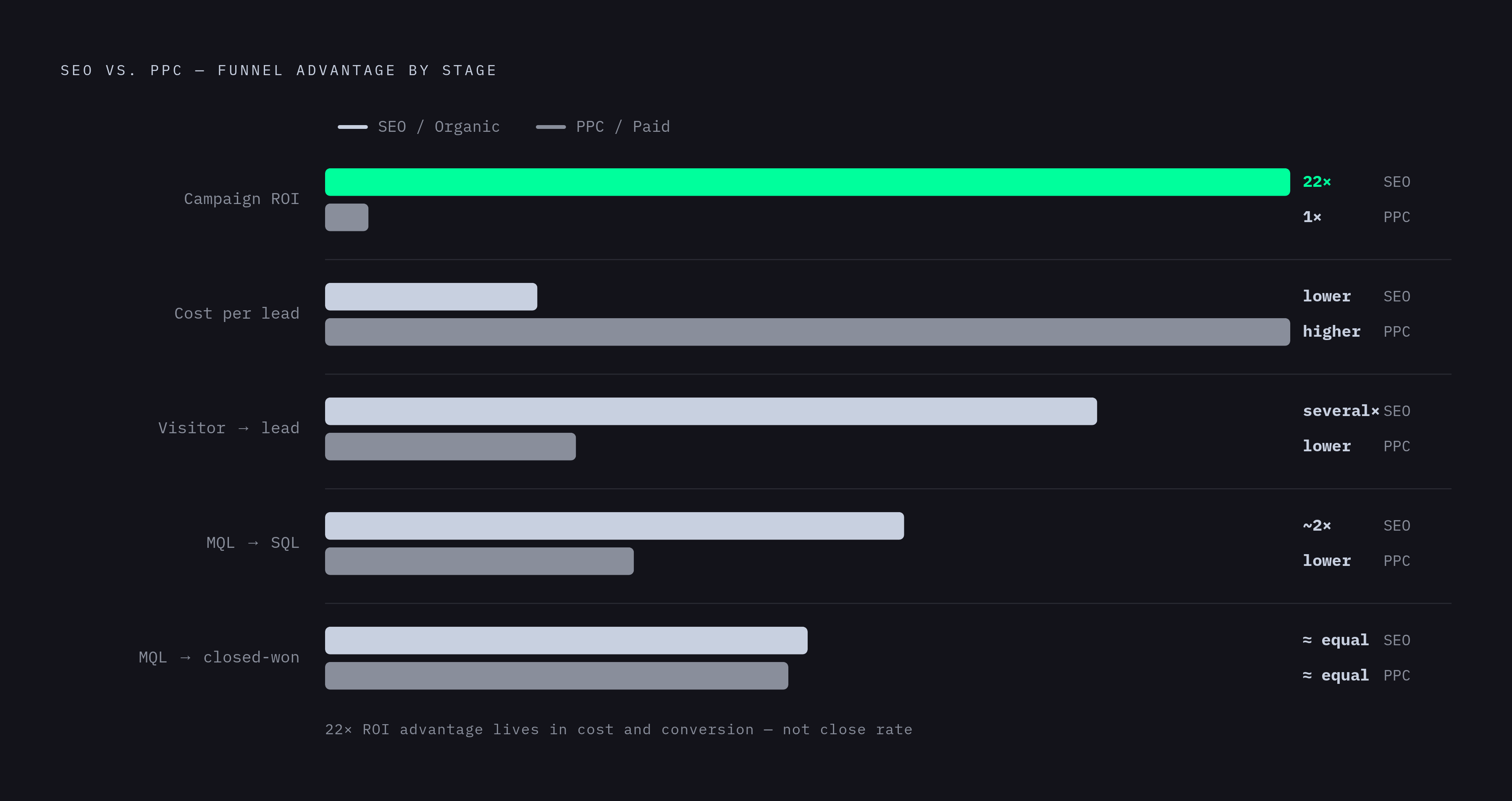
SEO returns roughly 22 times the campaign ROI of PPC. That's not a rounding error, and it shows up in every sub-metric underneath it. Cost per lead runs lower through organic, visitor-to-lead conversion runs several times higher, and MQL-to-SQL conversion nearly doubles. Every measure points the same direction, which raises the obvious question: why does organic convert so much better upstream?
Think about the buyer's state of mind. Someone who finds a piece of content through their own search has already decided the problem is worth solving, then went looking for an answer. Paid intercepts people mid-scroll, before they've necessarily gone looking for anything at all. One buyer arrives pre-qualified; the other has to be flagged down first.
The gap doesn't hold all the way through the funnel, though, and this is where the story gets more interesting than the headline number suggests. Once a lead actually qualifies, where it came from stops mattering much: paid-sourced and organic-sourced leads close at close to identical rates from MQL to closed-won. The channel advantage is front-loaded. Organic wins the getting-people-in-the-door contest; once they're in the room, the two channels are hard to tell apart.
The catch, and it's the whole ballgame for a lot of SaaS teams, is time. SEO takes months, often the better part of a year, to turn ROI-positive. A startup burning cash toward a fundraising milestone six months out cannot sit around waiting for organic traffic to compound; that math doesn't work no matter how good the content is. Content wins on almost every metric that matters long-term, but only if the company has the runway to survive long enough to collect on it. So the growth-stage question in the next section is really a runway question in disguise.
How the right allocation shifts across three distinct growth stages
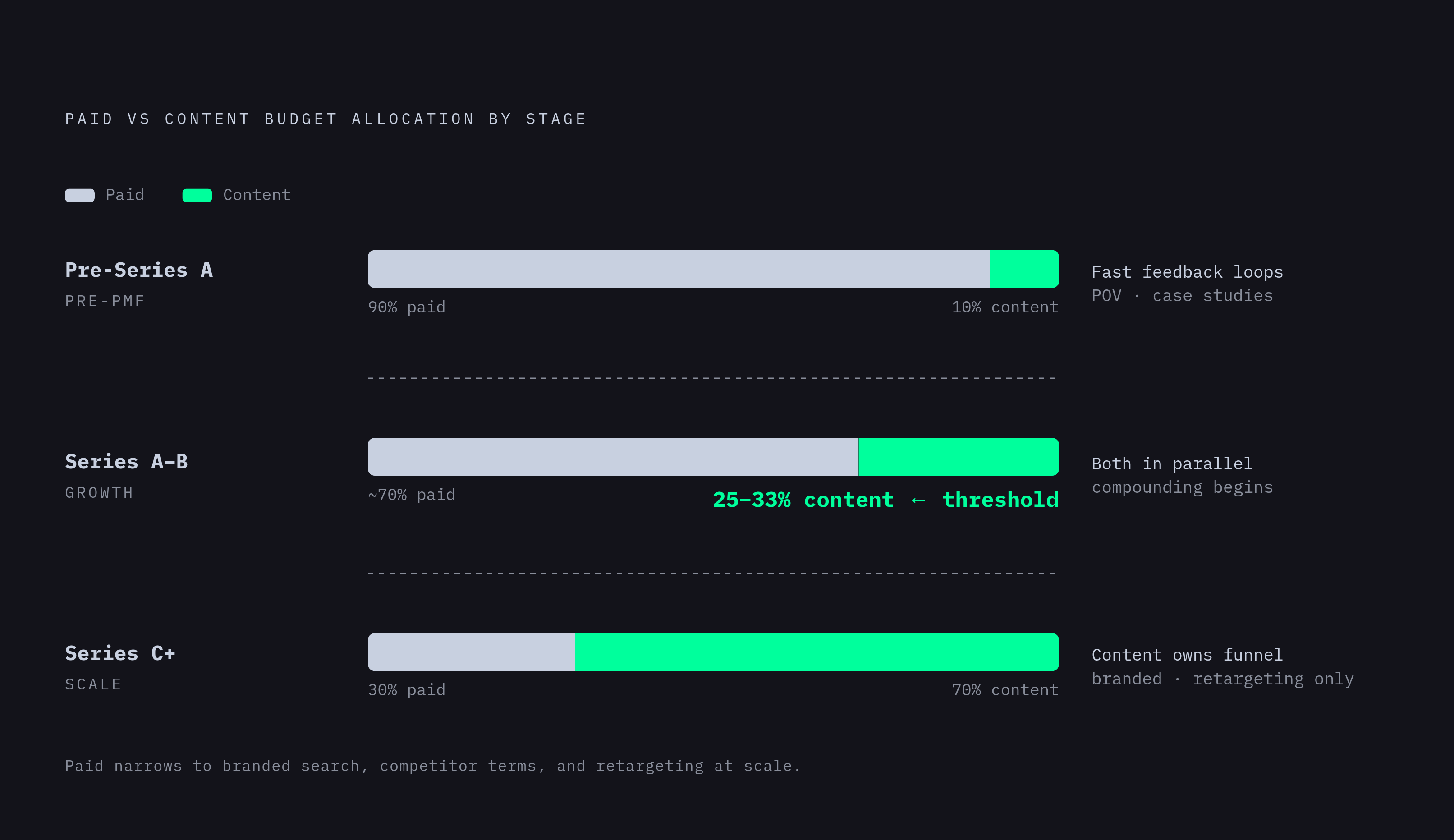
Pre-PMF and early traction, roughly pre-Series A. The job here is fast feedback and enough qualified pipeline to figure out who the ideal customer actually is. Paid is the right tool for that: a targeted LinkedIn or Google campaign surfaces real buyers within days, cheap enough to test messaging before committing to it for a quarter. Content still plays a role, just a narrow one: a handful of high-intent SEO pages, a clear point of view on the problem being solved, and case studies, which matter more than most founders assume as a sales-effectiveness tool. A broad publishing calendar doesn't belong at this stage. Writing at volume before the ICP is locked just compounds an audience of the wrong people, faster.
Growth and scaling ARR, Series A to Series B. Now the job is efficient, repeatable pipeline, and CAC starts drawing real scrutiny from investors who want to see the unit economics work. Paid search CAC in B2B SaaS runs high enough, and CAC payback periods stretch close to two years, that running paid alone at that pace turns into a genuine cash flow problem. This is the stage to start building the content engine in parallel, because the gap compounds from here: companies that out-publish the median by a wide margin turn that output gap into a much bigger pipeline gap over time. Paid defends against CAC creep while content quietly builds the asset that eventually takes pressure off the top of the funnel.
Scale and category leadership, Series C and beyond. The job shifts to brand authority and category ownership, with organic carrying more of the acquisition load and blended CAC coming down as a result. This is where content's economics become the whole story, delivering multi-year returns that dwarf paid's. Paid's job changes here too: bottom-of-funnel capture (brand terms, competitor conquesting) and retargeting the audiences content already built. High performers at this stage put roughly a quarter to a third of the marketing budget into content creation and distribution, and that ratio isn't arbitrary. It's what the top quartile actually does, repeatedly, across companies that otherwise look nothing alike.
The rising cost of paid dependence and what the benchmark data says about channel risk
CAC inflation isn't a rough quarter. It's a trend line, driven by more competitors bidding on the same keywords, privacy changes eroding targeting precision, and attribution getting harder to trust with every platform update. The median SaaS company now spends roughly two dollars to acquire one dollar of new ARR, and that ratio has been getting worse, not better. Run that math forward a few more quarters and the unit economics stop being a footnote; they become the whole conversation with the board.
The platform data backs this up in granular detail. Google Ads cost per lead jumped again in 2025, stacked on top of an even bigger jump the year before, according to WordStream's analysis of tens of thousands of campaigns. LinkedIn's cost per click keeps climbing year over year. Meanwhile, non-branded Google search's share of SaaS ad budgets has been shrinking, a sign that marketers are quietly walking away from the most expensive inventory rather than paying up for it.
Here's the structural risk underneath all of it, and it's the part most budget conversations skip: a company that builds its entire pipeline on paid owns nothing durable. Costs can spike, or a platform can quietly rewrite its targeting rules, and that pipeline evaporates overnight with no fallback asset sitting there to absorb the hit. The rule that follows is simple, if not exactly comforting: size the paid budget for what the company can survive through a CAC spike, not for the best-case cost per lead in an unusually cheap quarter. Budgeting for the good quarter is how companies get ambushed by the bad one.
Where content marketing breaks down, and why most SaaS teams never get the returns the data promises
Here's the uncomfortable part: almost everyone claims to do content marketing, and most privately admit it isn't working. The overwhelming majority of tech marketers report having a content strategy on paper; a small minority call it extremely or very effective in practice. That gap is the whole story of this section, and it's worth saying plainly: most of the industry is publishing without a clear payoff and calling it a strategy anyway.
Measurement makes it worse. Only a small fraction of marketers say they can effectively measure content ROI, even though most agree, in the abstract, that content increases engagement and leads. Teams believe it works while lacking the tooling to prove it works for their own pipeline specifically. That's a strange place to run a budget line from, and an even stranger place to defend one in a board meeting where somebody eventually asks what the blog actually bought them.
What goes wrong tends to repeat across teams, and it's rarely a talent problem. Teams publish without a search or distribution plan, so volume climbs while targeting sits at zero. Content gets treated as a brand exercise instead of pipeline infrastructure, which means it never gets resourced, staffed, or measured the way a revenue channel would be. Teams also underestimate the publishing cadence competition actually requires, since the gap between median output and top-quartile output doesn't grow in a straight line; it compounds. Format ends up misaligned with funnel stage too, writing awareness content for an audience that's already evaluating vendors, or skipping the case studies that would have closed the deal outright.
Take the eye-popping multi-year ROI figures cited for top-quartile content programs at face value, and a team will be disappointed. Those numbers describe a top-quartile outcome, not a default one. They require consistent publishing, tight alignment with a specific ICP, and hard thinking baked into every brief before a word gets written. Content that converts pipeline is a different discipline than content that just sits on a blog somewhere, picking up the occasional visit from someone who bounces in thirty seconds. The gap between the two comes down to whether anyone thought hard about the reader and the funnel stage before typing the first sentence.
What high-performing SaaS companies actually built: three content models worth studying
HubSpot treats content as a distribution product in its own right, publishing at a volume most teams would consider unsustainable. The more telling example is a single free tool: an email signature generator that drove hundreds of thousands of unique visits and tens of thousands of leads, producing an estimated eight-figure sum in new customer lifetime value within six months, and a nine-figure contribution over two years by one analyst's estimate. That's a free utility acting as an acquisition channel at a cost paid advertising struggles to match.
Ahrefs took the opposite structural approach and still landed past nine figures in ARR, largely through content and SEO with minimal paid spend. Every post the company publishes addresses a genuine problem its audience faces, then walks through the fix using the Ahrefs product itself. The content functions as a self-serve demo: a reader learns the solution and watches the tool solve it in the same breath. This shortens the sales cycle by design, since nobody needs a follow-up ad to remind them what the product does when the blog post already showed them, live, mid-read.
Notion built something different, and arguably smarter: a template gallery where users create, share, and sell their own templates, generating a constant stream of indexed, searchable content that Notion's own team never had to write a word of. It's user-generated content acting as a permanent acquisition engine, and the lesson generalizes past Notion specifically. At a certain scale, the highest-leverage content move is building the infrastructure that lets other people publish for you instead of publishing more internally.
Three different tactics, one shared decision underneath them: each company treated content as an investment tied directly to pipeline, managed with the same rigor as any other revenue channel and answerable to the same targets.
A practical allocation framework: inputs, ratios, and the decision rules that hold up across stages
Three questions decide the split, and they apply regardless of company size. How long can the company wait for compounding content returns to show up, given available runway? Where is pipeline actually breaking down right now, at awareness, consideration, or the final conversion step? And is the target buyer defined clearly enough that content can be written with precision, or is the ICP still a moving target nobody's pinned down?
The stage-by-stage rules follow directly from those answers. Early stage with short runway: lean heavily on paid for fast feedback, and keep content minimal and sharp, limited to a few high-intent pages, a clear point of view, and case studies. Growth stage with a year or two of runway: run both in parallel, paid holding the near-term pipeline steady while the content engine gets built underneath it, with roughly a quarter to a third of the marketing budget toward content, the benchmark high performers actually hit. Scale stage: content carries the top and middle of the funnel, and paid narrows down to branded search, competitor terms, and retargeting the audiences organic already built.
Within paid spend itself, the platform choice follows the same funnel logic. Google Ads suits high-intent, bottom-of-funnel capture, where buyers are actively comparing options. LinkedIn suits audience precision and brand-safe B2B targeting when return on ad spend matters more than raw volume, which is part of why LinkedIn's share of B2B ad budgets has been climbing while broad search spend contracts.
None of this works if the content itself is thin, and that's the failure mode most allocation debates skip past entirely. Publishing faster only compounds returns if the strategy behind each piece holds up: brief quality, ICP alignment, and a distribution plan matter from the outset. They're the first three things decided before a draft exists, weighed as carefully as the last three things checked before it publishes.
AI-assisted production changes one part of this equation and leaves the rest untouched. SaaS teams can now close the distance between median publishing output and top-quartile output without hiring a proportionally bigger team, using platforms like Letterstory, an end-to-end content automation platform built for exactly that kind of structured production; the bottleneck moves from how fast people can write to how clearly the team can think before they write. A large share of B2B marketers plan to spend more on AI going into 2026, and the ones pairing that spending with real editorial judgment and a well-defined ICP are the ones likely to see the compounding return this piece has been describing throughout. Teams using it purely to publish more, faster, without doing the strategic work first, will just reproduce the same strategy-versus-effectiveness gap, at a faster clip than before.