How to Build Hub-and-Spoke Internal Links Without Touching Every Post
Automate hub-and-spoke links at publication to scale authority.
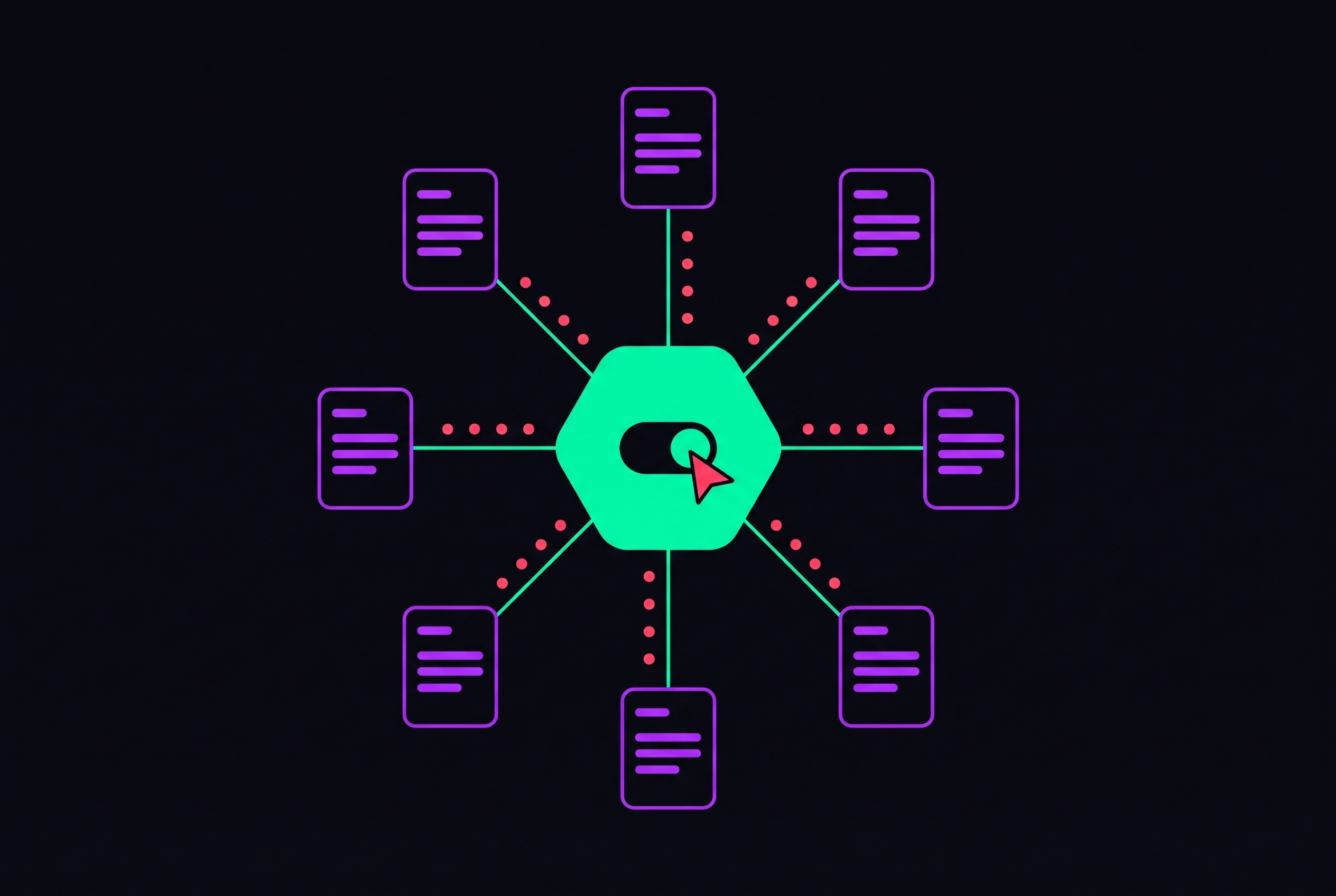
A hub-and-spoke internal linking structure connects a broad pillar page to a set of focused supporting pages, with every spoke linking back to the hub and the hub linking out to each spoke. This creates a closed loop of PageRank circulation within each topic cluster. Building this architecture without editing every post individually requires decisions made before content goes live: a clear taxonomy, a cluster map, consistent anchor text rules, and automation configured to apply those rules at publication time. The result is a system that continues funneling authority to priority pages as the content library grows, without requiring a site-wide revision every time a new article is published.
Why authority flow matters
In this setup, a wide-ranging pillar page connects to detailed pages on its supporting topics. Every spoke links to the hub, which in turn links to each spoke. Those links give PageRank paths to travel along. When a spoke picks up an outside backlink, that authority flows through its internal connection into the hub, and from there outbound links spread equity throughout the cluster.
This circulation is what turns related articles into an authority structure. A backlink can strengthen more than the individual page where it lands. The central page gains weight in a priority subject area, while supporting articles show how deep it goes. Their relevant interlinks clarify that connection.
This setup also gives search crawlers and AI response systems a clearer read on the subject. The hub frames the main subject, while the spoke links spell out the more specific questions each page answers. The words used in those links add to the context. By naming what each destination covers and placing it within the broader navigation, this structure can strengthen topical authority signals and improve eligibility for AI citations.
Why manual linking breaks at scale
Adding a spoke generates linking tasks on both sides. The fresh spoke must point toward its pillar hub and out to neighboring spokes, yet those outbound connections leave it without any incoming route. Prior pages also require updates. The hub must list the new spoke in its directory, and a couple of sibling spokes should link back to it. Finishing just the new page abandons half the linking duty.
When output stays moderate, the obligation turns into a recurring queue. Writers ship fresh content yet defer revisions on existing material, letting unfinished work accumulate outside the planned schedule. Freshly published pages may point to relevant destinations yet lack any incoming connections, leaving them isolated and without internal PageRank. While an XML sitemap aids indexing, it cannot replicate the authority transfer that the link graph enables.
As the library grows, other problems accumulate. Pages can end up buried more than three clicks from the homepage, which reduces how often they get crawled and how much PageRank they receive. Anchor text splinters as writers independently choose their own labels for the same target page. Navigation may continue to function even as key pages grow more distant and topic wording drifts apart.
The deeper mistake is treating hub-and-spoke as nothing more than a request to link pillar pages. Read that way, links being present is what counts as done, regardless of which direction they point or where they land. Automated tools can scale up that same error. Adding links will not fix a structure that never defined which pages should gain authority or how fresh spokes should connect to the existing graph.
Front-load structure before you write
A clear taxonomy paired with a cluster map forms the foundation. Before publication, assign each spoke a topic and pillar so linking rules have a structure to build on. This determines which relationships remain within a single cluster versus those spanning distinct topics. Their placement within the navigation subsequently dictates how readily both search bots and visitors access that framework.
To remain a single click away from the front page, hub pages should be linked via the main navigation, category sections, and the site's homepage. Such placement grants clusters quick access from the most powerful entry point without forcing constant updates to individual articles. Depth is still a constraint worth planning around. Shallow structures suit compact websites by limiting depth to two or three clicks, yet bigger platforms often require additional tiers and deliberate internal links to help people reach deeper pages.
Teams should define the full question set for each cluster before writing begins. Autocomplete suggestions, keyword data, and People Also Ask results can surface subtopics, and each distinct question with real search volume can be treated as a candidate spoke. Those boundaries need to reflect genuine differences. When two spokes answer the same search intent, they split attention and weaken the authority the system is supposed to concentrate in one place. Setting the divisions in advance keeps internal links from amplifying content that still overlaps.
A typical cluster plan calls for eight to twelve spokes under each pillar, with very broad head topics sometimes reaching twenty to thirty. Publication order should track that dependency. If the spokes go live first, or the hub launches with six to eight of them already attached, the pillar never debuts without linked supporting pages. The hub's template should give its spoke directory a fixed location, so that section of the structure stays maintained as new content is added.
Link choices and their destinations need to stay within the budget for outgoing links. Because PageRank distributes across every outgoing link, each additional target reduces the equity any single link passes. More links do not automatically produce better architecture. Homepage navigation deserves particular care, since removing one link from it sends a larger share of equity to the remaining links. Planning must therefore decide both which pages to include and which links should appear prominently and repeatedly across the site.
Set your anchor text rules first
The anchor text choice needs to be made before automation starts. It helps Google search and AI answer systems understand the destination page's subject, folding the wording into the cluster's semantic context. A phrase like "technical SEO for AI crawlers" marks out a precise subtopic within the cluster. Generic wording leaves the page without that clear signal, so search engines and AI systems have less context for interpreting the topic and judging citation fit. A system can reuse the chosen wording repeatedly, but repeating a vague label will not make it informative.
The initial requirement is a clear one-to-one match between phrase and target URL. One anchor text must not direct users to multiple URLs, as this divides topical signals among competing destinations. Anchor wording may vary so long as its meaning remains consistent. Repeatedly using an identical anchor for a single URL can create over-concentration when automation enforces that rule across many posts.
A safer approach is to define which anchor variants remain close enough in meaning to be treated as equivalent, then set link frequency limits for each destination URL. That protects the topic's identity while letting the phrasing fit the surrounding sentence. With the URL target and approved label options established, a tool can handle repeated placements without requiring fresh editorial judgment for each page.
Tools that automate linking at publication
On a WordPress site publishing at moderate volume, rules applied at publication time handle the repeated work of connecting new spokes to an existing hub. Link Whisper checks content relevance and proposes contextual internal links. Its automated linking feature connects chosen phrases to destination URLs using precise, partial, boundary-based, or pattern-matching criteria. Configuring a rule for the pillar automates spoke-to-hub connections once eligible content goes live.
Links across clusters require a separate boundary so automation does not join unrelated topics. One option is a cluster-bridge rule that restricts linking to selected pillar pages, preserving the intended separation between topic groups. AIOSEO's Link Assistant works as a WordPress alternative, recommending internal links and flagging orphaned pages for Pro plans and higher tiers. These features handle separate stages of the process: suggestions guide link selection, and orphan reports reveal which pages still lack any inbound link.
When a content library is already in place, publication-time rules alone cannot address the full retrofit. Link Whisper's Bulk Link Addition addresses this by inserting multiple intra-cluster connections simultaneously, a practical approach for platforms whose archives predate any hub-and-spoke strategy. Rather than opening each article to insert its pillar connection, teams can update the entire archive at once. Coherence across that mass update depends on the established linking architecture and anchor text standards to guide every placement decision.
When agencies or publishers oversee several CMSs, their operational scope spans the entire portfolio. LinkBoss offers a unified control panel for this task. Choosing a target pillar causes the tool to surface suitable anchor points throughout the post network and insert links at scale. Its advantage is unified implementation across the whole content collection, solving the challenge of coordinating multiple publishing platforms without requiring each site to handle linking independently.
Teams managing thousands of URLs can run a linking layer independent of their CMS. Priced at $49/month, InLinks builds an entity knowledge graph that analyzes semantic topics to recommend connections and injects them via JavaScript. Because JavaScript delivers those links rather than writing them into the CMS itself, the underlying content stays untouched. That linking layer operates independently, without requiring setup tailored to each CMS.
Which approach fits depends on operating conditions. Teams without automation can adopt a minimum publish-forward approach instead. For fresh content, this means connecting to the pillar plus two related spokes. For pages already live, the process involves refreshing the spoke directory on the hub and updating a couple of sibling spokes. The process stays manual, but it confines the effort to the new page's closest connections rather than converting each publication into a site-wide revision.
A monthly audit under an hour
A brief audit each month preserves the site's original structure over time. Automation reduces repetitive edits, yet the link graph it produces still needs to be inspected. The check stays narrow: it identifies orphan pages, flags internal links that no longer resolve, measures how thoroughly pillars cover their clusters, and reviews how anchors are distributed. Built around only those repeatable tasks, it should finish in under an hour rather than becoming another ongoing editorial burden.
Use Screaming Frog or a comparable crawler to find orphan pages. A page receiving no internal inlinks has no PageRank route inside the site, even if the XML sitemap lists it. Use topical fit to select the fix: point to each orphan from the live page that best matches its subject. This restores its connection to the internal graph while keeping prominent navigation from becoming a catch-all list.
Every active spoke needs a link from the hub, and the hub needs one back from each spoke. Coverage gaps typically emerge when fresh content goes live without the hub's index being updated, meaning functional spoke-to-hub connections alone cannot guarantee full reciprocal coverage. Confirming both directions of each link validates the connection the architecture was designed to preserve.
Anchor review checks whether the same phrases cluster too heavily on a single destination and whether vague labels like "read more" or "click here" have replaced descriptive wording. Edits must preserve the surrounding meaning while avoiding identical phrasing repeated across every instance. This audit should also surface any broken links. Because broken links waste crawl budget and cut off equity routes, fixing them restores connections the cluster already depends on.
Freshly created pages remain disconnected until another document points to them, which means automation must establish the inbound path and every outbound reference at the same time the page is published. When humans or partially automated tools handle the process, the monthly audit ensures connections are made promptly rather than accumulating as deferred work. It flags departures from the established framework and delegates standard connections back to the templates, rules, and bulk processes designed to handle them.
Sources
- Internal Linking Architecture Guide
Provided foundational detail on hub-and-spoke architecture, cluster sizing, PageRank circulation, and taxonomy planning that informed the article's structural guidance.
- Best Internal Linking Tools 2026: Complete Comparison Guide
Supplied specifics on Link Whisper, AIOSEO Link Assistant, LinkBoss, and InLinks—including pricing and feature descriptions—used in the tools section.
- Internal Link Audit: How to Find & Fix Issues (2026)
Informed the monthly audit section, including orphan page detection, anchor text review, broken link checks, and crawl-budget considerations.