How to Build a Social Media Content Strategy That Reaches Buyers
Focus on buyer intent and journey stage, not follower counts or posting frequency.

If your social media strategy is built to rack up followers, you're optimizing for the wrong goal. Instagram, TikTok, and YouTube have all changed course, serving posts to users whether or not they follow the creator, drawing on viewing habits and behavior instead of connections, a transition HubSpot's 2026 research frames as leaving the "social graph" behind in favor of discovery driven by what users care about. A tiny account can outperform a far bigger one if its content truly speaks to a specific issue, because distribution today follows relevance rather than follower count. The signals that genuinely drive reach are saves, comment depth, watch time, and DM shares, rather than posting frequency or the size of a follower base. According to HubSpot, nearly two-thirds of those marketing on social platforms skip daily publishing. That ends an argument teams have had for years: putting out more posts doesn't bring in more engagement, and anyone focused on hitting a set cadence is chasing something the algorithm no longer rewards. Every point made below builds on that shift. If reach comes from matching intent, strategy has to begin earlier in the process by identifying the purchaser and their current position. A content calendar is the wrong starting point.
The buyer's journey and content decisions
A buyer’s path is tied to social media’s revenue impact from the very first stage. People first encounter a brand while scrolling a feed, then use reactions and saved posts to weigh it, converting only after repeated exposure across platforms. The path moves through awareness and consideration before reaching conversion, loyalty, then advocacy, with each stage demanding its own kind of content. In the awareness stage, content must stop someone mid-scroll and make an unnoticed need or opportunity clear. In consideration, side-by-side reviews, how-to guides, and evidence explain why to pick this option. At conversion, client stories, live walkthroughs, and user endorsements lower risk. Loyalty material strengthens established bonds via member forums, real-time broadcasts, and exclusive backstage glimpses. Advocacy pieces offer loyal followers a standout experience or collaborative opportunity worth passing along.
Many organizations bypass this foundational framework. They typically produce material that racks up likes, views, and shares, never stopping to consider whether any of it moves people closer to actually buying. Kassandra Quinn, who works as ModSquad's Social Media Strategist, frames the danger like this: "Chasing algorithm approval blinds you to what genuinely delivers results. Begin by asking: Who is my target audience? What action am I hoping they'll take? What kind of post would they actually want to interact with?" Those three inquiries work as a filter. When an objective is articulated with precision, it constrains each subsequent choice. Suppose bookings are the target. Then posts drawing huge crowds without sparking a single lead shouldn't keep filling the schedule, regardless of how the platform's metrics rate them. Establishing that objective before any creation begins provides the discipline underpinning everything else here.
Building audience intelligence around intent rather than demographics
A buyer's age, gender, or job title reveals little about the content they find compelling enough to pursue. A person's actions depend instead on how clearly they recognize their issue and how close they are to buying. Grouping by intent works better than traditional profiles for shaping a content strategy. Rather than relying on standard persona attributes, an intent cluster organizes audiences around their core challenge, what sparked their investigation, and their proximity to a purchase decision. A buyer actively weighing alternatives engages entirely differently from one unaware of any issue, despite sharing identical persona traits, which drives them toward distinct media on separate channels.
You do not need a research department to create this picture. Start with a single valuable buyer group, then spell out what problem they already recognize, what search or social query they would actually enter, and what format would feel credible right then. A precise read on one actual segment’s intent beats a generic persona deck because concrete detail makes the content feel addressed to a real reader, not some averaged profile. HubSpot's 2026 research points the same way: people respond better to authentic content than slick production, partly because work aimed at one specific, real problem feels honest while average-demographic messaging does not. The same audience insight serves a second purpose. Grasp that cluster’s intent and its real hangouts become clear, giving you the basis for the next platform choice.
Choosing platforms based on where each buyer stage plays out, not where follower counts are largest
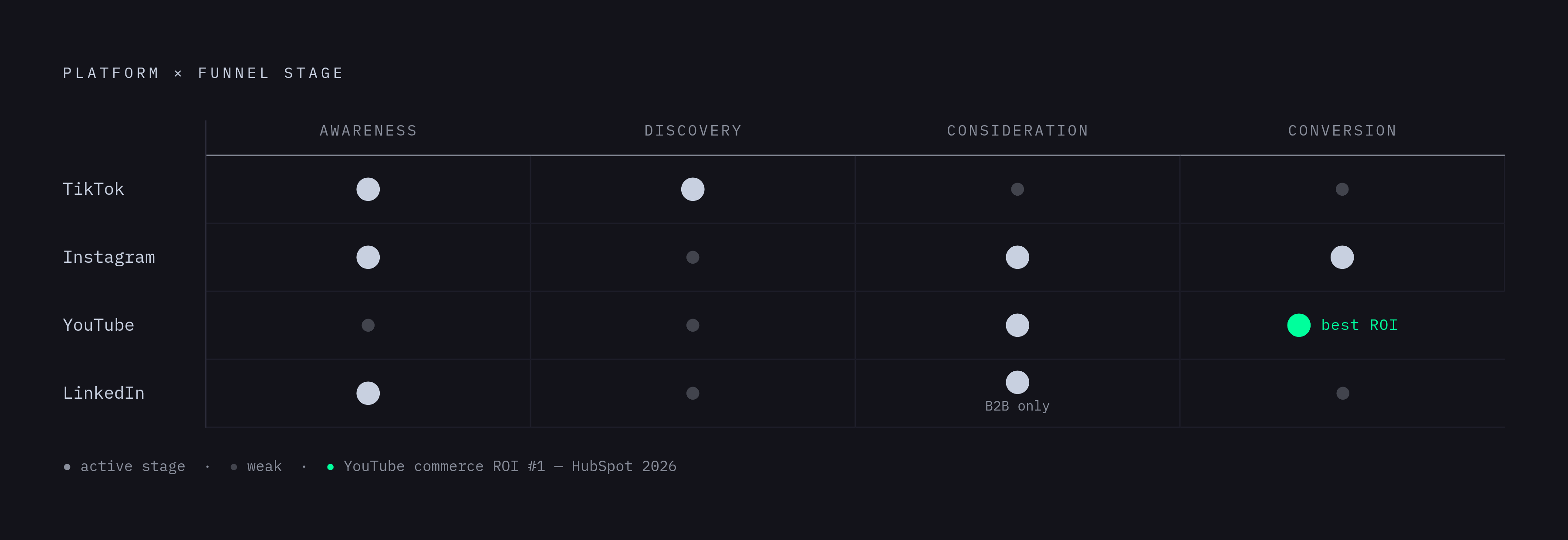
Every platform leans by design toward particular buyer stages and particular kinds of audience engagement, so choices should rest on buyer position and intent, not on sheer audience size or the loudest competitors. Sprout Social, in its 2026 data, finds TikTok, Facebook, and YouTube delivering the broadest business results, yet B2B marketers keep naming LinkedIn their top channel, a divide that mirrors real buyer behavior on each platform instead of arbitrary brand preference.
TikTok favors quick how-tos and unfiltered takes built to spark discovery, drive awareness, and hold attention immediately, while also serving as a genuine search destination where buyers vet products and reviews ahead of opening a browser. Instagram is the visual home for discovery, community, and mid-funnel proof: Reels build awareness, carousels support consideration, while Instagram Shops close the sale near the bottom of the funnel. YouTube builds authority in longer formats, using teaching-led series and deeper material to move buyers through consideration and conversion, supported by HubSpot data showing its social shopping features produced better commerce ROI than any other social platform. LinkedIn supports B2B buyers from initial visibility into evaluation through leader-led insights, carousel content, and structured frameworks, favoring richer discussion instead of posting more for its own sake.
Misjudging this mapping comes at a high cost. Picture a B2B outfit that brings aboard a hire steeped in B2C and crafts a glossy, eye-catching Instagram feed that yields no pipeline. The platform got picked for looking the part, not for matching the point at which the buyer actually decides. Beyond platform choice, a second danger lurks: a strategy that leans wholly on one algorithm can fall apart as soon as that platform shifts the signals it favors. HubSpot's 2026 study suggests cultivating a community to offset that instability, instead of counting on one channel alone to deliver consistent results forever. The practical rule is to locate where intent gathers for the buyer at each stage of the journey, pick the platform accordingly, and fight the urge to show up on every channel simultaneously.
Matching content format to funnel stage so the right message reaches the buyer at the right moment
Format isn't decoration layered over strategy. Every format persuades in its own way, so pairing the right platform with the wrong format throws away the reach your platform choice just secured. When it comes to awareness, short-form video leads: HubSpot's 2026 research shows it outperforms all other formats in usage and investment, keeping viewers engaged with minimal effort while serving as the main way younger buyers find new brands. Heading into 2026, quality standards have risen. The best short-form work takes shape as an ongoing series with a familiar hook or pattern rather than a standalone video, since repetition conditions the algorithm and viewers alike to return. Voice matters just as much: according to HubSpot, humorous clips deliver better ROI than any other short-form approach, proof that during awareness-building, delivery rivals substance in importance.
Carousels, together with threads, handle the consideration work. Because users can find them, bookmark them, and line them up next to each other, a save tells the algorithm the content has enduring worth rather than being a fleeting pause while scrolling. At the conversion stage, the job is reducing risk: customer stories, product walkthroughs, and endorsements supply the proof a shopper needs to back a choice already taking shape in their mind. Loyalty is where community spaces and live sessions come in: practitioners at Leapsome together with ModSquad see community becoming the key differentiator exactly because people are worn out on brand pages and crave something that feels genuinely connected. Content made by users spans multiple funnel steps simultaneously. National University cites research showing most buyers rely more on peer recommendations and customer-created material than on conventional brand ads. UGC works as proof for one buyer at the consideration stage while also drawing in someone entirely new at the funnel's entry point through word-of-mouth endorsement. While brief clips have grown in popularity, substantial authority-building material remains relevant. Slide-style posts, threaded discussions, and polished captions have become what SEO content looks like on social platforms: findable, organized, and designed to generate returns well beyond the publish date, setting up what comes next in the approach.
Treating social platforms as search channels, not just broadcast feeds
Those formats build lasting value only if they are easy to discover, so approach social platforms like places people search rather than channels for pushing posts. Sprout Social reports in 2026 that habits are changing: instead of starting on Google, people now research products, check reviews, and compare choices on Instagram, TikTok, and similar platforms. National University also reports that for 16- to 34-year-olds, social networks are now the top place to research brands, while younger adults find more through scrolling than conventional typed search.
Since discovery algorithms vary by network, tailoring content demands deliberate decisions. Because TikTok indexes spoken dialogue, visual overlays, and descriptions to match search queries, every element shapes discoverability. On Instagram, descriptions packed with relevant terms function as discovery engines rather than mere captions beneath an image. On LinkedIn, visibility goes to industry experts whose posts align with the search terms corporate decision makers use. The discipline this takes mirrors SEO practices: captions built around search terms, visual text that describes the content, metadata configured to surface in results, and a unified theme signaling an account's purpose to each algorithm. Posts designed solely for immediate feed impact, chasing quick reactions when published, overlook prospects using search instead of browsing, yet those are typically the people nearest to purchasing.
Authenticity as a conversion variable
Audiences have become so wary of slick brand messaging that genuine content now functions as a measurable performance driver rather than merely a nice-to-have quality. HubSpot found that a 76% share of marketers see genuine material beating highly produced work, a margin big enough to signal a real change in what drives conversions. National University cites Hootsuite's Social Trends findings, which reveal that close to a third of consumers are less inclined to pick a brand running ads made by AI. Stories told by real people now stand out as a true competitive edge, even while AI becomes routine across the industry for gathering insights, crunching numbers, and fine-tuning campaigns.
The risk runs sharpest in B2B, where buyers tend to be risk-averse, and they can increasingly spot AI-generated writing on sight. Practitioners at Leapsome and ModSquad point to community and genuine connection as the differentiator, because B2B audiences have grown disillusioned with brand content that reads as manufactured. None of this makes AI the enemy of the strategy. The productive use of AI is workflow acceleration, research, analytics, caption optimization, scheduling, the operational layer that makes everything above possible to execute at scale. What AI should never replace is the voice and point of view that make content read as human. AI now sits inside the majority of marketers' content workflows, but the advantage still belongs to brands with a distinctive point of view, not to brands that simply produce more.