How Buying Committee Content Differs From Lead Nurture Content
Enterprise deals need content built for consensus, not one buyer.
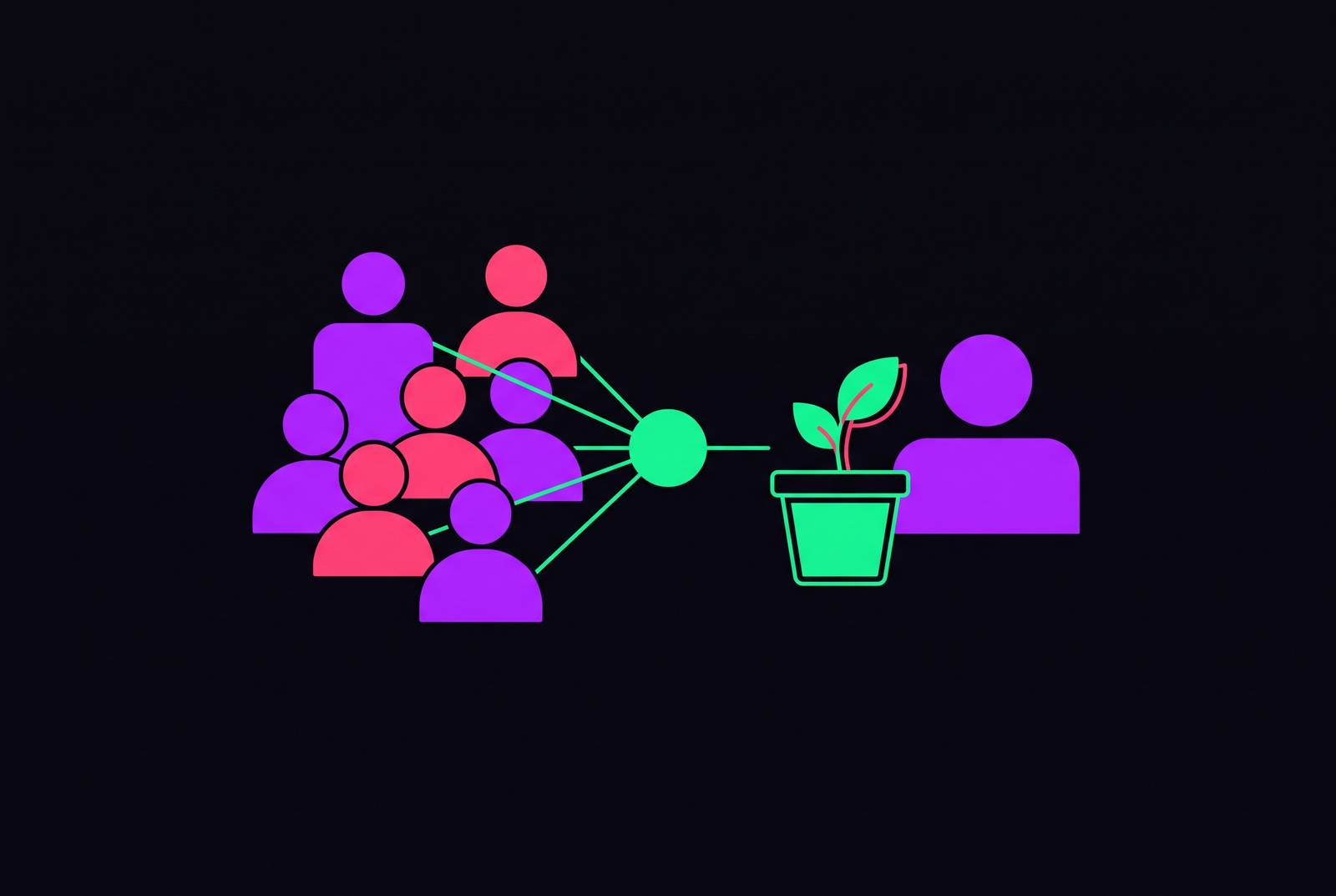
The old nurture model rested on one premise: marketing identifies an individual, cultivates trust with that buyer, and guides the journey until sales can step in. Enterprise purchasing has since outgrown that premise. According to Martal's citation of Gartner, typical enterprise purchasing groups range from a handful to numerous stakeholders, each arriving with distinct priorities, objections, and content requirements. The Starr Conspiracy reported in its 2026 trend brief that enterprise B2B tech buying groups now average eleven stakeholders, a size sufficient to shatter the persona model outright. None of this happened on its own. GDPR, SOC 2, FinOps, distributed work, and crowded vendor markets brought legal, security, finance, scattered approvers, and procurement into deals that previously moved without so many checks. Forrester's 2024 research puts the typical B2B buying group at thirteen people, says most opportunities span at least two departments, and shows why relying on one lead misfits this segment from the outset.
What lead nurture content does well
Lead nurture content still holds value and is well-constructed despite these limitations. Its strength lies in cultivating an individual connection while guiding their understanding and readiness throughout an extended buying process, using communication that remains steady, tailored, and responsive to their actions. The mechanics are laid out in Turtl's 2025 lead nurturing guide. Leads are sorted by persona, guided through buyer journey stages, and given content matched to their needs until they signal sales readiness. Formats such as emails, webinars, white papers, and case studies are calibrated for solitary progression instead of shared consensus-building. The 2026 B2B nurture guide from Martal makes the distinction plain. In a drip sequence, every recipient gets identical messages at preset intervals; genuine nurturing instead varies the content mix, send moment, and outreach path according to the prospect's observed actions. The contact is the unit being measured. It fits only when an SMB purchase has a single decision-maker carrying it from start to finish. For high-volume SMB motions, Knowledge Hub Media treats lead scoring and one-person nurture as valid, efficient plays. The mistake is using that tool uniformly in enterprise sales, where it was never designed to work.
Where lead nurture content fails the enterprise buying process
Once eight stakeholders must reach consensus, nurturing tied to one MQL metric shifts from incomplete to misleading, since that number can rise even as progress halts. Knowledge Hub Media outlines a scenario most enterprise demand gen marketers recognize: content resonates and scores rise, yet momentum dies because four additional stakeholders bring requirements the nurture stream never targeted. According to case data from The Starr Conspiracy, this pattern repeats at scale. For mid-market B2B SaaS groups navigating seven-member buying panels, agreements repeatedly circled back to earlier review phases before consensus emerged, timelines ballooned past forecasts, and roughly four out of every ten stage-two opportunities froze during consideration, since messaging and sales efforts targeted one archetype instead of every stakeholder present. IT security and procurement tend to arrive at most enterprise transactions once the technical choice is essentially locked in, which sets off rework, discounting pressure, and holdups stretching several weeks, since nobody designed anything for those roles up front. Even Martal points to a Gartner study that explains the dynamic: of all the time buyers devote to a purchase, only a fraction goes to supplier meetings, and while they weigh vendors against each other, any single rep may see no more than five percent of it. The deal is truly settled elsewhere, in talks the seller never witnesses, with players the nurturing effort never engaged at all.
What buying committee content is built to do
Content for buying committees seeks collective alignment across a group rather than preparing a single prospect to act. According to Knowledge Hub Media, nurturing an account means teaching the entire organization and changing its collective behavior by giving each buying committee member details suited to their role, whereas lead nurturing targets just one individual. As Livestorm's 2026 B2B guide to marketing content illustrates, assets must equip a champion to sway a manager so that person can subsequently pitch finance. That chain falls apart if any link lacks the resources to proceed. The format is a departure from lead-nurture collateral: business-case templates a champion can circulate or adapt, ROI calculators framed by stakeholder, decks that a buyer-side advocate can present, plus security or compliance files built for legal and procurement teams arriving late. By Q2 2025, practitioners were calling this consensus content, intentionally shaped around the buying committee overall rather than any individual member, and its late-demand conversion results now beat persona content. Digital Applied's 2026 guide makes the same point: in a normal deal, B2B buying groups collectively consult many pieces of content, not one person's linear stream, so teams need role-specific assets instead of one step-by-step nurture flow.
The content each committee role needs
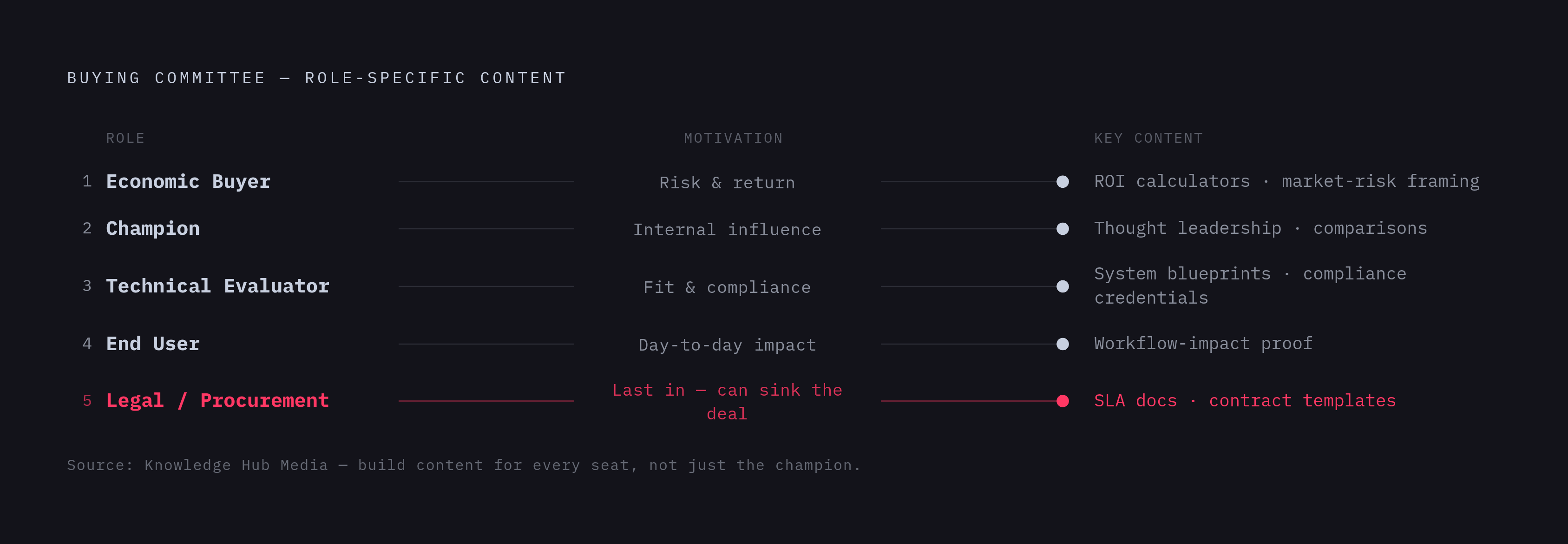
A standard buying committee creates friction for more than one reason. What satisfies finance, security, and daily users can clash, leaving no single asset able to reassure the CFO on cost, IT on protection, and employees on workflow. Knowledge Hub Media identifies the committee’s key players and the concerns that drive each one. For the economic buyer, the budget lens centers on return, exposure, and full cost, making ROI calculators, data-heavy case studies, and market-risk framing most persuasive. The champion is motivated by career upside and smooth rollout, so they need shareable thought leadership for colleagues, plus side-by-side comparisons that let them rally support for a deal they cannot approve alone. For the technical evaluator, the real test is whether the product fits the stack, meets security standards, and delivers in practice, so system blueprints, compliance credentials, and proof-of-concept results matter more than marketing copy. What the end user cares about is smooth daily use and a fast ramp-up, and they need proof the tool will simplify their work, not complicate it. Legal and procurement arrive near the end, yet they hold the power to sink a deal, and what they want is SLA documentation, contract templates, and compliance references, not a sales deck. One practitioner at Intentsify describes the practical side of this: "The CMO gets ROI calculators, the ops person gets our process documentation, and whoever's searching gets case studies". Stage sits on top of role here, since an economic buyer in the awareness phase wants market trend framing and a feel for business risk, while at the decision stage that same person responds better to hard-number case studies, meaning role-specific content must be tailored to each stage as well. Once a committee grows to three or more people, the minimum bar becomes distinct material for each seat: whoever evaluates the technology needs pieces on security, integrations, and implementation complexity; the financial buyer needs pieces on payback period, ROI, and TCO; the end user needs pieces on workflow impact and ease of use, because one generic asset cannot speak to every one of those readers at once.
Measurement for the buying group as the unit of analysis
A system designed to track one person cannot measure content built for a committee. Lead scoring evaluates one contact's activity and fit, but when a deal brings in eight people, that lone score becomes deceptive, appearing to show healthy pipeline while deal stall rates quietly rise. MQL scoring overlooks the additional stakeholders who really influence the choice, much of the buying research occurs without attribution and fails to generate an MQL, and elevated MQL totals suggest robust pipeline when they do not actually reflect it. As a fix, some practitioners advocate the Buying Group Depth Score, which tracks how many distinct roles interact with each target account, arguing this metric forecasts deal speed and win probability better than MQL volume. Digital Applied's 2026 guide identifies intent signals as the missing counterpart: external intent data reveals the moment an account begins actively researching, letting sales receive that account much sooner than a typical MQL handoff permits. Account scoring starts from a different place than lead scoring. It judges company-level fit by looking at firmographics, technology stack, intent to buy, and readiness across the organization, then identifies the account to prioritize, while lead scoring can only answer which person appears interested. Once deal sizes clear a meaningful ACV bar, Account scoring should become the deciding layer and lead scoring should sit below it as a supporting input. That does not make lead nurture content a poor fit in the situations it was designed to serve. It still works well in high-volume SMB plays, but the mistake is carrying that approach into enterprise, because it brings back the false pipeline picture that measurement built around committees is supposed to fix.
Why committee content at scale requires a modular architecture
The main pushback against this model is practical, and it is justified. In many companies, the audience definitions, asset library, and CRM structure are not mature enough to tailor materials by role across each buying group and deal phase. A modular content system that pairs committee patterns, such as security-led, finance-led, and ops-led, with demand states allows a single strong campaign to cover ground that would otherwise take dozens of separate campaigns. In Starr Conspiracy's B2B Messaging Personalization Trends, this shift is laid out as a matrix where persona stays as a tag while committee archetypes define the rows and demand states define the columns. For example, applying "a security-led committee in a regulated vertical" across four demand states with role-specific proof points creates just sixteen component slots rather than two hundred, a small enough system to prevent the model from sprawling beyond control. Knowledge Hub Media gives this execution a simpler grid form: one axis for personas, the other for buying stages, and each cell tied to relevant content assets. The aim isn't role-specific campaigns for everyone, but rather ensuring each stakeholder touchpoint gets dedicated content, with many assets serving multiple personas. Teams lacking capacity to build a complete committee content library at once can start by covering security, procurement, and finance first, then add end-user variants quarterly. AI plays a defined, limited part in this work instead of an unrestricted one. By examining firmographic information, job title trends, and past deals, it can pinpoint probable buying committee members prior to vendor outreach, while also assessing current content against the matrix to reveal gaps. When teams conduct this audit, they typically discover a consistent imbalance: abundant content aimed at champions, but very little addressing technical evaluators or procurement.
The effective window for committee content under dark social and automated shortlisting
Much of today’s B2B purchase vetting happens out of sight, ahead of vendor awareness that an opportunity exists, so committee-focused content must carry influence in places standard nurturing for named leads was not made to reach. Once a prospect submits a form or sales hears back, the committee may already have settled on shortlist preferences from material it discovered independently, reviewed together, and discussed beyond the vendor's reach. A single-lead content model cannot affect committee deliberations that unfold outside its view. When content is mapped to committee archetypes and placed in the formats and role-specific channels they use, it can already be present as unseen evaluation unfolds. That is why content should be reworked for buying groups instead of individual leads: the decisive phase of most enterprise deals arrives sooner and involves more stakeholders than the funnel can observe.
Sources
- The definitive guide to B2B lead nurturing
- B2B Content Marketing 2026: Lead Generation Guide
- Lead Nurturing: B2B Strategies, Tools & Examples [2026]
- B2B Content Marketing: The 2026 Strategy Guide
- How to Align Your Content to the Buying Committee
- B2B Messaging Personalization Trends
- How B2B Buying Groups Are Evolving - Intentsify