Thought Leadership Content for B2B Executive Audiences
Most B2B executives read thought leadership weekly, but 85% find it mediocre.

B2B thought leadership is effective when it provides those unable to speak in meetings with something to present. Here’s the rewrite:
This post’s whole point is simple: execs read tons of this stuff, most of it lets them down, and why it does shows who it should target and what it should say.
Begin with the numbers, since they're weirder than they seem. The 2024 Edelman-LinkedIn report, based on 3,484 global executives, revealed that 52% of decision-makers and 54% of C-suite leaders dedicate at least an hour weekly to thought leadership content. The 2025 follow-up, based on 1,934 respondents from seven markets, found nearly the same result in a group most content plans ignore: 63% to 64% of hidden and target buyers also spend at least an hour weekly. That's not a niche behavior. Most people involved in buying decisions spend a significant part of their week reading content they admit is usually not very good. Just 15% of decision-makers called the content they read very good or excellent, according to Edelman B2B Thought Leadership Research.
So why bother with junk? At any given time, about 95% of a company's potential customers aren't making a purchase, according to Edelman B2B Thought Leadership Research. Thought leadership helps them stay aware of problems they haven't dealt with yet. And per Dentsu's B2B Superpowers Index, "being seen as an active thought leader in category" jumped from the 20th most important vendor selection driver in 2022 to the 3rd. Executives now quietly see your ability to publish smart, credible ideas as a sign of whether you're worthy of their trust and investment. The rest of this piece shows how to turn the attention this content gets into earnings.
What B2B buying groups actually look like, and why most content strategies are aimed at the wrong people
An average B2B deal is like a jury trial, but just one juror ever meets the defense attorney. Everyone else, the finance juror, the legal juror, the procurement juror, forms their opinion from what gets passed around outside the courtroom. The 2025 Edelman-LinkedIn report describes a similar situation when it discusses the "hidden buyer": stakeholders in finance, legal, compliance, procurement, and operations who can block or support a deal but rarely get content aimed at them.
Ignoring them has real costs. More than 40% of B2B deals stall due to internal misalignment within buying groups, the 2025 Edelman–LinkedIn B2B Thought Leadership Impact Report says. Not because the champion failed to present the argument. Because the champion couldn't get the others to agree it was worth making the case.
This fact’s worth pausing over: that same study showed 81% of final picks were already familiar to the whole group on day one. Just 4% of buys were products only a few knew about from the start. In other words, the deal is usually set before any official review starts, so the real fight is for early, broad awareness, not convincing people later.
The 2025 report reveals that 71% of hidden buyers have limited contact with sales, according to Edelman B2B Thought Leadership Research. Compliance officers aren't getting calls from reps. Salespeople aren't courting procurement over meals. For most of the buying group, thought leadership isn’t just one option, it’s the only way to reach them.
Hidden buyers aren't just passive approvers awaiting a mention. Hidden buyers, the 2025 report notes, back fresh thinking that changes how they see things. They're evaluating arguments, not just scanning for keywords. That leads to the clear next question the following section must address: if these people read and think like others in the buying group, what happens when the content actually changes their mind?
How thought leadership turns hidden stakeholders into internal advocates
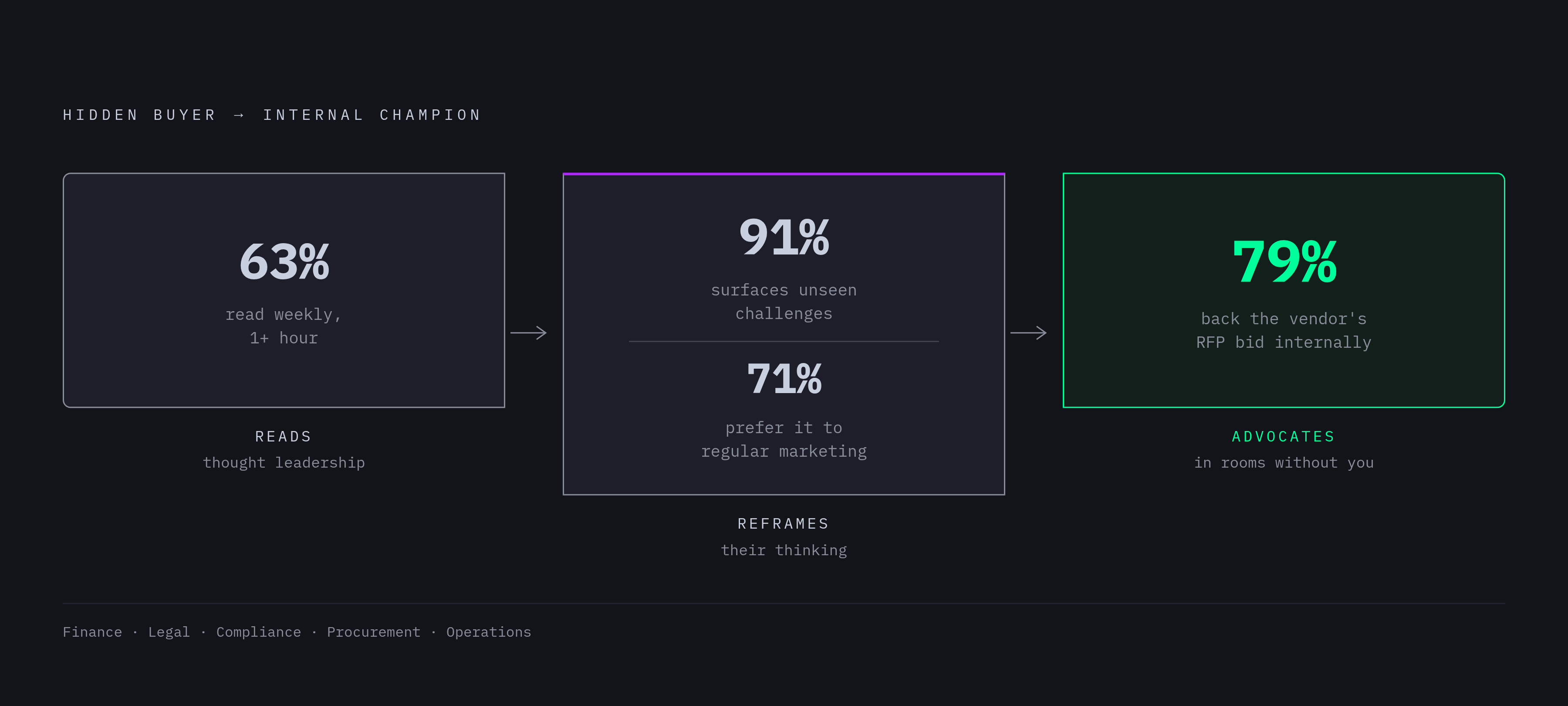
Here's a fact to reshape how firms view content ROI: 79% of secret decision-makers will back a vendor's RFP bid if the vendor regularly shares top-notch insights, says the 2025 Edelman-LinkedIn study. Not just "more favorable toward the brand." They’re more likely to push for it in meetings where the vendor isn’t present.
That’s the core process, and understanding exactly how it functions matters. For 91% of hidden decision-makers, quality thought leadership reveals challenges or needs they hadn't seen before. It's not pitching a product to someone with a clear need, it's doing the analysis that the hidden buyer would normally handle by themselves, in a role (legal, procurement, finance) that seldom gets help with that sort of analysis. If you provide someone in compliance with a clear, well-explained framework for a risk they barely noticed, you haven’t just informed them. You've given them the internal memo they needed to write.
Strong thought leadership makes 95% of hidden buyers more open to a vendor's sales and marketing follow-up, a deal-enabling stat masquerading as brand awareness. Seventy-one percent of hidden decision-makers believe thought leadership shows a vendor's skills better than regular marketing; 64% find it more trustworthy than product sheets.
Think about how this works in practice. A procurement lead, having read a vendor's research, can make the pitch without a rep present. She's made it to herself, probably out loud, possibly to her boss. The content is the sales pitch that happens internally, in meetings where the vendor isn't present. That's why the aim isn't to build brand affection. The head of legal doesn't need to like the company. They need her to keep, in a folder somewhere, the exact evidence and reasoning needed to convince her team to drop objections to the vendor. This distinction, evidence over affection, must govern every format and depth decision later in this piece.
The commercial consequences of getting thought leadership right and wrong
That idea might’ve felt vague or abstract, here’s the cash to prove it. In the 2024 Edelman-LinkedIn survey of 3,484 respondents, 75% of decision-makers and C-suite executives said one piece of thought leadership made them look into a product or service they hadn’t thought about before. That's new pipeline, generated solely by a persuasive PDF.
Pricing is another key factor. The 2024 report also found that 61% of C-suite executives prefer paying more for top-notch thought leadership. Separately, according to Clearly PR's 2024 research, 53% of buyers report thought leadership directly swayed a purchase. In short: the content doesn’t just get you in the room, it shifts how much people will pay once they’re inside.
The flip side, rarely talked about, may be even more compelling. According to Edelman-LinkedIn, 70% of C-suite leaders admit that thought leadership content has occasionally made them reconsider their relationship with a current supplier. Twenty-five percent of those executives who had doubts ended or cut back the relationship significantly. Somewhere, a vendor expecting an easy renewal was quietly beaten by a competitor’s blog post. That's not a hypothetical, that's a documented behavior pattern among a quarter of the executives who started questioning.
Quality has two sides, and here's the real issue. A FT Longitude study shows 73% of respondents think low-quality thought leadership can hurt a company’s reputation. And most companies are apparently taking that risk without the reward: Omnia Strategy Group's 2024 survey of more than 200 B2B tech marketing leaders found only 44% rate their own thought leadership programs as "very effective." So the honest summary of this section is uncomfortable: most organizations are absorbing real reputational downside while capturing only a fraction of the available upside. In short, it’s not just a branding extra, it’s a sales driver that moves deals, margins, and customer loyalty. If you treat it as less than that, you're missing out on money.
What separates content executives act on from content they tolerate
Just 15%. That's the share of decision-makers who rate the thought leadership they read as very good or excellent, per the 2024 Edelman-LinkedIn data cited earlier. The standard isn't high. Put another way, it’s an opportunity: succeeding just takes focus, not brilliance, and most rivals aren’t even trying.
So what actually clears it? That 2024 study, based on those 3,484 leaders, lists three key traits. Decision-makers say content backed by solid research and real data is key 55% of the time. Forty-four percent say content that shows them a challenge or chance they hadn’t noticed. Forty-three percent mention clear, actionable advice supported by case studies. Notice none of these are about polish. Not one brings up design, and not one talks about brand voice.
The 2025 report states hidden buyers want a fourth thing beyond the other three: bold, perspective-shifting ideas that challenge their thinking, not just what they already believe. That's a meaningfully higher bar than "informative." It's asking for content willing to be wrong in public, or at least willing to be disagreed with.
Why can't most organizations get past the first hurdle? Omnia Strategy Group's 2024 study shows the issues are structural, not about talent. Sixty-nine percent of respondents said the main issue was overemphasizing lead-focused content, where thought leadership was really just a lead magnet in disguise. Internal politics blocked real talk for 56% of those surveyed. Thirty-eight percent cited struggles with genuine market differentiation. This isn't about writing. It's an organizational permission problem, and we'll revisit it when we cover building a capable operation.
One key feature to point out: quality thought leadership causes tension. It challenges readers' beliefs rather than simply reinforcing what they already think. That's arguably what sets real thought leadership apart from dressed-up content marketing: daring to take a stand that others might challenge. Data supports the "make it defensible" approach: B2B content with original research receives 67% more engagement than opinion-based content. That's logical. Anyone can have an opinion. It's tougher to dispute data, and it's more likely to be shared with a CFO who'll want to know the source of the numbers.
Which formats carry thought leadership to executive audiences and which ones lose it
Executives don’t stick to a single type of content. Anderson and Marshall's 2025 study in Leader to Leader shows execs use reports, slides, blogs, and podcasts, more variety than most content plans cover. LinkedIn data shows in-person events reach 60%, video 59%, thought leadership content 57%, and digital events 49%. Thought leadership content reaches more people than digital events do. That’s a significant insight for teams that still rely on webinars as their go-to format for executives.
Research reports are the most effective format, which begs the question: why? That’s partly because original data boosts engagement by 67%. Some of it is due to institutional memory: Firms like McKinsey Quarterly have built credibility over decades with research reports that executives now consider essential reading, making the report format a credential in itself. There’s also a second purpose that’s less clear. A research report provides tangible material for a hidden buyer to bring into meetings. This isn't just early-stage content; it's a resource the buying group uses even after they've left the webpage.
McKinsey Quarterly, in print since 1964, shows a practical model: content with layers. A reader gets the summary at the surface and can follow "rabbit holes" down into the underlying research if they want more. It's straightforward when explained: give executives a quick summary, and let curious readers dig deeper. McKinsey’s approach values content over lead capture: share solid ideas freely because it helps the industry, and the trust you earn can’t be bought with ads.
This layered structure also clears up what seems like a conflict in the data. Edelman's research shows that 75% of B2B decision-makers are strongly drawn to concise, accessible content. Depth isn't the issue, order is: start with a summary, then show the proof. Watch out for content that starts with product pitches or takes too long to reveal its key insight; Edelman found most readers stop reading within the first minute if they’re not hooked right away.
Another notable shift impacting distribution: TopRank Marketing and Ascend2 (2026) report a growing share of professionals now find thought leadership via generative AI tools. This changes how content is discovered, favouring content with clear, citable claims over content that relies on visual design or brand recognition to seem trustworthy.
Building a thought leadership operation that produces this quality consistently
Lack of belief isn’t the issue. According to TopRank Marketing and Ascend2’s 2026 data, 97% of B2B marketers call thought leadership key to full-funnel success. Yet just 43% apply it after the sale, to keep and involve current clients. Almost everyone thinks this is important. Fewer than half know how to use it after closing.
Check Omnia Strategy Group’s 2024 data again, see the 56% who blamed internal politics for dull content. The significance of that number isn't immediately obvious. It means good thought leadership needs an editorial role free enough to say things that could unsettle legal or clash with this quarter’s sales deck, not just a better writer. While 69% saw lead-focused pressure as the main barrier, both issues highlight that the real bottleneck is organizational permission, not talent.
Before writing starts, they decide on the key traits: original data, a fresh perspective on challenges, and actionable advice. Audience. Problem. Perspective. If you get those wrong, good writing can't fix it. That brings up a good question: does speeding up mean abandoning that strategic foundation? Not necessarily. The operational fix isn’t trading speed for rigor, but splitting the work: lock in audience, angle, and evidence upfront, then execute production against that foundation. Consistent teams often use AI drafting after setting a strategic brief, with editors verifying content matches the brief, not starting from scratch. Letterstory, an end-to-end content marketing platform, supports this workflow by automating topic curation and drafting while keeping human oversight in place.
McKinsey’s setup teaches another key lesson besides the layered-access model: publishing operates completely separate from sales. The editorial team sets its own standards and schedule, seeing content quality as something to build over years, not deliver per campaign. In-house teams often have an advantage here that agencies lack: direct access to proprietary data, customer conversations, and internal experts, which drives the 55% of executives who value original research in thought leadership.
Tools that prioritize strategy, combining AI writing with a solid editorial process, are key, what sets them apart is the early focus on strategy, audience, problem, and perspective, which ensures the output is tailored, not just generic content that feels impersonal and irrelevant.
Measurement either completes the process or it doesn’t. Omnia Strategy Group's 2024 research highlights that thought leadership often goes unmeasured or is measured poorly. Teams measuring pipeline impact and customer retention can show solid numbers in budget talks. Teams tracking page views and downloads only argue feelings, which rarely survive budget cuts.
What a thought leadership strategy built for hidden buyers actually looks like in practice
Pull every thread from the sections above and the reframe is simple to state, harder to execute: thought leadership for B2B executive audiences isn't about broadcasting how smart a company is. It gives unseen, scattered decision-makers the proof and context they require to argue for you when you’re not there.
It begins by identifying the real buying group, not just the official buyer. The 2025 Edelman-LinkedIn report's "hidden buyers" in finance, legal, procurement, and operations consume content almost as much as visible decision-makers (63% vs. 64% spending an hour or more weekly) and judge it just as critically. Overlooking them isn't a reach issue, but a strategy one.
The content brief then almost writes itself, needing exactly four elements, no more, no less. Fresh data the reader won’t find elsewhere, because that’s the 55% of decision-makers who prioritize robust research. A problem frame that names what the reader half-noticed but couldn't quite articulate, the gap among hidden decision-makers the earlier 91% figure highlighted. A take that stands up to pushback, not just more of the same. And concrete guidance they can pass along, because hidden buyers evaluate and advocate, they don't do the building.
Distribution needs to follow the timeline shown by LinkedIn B2B Institute research: because 81% of final purchases were known to the whole buying group on day one, reaching hidden stakeholders only at the RFP stage is too late. LinkedIn and trade publications remain key channels for thought leadership doing that early, wide reach, precisely because they touch people sales never talks to. Get the content right by the standards laid out across this piece, and it stops being something hidden buyers merely tolerate reading. It turns into what they slip to their boss just before the meeting where choices are finalized.
Sources
- 22 Thought Leadership Statistics You Should Know
- 2025 Edelman - LinkedIn B2B Thought Leadership Impact Report | Edelman
- edelman.com
- Key Findings from Our Latest Thought Leadership Research
- B2B thought leadership effectiveness: what the data says in 2026 | Considered Content
- odwyerpr.com
- contentgrip.com
- businesswire.com