Gated Content Formats That Generate Marketing Qualified Leads
Interactive tools and research reports generate the highest-intent leads before the form appears.

Not all gated content works to generate leads the same way. The content behind the form decides who even tries to submit it, and whether they’re already near a purchase decision, turning the gate into an invisible sieve. Most filters have the wrong setting, a problem platforms like Letterstory address by automating topic curation to match intent signals, which this piece explains.
About 80% of B2B content marketing materials require a form, and marketers mostly say they create them to generate MQLs. According to MarketingSherpa, 79% of MQLs never convert into sales, with a lack of lead nurturing being a common cause. This excuse is easy, yet it's fundamentally flawed: nurturing won't help a lead that wasn't qualified to start with. The format sitting behind the gate decided, long before any nurture email got sent, whether the person filling it out had a real problem or just idle curiosity. The following ranks the main gated formats by the intent signal they show before the gate, and suggests where each belongs in a funnel, not just how many names it gets.
What makes a gated content lead "marketing qualified" in the first place
A lead that’s actually ready for sales, rather than just swapping an email for a free download, is what we call an MQL. Those are different achievements, and the industry has spent years pretending otherwise.
The volume data makes the gap hard to ignore. Organizations generate an average of roughly 1,877 leads a month, and about four in five of those get classified as MQLs. On average, just 13% of MQLs convert to Sales Qualified Leads (SQLs). Sit with that ratio: nearly 80% of monthly leads earn the "marketing qualified" label, but fewer than one in seven survives contact with an actual salesperson. That gap is not a failure of nurturing. It's a definition failure, upstream of nurturing entirely, and it usually traces back to a scoring model that counts activity (they downloaded something) instead of intent (they have a specific problem and something resembling a timeline).
Each gated format requires a varying degree of mental and behavioral effort before the form appears, and the greater that effort, the clearer the indication found in the download. Track these three questions separately for each format. Is the prospect aware of their problem? Are they looking for ways to fix it? Are they near enough to buying to be evaluating vendors with a deadline in mind? A format that only needs an email address to unlock a checklist answers none of the three. A format that requires fifteen minutes of input to generate a personalized result answers quite a lot. That's the lens through which we'll examine each section below; none, however, meets all three criteria at once. That's really the idea.
Interactive tools, calculators, assessments, and configurators, produce the strongest pre-gate intent signal
Static forms and interactive forms are not playing the same sport. Based on Outgrow's analysis of 50,000+ forms, interactive forms achieve an average conversion rate of 47.3%, compared to 2.8% for traditional static forms. That’s 16.9 times higher, enough to make a marketer pause mid-sip.
Why is an ROI calculator so much better than a static PDF? When people input their company size, current spend, and target outcome into a calculator, they've already spent time and provided context, before even reaching the email field. They qualified themselves without being asked. Demand Metric found that interactive content, apps, assessments, calculators, configurators, quizzes, converts moderately or very well 70% of the time, against 36% for passive content. Interactive formats like assessments, calculators, contests, and quizzes are often tailored to distinct stages and problem types.
A sales rep’s inbox gets more than just a name and title after a prospect completes a ten-question maturity assessment. It's more like a summary of their problems, current situation, and sometimes company details they offered freely, which is a much better way for an SDR to start a call than just knowing someone downloaded an eBook.
Interactive tools cost more and take longer to build than almost anything else here, and not every team can afford a custom configurator. That's okay, because even a low-cost interactive tool made from a template outranks a static PDF, if it addresses a genuine question the buyer is trying to diagnose or plan for. Leave that out and it's merely a quiz with added steps. These work best mid-funnel to late-funnel, when the buyer already suspects they have a problem and wants it quantified.
Original research reports and benchmark studies attract leads who are already deep in the problem
Original research reports consistently rank among the most effective gated formats for lead generation. It’s worth asking why, since the answer reveals insights into buyer psychology unmatched by any other format here.
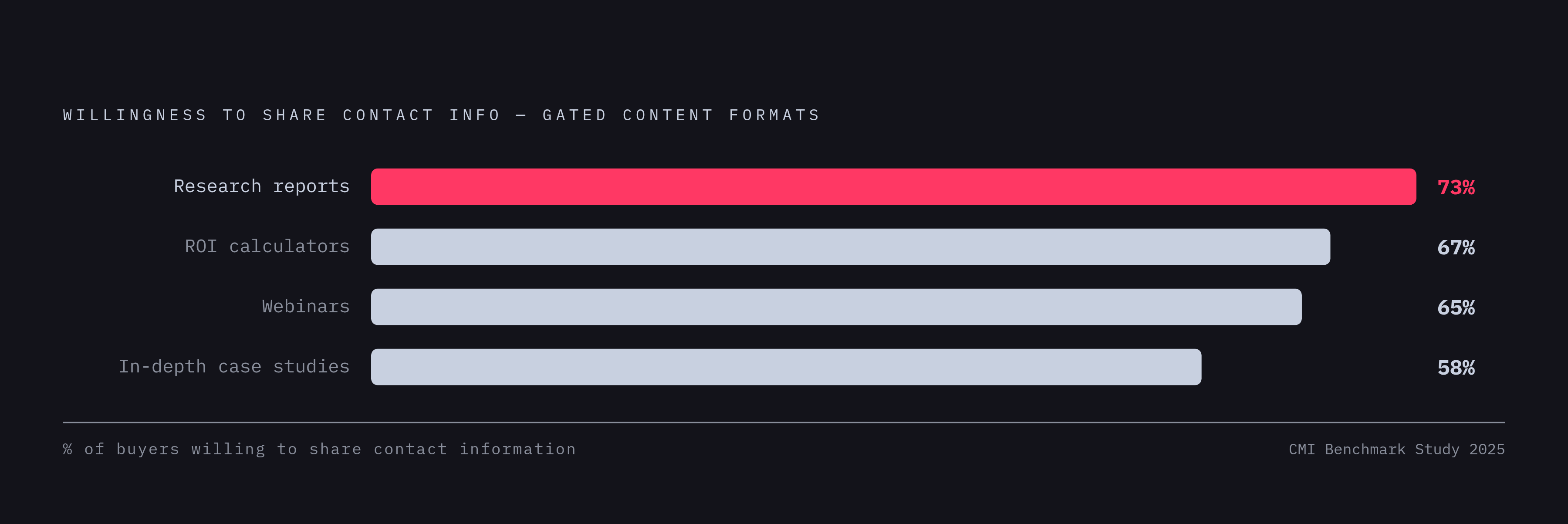
Someone searching for a benchmark study isn’t just browsing. They're benchmarking themselves against it, which means they already have a number in mind they're anxious to compare. That's active-evaluation behavior, not passive curiosity. According to the CMI Benchmark Study 2025 (via brixongroup.com), willingness to share contact info varies by format: 73% for research reports, 67% for ROI calculators, 65% for webinars, and 58% for in-depth case studies. Research reports lead the pack by a wide margin.
The format also has an economic advantage, which most content calendars overlook. A well-constructed research project yields proprietary data that remains relevant for 12 to 18 months, continually repurposed in blogs, webinars, sales decks, and social media. It’s not a one-time asset like a listicle. A proprietary benchmark study, a scored assessment, or a vertical-specific playbook routinely converts at 20 to 40 percent. The credibility angle is just as important as the conversion rate, because proprietary data can't be replicated elsewhere, and that uniqueness builds authority that syndicated content can't match. The leads coming through this gate tend to be decision-influencers checking their organization against a peer set, close to the exact persona sales wants showing up in the pipeline.
The issue is the cost of production. Original research requires a consistent editorial workflow, yearly surveys, consumption studies, and continuous customer data analysis, making it feasible only for teams ready to sustain this effort, not just run a single campaign.
Playbooks signal near-term purchase intent more reliably than any other written format
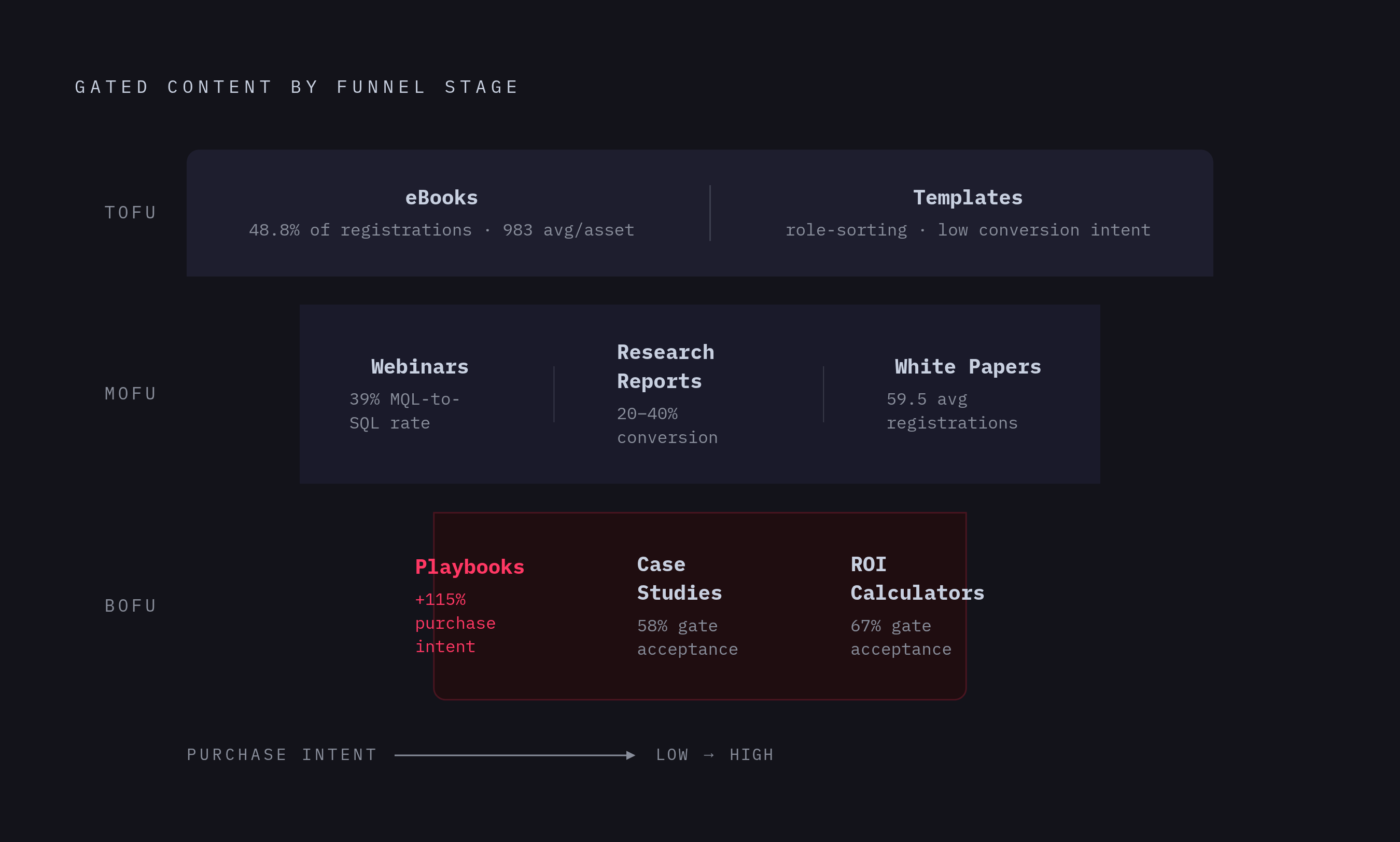
NetLine's 2025 data revealed that playbook registrations were 115% more likely to indicate a purchase decision within the next 12 months compared to the baseline format. That’s a striking number for a static, non-interactive written asset with no proprietary data, and it’s the most overlooked format here.
The reasoning behind it makes sense once explained: a playbook suggests the reader wants to act, not just know something. People won’t grab a playbook when they’re still unsure if the issue exists. NetLine's 2025 data highlights five formats most linked to purchase decisions within 12 months: playbooks, infographics, case studies, trend reports, and buyer's guides, with playbooks leading.
eBooks, covered in more detail next, show a clear contrast in reader mindset right away. eBooks cater to readers who are still shaping their views. Playbooks presume the reader's opinion is set and they seek a guide for implementation. That directly affects lead scoring, many teams still score it wrong: a playbook download should count more than an eBook download of the same length on the same topic, since they capture two distinct buyer stages. But there's a structural warning to consider. A playbook that turns vague and broad instead of sticking to clear, actionable steps loses the clear signal that makes it useful. The best approach is to use late-MOFU into BOFU, along with a follow-up sequence that quickly leads to a demo instead of more awareness content.
eBooks generate more registrations than any other format but should not be mistaken for high-intent signals
eBooks are the clear winner for volume. In 2025, eBooks made up 48.8% of all gated content registrations, according to NetLine, with each eBook asset averaging 983 registrations, far surpassing white papers' 59.5 registrations per asset.
Here's the key point: NetLine's study showed eBooks aren't closely linked to immediate buying interest. They help with awareness and initial learning. eBooks aren't for final decisions; many MQL models fail when they mistake eBook downloads for such evaluations.
Where do eBooks fit in? Top-of-funnel reach, topic authority, entry point into a nurture sequence, functioning as pipeline fillers rather than pipeline closers. Teams chasing MQL numbers alone will over-invest in eBooks, since they're cheap and easy to scale. Teams focused on converting MQLs to SQLs save their best follow-up efforts for content with a clearer signal, relegating eBooks to building a broad top-of-funnel that feeds better-performing formats. It's worth noting that eBook demand dropped by 16.7% year over year in NetLine's 2025-2026 data, suggesting buyers are becoming more selective even with a format designed for easy access. Quality matters more now, even at the top of the funnel. Practically, that means gating eBooks tightly at the very top and routing registrants immediately into a segmented nurture sequence, one that uses later touches, a webinar invite, an assessment, to surface which names in that big pool are worth escalating.
Webinars produce a different kind of qualified lead: one whose intent is demonstrated through time invested
Signing up for a webinar and then actually joining it are two different steps, and that gap is why it works. Registering for a webinar has a low barrier, similar to downloading a PDF. The commitment to attend on a Tuesday at 11am is a true scheduling obligation, and that's what really qualifies someone, not just registering.
Webinars achieve a 39% MQL-to-SQL conversion rate, lower than SEO and email but higher than other digital channels. Marketers running personalized webinar experiences see significantly higher CTA conversion and substantially more attendees than those running generic sessions. Even webinar replays bring in results: Webinar replays often achieve 22% to 26% CTA conversion rates, keeping the format useful long after the live event.
This isn't free. Webinars demand far more time and resources than calculators or eBooks, forcing marketers to judge their worth by how they move deals forward, not just by how many people sign up. According to the CMI Benchmark Study 2025, 65% of buyers are willing to register, ranking third behind research reports at 73% and ROI calculators at 67%. The format fits well in the middle of the funnel and is most effective when the topic aligns with a challenge the audience is facing, along with a CTA that directs them to a demo rather than another awareness tool.
White papers, templates, and case studies each occupy a specific narrow role in the MQL mix
Rather than competing, these three formats each fill distinct gaps, and grouping them together in a single content-calendar category often causes programs to veer off course.
Buyers are in active research mode but haven't yet compared vendors when they access white papers, which are mid-funnel. It's worth explaining the difference with research reports clearly. Buyers respond differently to white papers and research reports, and they respond to each completely differently. Gating acceptance for research reports stands at 73%, higher than for many other formats. On the NetLine platform, white papers average 59.5 registrations per asset, modest next to eBooks, but genuinely useful for niche or technical audiences where specificity beats reach.
Templates operate on a different level: they provide immediate, hands-on value, something the buyer takes away and actually uses instead of just reading. Templates provide immediate, hands-on value, drawing in those who do the work rather than those who approve budgets. Templates draw in those who do the work, rather than those who approve budgets, which is important for scoring because a template download usually reveals a job role before it shows purchasing power. Best for TOFU to early-MOFU, better at sorting contacts by role than sparking quick conversions.
Case studies do something neither of the other two can. Per the Content Marketing Institute's 2025 findings, case studies are highly persuasive at the decision stage, not the highest-volume format, but the one sitting closest to the actual close. A case study with a specific outcome for a specific client type can move a prospect that retargeting ads and nurture emails alone couldn't reach. Gating acceptance is 58%, according to the CMI Benchmark Study 2025, which is lower than for research reports or webinars, but those who do sign up are usually in active vendor evaluation. The ideal length for a case study is concise enough to establish credibility and read in one sitting. It should be placed at the end of the funnel, accompanied by a direct invitation to contact sales.
Choosing what to gate and what to leave open shapes the quality of every lead the formats above can generate
None of those rankings matter much if the gate appears at the wrong point in the buyer’s journey. That's the part that most content plans mess up: teams focus on what asset to create next, then apply the same gating rules to all content, no matter the stage, as if a calculator and an eBook need the same fifteen-field form.
Aggressive gating has a real cost. Gating too early, according to avair.ai, cuts off a significant number of potential leads during early research phases, as buyers unwilling to give up their email address just leave the page. It's a hidden loss. There's no warning when this happens, but months later, the top of the funnel is smaller than expected based on traffic. The industry shifted to hybrid strategies: per the CMI Benchmark Study 2025 (via brixongroup.com), a large majority of B2B companies now offer mostly free content, gating only select premium resources, down from 81% that used any gating in 2020. The combination shifted even when the basic urge to gate remained.
A useful rule of thumb, courtesy of qualentmedia.com: if a prospect would pay actual money to access a piece of content, it belongs behind a gate. If a prospect wouldn't pay for it, the content shouldn't be gated, regardless of how much effort went into making it. When applied to the funnel, that guideline forms a clear pattern. At the top, brand awareness content, videos, one-sheeters, light guides, remains ungated, as the focus is on reach, not capture. In the middle, where active research occurs, content like research reports, webinars, and assessments is gated with some selectivity, as the buyer is then prepared to identify themselves. At the bottom, during serious vendor evaluation, case studies, playbooks, and ROI calculators are tightly gated with real qualification fields, as each registration acts as a genuine signal instead of just a name in a spreadsheet. The format decides who shows up. Where the gate sits decides whether they show up ready to talk.