Integrated Content Campaign Structure for Product Launches
Coordinated messaging across channels turns product launch assets into a coherent campaign.
Most product launches fail not because the product is bad, but because the marketing around it is a pile of disconnected assets pretending to be a campaign. A press release goes out Tuesday, a demo video drops Thursday, social team posts whenever, and nobody checks whether any of it tells the same story. PMA and Ignition's 2024 State of Go-to-Market Report found that 79.5% of companies say product launches significantly affect revenue. Yet most launches still underperform, and the reason usually traces back to structure, not creative quality.
Here's the failure mode in practice: different teams produce different assets in parallel, each one competent on its own, none of them wired to the others. The press release has one message. The social push has a slightly different one. The demo video assumes the audience already knows things the press release was supposed to explain. Nothing compounds. Each channel just makes its own noise, and noise doesn't add up to signal no matter how much of it you generate. A pile of launch assets is not a launch campaign. A campaign has phases, it has channel roles, and it has a through-line that carries someone from "never heard of this" to "bought it." Most teams get this wrong in a specific, fixable way: they treat the launch date as the campaign, when the launch date is just the loudest week inside a much longer structure.
What "integrated" actually means in a launch context
Integrated Marketing Communications, or IMC, is the framework worth borrowing here: every promotional method gets bound together under one message architecture, where the core pillars stay fixed and the execution flexes per channel. Three layers make this work. First, a unifying narrative, the single story explaining why the product exists and why now. Second, phase logic: pre-launch, launch, post-launch, each with its own job. Third, channel roles, where each channel gets a specific task in the buyer's journey instead of getting treated like an interchangeable megaphone.
Consistency is not the same thing as uniformity, and this distinction trips up more teams than it should. The core message has to shift in tone, format, and depth depending on where it lands: an email to a warm list can go deep on features, a TikTok has maybe three seconds to earn attention before someone's thumb moves on. Same message, different clothes.
What actually goes into that unifying narrative? Four things: the problem the audience already has, the category position (does this product fit an existing shelf or does it argue the shelf is wrong), the proof points that back the claim up, and a call to action calibrated to wherever the audience sits in the funnel. Skip this architecture and something strange happens: individual assets can be excellent, genuinely well made, and still pull the audience in three directions at once. Good ingredients, no recipe.
The three-phase structure and what each phase is actually trying to do
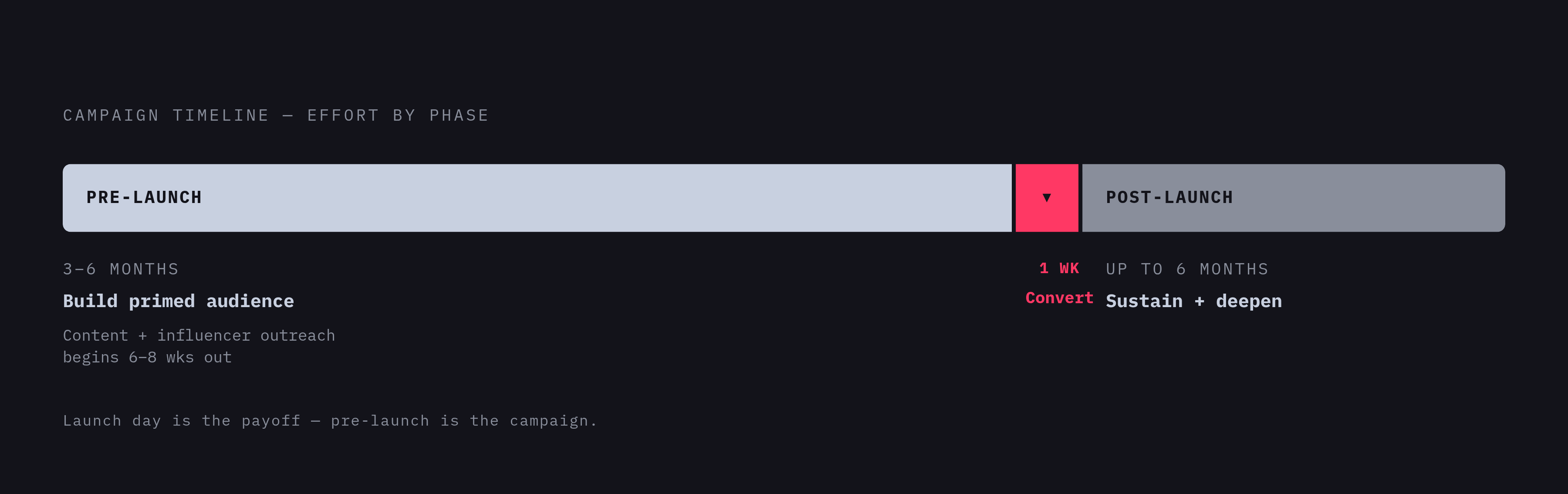
A full campaign runs three phases, not one big day. Pre-launch builds a qualified, primed audience before the product exists to buy. The launch window delivers a synchronized push designed to convert the people pre-launch primed. Post-launch sustains adoption, deepens engagement, and turns early buyers into people who talk the product up unprompted.
Typical span for the whole thing runs 8 to 12 weeks, with pre-launch eating the largest chunk of that calendar. Worth sitting with that ratio for a second, because it cuts against instinct. Launch day feels like the main event; structurally, it's the payoff of whatever got built beforehand. Teams that dump their whole budget into launch day and skip the runway are buying attention with no primed audience standing by to catch it. That's an expensive way to make noise, and it's the single most common budgeting mistake in this entire process: spending like launch day is the campaign instead of spending like launch day is the receipt.
The CMO Survey found that launches with a pre-launch marketing push are 50% more likely to succeed. One number, but it justifies the whole calendar allocation on its own. Phase logic also disciplines spend in a quieter way. Pre-launch content and influencer seeding cost less than launch-day paid media, so front-loading effort into content lowers what a team ends up paying to buy reach once launch week arrives. For big or complicated products, post-launch planning should stretch out to roughly six months. The campaign does not end when the box ships.
Pre-launch: building the audience before the product is live
Planning starts 3 to 6 months out depending on complexity, and content production plus influencer outreach begin at minimum 6 to 8 weeks before launch date. Inside that window, the teaser campaign breaks into three beats. Start with cryptic, curiosity-driven signals, just enough to make someone raise an eyebrow. Move into build-up: more specific detail, behind-the-scenes footage, ways for the audience to get involved through waitlists or referral programs. Finish with reveal: full disclosure, and the moment sign-ups or pre-orders open.
Format matters here too, and not every format earns trust the same way. Educational content that speaks to a problem the audience already has, positioning the coming product as the natural fix without hard-selling it, tends to work better than straight promotion. Behind-the-scenes material makes early followers feel like insiders rather than targets, which is a genuinely different feeling, and audiences can tell the difference. Thought leadership content, meanwhile, builds the brand's authority in its category before the product claim has to do all the convincing by itself.
Influencer seeding belongs in this phase structurally, not as a bolt-on nobody planned for, and this is where most teams get the selection criteria backwards. Preview units go out to selected creators several weeks ahead. Pick people for alignment with brand values and audience specificity, not follower count; a creator with 30,000 tightly-fit followers can outperform one with ten times that in reach and none of the relevance, which is the kind of content decision Letterstory, an end-to-end content automation platform, is built to support across the full launch calendar. Give them creative freedom, because scripted brand messaging reads as scripted, and authentic creator content just performs better in these formats. One documented skincare launch used eight micro-influencers in the 10,000 to 50,000 follower range, gave them early access and room to make what they wanted, and generated 127 pieces of user content before launch day, driving 3,200 clicks to the product page.
PR belongs in pre-launch too, and it's worth treating the press release as a content asset rather than a one-off. Publish it as a blog post at the same time it goes to press. Clip journalist quotes for social. Use the release as proof inside email sequences and ad copy later. By the time pre-launch wraps, the handoff to launch week should include a list of ready buyers, a primed audience, some earned media already in hand, and seeded influencer content sitting ready to amplify.
The launch window: coordinated pressure across channels, not a single event
Treat launch week as a week, not a single Tuesday. Daily reveals work better than one big drop: new features one day, use cases the next, a customer spotlight after that, rotating limited-time incentives threaded through. Stage press coverage across the week instead of firing it all at once. One consumer electronics example documented 40% more coverage from this staged approach compared to a single-day launch.
Content format matters at this stage in a different way than pre-launch. Product demos, video or live, convert people who already understand the problem and just want to watch the fix in action. Comparison content answers the question a primed buyer is already asking, which is usually some version of "okay, but how is this different from what I already have?" Testimonials and early-adopter spotlights supply third-party validation right at the decision point. Live events and webinars generate real-time engagement and, as a bonus, leave behind content assets to reuse after launch.
Channel coordination is the part that separates an integrated launch from an expensive coincidence. Email reaches the highest-intent group built during pre-launch and drives direct conversion. Social amplifies reach and rides the attention influencer seeding already generated. Paid fills the gaps organic reach can't cover and retargets people who engaged earlier but didn't buy. PR and content supply outside credibility right when audiences are weighing the decision. Apple's coordinated launches, keynote plus digital ads plus retail plus press coverage, show what channel synchronization looks like at scale: each piece reinforces the others instead of running its own parallel show.
What breaks this in practice is almost always the same thing. Someone approves channel-specific creative without checking it against the master narrative, or a paid team optimizes ad copy for click-through rate and the winning variant quietly contradicts the brand's core claim. Small thing, big leak.
Assigning channel roles based on what each channel actually does well
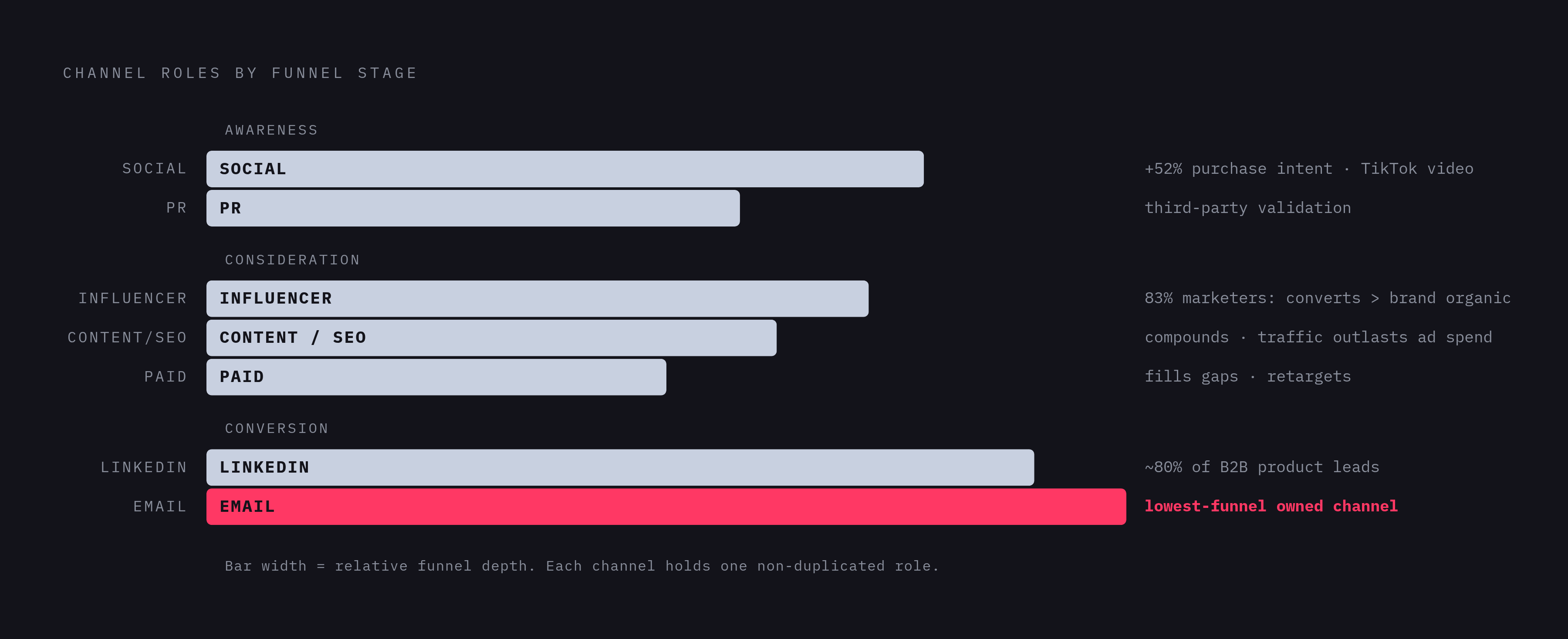
No single channel runs the table, and treating one as the whole strategy is where most launch plans quietly fall apart. Social sees the highest usage among marketers and the highest share who call it their most effective channel; email, content, paid, influencer, and PR all trail it on both counts but none of them drop out of the mix entirely. Spread that thin, and the case for one dominant channel collapses. That is exactly the argument for giving each channel a defined job instead of betting the whole launch on the one with the biggest number.
Practical assignments look like this. Social handles broad awareness and amplification, reaching people who aren't in the funnel yet; TikTok for Business reports that product videos on the platform drive 52% higher purchase intent, which makes it the strongest bridge from awareness to consideration for consumer brands. LinkedIn does the B2B lead generation work, generating an estimated 80% of B2B product leads, and suits thought leadership and demo requests specifically. Email owns conversion and retention, the lowest-funnel channel a brand actually controls, best aimed at the highest-intent segment pre-launch already built. Content and SEO compound over time: blog posts, guides, and comparison pages keep pulling traffic long after the launch-week ad spend runs dry. Paid fills coverage gaps and retargets people who showed interest but didn't convert. PR supplies the third-party validation owned channels simply cannot manufacture themselves.
Repurposing content across channels is its own discipline, and most teams get the middle path right without realizing it's a strategy. One widely cited marketing report found 48% of social marketers share similar content across platforms with minor tweaks, 34% build unique content per platform, and 17% post the same thing everywhere with no changes at all. That middle group, adapting rather than duplicating or cloning outright, is what channel role logic actually demands. Channel roles also need to map to funnel stage, not just channel format: G2 research found 77% of buyers want different content available at each stage of their research, which means the "same story, different clothes" idea from earlier applies down the funnel as much as it does across channels.
Influencer integration as a structural decision, not a line item
Research finds 83% of marketers say sponsored influencer content converts better than a brand's own organic posts, and 86% of consumers made at least one influencer-driven purchase in the past year. That's not a nice-to-have channel anymore, and treating influencer work as something the social team bolts on in week three is the mistake that shows up most often in weak launch plans.
Micro and mid-tier creators specifically make the structural case stronger. Later's Influencer Marketing Report found 73% of brands prefer working with them for the engagement-to-cost ratio, and the pattern holds: smaller accounts tend to post meaningfully higher engagement than the giant ones, at a fraction of the cost per thousand impressions. For a launch targeting a specific buyer profile, niche audience fit beats raw reach almost every time; 500,000 followers who don't care about skincare are worth less than 20,000 who do.
Influencer activity should map onto the three phases the same way everything else does. Pre-launch is seeding and early content, the skincare example's 127 pieces of user content before launch day being the model. Launch window means coordinated posting tied to that week's narrative beats, not creators running their own independent promotion on their own schedule. Post-launch is reviews, tutorials, and community content that keep the product surfacing in feeds long after the initial push fades. Sprout Social's Q1 2025 Pulse Survey found 59% of marketers plan to grow their influencer partnerships this year, so this piece of the structure is getting more load-bearing, not less.
Worth stating plainly: influencer fraud is a real and ongoing problem, and follower counts alone tell a buyer almost nothing about whether an audience is real. Vet engagement, not headline numbers. And every influencer brief should reference the campaign's unifying narrative directly; creative freedom belongs in format and voice, not in the core claim itself.
What a B2B launch structure looks like versus a B2C one
The skeleton, phase logic, channel roles, unifying narrative, holds steady across both worlds. What changes is the channel mix, how long the funnel runs, and which content formats actually move a buyer from curious to convinced.
A B2B SaaS launch tends to lean on LinkedIn ads, webinars, SEO-driven thought leadership, email nurture sequences, and content syndication. One documented example saw shared messaging across all of those channels produce roughly a 40% rise in demo requests over a single quarter. Consideration cycles run longer in B2B, so pre-launch content and nurture sequences end up carrying more of the weight than the launch-day paid push does; nobody signs a six-figure software contract because of a clever ad they saw on a Tuesday. Content aimed at decision-makers, comparison guides, ROI frameworks, case studies, belongs at the final funnel stage, right where a buying committee sits down to actually evaluate.
B2C e-commerce runs a different mix: search ads, paid social, influencer content, segmented email. One Black Friday campaign that ran the same offer messaging across every channel produced 30 to 40% more revenue and a 20% lower blended customer acquisition cost compared to running channels in isolation. Consideration cycles are shorter here, so the weight shifts toward speed, getting someone from first glance to checkout fast, and TikTok or Instagram do more structural heavy lifting than they would in a B2B stack. User-generated content and social proof function as B2C's version of what press coverage does for B2B: the outside validation that makes a stranger's claim believable.
The lesson holds across both, and it's the part teams tend to skip past because it sounds too simple to be the actual answer: the efficiency gain comes from synchronizing channels around one offer and one message. Picking the right channels matters, but it's not the thing doing the work by itself.
Post-launch: sustaining the campaign rather than winding it down
The most common mistake here is treating launch day like a finish line, and it's the mistake that undoes everything built in the two phases before it. Momentum built over months doesn't survive contact with silence; teams that stop producing content the week after launch watch interest decay with nothing in place to catch it.
Post-launch content has its own priorities, distinct from pre-launch or launch week. How-to guides and tutorials close the gap between someone buying the thing and actually succeeding with it, which is where churn quietly starts. Case studies and customer stories go to work on the prospects who were interested at launch but weren't ready to buy yet; those people don't disappear, they just need more proof, later. User-generated content programs turn early adopters into an ongoing supply of material instead of a one-time spike. Nurture sequences re-engage the people who showed interest during pre-launch or launch week and then went quiet.
Notion's post-launch approach is worth studying here: regular feature updates, user showcase campaigns, template sharing, community challenges, all sustained well past the initial release. The company grew from 1 million users to more than 30 million on the back of that ongoing structure. The launch got people in the door. Everything after that is what kept them there, and that distinction is really the whole argument of this piece: a launch is not an event a team survives. It's a structure a team builds, one that keeps generating pressure across every phase, long after the confetti's been swept up.