Content Campaigns for Account-Based Marketing Programs
Build account-level content maps to match buying committees, not generic funnels.

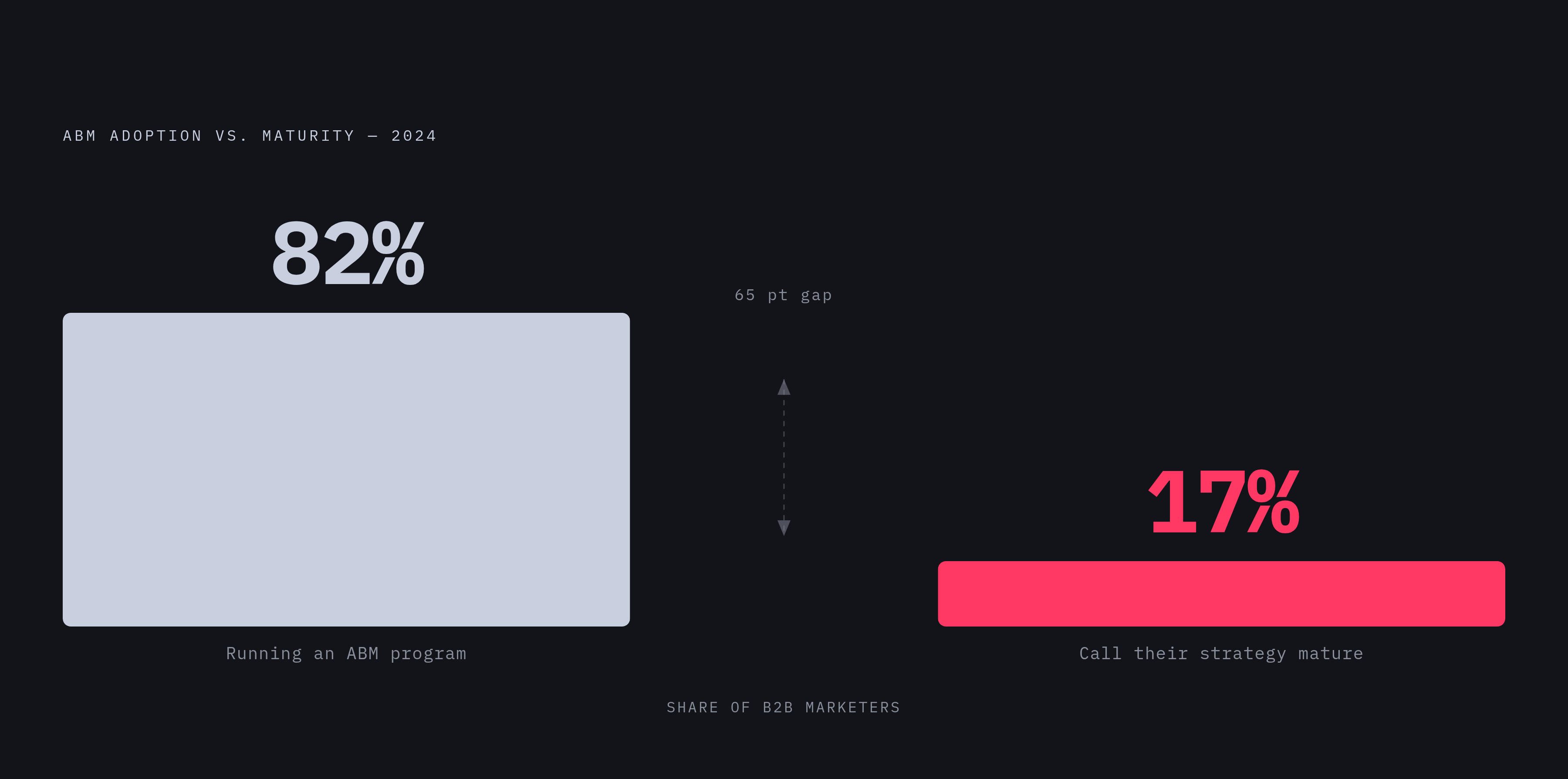
Account-based marketing has hit near-total adoption and mediocre execution at the same time. About 82% of B2B companies run an active ABM program as of 2024, but only 17% of marketers call their own strategy mature. That gap is what this piece is actually about, and the root cause is less exciting than a bad tech stack: most teams still treat ABM content as a find-and-replace exercise on assets built for a mass audience.
Swap the logo, swap the first name in the email, call it personalization — most teams count that as targeting, and most teams are wrong. Real personalization at the account level requires a content architecture: a system that maps specific assets to specific accounts, specific roles within those accounts, and specific points in the buying process. Running a publishing calendar with better mail-merge fields is a fundamentally different discipline, and most teams never make the switch. The three problems marketers rank highest in 2025, proving ROI, aligning sales and marketing, and scaling programs, all trace back to that missing architecture rather than to any shortage of software.
What the three ABM tiers actually demand from content teams
The one-to-one, one-to-few, one-to-many framework gets taught as a targeting model, but a production budget is the more useful lens, because that's what it actually governs, and the tier mismatch is where most ABM budgets quietly leak.
One-to-one, or strategic ABM, means fully custom campaigns for a small number of accounts large enough to justify the labor: custom microsites, ROI calculators fed with the account's actual contract numbers and headcount, executive narrative documents written like a memo rather than a slide deck. The economics work because the deal size is enormous. Forty hours of writing and design time on one account makes sense when that account is worth eight figures over its lifetime.
One-to-few, sometimes called ABM lite, clusters accounts by shared traits (industry, pain point, company stage) and builds content at the segment level. A whitepaper titled around "IT modernization in financial services" reads as tailored to any bank or insurer that opens it, even though it's serving a segment of maybe fifteen to fifty accounts, not one. The personalization happens at the segment, not the account, and confusing that distinction is how a content team ends up promising account-level customization it has no capacity to deliver.
One-to-many, the programmatic tier, is where intent data and automation take over, running campaigns across hundreds or thousands of accounts at once. It's also the tier growing fastest, which tracks given how cheap it is to execute relative to the other two. It demands a different asset architecture entirely: content built in modular components a system can reassemble dynamically, meant to be reshuffled rather than read start to finish as a single finished piece.
The failure mode isn't complicated, though it's shockingly easy to fall into. Applying one-to-one production effort to a one-to-many account list burns budget for no measurable gain. Applying one-to-many genericness to a strategic account tells that account exactly how replaceable it is. Matching investment to tier is the first discipline of the whole exercise, and it's the one most programs skip, because picking a new intent-data vendor is more fun than admitting the spreadsheet is misallocated.
How buying committee structure shapes the content map
B2B deals aren't decided by one person nodding at a slide anymore. Purchase decisions route through a buying committee of multiple stakeholders, each with a distinct set of concerns, and each one needs content built for what they actually care about, not a different first name in the same PDF.
A content map for an ABM account is a matrix, not one asset per funnel stage: buying stage on one axis, stakeholder role on the other. Gartner research found that reaching more than 70% of decision-makers within an account increases win rates by 38% compared to accounts where engagement stays limited to one or two contacts. That's the actual argument for multi-threading content, and it's a stronger one than most personalization pitches manage.
Break the committee down and the requirements diverge fast. The economic buyer wants the business case and the risk framing: what happens if this goes wrong, what happens if it doesn't move forward at all. The technical evaluator wants integration detail, security posture, API documentation, the unglamorous stuff that never makes it into a hero deck. The end user or internal champion wants proof the workflow actually gets easier, not a vision statement about digital transformation. A tone adjustment can't substitute for a content-type decision here. Treat it as one, and the matrix collapses before the campaign even launches.
Here's the wrinkle that makes all of this more urgent: a significant portion of the buyer's journey wraps up before a prospect ever contacts sales. Content aimed at anonymous researchers shapes which vendors make the shortlist; it's a load-bearing part of the funnel, not a nice-to-have top-of-funnel extra. Build content only for accounts already sitting in the CRM, and it arrives after the decision that mattered most already got made.
Mapping content formats to buying stages without wasting production effort
Ask a content team what to produce next and the answer is usually "what we're good at making." The question that matters instead is what this specific account needs at this specific stage to take its next step, and that question doesn't care about anyone's existing template library.
Early stage is about problem validation, not solution pitching: thought leadership, industry benchmark reports, point-of-view pieces that convince the account the problem is real before any vendor name enters the conversation. Intent signals here indicate topic research, not vendor evaluation. An account reading about supply chain visibility is telling everyone the topic is on someone's mind, nothing more specific than that.
Mid-stage is where case studies do the heavy lifting. Case studies and ebooks are widely cited as among the most effective ABM content formats at this stage, and segment specificity matters here in a way it doesn't earlier: an account in financial services responds to proof from other financial services companies, not a generic logo wall. A second consideration worth sitting with: video tends to be the format senior decision-makers actually engage with at this stage, and skipping it to save budget is a false economy. Video at this stage is the format executives actually engage with, and skipping it to save budget is a false economy.
Late stage is where the deal closes or stalls on internal approval, and content has to carry the business case: ROI calculators, competitive comparisons, risk-reduction narratives written for whoever has to defend the purchase in a budget meeting they weren't in. For one-to-one accounts, the proposal itself should read as an editorial document built around that account's numbers, not a templated deck with the logo swapped in.
None of this happens apart from delivery channel. Email and in-person events are consistently rated among the most effective ABM channels overall, and proving ROI is the top challenge, cited by 47% of marketers in 2025. Read those together and the conclusion is a little uncomfortable: content is doing more of the persuasive work than the event budget, even though the event budget usually gets more scrutiny in the planning meeting. And because no content team has unlimited production hours, the tier framework from the first section is what keeps format ambition honest. Nobody's building a custom ROI calculator for a one-to-many list of 3,000 companies. That math doesn't work, and it shouldn't.
Intent data as the signal layer that activates content delivery
A content map with no way to know when to use it is a filing cabinet with good labels. Intent data turns the map into something responsive, triggered by what an account is actually doing rather than by whatever the editorial calendar says should publish on a Tuesday.
Adoption here has grown substantially, with a large majority of B2B technology marketers now using intent data to prioritize accounts, decide which content to serve, and build target lists. Mechanically, that breaks into three jobs. It signals which topic cluster an account is researching, which determines which content set activates. It indicates roughly where in the buying process an account sits, which determines whether an awareness piece or a decision-stage asset is the right next move. And it shows which individuals within an account are engaging, which determines whether the technical-evaluator variant or the economic-buyer variant gets prioritized in outreach.
The mechanism in practice follows a consistent pattern: predictive scoring ranks target accounts by intent signal strength, and when sales development reps narrow outreach to the highest-scoring accounts, efficiency improves substantially. Fewer calls into the void, more calls into accounts already showing behavioral signs of interest.
AI now sits inside most ABM programs generally, with a large and growing share of B2B marketers reporting some AI use in their programs. Its role in content extends past delivery routing, though. Dynamic messaging systems adjust a website experience in real time based on the visiting account, customize email copy per recipient, and generate account-specific variants of a core asset at a scale that would have taken a much larger team to produce by hand a few years back.
Here's the tension worth naming, because it's the part vendors skip in the pitch: intent data makes an existing content library more efficient. Signal without an asset mapped to that signal just tells a marketer an opportunity is happening, and nobody's home to answer it.
Multi-channel orchestration and where most content campaigns break down
Coordinated channels meaningfully outperform siloed ones in engagement, a consistent finding across research on multi-channel ABM programs versus single-channel efforts. That gap should reshape how campaigns get planned. Most orchestration failures, though, turn out to be handoff problems wearing a channel costume.
Four channels carry most of the weight. Paid media (display, social, video) reaches decision-makers before they've self-identified to anyone, often the first touch in a programmatic campaign. Email, already the top-rated channel overall, performs best triggered by an intent signal rather than sent on a fixed cadence; a weekly newsletter blast is just marketing with an account list stapled on. In-person and virtual events carry high trust and convert well for late-stage accounts, and content built for an event has real shelf life if it gets repurposed into a one-pager or a follow-up email instead of filed away the day after. Personalized web experiences, dynamic pages that shift content by visiting account, require the CMS and the ABM platform to actually talk to each other, which sounds simple and is regularly where integration projects stall for months.
Here's where it usually falls apart: sales runs its own outreach sequence, marketing runs its own ad campaign, and somewhere there's a shared drive full of content nobody on either team is actively deploying in real time. Everyone's technically working the account. Nobody's coordinating it.
The fix is fewer channels, run well, with a content activation playbook assigning specific assets to specific channels at specific buying stages for each tier, maintained jointly by both teams rather than owned by marketing and handed off as a PDF nobody opens after week one. Sales-and-marketing alignment is among the most cited ABM challenges for 2025, at 43%, and most of what gets labeled an alignment problem is actually a content handoff failure: sales doesn't know an asset exists, or marketing has no visibility into what sales is actually saying on the call. Every asset built for an ABM campaign needs a defined channel home, a trigger condition, and a named owner, not just a folder location.
The ROI case for getting the content architecture right, and how to measure it
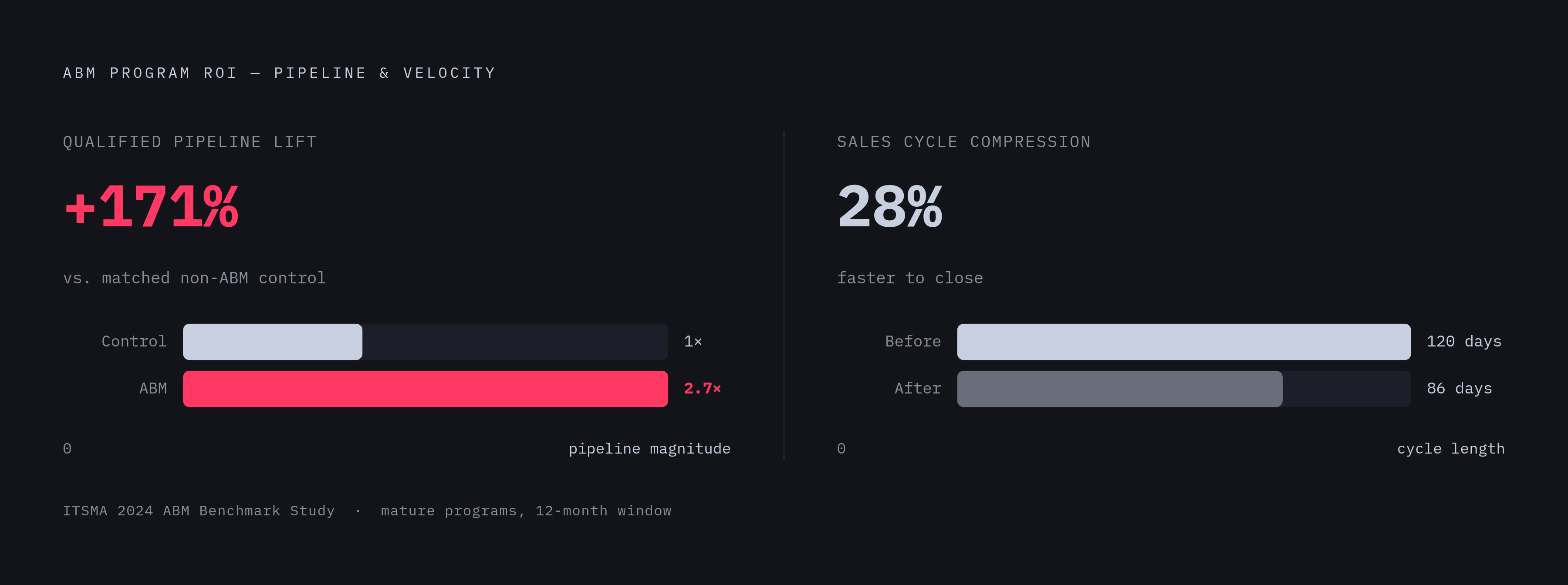
Here's the number that should reframe the conversation: mature ABM programs, defined in ITSMA's 2024 ABM Benchmark Study, defining mature programs as those with sustained operation, delivered a 171% lift in qualified pipeline over matched non-ABM control groups within 12 months. That's the kind of number that gets a program funded for another three years.
Read the fine print before building a business case on it, though. That figure describes mature programs specifically, which is exactly why the market-wide average sits so much lower, and why most marketers, per the adoption figures cited earlier, are still somewhere in the process of refining a strategy rather than running a finished one. Maturity isn't a badge; it's 24 months of iteration, and iteration requires exactly the kind of stage-mapped content architecture this piece keeps circling back to.
ABM also compresses the sales cycle by an average of 28%, from 120 days down to 86, which matters as a revenue argument independent of win rate: a faster cycle means more cycles per year off the same account list, a quieter but real form of ROI.
Mature programs measure differently, and that's not incidental to their maturity. It's a cause of it. They track pipeline movement instead of content engagement, because downloads and page views don't show up in a board deck and pipeline contribution does. They track account progression through buying stages rather than counting raw leads, a subtler but more honest metric. And yet a substantial share of companies still do not formally measure ABM ROI at all. Measurement correlates with maturity here. Maybe it causes it.
One caution worth stating plainly: some widely circulated ABM ROI statistics trace back to a single older survey, repeated so many times it now reads as current fact. Anyone building a business case should lean on program-specific benchmarks and recent controlled studies instead of a decade-old number photocopied into every deck since. And the architecture matters here too, not just as a production framework but as a measurement precondition: when assets are mapped to specific stages and specific accounts, tracing which piece of content moved which account through the pipeline becomes possible. Without that mapping, attribution is a guess wearing a dashboard as a costume.
Building and executing the content campaign without sacrificing speed or quality
Here's the tension every content lead runs into eventually: ABM demands more precision per asset than broad content ever did, but headcount rarely grows to match. The fix is producing on a different logic, one where the content map gets defined before a single asset gets commissioned, not somewhere in the middle of a sprint when someone finally asks who this is actually for.
A workable sequence looks something like this. Define the account tier first, and identify which buying committee roles are actually in play for this account or segment. Map buying stages against those roles and find the real gaps: what already exists, what needs building from scratch, what can be adapted from the library. Build a modular asset library, core narratives and a central point-of-view piece that flex across tiers instead of getting rebuilt every time a new account needs a version. Define the activation triggers, which intent signals or account behaviors deploy which asset through which channel. Then assign channel owners and a handoff protocol between marketing and sales, in writing, so the plan survives beyond whoever happens to remember it out loud.
AI-assisted generation is already part of this workflow for a meaningful share of high performers: a meaningful share of high-performing go-to-market teams now use AI for automatic content generation. The pattern among the teams doing this well pairs AI generation with editorial review, a human still reading it before it ships. The modular principle extends the logic further: one well-researched core piece, an industry benchmark report, say, becomes a segment-specific executive summary, a sales one-pager, a personalized email sequence, and a landing page. Four deliverables off one research investment, not four separate projects starting from a blank page.
Speed, in the end, comes from locking the strategy before production starts, not from typing faster once it does. The campaigns that stretch into month four aren't slow because the writing took too long. They're slow because the strategy got worked out in real time, mid-production, with deadlines already committed to a client who's checking a calendar. Platforms that pair AI-generated drafting with actual editorial oversight, are built around this model: strategy defined up front, content generated and reviewed at the pace ABM programs actually require, without the multi-week agency turnaround or the flatness of a purely automated draft nobody bothered to edit.
The end state worth aiming for is a repeatable campaign, not a single great one. Once the content map and the modular library exist for a segment, the next campaign into that segment costs a fraction of what the first one did, because the hardest work, figuring out what this account needs and when, only has to happen once.