Keyword Clustering for Large Content Programs
How you group keywords shapes site architecture, authority, and linking.
- The conventional framing: clustering as tidying a keyword spreadsheet before writing begins
- The reframe: at scale, how you build clusters determines content hierarchy, topical authority signals, internal linking logic, and whether teams can grow without duplicating effort or leaving gaps
- Google's evaluation model: per the research, content relevance is assessed at entity and topic level, not keyword-by-keyword — a well-clustered architecture signals expertise across a subject area; a poorly structured one creates cannibalization that suppresses rankings site-wide
- The scale threshold that makes this real: clustering adds meaningful structural value around 200–300 keywords; below that, manual grouping is faster — above it, the architecture question becomes unavoidable
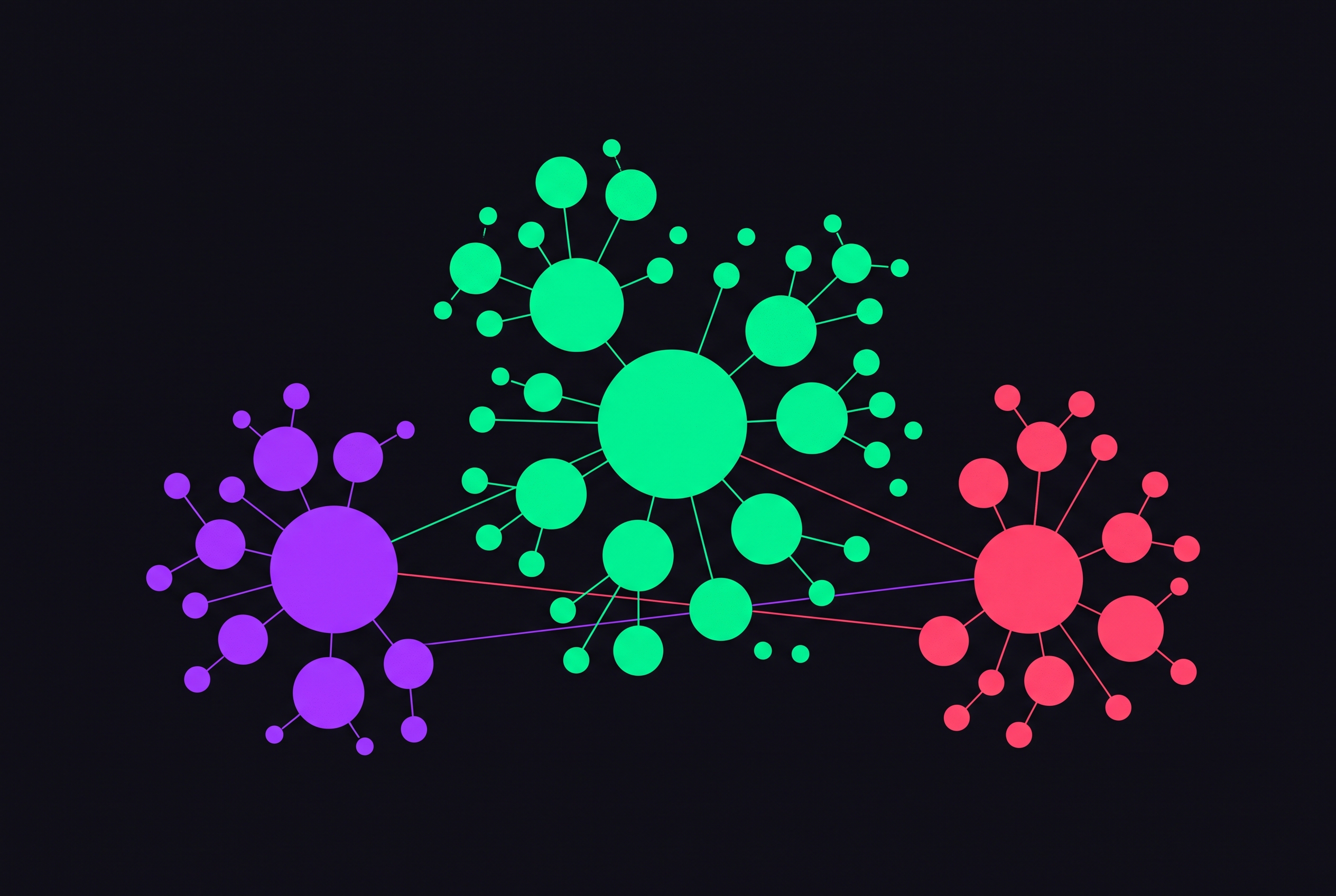
- Introduce the pillar-cluster model as the dominant structural response: pillar pages (3,000–5,000 words of comprehensive coverage) anchoring topic clusters of supporting articles, all internally linked — not just a content format but an authority signal
- Sites that implement content clusters correctly see an average 40% increase in organic traffic compared to non-clustered strategies (per digitalapplied.com)
- Frame the stakes for agencies and multi-brand teams specifically: getting the structure wrong at the start means rebuilding it later under live traffic — the architectural cost compounds
How clustering methodology has changed and why the old defaults no longer hold
- Three generations of clustering logic:
- First generation: cosine similarity between keyword embeddings — mathematically groups terms that look similar, frequently misses intent differences
- Second generation: SERP co-occurrence — groups keywords that share ranking URLs, more accurate but inherits the competitive landscape's mistakes
- Third generation (current): intent volatility scoring — measures how much a keyword's SERP composition changes over time, adding a forward-looking layer
- The critical limitation of SERP-based clustering in 2026: it reflects the existing competitive landscape, not optimal architecture — if every competitor has a weak, poorly-organized site, SERP clustering replicates their errors
- Semantic clustering based on search intent is forward-looking — it organizes topics around user need regardless of what currently ranks
- The hybrid workflow most advanced teams now use: SERP-based clustering for the core grouping, AI for intent labeling, brief generation, and pillar-spoke mapping
- Speed implication: embedding models can process 10,000 keywords in under two minutes, produce hierarchical cluster structures, and assign intent labels automatically — what previously took a senior SEO strategist a full day (per topicalmap.ai)
- Practical cluster sizing: a well-formed cluster typically contains 10–25 keywords; fewer than 10 may indicate unnecessary splitting; more than 25 usually signals over-grouping requiring a secondary pass
- The point this section lands on: the method is a structural choice with downstream consequences — it shapes which pages get built and how authority accumulates
What the leading tools actually do differently and how to match them to program scale
- Framing note: no single tool wins — the right choice depends on keyword volume, team structure, workflow integration, and whether clustering is a standalone step or part of a broader content pipeline
- Keyword Insights — agency go-to for bulk SERP-based clustering; groups keywords where two terms share 40%+ of the same ranking URLs; pricing as of sources: $49/month (Basic), $58/month (12,000 keyword clustering credits), $99/month (Standard), $145/month (36,000 credits); fast export to writer-ready format; best for large agency keyword sets where intent accuracy against live SERPs matters
- KeyClusters — no-frills SERP-based grouping engine; analyzes top 10 Google results; no briefs, no writing tools, no rank tracking; upload CSV, receive clean Excel or Google Sheets output; an agency could process 5,000 keywords from Ahrefs and have clusters within an hour; suited to teams that already have briefing and production systems and just need fast, clean clustering output
- Semrush Keyword Strategy Builder / Authority Clustering — Semrush's 2026 update uses its Keyword Strategy Builder to cluster keywords via SERP overlap logic, grouping related terms by search volume, keyword difficulty, and intent; per topicalmap.ai, proved 67% more effective at identifying content opportunities that move topical authority metrics compared to traditional semantic clustering; advanced tiers support monitoring up to 40 websites and tracking 5,000 keywords daily (Semrush, 2026); best for in-house teams running full-funnel campaigns within the Semrush ecosystem
- Surfer SEO Content Planner — combines keyword research, cluster planning, content briefs, and an AI writing editor in one platform; Topical Map feature analyzes your connected domain against topical authority benchmarks, surfacing content gaps and suggesting pillar and supporting articles to build topical authority (requires Google Search Console integration; does not prescribe a fixed creation order); particularly useful for teams launching new content programs who need a full roadmap quickly
- Keyword Cupid — produces a visual mind map with pillar topics and sub-clusters; a "digital marketing" hub, for example, renders "SEO," "PPC," and "social media" as main pillars with sub-clusters like "link building" branching off; supports up to 80,000 keywords with geotargeting options; the visual output is particularly useful for client presentations where stakeholders won't engage with a keyword spreadsheet
- MarketMuse — AI-powered content intelligence and strategy platform; scores content against competitors; Content Score metric benchmarks topical coverage at the page level against top-ranking pages; supports inventory analysis of existing content mapped to topic clusters; pricing from $99/month (Optimize) to $249/month (Research) to $499/month (Strategy), with a free tier available (10 queries/month)
- Surfer SEO, Ahrefs Keywords Explorer, LowFruits, Search Atlas Content Planner, Slate, Frase, Clearscope, RankYak, Juma, NeuronWriter, Writesonic — additional tools named in sources; each occupies a different segment (budget, data depth, AI-speed, collaboration, content creation integration); the sources' comparison tables note: Ahrefs best for backlink-heavy SEO teams at $129/month; Clearscope for content optimization depth at $129/month; NeuronWriter for freelancers and small teams at $23/month; Writesonic for integrated AI writing with cluster context at $39/month
- The clustering output format matters as much as the tool: some produce spreadsheets ready for handoff; others generate visual maps for stakeholder buy-in; others connect directly to brief generation and CMS publishing — the workflow integration question should drive tool selection as much as the clustering algorithm
How cluster architecture determines content hierarchy and internal linking at scale
- The pillar page as load-bearing element: must address the full topic at a high level, link to every cluster page, and serve as the canonical authority — thin pillar pages undermine the entire cluster's authority signal, not just the pillar page itself
- Internal linking as a structural output of clustering, not an afterthought: when clusters are correctly defined, the linking map is implicit in the cluster structure — every spoke article links to its pillar; pillar pages link to every spoke; related clusters cross-link at the pillar level
- Cannibalization as an architectural failure, not a content quality problem:
- Two pages targeting the same intent split ranking signals — neither wins
- Clustering prevents this by making intent assignment explicit before any page is created
- Example from sources: "small business accounting," "accounting for small business," and "small business bookkeeping" without clustering become three cannibalizing posts; with clustering, one comprehensive guide ranks for all three
- Content hierarchy as editorial calendar architecture: clusters determine sequencing — pillar page first, spoke articles in order of search volume or gap priority; this gives content teams a build order, not just a topic list
- Gap analysis as an ongoing structural function: AI cluster tools can audit existing content against the cluster map and surface which spoke articles are missing, which pillar pages are under-covered, and which existing pages compete with each other
- For agencies managing multiple clients, the architectural implication is multiplicative: a structural error in one client's cluster map propagates through every piece of content built on top of it — the cost of getting it right once versus rebuilding it at volume
How cluster architecture connects to AI search visibility, not just organic rankings
- The AI search context: nearly a third (31.3%) of the US population will use generative AI search in 2026, per an EMARKETER forecast; AI Overviews have reduced click-through rates for top-ranking Google content by 58% (up from 34.5% the prior year), per Ahrefs; website traffic from AI search engines increased 16x from 2024 to 2026 (per SE Ranking)
- The structural connection: AI systems reward topical depth and coherence — a well-clustered content architecture that covers a subject comprehensively makes a brand more likely to be recognized as an authoritative source worthy of citation, not just ranked
- The Princeton/IIT Delhi/Georgia Tech/Allen Institute GEO-bench study (Aggarwal et al.) tested content-modification tactics on a Bing-Chat-style generative engine across roughly 10,000 user queries: adding quotations from credible sources raised a source's share of AI answers by roughly 41%, statistics by about 31%, citations by about 28% — the tactics that worked were not what most marketers expected
- Platform-specific behavior matters for cluster content design:
- Perplexity rewards freshness, authority, and multi-channel presence
- Microsoft Copilot leans heavily on LinkedIn for B2B queries
- Claude prefers long-form, comprehensive guides
- Gemini analyzes multimodal content (video, images)
- ChatGPT accounts for an average 87.4% of all AI referral traffic across 10 key industries, per Conductor's State of AEO/GEO 2026 report — but Gemini drove 21% of AI traffic to the Utilities industry, showing the platform mix varies by sector
- About 85% of brand mentions in AI search originate from third-party pages, not brand-owned sites — brands are 6.5x more likely to be cited through third-party sources than their own websites; and 40% to 60% of cited sources change month-to-month across Google AI Mode and ChatGPT, making visibility far less stable than organic rankings
- The structural implication: cluster architecture needs to account for third-party coverage, not just owned content — which topics have authoritative third-party coverage that reinforces the brand's cluster? Which don't?
- First 200 words rule for AI retrieval systems: AI systems using real-time retrieval evaluate relevance primarily on opening content — cluster articles need to directly and completely answer the primary query in the first 200 words, not build to the answer
- 94% of CMOs plan to increase AEO and GEO investment in 2026, per Conductor's State of AEO/GEO 2026 report — cluster architecture is increasingly the foundation on which that investment lands
What agencies need to manage clustering across a client portfolio at scale
- The agency-specific problem: cluster mapping for one client is manageable; doing it for ten clients simultaneously without a systematic approach produces inconsistent architecture, duplicated effort, and gaps that are invisible until a client asks why a topic isn't ranking
- The volume and consistency challenge: agencies need repeatable clustering processes that can be applied across clients without rebuilding the methodology each time — this is where tool selection and workflow design intersect
- Team enablement as a real constraint: account managers and strategists who can't articulate why clusters are structured the way they are can't defend the architecture to clients or course-correct when it's wrong. Enablement must be treated as a product feature, not an afterthought, and agencies cannot credibly sell AI visibility services unless their own teams understand the space.
- Access and billing structure: agencies managing multiple clients need platforms where clustering work for different clients stays separated, where outputs can be exported per client, and where the commercial model fits how the agency actually bills — a one-size-fits-all seat model creates friction at scale
- Ahrefs' 2025 "Brand Radar" tool — tracks what percentage of AI chats mention a brand versus competitors, framed as AI Share of Voice — represents the kind of per-client monitoring capability agencies now need to offer; monitoring AI visibility alongside organic clustering performance is becoming table stakes
- The agency's own AI visibility: agencies that build topical authority in the AI visibility and content strategy space — through their own well-clustered content programs — become more credible to clients shopping for expertise in exactly this area
How to measure whether a cluster architecture is working and when to rebuild it
- The architectural signals to track: topical authority growth across a cluster (not just individual page rankings), cannibalization re-emergence (two pages converging on the same SERP), pillar page coverage gaps relative to competitor cluster maps, and AI citation share alongside organic performance
- Cluster decay is structural, not just a content freshness problem: when a cluster stops performing, the first question is whether the intent grouping still reflects how the topic is searched — intent volatility scoring (the third-generation clustering layer) exists precisely to surface this
- Rebuilding triggers:
- A pillar page that has grown thin relative to the topic's scope — the pillar page must address the full topic at a high level, and if the topic has expanded, a thin pillar undermines the whole cluster
- Cannibalization resurfaces between spoke articles — usually a sign the original cluster was over-grouped or the content team has built outside the cluster map
- AI citation patterns shift — 40% to 60% of cited sources change month-to-month, which means cluster content may need refresh
Sources
- 12 Best AI Topic Cluster Tools for SEO in 2026
Supplied the tool landscape, including Slate, Frase, Clearscope and the segment and pricing comparisons for cluster tools.
- Topical Map AI - Unlock SEO Insights
Provided the embedding-speed figure and the Semrush authority-clustering effectiveness claim.
- Topical Map AI - Unlock SEO Insights
Informed the discussion of SERP-based versus semantic clustering generations and the hybrid workflow with AI labeling.
- https://www.keywordinsights.ai/blog/keyword-clustering-tools/
Described how Keyword Insights groups keywords by shared ranking URLs and its pricing tiers.
- https://www.keyclusters.com/blog/keyword-clustering-tools-comparison
Supplied the KeyClusters workflow details, including top-10 SERP analysis and CSV-in, spreadsheet-out output.
- https://www.digitalapplied.com/blog/seo-content-clusters-2026-topic-authority-guide
Source of the 40% organic traffic lift claim and the pillar-cluster structure guidance.
- https://topicalmap.ai/blog/auto/internal-linking-architecture-for-topic-clusters
Informed the pillar-to-spoke internal linking structure treated as an output of clustering.
- https://www.conductor.com/academy/aeo-geo-benchmarks-report/
Provided the ChatGPT referral share, the Gemini utilities example and the CMO investment figure.